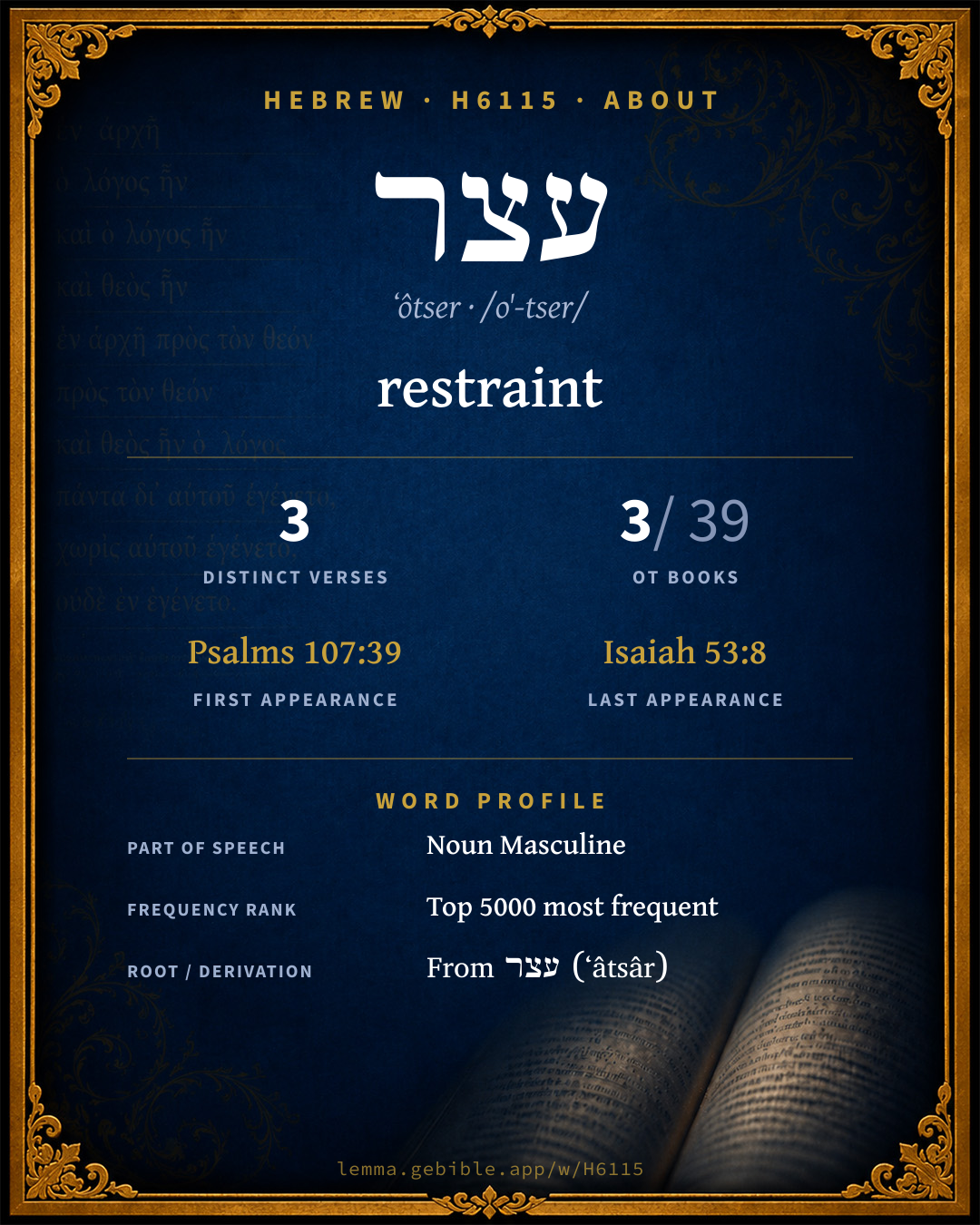
עֹ֫צֶר
restraint
‘restraint’ is one of 2 main senses fuller range ↓
Full lexicon entry — Brown-Driver-Briggs (BDB)
From Brown-Driver-Briggs (BDB)
Where this word appears
Grammar key — what these labels mean
Noun type
- Common
- A common noun — a general class of person, place, or thing (“king,” “city,” “water”), not a specific name.
State
- Construct
- A noun bound to a following noun in a possessive / “of” relationship (the construct chain).
- Absolute
- The independent form of a noun, not bound to a following word.
Gender
- Masculine
- Grammatically masculine.
Number
- Singular
- One.
Every verse where H6115 appears in the Book of Isaiah — 1 distinct verse. Click any verse to open its interlinear word-by-word view. Verse text shown in the World English Bible for context — . Each verse’s Hebrew form is shown with its reference; the English is not keyword-highlighted, since the data carries no word-level English alignment. Use “Compare translations” on any verse to read it across multiple English versions. This concordance covers the Hebrew Bible; Septuagint (Greek Old Testament) occurrences are not indexed here.
Isaiah
About this entry
At a glance — auto-summarized from this page’s data, not written by a person. Every figure links to its source below. This summary describes the numbers; it doesn’t interpret them.
עצר (ʻôtser) is a Hebrew noun most often rendered “restraint.” With only 3 verses it sits in the long tail of Hebrew Bible vocabulary. It concentrates in Psalms, which alone accounts for 33% of its uses. It first appears in Psalms 107:39. Its lexical range runs to 2 senses. For the data behind this summary, explore the sense tree and the renderings breakdown below.
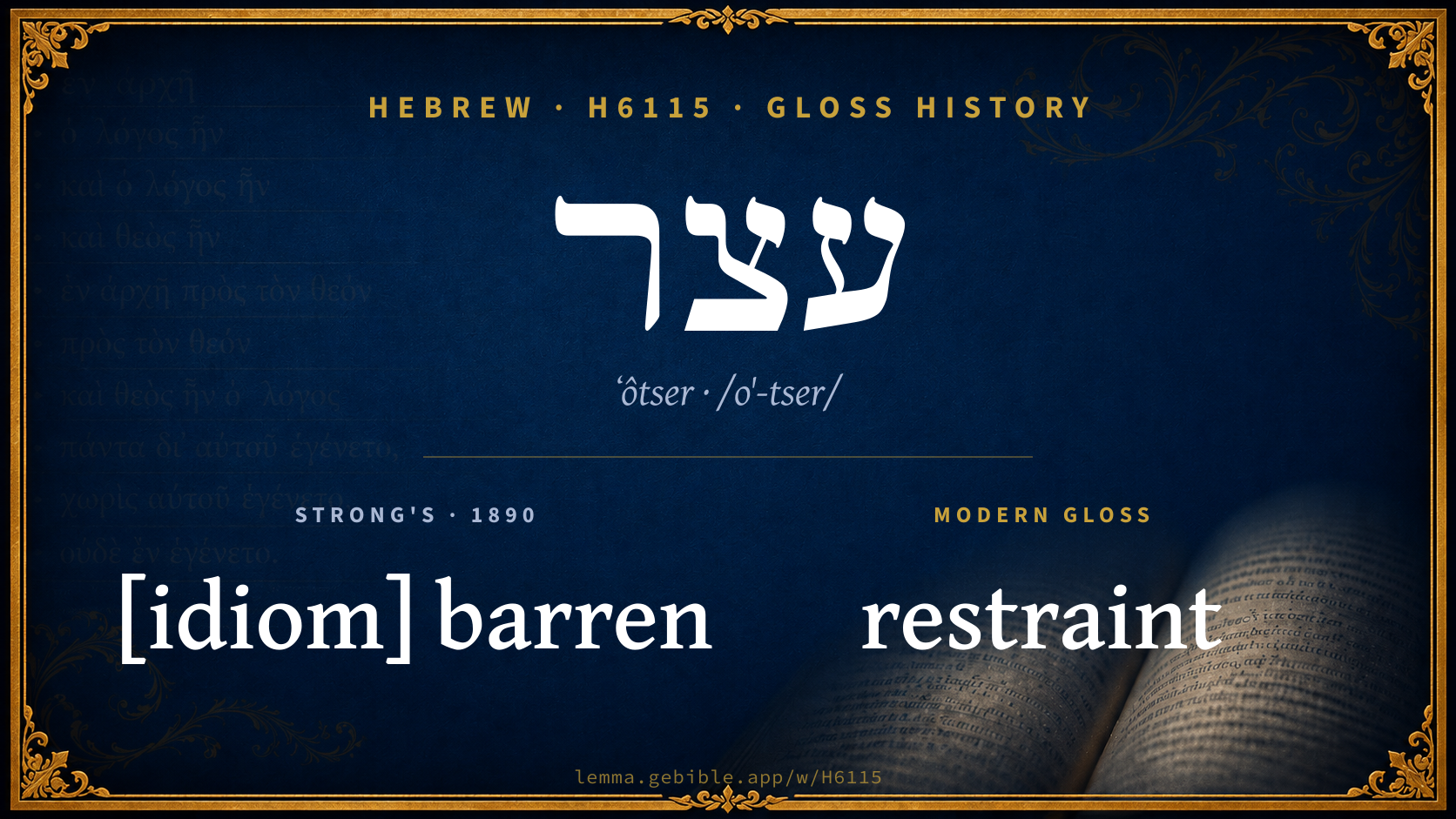
Gloss history
Strong's 1890 vs modern scholarship
About this word
Strong's H6115 catalogs a Hebrew word from the Hebrew Old Testament.
These counts are not copied from any lexicon or concordance. They are computed here, from the morphology-tagged Hebrew Old Testament. What Lemma adds →
- 3
- distinct verses
- The word appears in 3 distinct verses.
- 3 / 39
- OT books
- The word appears in 3 of 39 Old Testament books.
- #4,179
- by frequency
- Top 5000 most frequent Hebrew words (rank 4,179 of 8,640 Hebrew words by occurrence).
View all 3 occurrences in the concordance →
By section of the Old Testament
By traditional corpus
Conventional, traditional groupings — biblical authorship is debated, so this is a traditional corpus grouping, not an authorship claim. Each share is this word’s portion of its verses in that division of the Hebrew canon. Each figure is a share of the word’s 3 distinct verses.
- Writings (Ketuvim) 2 verses · 67%
- Prophets (Nevi'im) 1 verse · 33%
How translations render this word
Counts come from each version’s own published word-to-Strong’s tagging or interlinear alignment — an approximate guide to how each version renders this word, not a word-level alignment the data otherwise carries. Because each total is that version’s own tagged count, the per-version totals vary from one another and need not match the appearance or distinct-verse counts above. These counts may also differ from a printed concordance because Lemma counts each distinctly tagged rendering and does not collapse phrase taggings into a single head-word total. This is a fixed set of word-tagged versions (KJV, ASV, BSB, ULT) and does not change with the reading translation you choose elsewhere. Each version’s license is shown beside its name below (and on Sources).
- King James Version: Barren 1×, Prison 1×, Through oppression 1×
- American Standard Version: Barren 1×, Oppression 1×, Through oppression 1×
- Berean Standard Bible: Oppression 2×
- unfoldingWord Literal Text: Closure of 1×, Coercion 1×, Distress 1×
King James Version Public Domain
Renders H6115 across 3 tagged occurrences — most commonly:
American Standard Version Public Domain
Renders H6115 across 3 tagged occurrences — most commonly:
Berean Standard Bible Public Domain
Renders H6115 across 3 tagged occurrences — most commonly:
Plus 1 rendering that appears only once — usually multi-word phrases or single function words the recovered tagging swept in, not distinct renderings.
unfoldingWord Literal Text CC BY-SA 4.0
Renders H6115 across 3 tagged occurrences — most commonly:
Senses in BDB
The 2 senses BDB distinguishes for this word, in lexicon order (not ranked by frequency or importance). The full entry — with sub-senses — is in the Lexicon Entry tab.
- restraint, coercion
- barrenness (of womb)
Word origin
n.[m.] restraint, coercion;—ע׳ abs.: מֵע׳ וּמִמִּשְׁפָּט Is 53:8 from (as a result of) coercion and judgment he was taken off; cstr. ע׳ רָעָה ψ 107:39; ע׳ רָ֑חַם Pr 30:16 restraint of womb, barrenness (so ψ 107:39 PerlesAnal. 85).
— Brown-Driver-Briggs (Oxford 1906, public domain), digitized via Sefaria, supplemented by the OpenScriptures HebrewLexicon (CC BY 4.0). See Sources.
Derived from עצר (ʻâtsâr) (H6113) — to restrain.
Jastrow Dictionary
A second Hebrew/Aramaic lexicon for comparison, covering Aramaic and post-biblical (Talmudic, Targumic, Midrashic) usage that the biblical-Hebrew BDB does not. Matched by lemma rather than by Strong’s number, so a lemma may carry more than one Jastrow headword (shown separately below), and the entries cover usage well beyond the Bible.
עָצַר
- [to press,] to close up; to detain; to ward off; to gather, store away. Succ. 38ᵃ עוֹצֶרֶת רוחות וכ׳ wards off evil winds and dews (v. infra). Num. R. s. 19 היאך יכול … וַעֲצָרוֹ how could the angel of death strike a man that had stood up against the angel of death and warded him off? (ref. to Num. XVII, 13). Sifré Num. 151; Yalk. ib. 782 (ref. to עצרת, Num. XXIX, 35) עֲצָרוֹ הכתוב מלצאת the Scripture keeps him (the pilgrim) from leaving (Jerusalem, on the eighth day). Pesik. R. (ed. Fr.) addit. s. 4; Pesik. Bayom, p. 193ᵇ הק"בה עוֹצֵר וכ׳ the Lord locks his Presence up with them, v. infra. Ab. Zar. 71ᵃ עול תחתי לעוֹצֵר, v. עָלַל; a. fr.—Part. pass. עָצוּר; f. עֲצוּרָה; pl. עֲצוּרִים, עְצוּרִין; עְצוּרוֹת. Sifré l. c. מה זה ע׳ מלצאת אף זה ע׳ וכ׳ as on this (the eighth day) one is prohibited to leave, so is one on this (the first day). Sifré Deut. 135 (ref. to עצרת, Deut. XVI, 8) יכול יהא אדם ע׳ כל וכ׳ from this you might infer that one must be confined the whole day in the schoolhouse (for religious exercises). Ib. מה שביעי ע׳ אף ששי ע׳ as the seventh day is under restrictions (as to week-day labor), so is the sixth day (i.e. the days intervening between the first and the seventh day); אי מה שביעי ע׳ מכל מלאכה וכ׳ you might infer from this that as the seventh day is under restriction as regards all sorts of labor (even work of necessity), so is the sixth; Ḥag. 18ᵃ השביעי ע׳ בכל מלאכה … ימים ע׳ וכ׳ the seventh day is under a general restriction, but the six days are not; Yalk. Deut. 904; ib. 907. Ḥull. 67ᵃ בורות … שהן ע׳ ככלים wells, pits and caves, the waters of which are restrained as in vessels; Yalk. Lev. 537 עצירים … בכלים (corr. acc.); a. fr. e.g. Numbers 17:13
- to be detained; to be gathered together. Pesik. R. l. c. כל זמן שישראל נֶעֱצָרִין וכ׳ as long as Israel holds festive gatherings in synagogues and schoolhouses, the Lord locks up &c. (v. supra); Pesik. l. c.ᵃ מְעַצְּרִין (Pi.). Yalk. Num. 782 (ref. to עצרת, v. supra) למה נֶעֶצְרוּ עיד יום אחד why are they detained one more day? Taan. 7ᵇ הגשמים נעצרין the rains are withheld. Ib. 8ᵃ השמים נעצרין מלהוריד וכ׳ the heavens are locked up so as not to let down rain &c.; a. fr.
- 1. to hold festive gatherings. Pesik. l. c., v. supra.
- 2. to detain, keep off. Succ. 37ᵇ כדי לעַצֵּר רוחות וכ׳ in order to keep off evil winds &c. (v. supra).
עֲצַר
- 1. to press, squeeze. Targ. Jud. VI, 38. Targ. Gen. XL, 11 (O. ed. Vien. עַצָּרִית, Pa.); a. fr.—Y. Sabb. XVII, 16ᵇ top; Y. Bets. I, 60ᵇ bot., v. זַיָּירָא.
- 2. to keep back, save. Y. Taan. III, 66ᵈ top עֲצוֹר וכ׳, v. גּוֹלְתָא.
עַצָּר
- m. = עָצוֹר. Targ. Am. IX, 13 ע׳ ענבין (not עֵצֶר, עֵצָר).
A Dictionary of the Targumim, the Talmud Babli and Yerushalmi, and the Midrashic Literature (Marcus Jastrow; London, Luzac, 1903) — Public Domain. Digitized via Sefaria. Digitized via Sefaria. Full attribution on Sources.
Forms in the corpus
The 3 distinct written forms H6115 takes in the Hebrew Bible, most frequent first — each parse links to that state’s occurrences in the concordance. Hebrew forms include their vowel points and cantillation, so a single lemma takes many written forms.
| Form | Parsing | Example | Uses |
|---|---|---|---|
| וְ/עֹ֪צֶ֫ר | Noun, Common, Masculine, Singular, Construct | Proverbs 30:16 | 1 |
| מֵ/עֹ֖צֶר | Noun, Common, Masculine, Singular, Construct | Psalms 107:39 | 1 |
| מֵ/עֹ֤צֶר | Noun, Common, Masculine, Singular, Absolute | Isaiah 53:8 | 1 |
Same root — word family
Other BDB entries built from the same root as H6115, grouped by Strong’s listed origin. These share a root / origin per the lexicon — not necessarily a shared meaning. Each links to that word’s own entry.
Derives from
Shares the same root
- מעצור maʻtsôwr H4622 restraint
- מעצר maʻtsâr H4623 control
- עצר ʻetser H6114 restraint
- עצרה ʻătsârâh H6116 assembly
Compare all same-root words → Showing 4 of 6 — not the complete family. They share a root, not necessarily a meaning.
Septuagint verse parallels
This word appears in 2 verses that also exist in the Greek Old Testament (Septuagint), out of the 3 Hebrew verses it occurs in. You can read those verses in Greek by switching the Old Testament edition to the Septuagint.
Read these verses in the Septuagint
This is a verse-level parallel only — the same verses exist in both the Hebrew and Greek Old Testaments. No word-level Hebrew↔Greek correspondence is claimed: the data carries no such alignment, so no Greek word is shown as this Hebrew word’s translation. Coverage is not total — the Septuagint omits the deuterocanon and renumbers the Psalms, so some Hebrew verses have no direct Greek parallel.