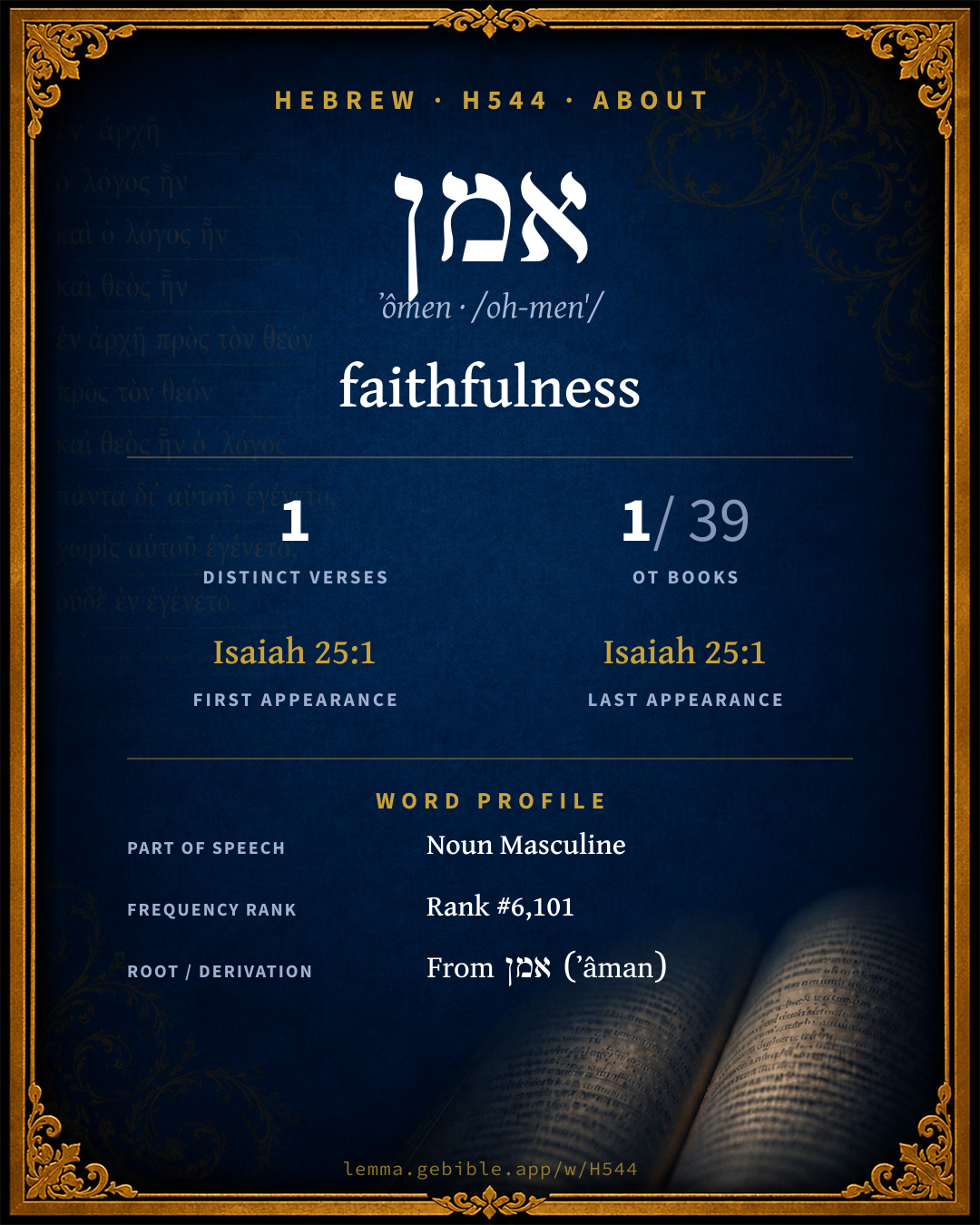
אֹ֫מֶן
faithfulness
Full lexicon entry — Brown-Driver-Briggs (BDB)
From Brown-Driver-Briggs (BDB)
Where this word appears
Grammar key — what these labels mean
Part of speech
- Noun
- A naming word — a person, place, thing, or idea.
Noun type
- Common
- A common noun — a general class of person, place, or thing (“king,” “city,” “water”), not a specific name.
State
- Absolute
- The independent form of a noun, not bound to a following word.
Gender
- Masculine
- Grammatically masculine.
Number
- Singular
- One.
Every verse where H544 appears — 1 distinct verse across 1 book. Click any verse to open its interlinear word-by-word view. Verse text shown in the World English Bible for context — . Each verse’s Hebrew form is shown with its reference; the English is not keyword-highlighted, since the data carries no word-level English alignment. Use “Compare translations” on any verse to read it across multiple English versions. This concordance covers the Hebrew Bible; Septuagint (Greek Old Testament) occurrences are not indexed here.
Isaiah 1 verse
About this entry
At a glance — auto-summarized from this page’s data, not written by a person. Every figure links to its source below. This summary describes the numbers; it doesn’t interpret them.
“faithfulness” is the headline sense of the Hebrew noun אמן (ʼômen). It occurs a mere 1 verse across Scripture. It clusters heavily in Isaiah, which alone accounts for 100% of its uses. Found nowhere else but Isaiah 25:1. From the same root come אמן, אמון and אמון. See the sense tree, 1-verse concordance, and the renderings breakdown below.
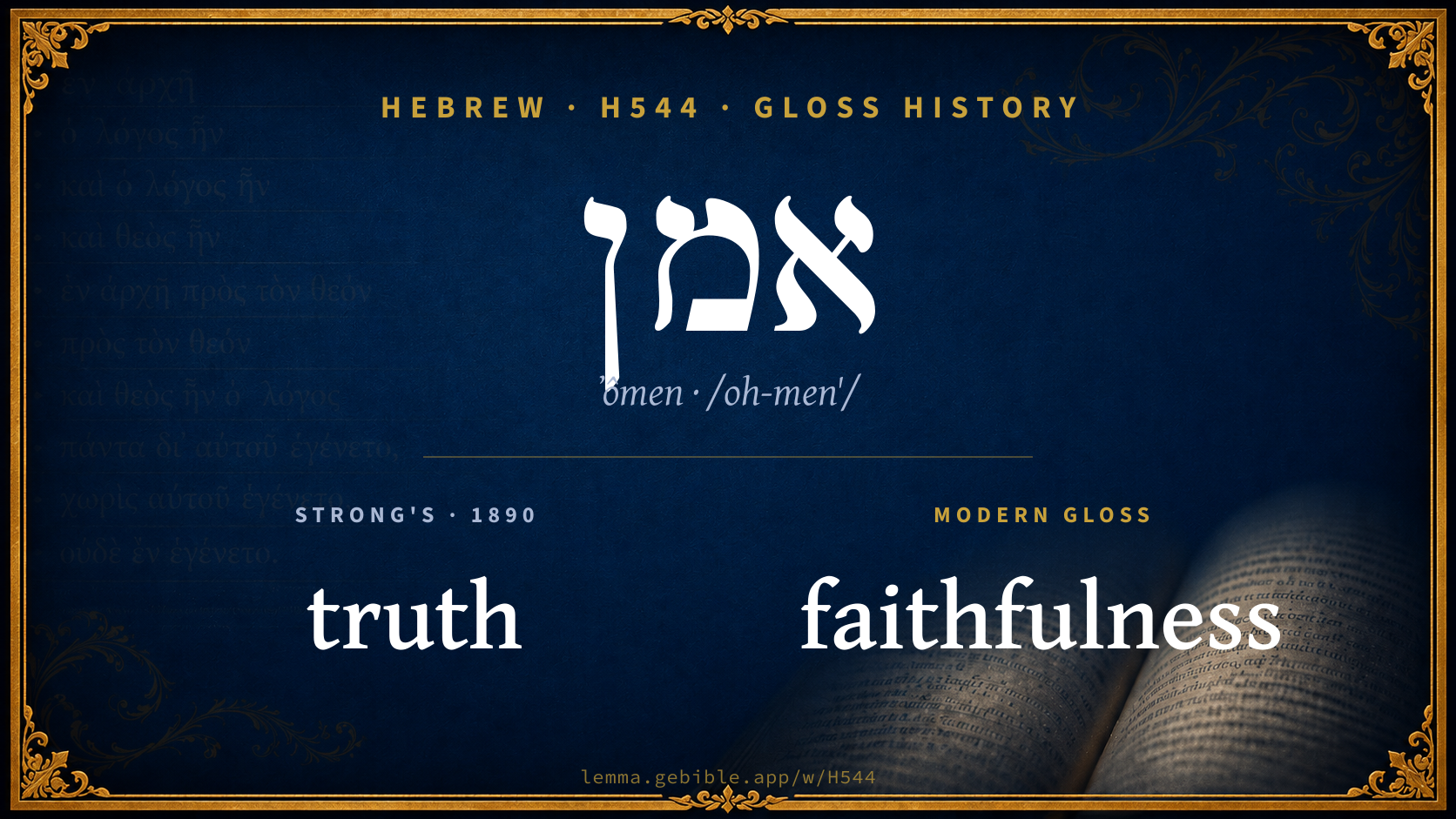
Gloss history
Strong's 1890 vs modern scholarship
About this word
Strong's H544 catalogs a Hebrew word from the Hebrew Old Testament.
These counts are not copied from any lexicon or concordance. They are computed here, from the morphology-tagged Hebrew Old Testament. What Lemma adds →
- 1
- distinct verses
- The word appears in 1 distinct verse.
- 1 / 39
- OT books
- The word appears in 1 of 39 Old Testament books.
- #6,101
- by frequency
- Rank #6,101 (rank 6,101 of 8,640 Hebrew words by occurrence).
View all 1 occurrence in the concordance →
Most concentrated in
- Isaiah 1 verse 100%
By section of the Old Testament
By traditional corpus
Conventional, traditional groupings — biblical authorship is debated, so this is a traditional corpus grouping, not an authorship claim. Each share is this word’s portion of its verses in that division of the Hebrew canon. Each figure is a share of the word’s 1 distinct verse.
- Prophets (Nevi'im) 1 verse · 100%
How translations render this word
Counts come from each version’s own published word-to-Strong’s tagging or interlinear alignment — an approximate guide to how each version renders this word, not a word-level alignment the data otherwise carries. Because each total is that version’s own tagged count, the per-version totals vary from one another and need not match the appearance or distinct-verse counts above. These counts may also differ from a printed concordance because Lemma counts each distinctly tagged rendering and does not collapse phrase taggings into a single head-word total. This is a fixed set of word-tagged versions (KJV, ASV, BSB, ULT) and does not change with the reading translation you choose elsewhere. Each version’s license is shown beside its name below (and on Sources).
- King James Version: Truth 1×
- American Standard Version: Truth 1×
- Berean Standard Bible: not separately translated
- unfoldingWord Literal Text: Faithfulness 1×
King James Version Public Domain
Renders H544 across 1 tagged occurrence — most commonly:
American Standard Version Public Domain
Renders H544 across 1 tagged occurrence — most commonly:
Berean Standard Bible Public Domain
Does not render H544 with a distinct English word (not separately translated in its 1 tagged occurrence).
unfoldingWord Literal Text CC BY-SA 4.0
Renders H544 across 1 tagged occurrence — most commonly:
Senses in BDB
The 1 sense BDB distinguishes for this word, in lexicon order (not ranked by frequency or importance). The full entry — with sub-senses — is in the Lexicon Entry tab.
- faithfulness
Word origin
n.[m.] faithfulness; אֱמוּנָה אֹמֶן perfect faithfulness (faithfulness, faithfulness) Is 25:1.
— Brown-Driver-Briggs (Oxford 1906, public domain), digitized via Sefaria, supplemented by the OpenScriptures HebrewLexicon (CC BY 4.0). See Sources.
Derived from אמן (ʼâman) (H539) — to confirm.
Jastrow Dictionary
A second Hebrew/Aramaic lexicon for comparison, covering Aramaic and post-biblical (Talmudic, Targumic, Midrashic) usage that the biblical-Hebrew BDB does not. Matched by lemma rather than by Strong’s number, so a lemma may carry more than one Jastrow headword (shown separately below), and the entries cover usage well beyond the Bible.
אָמַן
- , v. אֵם; cmp. אַמָּה) to arrange in lines, array. Ukts. II, 5 nuts שאֲמָנָן which one arranged (Var. Ar. שחמרן which one piled).—Denom. אוּמָן expert, skilful, whence
- to make skilful, to train. Sabb. 103ᵃ מְאַמֵּן את ידו he trains his hand (practicing). V. next w.
אָמֵן I
- (√אם, v. אֵם; cmp. preced.) to be strong, enduring; (act. v. אָמַן to support, v. II Kings XVIII, 16 אֹמְנוֹת).—Pi. אִימֵּן, אִמֵּן to support; trnsf. to confirm, verify, approve. Tosef. Ter. I, 4 it is not the minor that made it T’rumah אלא אביו שאִימֵּן אחריו Var. (ed. Zuck. שאומן) but his father who confirmed his act (= ib. קיים על יד); Y. ib. 40ᵇ א׳ על ידו. Ib.ᶜ top מְאַמֵּין. e.g. 2 Kings 18:16
- (b. h.)
- 1. part. נֶאֱמָן m., נֶאֱמָנֶת f. approved, trustworthy, reliable. Peah VIII, 2 נֶאֱמָנִים על וכ׳ (the poor) may be relied upon concerning garnered fruit &c., i.e. if they declare the fruits to be the poor man’s share, they are exempt from tithes. Keth. I, 6 נאמנת her statement is acted upon as true. Ab. Zar. 16ᵇ נ׳ עלי הדיין my judge is a reliable witness concerning me, i.e. I appeal to thy own judgment that I could not have engaged in such follies.—Dem. II, 2 if one resolves להיות נ׳ to be one of the reliable (conscientious in giving tithes); a. fr.
- 2. to be confirmed. Y. Sot. II, 18ᵇ top אמן יֵאָמְנוּ הדברים Amen means, May the words (of the oath) be fulfilled.
- (b. h.) to declare trustworthy, to trust, believe in. Dem. VII, 1 והוא אינו מַאֲמִינוֹ but he (the invited guest) trusts him not in tithe affairs. Ib. 3; a. fr.—Ab. Zar. 16ᵇ הואיל וְהֶאֱמַנְתַּנִי עליך ed. Pes., En Yak. (v. Rabb. D. S. a. l. note; ed. הָאֳמַנְתִּי Hof.; since thou didst declare me a reliable witness unto thyself (appealing to my judgment), v. supra; [Ms. M. האמנת עלי thou reliedst on me]. Ch., v. הֵימַן.
אָמֵן II
- v. preced.) firm, straight, whence
- 1. Amen!, true! so may it be! Shebu. 36ᵃ א׳ בו שבועה וכ׳ in Amen is implied an oath, a promise, and a prayer for fulfillment. Ab. Zar. 65ᵃ; a. fr.
- 2. fem., the response Amen. Ber. 47ᵃ א׳ חטופה an Amen hastily pronounced (’men); א׳ קטופה an Amen cut short (ame-); א׳ יתומה an orphan Amen, the responder not having heard the benediction to which the Amen refers; Tosef. Meg. IV (III), 27.
A Dictionary of the Targumim, the Talmud Babli and Yerushalmi, and the Midrashic Literature (Marcus Jastrow; London, Luzac, 1903) — Public Domain. Digitized via Sefaria. Digitized via Sefaria. Full attribution on Sources.
Same root — word family
Other BDB entries built from the same root as H544, grouped by Strong’s listed origin. These share a root / origin per the lexicon — not necessarily a shared meaning. Each links to that word’s own entry.
Derives from
Shares the same root
- אמון ʼâmôwn H525 craftsman
- אמון ʼêmûwn H529 faithfulness
- אמן ʼăman H540 to trust
- אמן ʼâmân H542 artisan
- אמן ʼâmên H543 truly
- אמת ʼemeth H571 faithfulness
Derived from this word
Proper names from this root
People and places named from this root — a name, not an additional meaning of the word.
Compare all same-root words → Showing 4 of 14 — not the complete family. 2 of the same-root words are proper names (people or places). They share a root, not necessarily a meaning.
Septuagint verse parallels
This word appears in 1 verse that also exists in the Greek Old Testament (Septuagint), out of the 1 Hebrew verse it occurs in. You can read those verses in Greek by switching the Old Testament edition to the Septuagint.
Read these verses in the Septuagint
This is a verse-level parallel only — the same verses exist in both the Hebrew and Greek Old Testaments. No word-level Hebrew↔Greek correspondence is claimed: the data carries no such alignment, so no Greek word is shown as this Hebrew word’s translation. Coverage is not total — the Septuagint omits the deuterocanon and renumbers the Psalms, so some Hebrew verses have no direct Greek parallel.