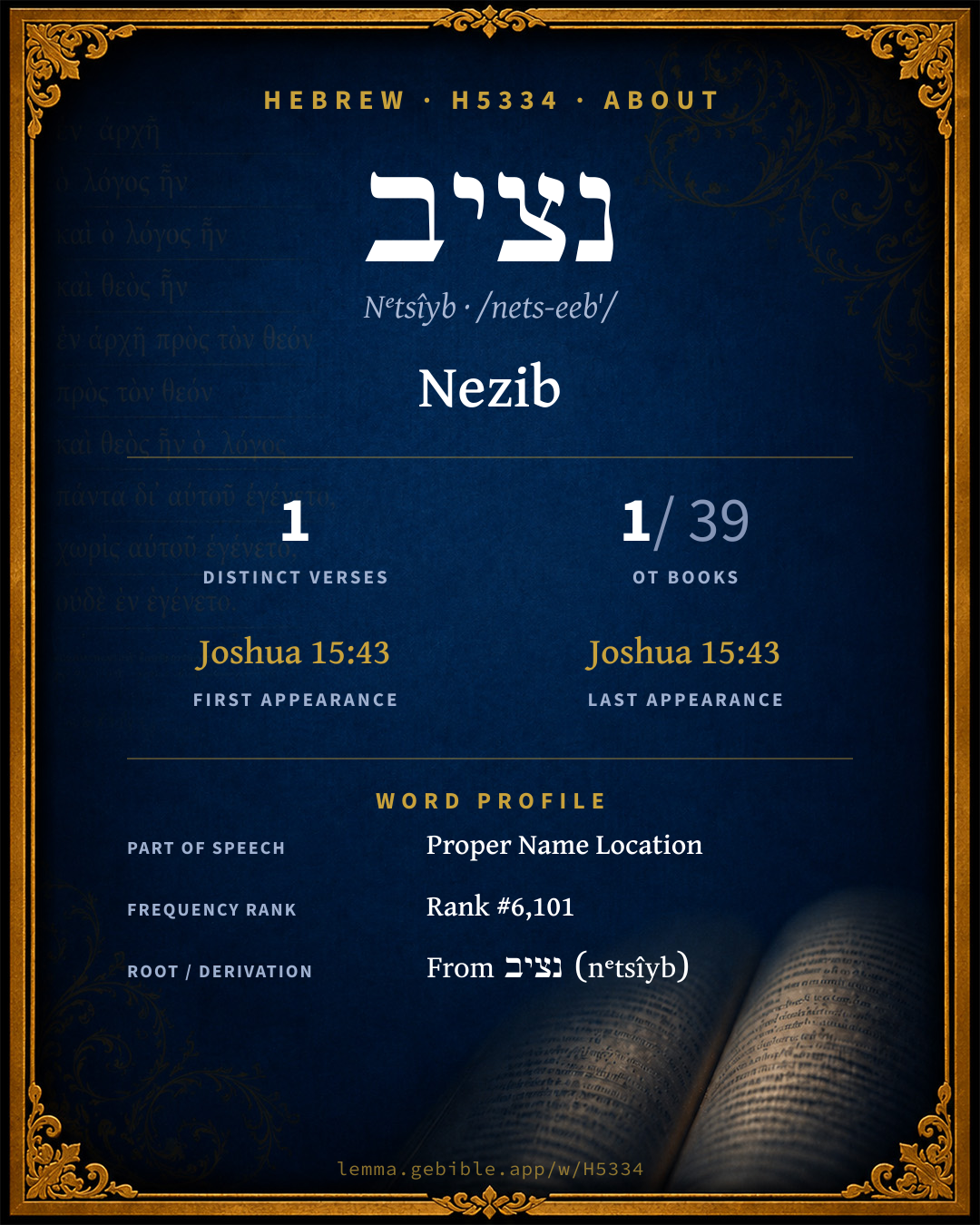
נְצִיב
Nezib
BDB lists 2 entries for ‘Nezib’ fuller range ↓
Full lexicon entry — Brown-Driver-Briggs (BDB)
From Brown-Driver-Briggs (BDB)
Where this word appears
Grammar key — what these labels mean
Noun type
- Proper
- A name of a specific person, place, or people (e.g. Abraham, Zion, Israel).
Every verse where H5334 appears — 1 distinct verse across 1 book. Click any verse to open its interlinear word-by-word view. Verse text shown in the World English Bible for context — . Each verse’s Hebrew form is shown with its reference; the English is not keyword-highlighted, since the data carries no word-level English alignment. Use “Compare translations” on any verse to read it across multiple English versions. This concordance covers the Hebrew Bible; Septuagint (Greek Old Testament) occurrences are not indexed here.
Joshua 1 verse
About this entry
At a glance — auto-summarized from this page’s data, not written by a person. Every figure links to its source below. This summary describes the numbers; it doesn’t interpret them.
The Hebrew name נציב centers on the idea of “Nezib.” It is rare — just 1 verse in the entire Hebrew Bible. Joshua dominates its distribution — 1 of 1 verses. Found nowhere else but Joshua 15:43. Dig into 1-verse concordance and the renderings breakdown below.
Gloss history
Strong's 1890 vs modern scholarship
About this word
Strong's H5334 catalogs a Hebrew word from the Hebrew Old Testament.
These counts are not copied from any lexicon or concordance. They are computed here, from the morphology-tagged Hebrew Old Testament. What Lemma adds →
- 1
- distinct verses
- The word appears in 1 distinct verse.
- 1 / 39
- OT books
- The word appears in 1 of 39 Old Testament books.
- #6,101
- by frequency
- Rank #6,101 (rank 6,101 of 8,640 Hebrew words by occurrence).
View all 1 occurrence in the concordance →
Most concentrated in
- Joshua 1 verse 100%
By section of the Old Testament
By traditional corpus
Conventional, traditional groupings — biblical authorship is debated, so this is a traditional corpus grouping, not an authorship claim. Each share is this word’s portion of its verses in that division of the Hebrew canon. Each figure is a share of the word’s 1 distinct verse.
- Prophets (Nevi'im) 1 verse · 100%
How translations render this word
Counts come from each version’s own published word-to-Strong’s tagging or interlinear alignment — an approximate guide to how each version renders this word, not a word-level alignment the data otherwise carries. Because each total is that version’s own tagged count, the per-version totals vary from one another and need not match the appearance or distinct-verse counts above. These counts may also differ from a printed concordance because Lemma counts each distinctly tagged rendering and does not collapse phrase taggings into a single head-word total. This is a fixed set of word-tagged versions (KJV, ASV, BSB, ULT) and does not change with the reading translation you choose elsewhere. Each version’s license is shown beside its name below (and on Sources).
BDB lists this Strong’s number as 2 distinct words (homographs). Each count above pools all of them and is not split by sense — see the Senses section below. A low-frequency rendering may belong to a different one of those words, not the primary meaning.
- King James Version†: Nezib 1×
- American Standard Version†: Nezib 1×
- Berean Standard Bible†: Nezib 1×
- unfoldingWord Literal Text†: Nezib 1×
King James Version Public Domain
Renders H5334 across 1† tagged occurrence — most commonly:
American Standard Version Public Domain
Renders H5334 across 1† tagged occurrence — most commonly:
Berean Standard Bible Public Domain
Renders H5334 across 1† tagged occurrence — most commonly:
unfoldingWord Literal Text CC BY-SA 4.0
Renders H5334 across 1† tagged occurrence — most commonly:
Senses in the full BDB
What do BDB’s symbols mean?
BDB uses these scholarly abbreviations:
| Symbol | Meaning |
|---|---|
| 𝔊 | the Septuagint (the ancient Greek translation, LXX) |
| 𝔙 | the Vulgate (the Latin translation) |
| 𝔖 | the Syriac version (the Peshitta) |
| 𝔗 | the Targum (the Aramaic translation) |
| ψ | the Psalms |
| √ | root (the underlying root or stem) |
| ‖ | parallel passage (a synonymous or contrasted parallel) |
| † | the dagger: every passage where the word occurs is cited |
The 2 senses and sub-senses the full Brown-Driver-Briggs lexicon distinguishes for this word, in lexicon order (not ranked by frequency), with BDB’s own verbatim wording and sub-sense lettering. Shown in Hebrew script with BDB’s own scholarly abbreviations. The condensed entry is in the Lexicon Entry tab.
נציב I pillar, prefect, also appar. garrison, post (Ecclus 46
- 1. pillar, נ׳ מֶלַח Gn 19:26 (J). e.g. Genesis 19:26
- 2. prefect, deputy 1 K 4:19 (on text cf. Klo Benz), so perhaps also 1 S 10:5 (HPS; pillar 𝔊 Th Dr Klo Kit), and appar. 13:3, 4 (> al. pillar); this meaning serves also for 2 S 8:6, 14(×2) (so Ki; Th HPS garrison) 1 Ch 11:16; 18:13; 2 Ch 8:10 (where read Kt), 17:2 (Kau garrison in 11:16; 17:2; Ecclus 46:18—v. supr.—would favour this meaning in other passages). e.g. 1 Kings 4:19
נציב II loc. in Judah on border of Philist. Jos 15
Senses from the full Brown-Driver-Briggs lexicon (Brown, Driver, Briggs; Oxford 1906 — public domain), digitized via Sefaria, supplemented by the OpenScriptures HebrewLexicon (CC BY 4.0). Full attribution on Sources.
Word origin
I. n.m. pillar, prefect, also appar. garrison, post (Ecclus 46:18 ויכנע נציבי צר and he subdued garrisons, posts, of the foe);—נ׳ abs. 1 K 4:19; cstr. 1 S 13:3 + 3 times; pl. נְצִיבִים 2 S 8:6 + 2 times + 2 Ch 8:10 Kt, נְצִבִים 2 S 8:14(×2); cstr. נְצִבֵי 1 S 10:5 MT, but read נְצִיב 𝔊 𝔖 𝔙 Th We Dr Klo Kit Bu HPS;—
II. n.pr.loc. in Judah on border of Philist. Jos 15:43; 𝔊 Νασειβ, A𝔊L Νεσ(ε)ιβ; v. also LagBN 95 Anm.; mod. Beit Naṣîb, c. 8 m. NW. of Hebron BuhlGeogr. 193.
— Brown-Driver-Briggs (Oxford 1906, public domain), digitized via Sefaria, supplemented by the OpenScriptures HebrewLexicon (CC BY 4.0). See Sources.
Derived from נציב (nᵉtsîyb) (H5333) — garrison.
Jastrow Dictionary
A second Hebrew/Aramaic lexicon for comparison, covering Aramaic and post-biblical (Talmudic, Targumic, Midrashic) usage that the biblical-Hebrew BDB does not. Matched by lemma rather than by Strong’s number, so a lemma may carry more than one Jastrow headword (shown separately below), and the entries cover usage well beyond the Bible.
נְצַב
- , to put up, plant. Targ. Gen. IX, 20 (h. text נטע). Targ. Y. Deut. XXXII, 50 (cmp. נָטַע); a. fr.—Lev. R. s. 25 למִנְצַב נציבין to plant (trees); Koh. R. to II, 20 למִינְצַב. Y. Orl. I, 61ᵃ top ונ׳ לון בארץ and planted them in the land (Palestine); a. fr.—Part. pass. נְצִיב, נְצִיבָא. Lam. R. to I, 1 חד גופנא … והוה נ׳ (רבתי) וכ׳ we had a vine which was planted on our father’s grave.
- to point, sharpen (cmp. נצבתא, Dan. II, 41). Targ. I Sam. XIII, 21 לאַנְצָבָא, (Ar. לאנצא, v. אֲנַץ; h. text להציב). e.g. Daniel 2:41
נְצֵיב
- , v. נְצַב
נָצִיב
- (נָצַב; cmp. יַצִּיבָא) permanent resident, opp. גֵּר. Gen. R. s. 64 (ref. to שְׁכֹן, Gen. XXVI, 2) עשה שכונה הוי נוטע הוי זורע הוי נ׳ … make a settlement in the land of Israel, be a planter, be a sower, be a citizen. e.g. Genesis 26:2
נְצִיב
- officer, post; (in a secret letter) month. Snh. 12ᵃ לקבוע נ׳ אחד to establish one post (to intercalate one month).
נְצִיב ²
- , q. v. Targ. Job XIV, 8, sq. Ms.—Pl. נְצִיבִין. Targ. Ps. CXLIV, 12.—Lev. R. s. 25, v. נְצַב; a. e.—Targ. Y. Ex. XXVI, 15 כאורח נְצִיבֵיהוֹן the way they grow, v. גְּדִילָה I.
A Dictionary of the Targumim, the Talmud Babli and Yerushalmi, and the Midrashic Literature (Marcus Jastrow; London, Luzac, 1903) — Public Domain. Digitized via Sefaria. Digitized via Sefaria. Full attribution on Sources.
Bible dictionary
Public-domain dictionary articles matched to this entry by name (Nezib). A biblical name can be shared by more than one person or place, so an article may treat several.
Easton's Bible Dictionary · M. G. Easton, 1897
A town in the "plain" of Judah. It has been identified with Beit Nuzib, about 14 miles south-west of Jerusalem, in the Wady Sur (Josh. 15:43).
Smith's Bible Dictionary · William Smith, 1863
(garrison, pillar), a city of Judah, (Joshua 15:43) only, in the district of the Shefelah or lowland, one of the same group with Keilah and Mareshah. To Eusebius and Jerome it was evidently known. They place it on the road between Eleutheropolis and Hebron, seven or nine miles from the former, and there it still stands under the almost identical name of Beit Nusib or Chirbeh Nasib .
Hitchcock's Bible Names Dictionary · Roswell D. Hitchcock, 1869
standing-place
Classic public-domain reference works; full attribution on Sources.
Septuagint verse parallels
This word appears in 1 verse that also exists in the Greek Old Testament (Septuagint), out of the 1 Hebrew verse it occurs in. You can read those verses in Greek by switching the Old Testament edition to the Septuagint.
Read these verses in the Septuagint
This is a verse-level parallel only — the same verses exist in both the Hebrew and Greek Old Testaments. No word-level Hebrew↔Greek correspondence is claimed: the data carries no such alignment, so no Greek word is shown as this Hebrew word’s translation. Coverage is not total — the Septuagint omits the deuterocanon and renumbers the Psalms, so some Hebrew verses have no direct Greek parallel.