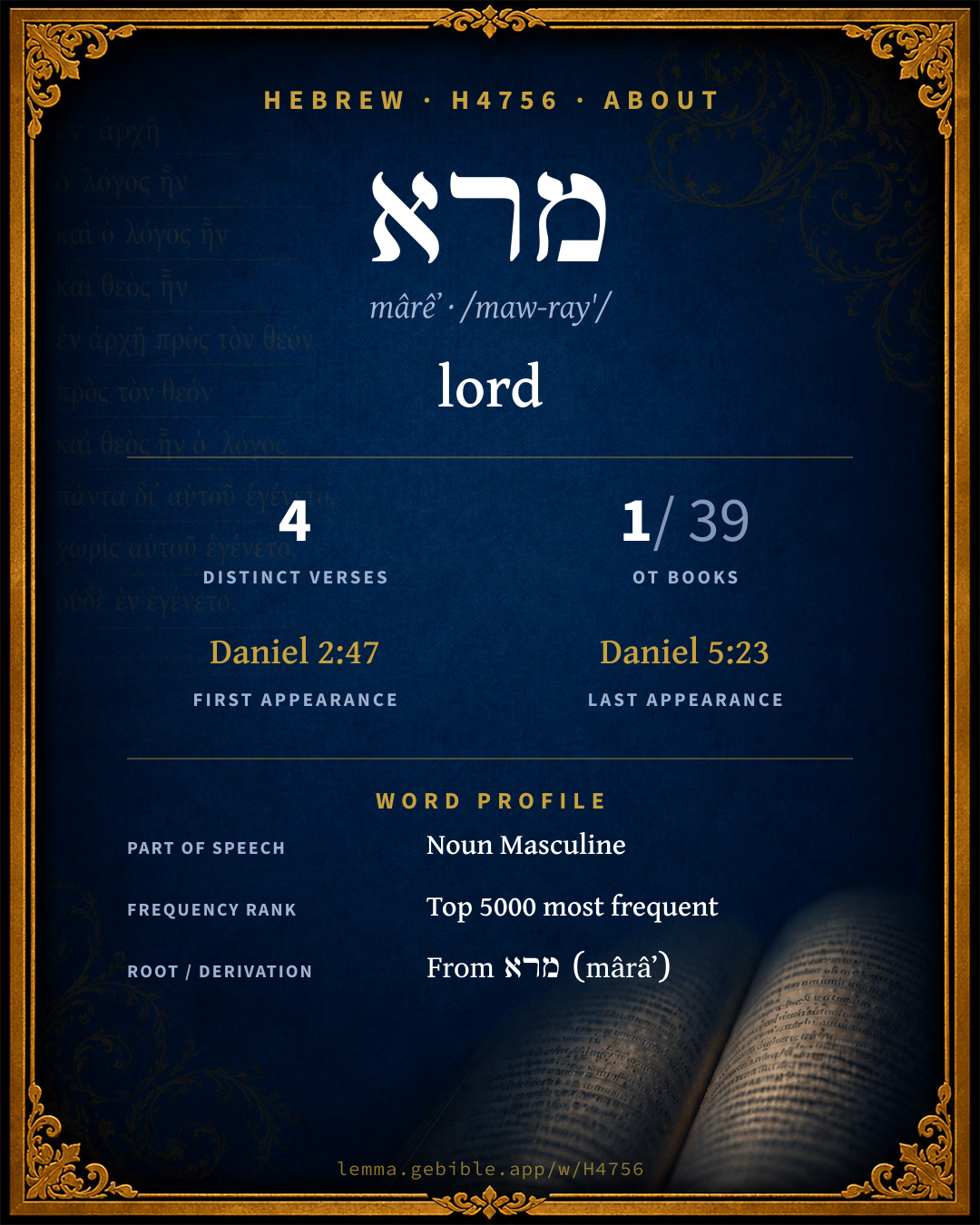
מָרֵא
lord
‘lord’ is one of 3 main senses fuller range ↓
Full lexicon entry — Brown-Driver-Briggs (BDB)
From Brown-Driver-Briggs (BDB)
Where this word appears
Grammar key — what these labels mean
Part of speech
- Noun
- A naming word — a person, place, thing, or idea.
Noun type
- Common
- A common noun — a general class of person, place, or thing (“king,” “city,” “water”), not a specific name.
State
- Construct
- A noun bound to a following noun in a possessive / “of” relationship (the construct chain).
Gender
- Masculine
- Grammatically masculine.
Number
- Singular
- One.
Every verse where H4756 appears — 4 distinct verses across 1 book. Click any verse to open its interlinear word-by-word view. Verse text shown in the World English Bible for context — . Each verse’s Hebrew form is shown with its reference; the English is not keyword-highlighted, since the data carries no word-level English alignment. Use “Compare translations” on any verse to read it across multiple English versions. This concordance covers the Hebrew Bible; Septuagint (Greek Old Testament) occurrences are not indexed here.
Daniel 4 verses
- Daniel 2:47 וּ/מָרֵ֥א conj + n c ms cs The king answered to Daniel, and said, Of a truth your God is the God of gods, and the Lord of kings, and a revealer of secrets, seeing you have been able to reveal this secret.
- Daniel 4:19 מרא/י מָרִ֕/י n c ms cs + sfx pers 1cs n c ms cs + sfx pers 1cs Then Daniel, whose name was Belteshazzar, was stricken mute for a while, and his thoughts troubled him. The king answered, Belteshazzar, don't let the dream, or the interpretation, trouble you. Belteshazzar answered, My lord, the dream be to those who hate you, and the interpretation of it to your adversaries.
- Daniel 4:24 מרא/י מָרִ֥/י n c ms cs + sfx pers 1cs n c ms cs + sfx pers 1cs this is the interpretation, O king, and it is the decree of the Most High, which is come on my lord the king:
- Daniel 5:23 מָרֵֽא n c ms cs but have lifted up yourself against the Lord of heaven; and they have brought the vessels of his house before you, and you and your lords, your wives and your concubines, have drunk wine from them; and you have praised the gods of silver and gold, of brass, iron, wood, and stone, which don't see, nor hear, nor know; and the God in whose hand your breath is, and whose are all your ways, you have not glorified.
About this entry
At a glance — auto-summarized from this page’s data, not written by a person. Every figure links to its source below. This summary describes the numbers; it doesn’t interpret them.
The Hebrew noun מרא centers on the idea of “lord.” A scarce word — 4 verses in all of the Hebrew Bible. The word gravitates to Daniel (100%). Its earliest occurrence is Daniel 2:47. BDB distinguishes 3 senses for it. For the data behind this summary, explore the sense tree and the renderings breakdown below.
Gloss history
Strong's 1890 vs modern scholarship
About this word
Strong's H4756 catalogs a Hebrew word from the Hebrew Old Testament.
These counts are not copied from any lexicon or concordance. They are computed here, from the morphology-tagged Hebrew Old Testament. What Lemma adds →
- 4
- distinct verses
- The word appears in 4 distinct verses.
- 1 / 39
- OT books
- The word appears in 1 of 39 Old Testament books.
- #3,040
- by frequency
- Top 5000 most frequent Hebrew words (rank 3,040 of 8,640 Hebrew words by occurrence).
View all 4 occurrences in the concordance →
Most concentrated in
- Daniel 4 verses 100%
By section of the Old Testament
By traditional corpus
Conventional, traditional groupings — biblical authorship is debated, so this is a traditional corpus grouping, not an authorship claim. Each share is this word’s portion of its verses in that division of the Hebrew canon. Each figure is a share of the word’s 4 distinct verses.
- Writings (Ketuvim) 4 verses · 100%
How translations render this word
Counts come from each version’s own published word-to-Strong’s tagging or interlinear alignment — an approximate guide to how each version renders this word, not a word-level alignment the data otherwise carries. Because each total is that version’s own tagged count, the per-version totals vary from one another and need not match the appearance or distinct-verse counts above. These counts may also differ from a printed concordance because Lemma counts each distinctly tagged rendering and does not collapse phrase taggings into a single head-word total. This is a fixed set of word-tagged versions (KJV, ASV, BSB, ULT) and does not change with the reading translation you choose elsewhere. Each version’s license is shown beside its name below (and on Sources).
- King James Version: Lord 4×
- American Standard Version: Lord 4×
- Berean Standard Bible: Lord 4×
- unfoldingWord Literal Text: Lord 2×, Lord of 2×
King James Version Public Domain
Renders H4756 across 4 tagged occurrences — most commonly:
American Standard Version Public Domain
Renders H4756 across 4 tagged occurrences — most commonly:
Berean Standard Bible Public Domain
Renders H4756 across 4 tagged occurrences — most commonly:
unfoldingWord Literal Text CC BY-SA 4.0
Renders H4756 across 4 tagged occurrences — most commonly:
Senses in BDB
The 3 senses BDB distinguishes for this word, in lexicon order (not ranked by frequency or importance). The full entry — with sub-senses — is in the Lexicon Entry tab.
- lord
- of king
- of God
Word origin
Derived from מרא (mârâʼ) (H4754) — to beat.
Jastrow Dictionary
A second Hebrew/Aramaic lexicon for comparison, covering Aramaic and post-biblical (Talmudic, Targumic, Midrashic) usage that the biblical-Hebrew BDB does not. Matched by lemma rather than by Strong’s number, so a lemma may carry more than one Jastrow headword (shown separately below), and the entries cover usage well beyond the Bible.
מָר
- 1. (= מארא, v. אָרָה) hoe, rake. Erub. 77ᵇ דבעי מ׳ וחצינא it requires hoe or pick-axe (to get it out). Meg. 28ᵃ, v. דְּרֵי II. Taan. 23ᵇ top ציבי ומ׳ the wood (he had collected) and the rake. B. Mets. 82ᵇ מ׳ ופסל וקרדום (Ms. מר, Ar. מר פסל) hoe and mattock and axe; Ber. 57ᵇ מר פסל וקרדום. Keth. 64ᵃ בעינא … ומָרָה לקבורה I want a staff to lean on and a hoe to make my grave, i.e. a son to support me in old age and to provide for my burial; Yeb. 65ᵇ. Taan. 21ᵇ, v. זְבִילָא; a. e.—
- *2. (= מארא, denom. of אוּרָא; cmp. Arab. marvu silices &c.) flint for striking a light. Zeb. 116ᵇ אפיקו נורא ממ׳ חדתא (Ms. M. ממַגָּאנָא, Yalk. Lev. 579 ממַגָּנָה, v. מַנְגָּנָא; Ms. K. ממָאנָא; En Yaăk. ממָנָא) produce fire with a flint-stone which has not been used before.
מָרָא
- , to be strong, v. מרי.
מְרָא
- , v. מְרֵי
מֻרָּא
- , v. מוּרָא
מרי I
- (b. h.) to be strong, fat.
- to fatten, stuff. Sabb. XXIV, 3 (155ᵇ) אין מַמְרִים וכ׳ (Y. ed. מַמְרִין; Bab. ed. מאמירין, v. אָמַר II) you must not stuff calves (on the Sabbath), v. הַמְרָאָה I.
מְרֵי
- ; Af. אַמְרֵי to provoke. [Targ. Zech. XII, 10, v. מְרר].—Sot. 35ᵇ top מאן אַמְרִיךְ דאִימַּרְיַית (Ar. ed. Koh. s. v. אמר: אימרייך דאימרת, corr. acc.) who provoked thee that thou didst get angry?; Num. R. s. 5, end.—Gen. R. s. 42 (play on א̇מ̇ר̇פל̇) דא̇מ̇ר̇י וא̇פ̇ל̇י וכ׳ he provoked and made sport of &c.
- 1. to get angry. Num. R. l. c. דאִמַּרְיַת; Sot. l. c., v. supra.
- 2. to quarrel, rebel. B. Mets. 84ᵇ אִימַּרְיָא Ms. M., v. מְרַד.—Ḥull. 58ᵇ אִימְּרָאִי … לבקא Ar., v. בַּקָּא (ed. אִימְּרָא … מב׳ she ran away in anger from &c., v. מְרַד). Keth. 63ᵇ אימראי quot. in Rashi to Job XXXIX, 18 (ed. אימרדה). e.g. Job 39:18
- 3. to refuse to abide by a bargain; to retract. B. Mets. 77ᵃ אייקרא … ואִימְּרוּ פועלים labor became dearer, and the laborers struck. Ib. ואימרי בעה"ב Ar. (ed. ואימר, fr. ימר, v. מוּר I) and the employer refused &c.
A Dictionary of the Targumim, the Talmud Babli and Yerushalmi, and the Midrashic Literature (Marcus Jastrow; London, Luzac, 1903) — Public Domain. Digitized via Sefaria. Digitized via Sefaria. Full attribution on Sources.
Forms in the corpus
The 5 distinct written forms H4756 takes in the Hebrew Bible, most frequent first — each parse links to that state’s occurrences in the concordance. Hebrew forms include their vowel points and cantillation, so a single lemma takes many written forms.
| Form | Parsing | Example | Uses |
|---|---|---|---|
| מרא/י | Noun, Common, Masculine, Singular, Construct | Daniel 4:19 | 2 |
| וּ/מָרֵ֥א | Noun, Common, Masculine, Singular, Construct | Daniel 2:47 | 1 |
| מָרִ֕/י | Noun, Common, Masculine, Singular, Construct | Daniel 4:19 | 1 |
| מָרִ֥/י | Noun, Common, Masculine, Singular, Construct | Daniel 4:24 | 1 |
| מָרֵֽא | Noun, Common, Masculine, Singular, Construct | Daniel 5:23 | 1 |
Same root — word family
Other BDB entries built from the same root as H4756, grouped by Strong’s listed origin. These share a root / origin per the lexicon — not necessarily a shared meaning. Each links to that word’s own entry.
Derives from
Shares the same root
Proper names from this root
People and places named from this root — a name, not an additional meaning of the word.
Compare all same-root words → 1 of the same-root words is a proper name (a person or place). They share a root, not necessarily a meaning.
Septuagint verse parallels
This word appears in 3 verses that also exist in the Greek Old Testament (Septuagint), out of the 4 Hebrew verses it occurs in. You can read those verses in Greek by switching the Old Testament edition to the Septuagint.
Read these verses in the Septuagint
This is a verse-level parallel only — the same verses exist in both the Hebrew and Greek Old Testaments. No word-level Hebrew↔Greek correspondence is claimed: the data carries no such alignment, so no Greek word is shown as this Hebrew word’s translation. Coverage is not total — the Septuagint omits the deuterocanon and renumbers the Psalms, so some Hebrew verses have no direct Greek parallel.