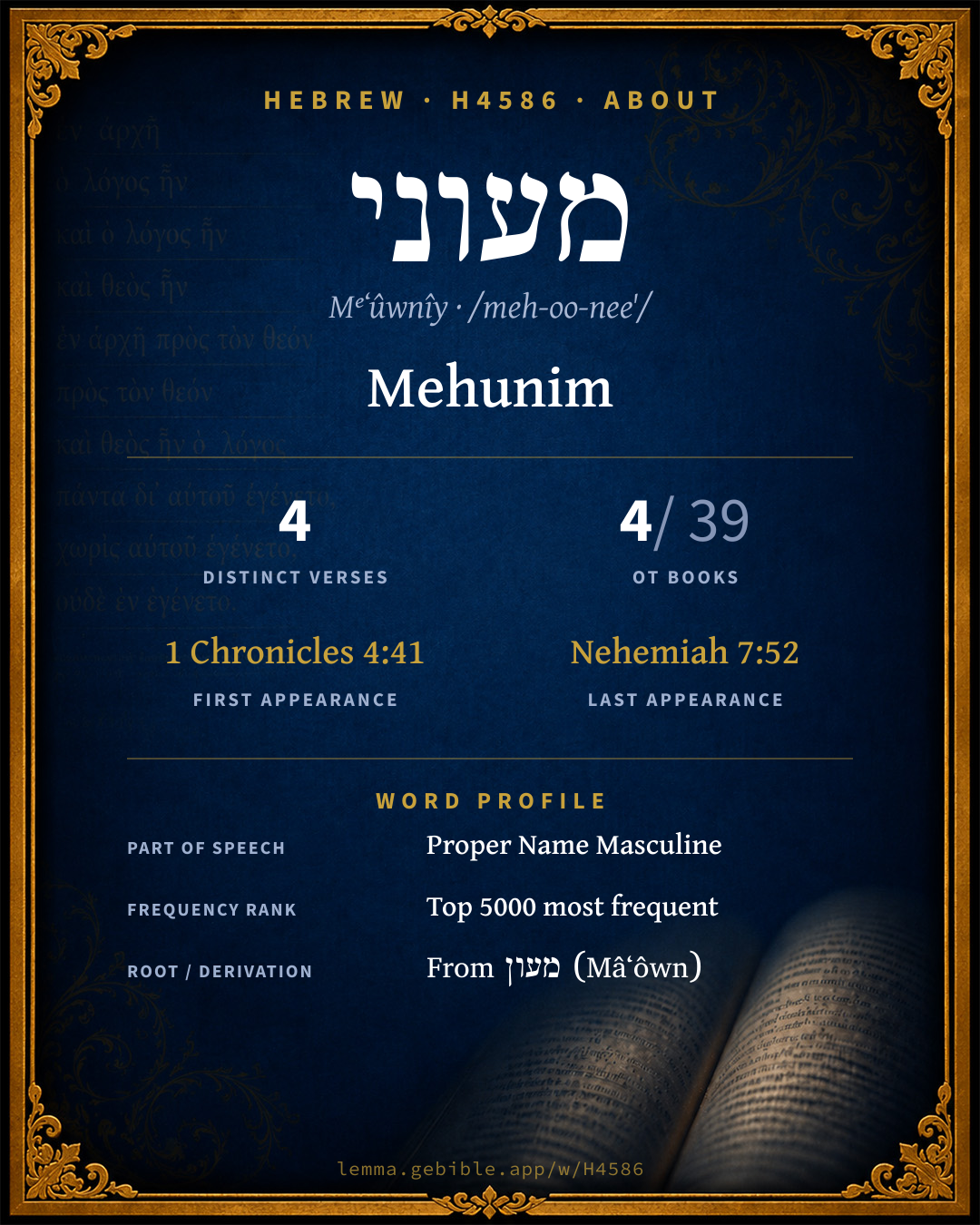
מְעוּנִים
Mehunim
BDB lists 3 entries for ‘Mehunim’ fuller range ↓
Full lexicon entry — Brown-Driver-Briggs (BDB)
From Brown-Driver-Briggs (BDB)
Where this word appears
Grammar key — what these labels mean
Part of speech
- Noun
- A naming word — a person, place, thing, or idea.
Noun type
- Gentilic
- A noun naming a member of a people, tribe, or region of origin (e.g. an Israelite, a Moabite).
State
- Absolute
- The independent form of a noun, not bound to a following word.
Gender
- Masculine
- Grammatically masculine.
Number
- Plural
- More than one (in Hebrew, generally three or more).
Every verse where H4586 appears in the Book of 1 Chronicles — 1 distinct verse. Click any verse to open its interlinear word-by-word view. Verse text shown in the World English Bible for context — . Each verse’s Hebrew form is shown with its reference; the English is not keyword-highlighted, since the data carries no word-level English alignment. Use “Compare translations” on any verse to read it across multiple English versions. This concordance covers the Hebrew Bible; Septuagint (Greek Old Testament) occurrences are not indexed here.
1 Chronicles
About this entry
At a glance — auto-summarized from this page’s data, not written by a person. Every figure links to its source below. This summary describes the numbers; it doesn’t interpret them.
“Mehunim” is the headline sense of the Hebrew name מעוני (Mᵉʻûwnîy). A scarce word — 4 verses in all of the Hebrew Bible. It concentrates in 1 Chronicles, which alone accounts for 25% of its uses. First canonically at 1 Chronicles 4:41, it enters the text early. See 4-verse concordance and the renderings breakdown below.
Gloss history
Strong's 1890 vs modern scholarship
About this word
Strong's H4586 catalogs a Hebrew word from the Hebrew Old Testament.
These counts are not copied from any lexicon or concordance. They are computed here, from the morphology-tagged Hebrew Old Testament. What Lemma adds →
- 4
- distinct verses
- The word appears in 4 distinct verses.
- 4 / 39
- OT books
- The word appears in 4 of 39 Old Testament books.
- #3,040
- by frequency
- Top 5000 most frequent Hebrew words (rank 3,040 of 8,640 Hebrew words by occurrence).
View all 4 occurrences in the concordance →
Most concentrated in
- 1 Chronicles 1 verse 25%
- 2 Chronicles 1 verse 25%
- Ezra 1 verse 25%
By section of the Old Testament
By traditional corpus
Conventional, traditional groupings — biblical authorship is debated, so this is a traditional corpus grouping, not an authorship claim. Each share is this word’s portion of its verses in that division of the Hebrew canon. Each figure is a share of the word’s 4 distinct verses.
- Writings (Ketuvim) 4 verses · 100%
How translations render this word
Counts come from each version’s own published word-to-Strong’s tagging or interlinear alignment — an approximate guide to how each version renders this word, not a word-level alignment the data otherwise carries. Because each total is that version’s own tagged count, the per-version totals vary from one another and need not match the appearance or distinct-verse counts above. These counts may also differ from a printed concordance because Lemma counts each distinctly tagged rendering and does not collapse phrase taggings into a single head-word total. This is a fixed set of word-tagged versions (KJV, ASV, BSB, ULT) and does not change with the reading translation you choose elsewhere. Each version’s license is shown beside its name below (and on Sources).
- King James Version: Mehunim 1×, Mehunims 1×, Meunim 1×
- American Standard Version: Meunim 3×
- Berean Standard Bible: Meunim 2×
- unfoldingWord Literal Text: Meunim 2×, Meunites 2×
King James Version Public Domain
Renders H4586 across 3 tagged occurrences — most commonly:
American Standard Version Public Domain
Renders H4586 across 3 tagged occurrences — most commonly:
Berean Standard Bible Public Domain
Renders H4586 across 4 tagged occurrences — most commonly:
Plus 2 renderings that appear only once — usually multi-word phrases or single function words the recovered tagging swept in, not distinct renderings.
unfoldingWord Literal Text CC BY-SA 4.0
Renders H4586 across 4 tagged occurrences — most commonly:
Senses in BDB
The 3 senses BDB distinguishes for this word, in lexicon order (not ranked by frequency or importance). The full entry — with sub-senses — is in the Lexicon Entry tab.
- Mehunim or Meunim = "habitations"
- a people who lived south of Canaan
- a group of returning exiles, perhaps descendants of 1
Word origin
n.pr.gent. Meʿunim, Meʿunites (usually connected with מָעוֹן (v. עון), but dub., cf. Buhl Edom. 41 f.);—a people S. (SE?) of Canaan (cf. Buhl l.c.);—הַמּ׳ 2 Ch 26:7 and 1 Ch 4:41 Qr (Kt המעינים, 𝔊B τοὺς Μιναίους, 𝔊L τ. κιναίους); read also מֵהַמְּעוּנִים 2 Ch 20:1 (for MT מֵהָעַמּוֹנִים), so 𝔊Biblical Aramaic (𝔊L Αμμανιειμ), Ew Be Ke Öt Kau Kit; בְּנֵי־מְעוּנִים (among Nethinim who went back with Zerub.) Ezr 2:50=Neh 7:52 are perhaps descendants of those named above (2 Ch 26:7). 𝔊 οἱ Μιναῖοι, but against מ׳=Minæans (GlaserSkizze ii. 450 f. al.) v. SprengerZMG xliv (1890), 505.
— Brown-Driver-Briggs (Oxford 1906, public domain), digitized via Sefaria, supplemented by the OpenScriptures HebrewLexicon (CC BY 4.0). See Sources.
Derived from מעון (Mâʻôwn) (H4584) — Maon.
Jastrow Dictionary
A second Hebrew/Aramaic lexicon for comparison, covering Aramaic and post-biblical (Talmudic, Targumic, Midrashic) usage that the biblical-Hebrew BDB does not. Matched by lemma rather than by Strong’s number, so a lemma may carry more than one Jastrow headword (shown separately below), and the entries cover usage well beyond the Bible.
מְעוֹנִי
- 1. of Maon, v. preced.
- 2. סֵפֶר מ׳ the Book M’ʿoni, name of a Pentateuch copy in Jerusalem in which מָעוֹן was written in place of מְעֹנָה (Deut. XXXIII, 27). Y. Taan. IV, 68ᵃ bot. ספר מ׳; Sifré Deut. 356 של מְעוֹנִים; Treat. Sof’rim VI, 4 ספר מעונה (corr. acc.). e.g. Deuteronomy 33:27
עוֹנִי I
- , v. עוֹנָה II) misery, poverty, privation. Ab. IV, 9 כל המקיים … מע׳ וכ׳ he who fulfills the Law in spite of poverty, shall finally do so in wealth; וכל המבטל … סופו לבטלה מע׳ and he who neglects the Law on account of his wealth, shall finally neglect it from poverty. M. Kat. 17ᵇ, a. e. כל מקום … או מיתה או ע׳ wherever the scholars put their eyes (upon a person, i.e. decreed the ban), there follows either death or poverty. Midr. Till. to Ps. V (ref. to I Chr. XXII, 13) בעָנְיִי בצער וכ׳ what does ‘in my misery’ mean? In the pain which I suffered about it. Sifré Deut. 130 (ref. to Deut. XVI, 3) למה נקרא לחם ע׳ על שם עינוי וכ׳ why is it called bread of misery? For the affliction which they suffered in Egypt; a. fr.—[Pes. 36ᵇ תיפוק ליה מלחם ע׳ … באוני derive it (that you dare not use second tithes for unleavened bread to be eaten with the Passover lamb) from the expression ‘bread of misery’, which intimates ‘that which it is permitted to eat in mourning (to the exclusion of second tithes, v. Deut. XXVI, 14); ib.ᵃ לחם ע׳ מה שנאכל באנינות. Ib., a. e. לחם ע׳ לחם שעונין עליו וכ׳ ‘bread of recitation’, bread over which they recite many words (the Hagadah, Hallel &c.).] e.g. 1 Chronicles 22:13
עוֹנִי
- ch., v. עַנִּי
*עוֹנִי II
- ‘Oni. Tosef. Ohol. XVI, 12 תחום ע׳ (R. S. to Ohol. XVI, 5 עכו); cmp. אוֹנִי II.
A Dictionary of the Targumim, the Talmud Babli and Yerushalmi, and the Midrashic Literature (Marcus Jastrow; London, Luzac, 1903) — Public Domain. Digitized via Sefaria. Digitized via Sefaria. Full attribution on Sources.
Forms in the corpus
The 5 distinct written forms H4586 takes in the Hebrew Bible, most frequent first — each parse links to that state’s occurrences in the concordance. Hebrew forms include their vowel points and cantillation, so a single lemma takes many written forms.
| Form | Parsing | Example | Uses |
|---|---|---|---|
| מְעוּנִ֖ים | Noun, Gentilic, Masculine, Plural, Absolute | Ezra 2:50 | 2 |
| ה/מעינים | Noun, Gentilic, Masculine, Plural, Absolute | 1 Chronicles 4:41 | 1 |
| הַ/מְּעוּנִ֨ים | Noun, Gentilic, Masculine, Plural, Absolute | 1 Chronicles 4:41 | 1 |
| וְ/הַ/מְּעוּנִֽים | Noun, Gentilic, Masculine, Plural, Absolute | 2 Chronicles 26:7 | 1 |
| מעינים | Noun, Gentilic, Masculine, Plural, Absolute | Ezra 2:50 | 1 |
Bible dictionary
Public-domain dictionary articles matched to this entry by name (Mehunim). A biblical name can be shared by more than one person or place, so an article may treat several.
Smith's Bible Dictionary · William Smith, 1863
(habitations). (Ezra 2:50) Elsewhere called Mehunims and Meunim.
Classic public-domain reference works; full attribution on Sources.
Septuagint verse parallels
This word appears in 3 verses that also exist in the Greek Old Testament (Septuagint), out of the 4 Hebrew verses it occurs in. You can read those verses in Greek by switching the Old Testament edition to the Septuagint.
Read these verses in the Septuagint
This is a verse-level parallel only — the same verses exist in both the Hebrew and Greek Old Testaments. No word-level Hebrew↔Greek correspondence is claimed: the data carries no such alignment, so no Greek word is shown as this Hebrew word’s translation. Coverage is not total — the Septuagint omits the deuterocanon and renumbers the Psalms, so some Hebrew verses have no direct Greek parallel.