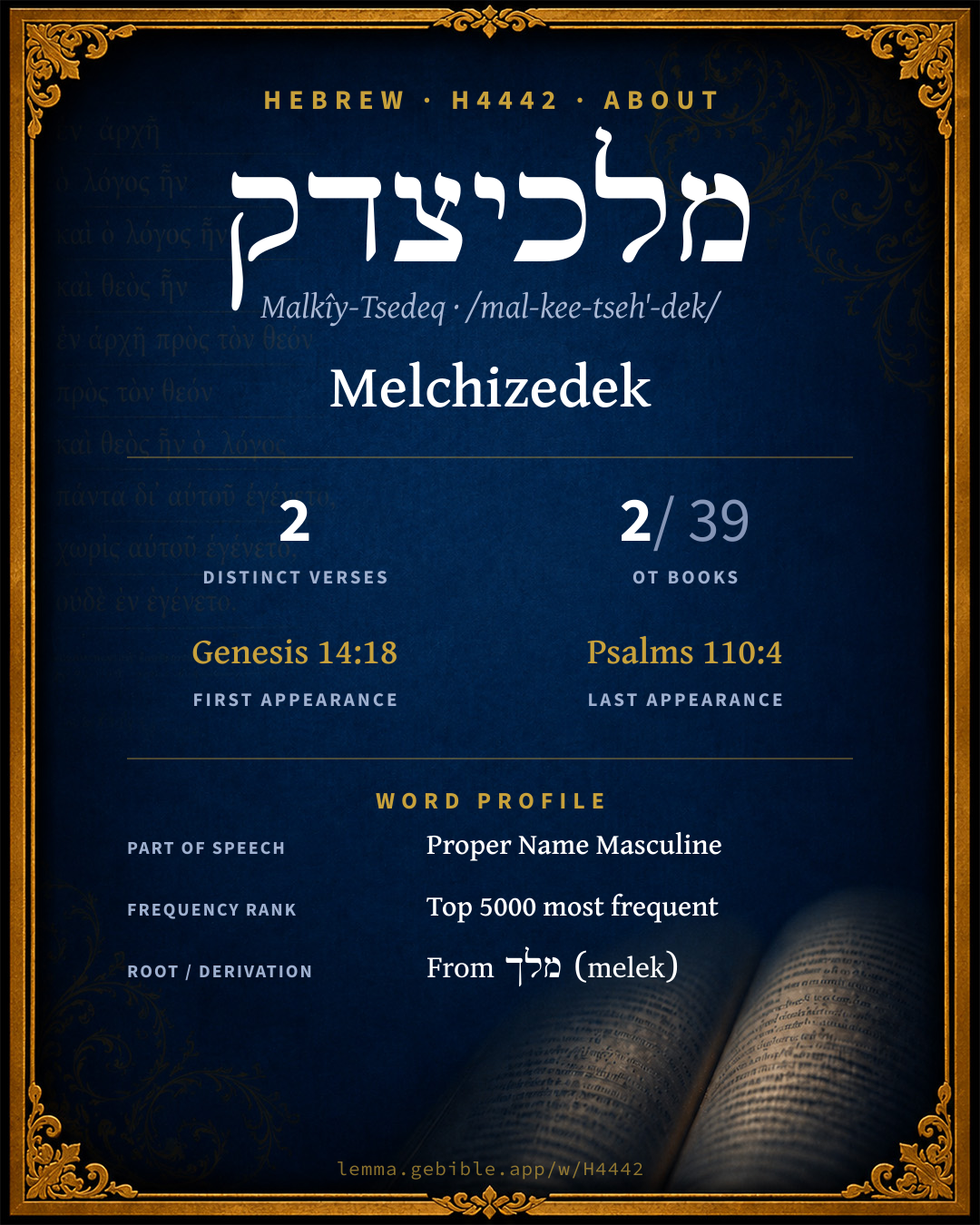
מַלְכִּי־צֶ֫דֶק
Melchizedek
BDB lists 2 entries for ‘Melchizedek’ fuller range ↓
Full lexicon entry — Brown-Driver-Briggs (BDB)
From Brown-Driver-Briggs (BDB)
Where this word appears
Grammar key — what these labels mean
Part of speech
- Noun
- A naming word — a person, place, thing, or idea.
Noun type
- Proper
- A name of a specific person, place, or people (e.g. Abraham, Zion, Israel).
Every verse where H4442 appears in the Book of Psalms — 1 distinct verse. Click any verse to open its interlinear word-by-word view. Verse text shown in the World English Bible for context — . Each verse’s Hebrew form is shown with its reference; the English is not keyword-highlighted, since the data carries no word-level English alignment. Use “Compare translations” on any verse to read it across multiple English versions. This concordance covers the Hebrew Bible; Septuagint (Greek Old Testament) occurrences are not indexed here.
Psalms
About this entry
At a glance — auto-summarized from this page’s data, not written by a person. Every figure links to its source below. This summary describes the numbers; it doesn’t interpret them.
“Melchizedek” is the headline sense of the Hebrew name מלכיצדק (Malkîy-Tsedeq). A scarce word — 2 verses in all of the Hebrew Bible. It clusters heavily in Genesis, which alone accounts for 50% of its uses. First canonically at Genesis 14:18, it enters the text early. See 2-verse concordance and the renderings breakdown below.
Gloss history
Strong's 1890 vs modern scholarship
About this word
Strong's H4442 catalogs a Hebrew word from the Hebrew Old Testament.
These counts are not copied from any lexicon or concordance. They are computed here, from the morphology-tagged Hebrew Old Testament. What Lemma adds →
- 2
- distinct verses
- The word appears in 2 distinct verses.
- 2 / 39
- OT books
- The word appears in 2 of 39 Old Testament books.
- #3,696
- by frequency
- Top 5000 most frequent Hebrew words (rank 3,696 of 8,640 Hebrew words by occurrence).
View all 2 occurrences in the concordance →
By traditional corpus
Conventional, traditional groupings — biblical authorship is debated, so this is a traditional corpus grouping, not an authorship claim. Each share is this word’s portion of its verses in that division of the Hebrew canon. Each figure is a share of the word’s 2 distinct verses.
- Torah (Pentateuch) 1 verse · 50%
- Writings (Ketuvim) 1 verse · 50%
How translations render this word
Counts come from each version’s own published word-to-Strong’s tagging or interlinear alignment — an approximate guide to how each version renders this word, not a word-level alignment the data otherwise carries. Because each total is that version’s own tagged count, the per-version totals vary from one another and need not match the appearance or distinct-verse counts above. These counts may also differ from a printed concordance because Lemma counts each distinctly tagged rendering and does not collapse phrase taggings into a single head-word total. This is a fixed set of word-tagged versions (KJV, ASV, BSB, ULT) and does not change with the reading translation you choose elsewhere. Each version’s license is shown beside its name below (and on Sources).
- King James Version: Melchizedek 2×
- American Standard Version: Melchizedek 2×
- Berean Standard Bible: Melchizedek 2×
- unfoldingWord Literal Text: Melchizedek 4×
King James Version Public Domain
Renders H4442 across 2 tagged occurrences — most commonly:
American Standard Version Public Domain
Renders H4442 across 2 tagged occurrences — most commonly:
Berean Standard Bible Public Domain
Renders H4442 across 2 tagged occurrences — most commonly:
unfoldingWord Literal Text CC BY-SA 4.0
Renders H4442 across 4 tagged occurrences — most commonly:
Senses in BDB
The 2 senses BDB distinguishes for this word, in lexicon order (not ranked by frequency or importance). The full entry — with sub-senses — is in the Lexicon Entry tab.
- Melchizedek = "my king is Sedek"
- king of Salem and priest of the Most High God to whom Abram paid tithe after the battle he fought to free Lot…
Word origin
n.pr.m. king of שָׁלֵם (q.v.), (my king is Ṣedeḳ)—Gn 14:18 ψ 110:4. 𝔊 Μελχισεδεκ.
— Brown-Driver-Briggs (Oxford 1906, public domain), digitized via Sefaria, supplemented by the OpenScriptures HebrewLexicon (CC BY 4.0). See Sources.
Derived from מלך (melek) (H4428) — king.
Forms in the corpus
The 4 distinct written forms H4442 takes in the Hebrew Bible, most frequent first — each parse links to that state’s occurrences in the concordance. Hebrew forms include their vowel points and cantillation, so a single lemma takes many written forms.
| Form | Parsing | Example | Uses |
|---|---|---|---|
| וּ/מַלְכִּי | Noun, Proper | Genesis 14:18 | 1 |
| מַלְכִּי | Noun, Proper | Psalms 110:4 | 1 |
| צֶ֨דֶק֙ | Noun, Proper | Genesis 14:18 | 1 |
| צֶֽדֶק | Noun, Proper | Psalms 110:4 | 1 |
Same root — word family
Other BDB entries built from the same root as H4442, grouped by Strong’s listed origin. These share a root / origin per the lexicon — not necessarily a shared meaning. Each links to that word’s own entry.
Derives from
Shares the same root
Proper names from this root
People and places named from this root — a name, not an additional meaning of the word.
- מלך Melek H4429 Melech
- מלכיאל Malkîyʼêl H4439 Malchiel
- מלכיה Malkîyâh H4441 Malchijah
- מלכירם Malkîyrâm H4443 Malchiram
- מלכישוע Malkîyshûwaʻ H4444 Malchishua
- מלכם Malkâm H4445 Milcom
- Μελχισεδεκ Melchisedék G3198 Melchizedek
Compare all same-root words → Showing 4 of 11 — not the complete family. 7 of the same-root words are proper names (people or places). They share a root, not necessarily a meaning.
Bible dictionary
Public-domain dictionary articles matched to this entry by name (Melchizedek). A biblical name can be shared by more than one person or place, so an article may treat several.
Easton's Bible Dictionary · M. G. Easton, 1897
King of righteousness, the king of Salem (q.v.). All we know of him is recorded in Gen. 14:18-20. He is subsequently mentioned only once in the Old Testament, in Ps. 110:4. The typical significance of his history is set forth in detail in the Epistle to the Hebrews, ch. 7. The apostle there points out the superiority of his priesthood to that of Aaron in these several respects, (1) Even Abraham paid him tithes; (2) he blessed Abraham; (3) he is the type of a Priest who lives for ever; (4) Levi, yet unborn, paid him tithes in the person of Abraham; (5) the permanence of his priesthood in Christ implied the abrogation of the Levitical system; (6) he was made priest not without an oath; and (7) his priesthood can neither be transmitted nor interrupted by death: "this man, because he continueth ever, hath an unchangeable priesthood."
The question as to who this mysterious personage was has given rise to a great deal of modern speculation. It is an old tradition among the Jews that he was Shem, the son of Noah, who may have survived to this time. Melchizedek was a Canaanitish prince, a worshipper of the true God, and in his peculiar history and character an instructive type of our Lord, the great High Priest (Heb. 5:6, 7; 6:20). One of the Amarna tablets is from Ebed-Tob, king of Jerusalem, the successor of Melchizedek, in which he claims the very attributes and dignity given to Melchizedek in the Epistle to the Hebrews.
Smith's Bible Dictionary · William Smith, 1863
(king of righteousness), king of Salem and priest of the most high God, who met Abram in the valley of Shaveh, which is the king's valley, bought out bread and wine, blessed him, and received tithes from him. (Genesis 14:18-20) The other places in which Melchizedek is mentioned are (Psalms 110:4) where Messiah is described as a priest forever, "after the order of Melchizedek," and (Hebrews 5:1; Hebrews 6:1; Hebrews 7:1) ... where these two passages of the Old Testament are quoted, and the typical relation of Melchizedek to our Lord is stated at great length. There is something surprising and mysterious in the first appearance of Melchizedek, and in the subsequent reference to him. Bearing a title which Jews in after ages would recognize as designating their own sovereign, bearing gifts which recall to Christians the Lord's Supper, this Canaanite crosses for a moment the path of Abram, and is unhesitatingly recognized as a person of higher spiritual rank than the friend of God. Disappearing as suddenly as he came, he is lost to the sacred writings for a thousand years. Jewish tradition pronounces Melchizedek to be a survivor of the deluge, the patriarch Shem. The way in which he is mentioned in Genesis would rather lead to the inference that Melchizedek was of one blood with the children of Ham, among whom he lived, chief (like the king od Sodom) of a settled Canaanitish tribe. The "order of Melchizedek," in (Psalms 110:4) is explained to mean "manner" = likeness in official dignity = a king and priest. The relation between Melchizedek and Christ as type and antitype is made in the Epistle to the Hebrews to consist in the following particulars: Each was a priest, (1) not of the Levitical tribe;
(2) superior to Abraham; (3) whose beginning and end are unknown; (4) who is not only a priest, but also a king of righteousness and peace. A fruitful source of discussion has been found in the site of Salem. [Salem]
Hitchcock's Bible Names Dictionary · Roswell D. Hitchcock, 1869
king of justice
Classic public-domain reference works; full attribution on Sources.
Septuagint verse parallels
This word appears in 2 verses that also exist in the Greek Old Testament (Septuagint), out of the 2 Hebrew verses it occurs in. You can read those verses in Greek by switching the Old Testament edition to the Septuagint.
Read these verses in the Septuagint
This is a verse-level parallel only — the same verses exist in both the Hebrew and Greek Old Testaments. No word-level Hebrew↔Greek correspondence is claimed: the data carries no such alignment, so no Greek word is shown as this Hebrew word’s translation. Coverage is not total — the Septuagint omits the deuterocanon and renumbers the Psalms, so some Hebrew verses have no direct Greek parallel.