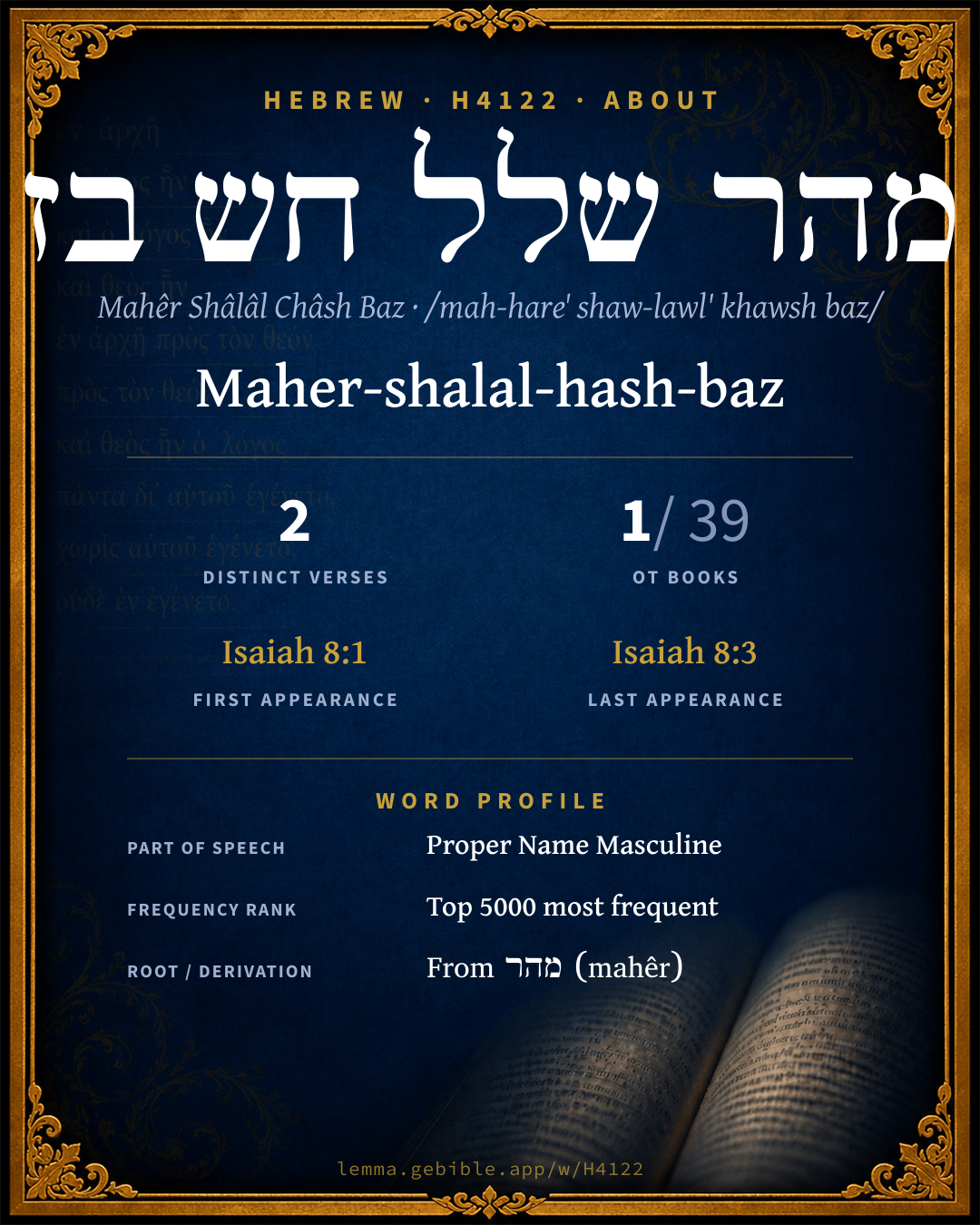
מַהֵר שָׁלָל חָשׁ בַּז
Maher-shalal-hash-baz
BDB lists 2 entries for ‘Maher-shalal-hash-baz’ fuller range ↓
Full lexicon entry — Brown-Driver-Briggs (BDB)
From Brown-Driver-Briggs (BDB)
Where this word appears
Grammar key — what these labels mean
Part of speech
- Noun
- A naming word — a person, place, thing, or idea.
Noun type
- Proper
- A name of a specific person, place, or people (e.g. Abraham, Zion, Israel).
Every verse where H4122 appears — 2 distinct verses across 1 book. Click any verse to open its interlinear word-by-word view. Verse text shown in the World English Bible for context — . Each verse’s Hebrew form is shown with its reference; the English is not keyword-highlighted, since the data carries no word-level English alignment. Use “Compare translations” on any verse to read it across multiple English versions. This concordance covers the Hebrew Bible; Septuagint (Greek Old Testament) occurrences are not indexed here.
Isaiah 2 verses
- Isaiah 8:1 לְ/מַהֵ֥ר שָׁלָ֖ל חָ֥שׁ בַּֽז prep + n Proper n Proper n Proper n Proper Yahweh said to me, "Take a large tablet, and write on it with a man's pen, 'For Maher Shalal Hash Baz;'
- Isaiah 8:3 מַהֵ֥ר שָׁלָ֖ל חָ֥שׁ בַּֽז n Proper n Proper n Proper n Proper I went to the prophetess; and she conceived, and bore a son. Then said Yahweh to me, Call his name Maher Shalal Hash Baz.
About this entry
At a glance — auto-summarized from this page’s data, not written by a person. Every figure links to its source below. This summary describes the numbers; it doesn’t interpret them.
מהר שלל חש בז — transliterated Mahêr Shâlâl Châsh Baz — is a Hebrew name carrying the sense “Maher-shalal-hash-baz.” It is rare — just 2 verses in the entire Hebrew Bible. Its uses cluster heavily in Isaiah (100% of all occurrences). First canonically at Isaiah 8:1, it enters the text early. See 2-verse concordance and the renderings breakdown below.
Gloss history
Strong's 1890 vs modern scholarship
About this word
Strong's H4122 catalogs a Hebrew word from the Hebrew Old Testament.
These counts are not copied from any lexicon or concordance. They are computed here, from the morphology-tagged Hebrew Old Testament. What Lemma adds →
- 2
- distinct verses
- The word appears in 2 distinct verses.
- 1 / 39
- OT books
- The word appears in 1 of 39 Old Testament books.
- #2,625
- by frequency
- Top 5000 most frequent Hebrew words (rank 2,625 of 8,640 Hebrew words by occurrence).
View all 2 occurrences in the concordance →
Most concentrated in
- Isaiah 2 verses 100%
By section of the Old Testament
By traditional corpus
Conventional, traditional groupings — biblical authorship is debated, so this is a traditional corpus grouping, not an authorship claim. Each share is this word’s portion of its verses in that division of the Hebrew canon. Each figure is a share of the word’s 2 distinct verses.
- Prophets (Nevi'im) 2 verses · 100%
How translations render this word
Counts come from each version’s own published word-to-Strong’s tagging or interlinear alignment — an approximate guide to how each version renders this word, not a word-level alignment the data otherwise carries. Because each total is that version’s own tagged count, the per-version totals vary from one another and need not match the appearance or distinct-verse counts above. These counts may also differ from a printed concordance because Lemma counts each distinctly tagged rendering and does not collapse phrase taggings into a single head-word total. This is a fixed set of word-tagged versions (KJV, ASV, BSB, ULT) and does not change with the reading translation you choose elsewhere. Each version’s license is shown beside its name below (and on Sources).
- King James Version: Concerning mahershalalhashbaz 1×, Mahershalalhashbaz 1×
- American Standard Version: Maher-shalal 2×
- Berean Standard Bible: Maher-shalal-hash-baz 2×
- unfoldingWord Literal Text: Baz 2×, Hash 2×, Maher 2×
King James Version Public Domain
Renders H4122 across 2 tagged occurrences — most commonly:
American Standard Version Public Domain
Renders H4122 across 2 tagged occurrences — most commonly:
Berean Standard Bible Public Domain
Renders H4122 across 2 tagged occurrences — most commonly:
Not rendered by a distinct English word in 6 further occurrences.
unfoldingWord Literal Text CC BY-SA 4.0
Renders H4122 across 8 tagged occurrences — most commonly:
Senses in BDB
The 2 senses BDB distinguishes for this word, in lexicon order (not ranked by frequency or importance). The full entry — with sub-senses — is in the Lexicon Entry tab.
- = Maher-shalal-hash-baz " swift is booty, speedy is prey"
- symbolic name given by Isaiah by the Lord's direction to Isaiah's son…
Word origin
as n.pr.m. Is 8:1, 3 (lit. Swift is booty, speedy is prey).
— Brown-Driver-Briggs (Oxford 1906, public domain), digitized via Sefaria, supplemented by the OpenScriptures HebrewLexicon (CC BY 4.0). See Sources.
Derived from מהר (mahêr) (H4118) — swift.
Jastrow Dictionary
A second Hebrew/Aramaic lexicon for comparison, covering Aramaic and post-biblical (Talmudic, Targumic, Midrashic) usage that the biblical-Hebrew BDB does not. Matched by lemma rather than by Strong’s number, so a lemma may carry more than one Jastrow headword (shown separately below), and the entries cover usage well beyond the Bible.
בַּז
- , v. בָּזַז, בְּזַז.
הַר
- mound, mountain; trnsf. eminent person. Midd. II, 1, a. fr. הַר הבית the Temple mount. Yeb. 17ᵃ (play on ה̇ר̇פ̇נ̇יא) ה̇ר̇ שהכל פ̇ונ̇ין בו a hill to which all turn (whose spurious descent prevents them from getting wives elsewhere); a. v. fr.—Ḥull. 39ᵇ (in Chald. diction) רישיך והר here is thy head and here the mountain (a colloquial phrase for compelling one to give up a bargain).—Ex. R. s. 28 (ref. to Ex. XIX, 3) בזכות הה׳ for the merit of the distinguished one (Abraham), ואין הה׳ אלא אבות har means the patriarchs (ref. to Mic. VI, 2). Snh. 107ᵃ ה׳ שבכם the most prominent of you; a. fr.—[For proper nouns composed with הר, v. respective determinants.]—Pl. הָרִים, הֲרָרִים. Tam. 32ᵃ, a. e. הָרֵי חושך, v. חו̇שֶׁךְ.—Snh. 24ᵃ עוקר הרי הרים uprooting the highest mountains (a figure for dialectical ingenuity). Y. Yeb. I, 3ᵃ bot. בין שני הֶהָ׳ וכ׳ between the two high mountains (great scholars). Ex. R. s. 15 ואין ה׳ אלא אבות, v. supra.—Ḥag. I, 8 כה׳ תלויין בשערה like mountains suspended on a hair (a slender Bible text for numerous Talmudic laws); a. v. fr. e.g. Exodus 19:3
חָשׁ
- , v. חוּשׁ, חָשַׁשׁ, חֲשַׁשׁ.
מָהַר
- to exchange, buy. Denom. מוֹהַר.
- (cmp. חָלַף)
- 1. to hurry, be speedy. Sabb. 97ᵃ מְמַהֶרֶת לבוא וכ׳ comes quicker than &c. B. Kam. 93ᵃ מְמַהֲרִין לצועק וכ׳ he who cries for revenge will sooner be punished than he who is cried against. Sifré Deut. 277 מְמַהֵר אני ליפרע ע"י עני I (the Lord) will sooner take revenge when a poor man is wronged than when a rich man is; a. fr.
- 2. to expedite. Kidd. 31ᵇ מַהֲרוּנִי expedite me (on my journey).
מֹהַר
- , v. מוֹהַר
מָהִר
- preced. art.) quick, ready. Ab. V, 12 מ׳ לשמוע ומ׳ לאבד quick of perception and quick to forget. Ex. R. s. 11, beg.; a. e.
שָׁלַל I
- [to hang down, be loose,]
- 1. to hang on, to chain. Part. pass. שָׁלוּל. Lam. R. introd. (R. Z’ʿera) כת … שְׁלוּלִים בשלשלאות a troop of old men chained with chains.
- 2. to make chain-stitches, to baste, opp. אחה to sew together with fine stitches. Y. M. Kat. III, 82ᵇ top על כל המתים הוא שׁוֹלֵל … ומאחה וכ׳ for all deceased relatives one may baste the rent after seven days, and sew it after thirty days; ויִשְׁלוֹל יום שביעי וכ׳ let him be permitted to baste it on the seventh day &c.; Treat. S’maḥ. ch. IX; M. Kat. 22ᵇ. Ib. האשה שׁוֹלַלְתּוֹ וכ׳ a woman may baste it immediately (after rending), out of regard for her dignity; ib. 26ᵇ. Ib. דלא ניתן לשׁוֹלְלוֹ because it is not to be basted (during the seven days); a. e.
- to hang with, decorate with.—Part. pass. מְשׁוּלָּל. Mekh. B’shall., s. 1 מְשׁוּלָּלִין בזיין, v. שָׁלִישׁ.
שָׁלַל II
- (b. h.) to draw, capture; to carry off. Pirké d’R. El. ch. XXXVIII; Yalk. Gen. 134 שְׁלָלָהּ וכ׳ he (Shechem) carried her off and slept with her.—Trnsf. (of water) to make inroads. B. Kam. 61ᵃ, a. e. שׁוֹלְלִין, v. שְׁלוּלִית.
- to be bereft (of reason), be senseless. Snh. 97ᵃ (expl. Is. LIX, 15) וסר מרע מִשְׁתּוֹלֵל על הבריות he that departs from evil is considered by people as senseless. e.g. Isaiah 59:15
שָׁלָל I
- preced.) booty, gain. B. Kam. 61ᵃ, v. אֲגַף. Ex. R. s. 18 (ref. to Is. VIII, 3) ומיהר לבוז שְׁלָלָם (ed. Leipz. שלול, read: שְׁלָלוֹ) and he shall hasten to plunder their (his) booty. Mekh. B’shall., Shir., s. 7 [read:] מוחלק אני להם שְׁלָלִי וממוני להם I am assigned to them, my booty and my own property shall be theirs; Yalk. Ex. 249; a. e. e.g. Isaiah 8:3
שָׁלָל II
- (שָׁלַל 1) chain, loose stitch, baste. M. Kat. 26ᵇ הקורע מתוך הש׳ he who rends his garment (in mourning) where it has been stitched; Y. ib. III, 83ᵇ top מן הש׳. Ukts. II, 6 שְׁלַל הכובסין the washers’ materials loosely stitched together; Sabb. 48ᵇ ש׳ של כובסים.—Trnsf. ש׳ של ביצים embryonic eggs laced together with veins; ovary of birds. Tosef. Zab. V, 9; Bets. 7ᵃ
A Dictionary of the Targumim, the Talmud Babli and Yerushalmi, and the Midrashic Literature (Marcus Jastrow; London, Luzac, 1903) — Public Domain. Digitized via Sefaria. Digitized via Sefaria. Full attribution on Sources.
Forms in the corpus
The 5 distinct written forms H4122 takes in the Hebrew Bible, most frequent first — each parse links to that state’s occurrences in the concordance. Hebrew forms include their vowel points and cantillation, so a single lemma takes many written forms.
| Form | Parsing | Example | Uses |
|---|---|---|---|
| בַּֽז | Noun, Proper | Isaiah 8:1 | 2 |
| חָ֥שׁ | Noun, Proper | Isaiah 8:1 | 2 |
| שָׁלָ֖ל | Noun, Proper | Isaiah 8:1 | 2 |
| לְ/מַהֵ֥ר | Noun, Proper | Isaiah 8:1 | 1 |
| מַהֵ֥ר | Noun, Proper | Isaiah 8:3 | 1 |
Same root — word family
Other BDB entries built from the same root as H4122, grouped by Strong’s listed origin. These share a root / origin per the lexicon — not necessarily a shared meaning. Each links to that word’s own entry.
Derives from
Shares the same root
Compare all same-root words → They share a root, not necessarily a meaning.
Bible dictionary
Public-domain dictionary articles matched to this entry by name (Maher-shalal-hash-baz). A biblical name can be shared by more than one person or place, so an article may treat several.
Easton's Bible Dictionary · M. G. Easton, 1897
Plunder speedeth; spoil hasteth, (Isa. 8:1-3; comp. Zeph. 1:14), a name Isaiah was commanded first to write in large characters on a tablet, and afterwards to give as a symbolical name to a son that was to be born to him (Isa. 8:1, 3), as denoting the sudden attack on Damascus and Syria by the Assyrian army.
Smith's Bible Dictionary · William Smith, 1863
(i.e. hasten-booty speedspoil), whose name was given by divine direction to indicate that Damascus and Samaria were soon to be plundered by the king of Assyria. (Jeremiah 8:14)
Hitchcock's Bible Names Dictionary · Roswell D. Hitchcock, 1869
making speed to the spoil; he hastens to the prey
Classic public-domain reference works; full attribution on Sources.
Septuagint verse parallels
This word appears in 2 verses that also exist in the Greek Old Testament (Septuagint), out of the 2 Hebrew verses it occurs in. You can read those verses in Greek by switching the Old Testament edition to the Septuagint.
Read these verses in the Septuagint
This is a verse-level parallel only — the same verses exist in both the Hebrew and Greek Old Testaments. No word-level Hebrew↔Greek correspondence is claimed: the data carries no such alignment, so no Greek word is shown as this Hebrew word’s translation. Coverage is not total — the Septuagint omits the deuterocanon and renumbers the Psalms, so some Hebrew verses have no direct Greek parallel.