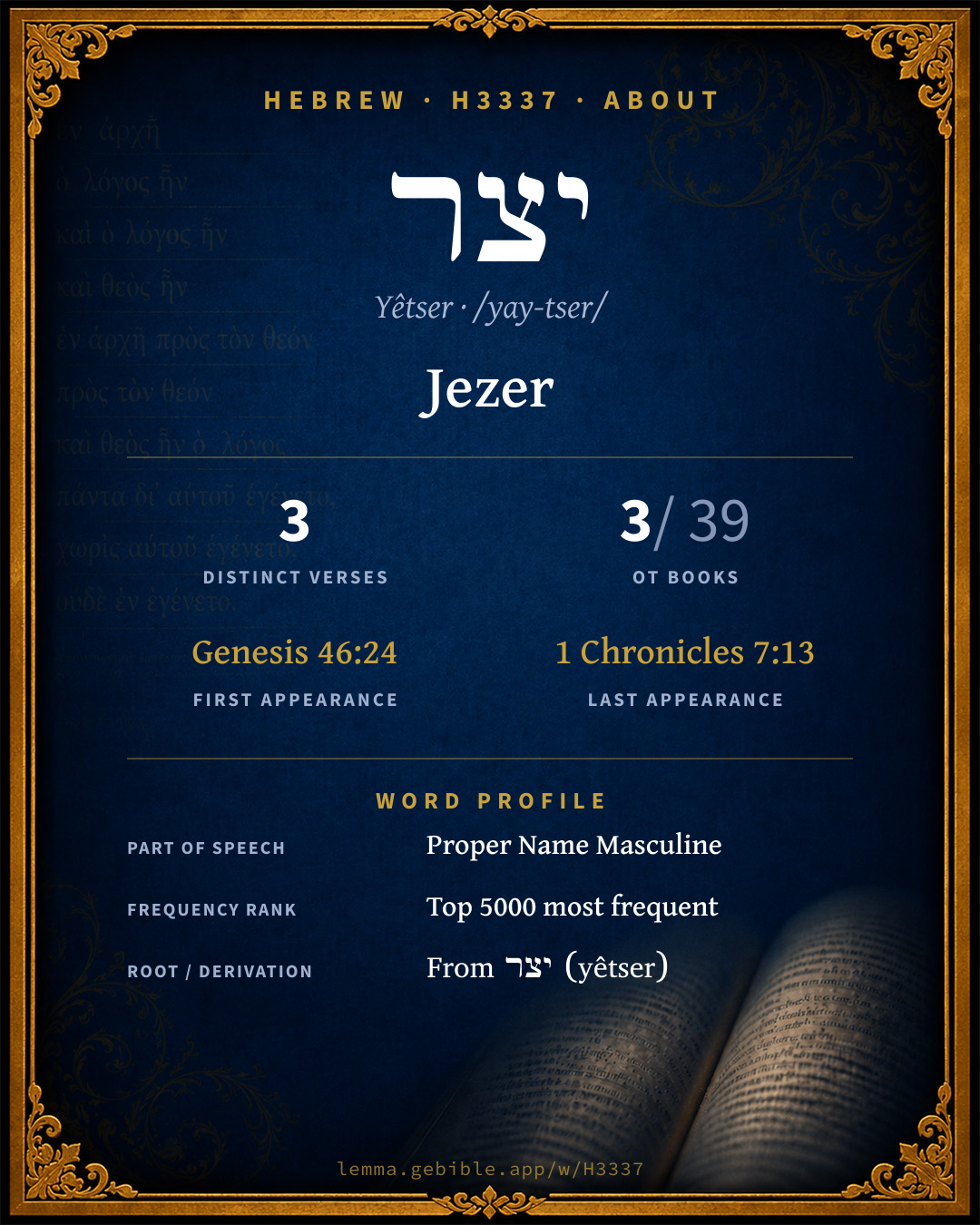
יֵ֫צֶר
Jezer
BDB lists 2 entries for ‘Jezer’ fuller range ↓
Full lexicon entry — Brown-Driver-Briggs (BDB)
From Brown-Driver-Briggs (BDB)
Where this word appears
Grammar key — what these labels mean
Noun type
- Proper
- A name of a specific person, place, or people (e.g. Abraham, Zion, Israel).
Every verse where H3337 appears in the Book of Genesis — 1 distinct verse. Click any verse to open its interlinear word-by-word view. Verse text shown in the World English Bible for context — . Each verse’s Hebrew form is shown with its reference; the English is not keyword-highlighted, since the data carries no word-level English alignment. Use “Compare translations” on any verse to read it across multiple English versions. This concordance covers the Hebrew Bible; Septuagint (Greek Old Testament) occurrences are not indexed here.
Genesis
About this entry
At a glance — auto-summarized from this page’s data, not written by a person. Every figure links to its source below. This summary describes the numbers; it doesn’t interpret them.
יצר — transliterated Yêtser — is a Hebrew name carrying the sense “Jezer.” The Hebrew Bible uses it only 3 verses. Its uses concentrate in Genesis (33% of all occurrences). Its earliest occurrence is Genesis 46:24. Each statement above links to its evidence; the full detail follows below.
Gloss history
Strong's 1890 vs modern scholarship
About this word
Strong's H3337 catalogs a Hebrew word from the Hebrew Old Testament.
These counts are not copied from any lexicon or concordance. They are computed here, from the morphology-tagged Hebrew Old Testament. What Lemma adds →
- 3
- distinct verses
- The word appears in 3 distinct verses.
- 3 / 39
- OT books
- The word appears in 3 of 39 Old Testament books.
- #4,179
- by frequency
- Top 5000 most frequent Hebrew words (rank 4,179 of 8,640 Hebrew words by occurrence).
View all 3 occurrences in the concordance →
Most concentrated in
- Genesis 1 verse 33%
- Numbers 1 verse 33%
- 1 Chronicles 1 verse 33%
By section of the Old Testament
By traditional corpus
Conventional, traditional groupings — biblical authorship is debated, so this is a traditional corpus grouping, not an authorship claim. Each share is this word’s portion of its verses in that division of the Hebrew canon. Each figure is a share of the word’s 3 distinct verses.
- Torah (Pentateuch) 2 verses · 67%
- Writings (Ketuvim) 1 verse · 33%
How translations render this word
Counts come from each version’s own published word-to-Strong’s tagging or interlinear alignment — an approximate guide to how each version renders this word, not a word-level alignment the data otherwise carries. Because each total is that version’s own tagged count, the per-version totals vary from one another and need not match the appearance or distinct-verse counts above. These counts may also differ from a printed concordance because Lemma counts each distinctly tagged rendering and does not collapse phrase taggings into a single head-word total. This is a fixed set of word-tagged versions (KJV, ASV, BSB, ULT) and does not change with the reading translation you choose elsewhere. Each version’s license is shown beside its name below (and on Sources).
BDB lists this Strong’s number as 2 distinct words (homographs). Each count above pools all of them and is not split by sense — see the Senses section below. A low-frequency rendering may belong to a different one of those words, not the primary meaning.
- King James Version†: Jezer 3×
- American Standard Version†: Jezer 3×
- Berean Standard Bible†: Jezer 3×
- unfoldingWord Literal Text†: Jezer 3×
King James Version Public Domain
Renders H3337 across 3† tagged occurrences — most commonly:
American Standard Version Public Domain
Renders H3337 across 3† tagged occurrences — most commonly:
Berean Standard Bible Public Domain
Renders H3337 across 3† tagged occurrences — most commonly:
unfoldingWord Literal Text CC BY-SA 4.0
Renders H3337 across 3† tagged occurrences — most commonly:
Senses in the full BDB
What do BDB’s symbols mean?
BDB uses these scholarly abbreviations:
| Symbol | Meaning |
|---|---|
| 𝔊 | the Septuagint (the ancient Greek translation, LXX) |
| 𝔙 | the Vulgate (the Latin translation) |
| 𝔖 | the Syriac version (the Peshitta) |
| 𝔗 | the Targum (the Aramaic translation) |
| ψ | the Psalms |
| √ | root (the underlying root or stem) |
| ‖ | parallel passage (a synonymous or contrasted parallel) |
| † | the dagger: every passage where the word occurs is cited |
The 4 senses and sub-senses the full Brown-Driver-Briggs lexicon distinguishes for this word, in lexicon order (not ranked by frequency), with BDB’s own verbatim wording and sub-sense lettering. Shown in Hebrew script with BDB’s own scholarly abbreviations. The condensed entry is in the Lexicon Entry tab. See also the Forms in the corpus table below.
יצר I
- 1. pottery, formed by the potter Is 29:16. e.g. Isaiah 29:16
- 2. form of a graven image Hb 2:18. e.g. Habakkuk 2:18
- 3. form of man as made of the dust ψ 103:14. e.g. Psalms 103:14
- 4. of what is framed in the mind (cf. יָצַר 1 c, 2 b), imagination, device, purpose: יצר מחשׁב(ו)ת לב(ב) Gn 6:5 (J), 1 Ch 29:18; י׳ מחשׁבות 28:9; י׳ לב Gn 8:21 (J); יֵצֶר alone Dt 31:21 (J); יֵצֶר סָמוּךְ Is 26:3 a stedfast purpose (or frame of mind). (In NH יֵצֶר is common in sense of impulse: יצר הטוב and יצר הרע of good and bad tendency in man.) e.g. Genesis 6:5
יצר II m. son of Naphtali Gn 46
Senses from the full Brown-Driver-Briggs lexicon (Brown, Driver, Briggs; Oxford 1906 — public domain), digitized via Sefaria, supplemented by the OpenScriptures HebrewLexicon (CC BY 4.0). Full attribution on Sources.
Word origin
I. n.m. Is 26:3 form, framing, purpose;—י׳ Gn 6:5 + 5 times; יִצְרוֹ Dt 31:21 Hb 2:18; יִצְרֵנוּ ψ 103:14;—
II. n.pr.m. son of Naphtali Gn 46:24 = 1 Ch 7:13, Nu 26:49 (P).
— Brown-Driver-Briggs (Oxford 1906, public domain), digitized via Sefaria, supplemented by the OpenScriptures HebrewLexicon (CC BY 4.0). See Sources.
Derived from יצר (yêtser) (H3336) — form.
Jastrow Dictionary
A second Hebrew/Aramaic lexicon for comparison, covering Aramaic and post-biblical (Talmudic, Targumic, Midrashic) usage that the biblical-Hebrew BDB does not. Matched by lemma rather than by Strong’s number, so a lemma may carry more than one Jastrow headword (shown separately below), and the entries cover usage well beyond the Bible.
יָצַר
- to turn, shape, form. Keth. 8ᵃ (marriage benediction) אשר י׳ את וכ׳ who hast formed man in thine image. Ber. 58ᵇ (prayer in a burial place) אשר י׳ אתכם וכ׳ who created you in justice &c.; a. fr.—Part. יוֹצֵר (as noun, v. יוֹצֵר). Ib. 11ᵇ (in the morning prayer) י׳ אור בורא וכ׳ who didst form light and create darkness.—יוֹצֵר אוֹר or יוֹצֵר name of one of the benedictions preceding the reading of the morning Sh’ma. Ib.; ib. 12ᵃ; a. fr.
- to be formed, created; to be fully developed. Gen. R. s. 9 קודם עד שלא נוֹצְרָה מחשבה וכ׳ ere yet a thought is formed in the heart of man &c. Ib. קודם … נ׳ יצור, v. יְצִיר. Ab. II, 8 לכך נוֹצָרְתָּ for that purpose (of studying) thou hast been created. Ib. IV, 22. Gen. R. s. 14, beg.; Y. Yeb. IV, 5ᵈ top נ׳ לשבעה if the embryo was fully developed at seven months, contrad. to נולד, v. יָלַד. Yoma 85ᵃ; Sot. 45ᵇ מהיכן הוולד נ׳ from where does the formation of the embryo start?; a. fr.—V. צוּר.
יְצַר
- Targ. Am. IV, 13 דִּיצַר (some ed. דְּצָר), v. צוּר
- to be created, formed. Yoma 85ᵃ; Sot. 45ᵇ ממציעתיה מִיתְּצַר the formation of the embryo starts from the central portion of the body.
יֵצֶר
- preced.) [shape, formation, whence] (v. Gen. VI, 5) = י׳ מחשבות the formation of thoughts, bent of mind, inclination, desire.—י׳ הטוב or י׳ טוב (abbr. יה"ט or י"ט) the good nature of man, the inclination to do good; (personified) the good genius; י׳ הרע (abbrev. יצה"ר), also only י׳ the evil inclination, worldly desires; (personified) the tempter. Ber. 61ᵃ מיִצְרִי, v. יוֹצֵר. Gen. R. s. 9; Koh. R. to III, 11 אילולי יצה"ר לא בנה וכ׳ but for the worldly desires of man, none would build a house &c. Ab. II, 11 עין הרע ויצה"ר וכ׳ greed, sensual passion and hatred &c. Snh. 103ᵃ; Yalk. Ps. 842 שלא ישלוט בך יצה"ר that temptation may have no power over thee. Succ. 52ᵃ … לעתיד מביאו ליצה"ר וכ׳ in the days to come the Lord shall bring the Tempter and slaughter him &c. Gen. R. s. 22 מפנק את יִצְרוֹ who indulges the senses. Ib. אם בא יִצְרְךָ להשחיקך when thy inclination (Tempter) comes to lead thee to amusement. Cant. R. to VII, 8 י׳ ע"ז the passion for idolatry, י׳ זנות the passion of lust. Ab. IV, 1 הכובש את יצרו who conquers his inclination; a. v. fr. [Yoma 69ᵇ כובש את יצרו, read with Ms. M. כעסו.]—Pl. יְצָרִים. Ber. 61ᵃ (ref. to וייצר, Gen. II, 7, v. יְצִירָה) שני י׳ וכ׳ two natures, the good and the evil. Cant. R. l. c. שני י׳ ברא וכ׳ two passions did God create in this world, v. supra. Snh. 105ᵃ יסרו יצריכם chasten your passions; Yalk. Is. 302.—[יְצָרִים moulds, v. יְצִירִין.] e.g. Genesis 6:5
יֵצֶר ²
- Targ. Gen. VI, 5. Targ. Ps. XIII, 5; a. fr.—Sabb. 156ᵇ אלמיה יִצְרֵיה, v. אֲלַם. Ḥag. 16ᵃ דמצי כייף ליה ליצריה when he can conquer his passion. Kidd. 81ᵇ; Keth. 51ᵇ יצר אלבשה, v. לְבַשׁ. Snh. 64ᵃ היינו י׳ דע"ז this (lion of fire) is the passion for (tempter to) idolatry. Ib. ניבעי רחמי אַיִּ׳ דעבירה let us pray against the sensual desire (the tempter to sexual indulgence); a. fr.
A Dictionary of the Targumim, the Talmud Babli and Yerushalmi, and the Midrashic Literature (Marcus Jastrow; London, Luzac, 1903) — Public Domain. Digitized via Sefaria. Digitized via Sefaria. Full attribution on Sources.
Forms in the corpus
The 2 distinct written forms H3337 takes in the Hebrew Bible, most frequent first — each parse links to that state’s occurrences in the concordance. Hebrew forms include their vowel points and cantillation, so a single lemma takes many written forms.
| Form | Parsing | Example | Uses |
|---|---|---|---|
| וְ/יֵ֥צֶר | Noun, Proper | Genesis 46:24 | 2 |
| לְ/יֵ֕צֶר | Noun, Proper | Numbers 26:49 | 1 |
Same root — word family
Other BDB entries built from the same root as H3337, grouped by Strong’s listed origin. These share a root / origin per the lexicon — not necessarily a shared meaning. Each links to that word’s own entry.
Derives from
Proper names from this root
People and places named from this root — a name, not an additional meaning of the word.
Compare all same-root words → 1 of the same-root words is a proper name (a person or place). They share a root, not necessarily a meaning.
Bible dictionary
Public-domain dictionary articles matched to this entry by name (Jezer). A biblical name can be shared by more than one person or place, so an article may treat several.
Smith's Bible Dictionary · William Smith, 1863
(power), the third son of Naphtali, (Genesis 46:24; Numbers 26:49; 1 Chronicles 7:13) and father of the family of Jezerites.
Hitchcock's Bible Names Dictionary · Roswell D. Hitchcock, 1869
island of help
Classic public-domain reference works; full attribution on Sources.
Septuagint verse parallels
This word appears in 3 verses that also exist in the Greek Old Testament (Septuagint), out of the 3 Hebrew verses it occurs in. You can read those verses in Greek by switching the Old Testament edition to the Septuagint.
Read these verses in the Septuagint
This is a verse-level parallel only — the same verses exist in both the Hebrew and Greek Old Testaments. No word-level Hebrew↔Greek correspondence is claimed: the data carries no such alignment, so no Greek word is shown as this Hebrew word’s translation. Coverage is not total — the Septuagint omits the deuterocanon and renumbers the Psalms, so some Hebrew verses have no direct Greek parallel.