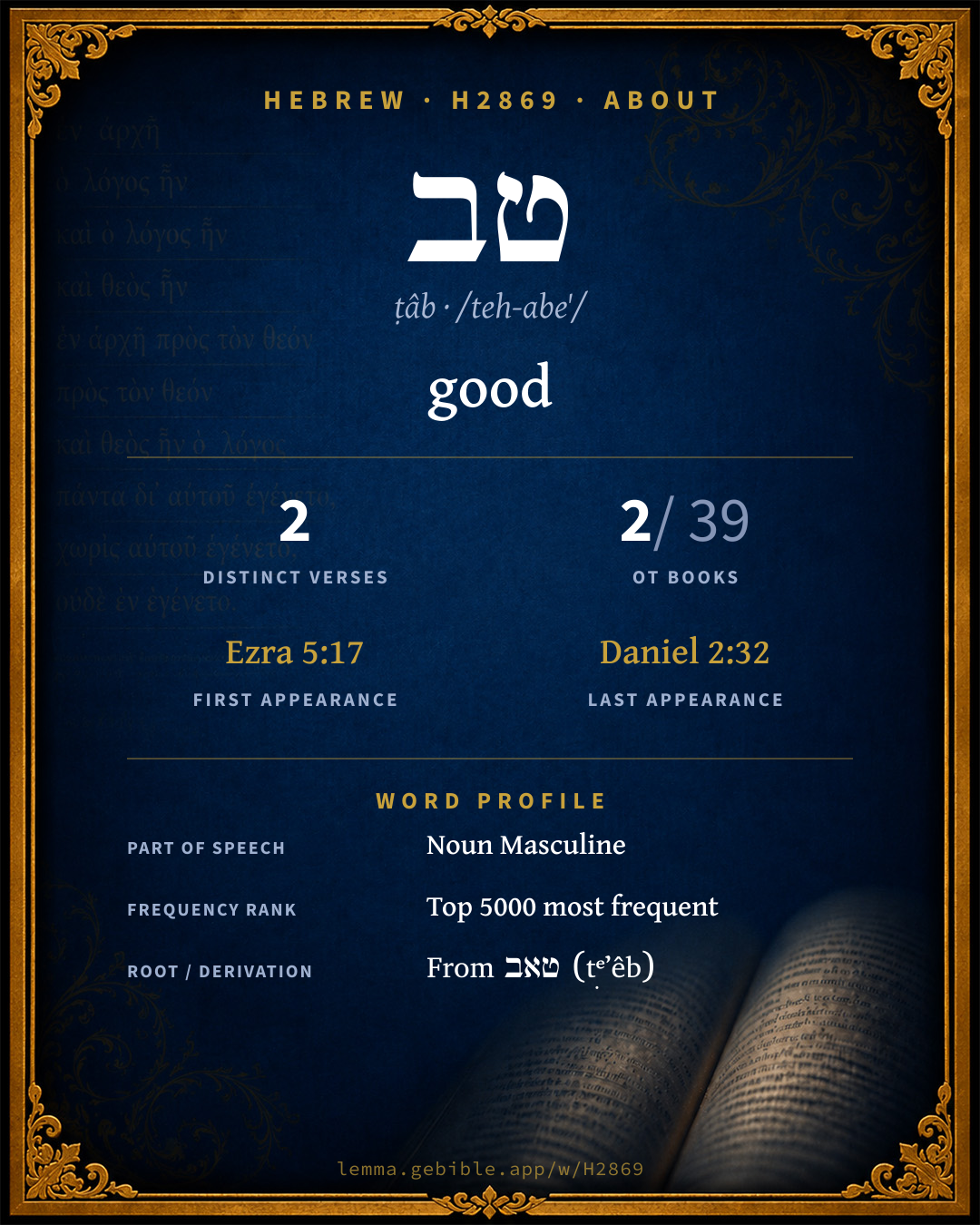
טָב
good
Full lexicon entry — Brown-Driver-Briggs (BDB)
From Brown-Driver-Briggs (BDB)
Where this word appears
Grammar key — what these labels mean
Part of speech
- Adjective
- A word that describes or qualifies a noun.
State
- Absolute
- The independent form of a noun, not bound to a following word.
Gender
- Masculine
- Grammatically masculine.
Number
- Singular
- One.
Every verse where H2869 appears in the Book of Daniel — 1 distinct verse. Click any verse to open its interlinear word-by-word view. Verse text shown in the World English Bible for context — . Each verse’s Hebrew form is shown with its reference; the English is not keyword-highlighted, since the data carries no word-level English alignment. Use “Compare translations” on any verse to read it across multiple English versions. This concordance covers the Hebrew Bible; Septuagint (Greek Old Testament) occurrences are not indexed here.
Daniel
About this entry
At a glance — auto-summarized from this page’s data, not written by a person. Every figure links to its source below. This summary describes the numbers; it doesn’t interpret them.
At its core, טב (ṭâb) means “good.” The Hebrew Bible uses it only 2 verses. The word gravitates to Ezra (50%), then Daniel. Scripture first uses it in Ezra 5:17. Each statement above links to its evidence; the full detail follows below.
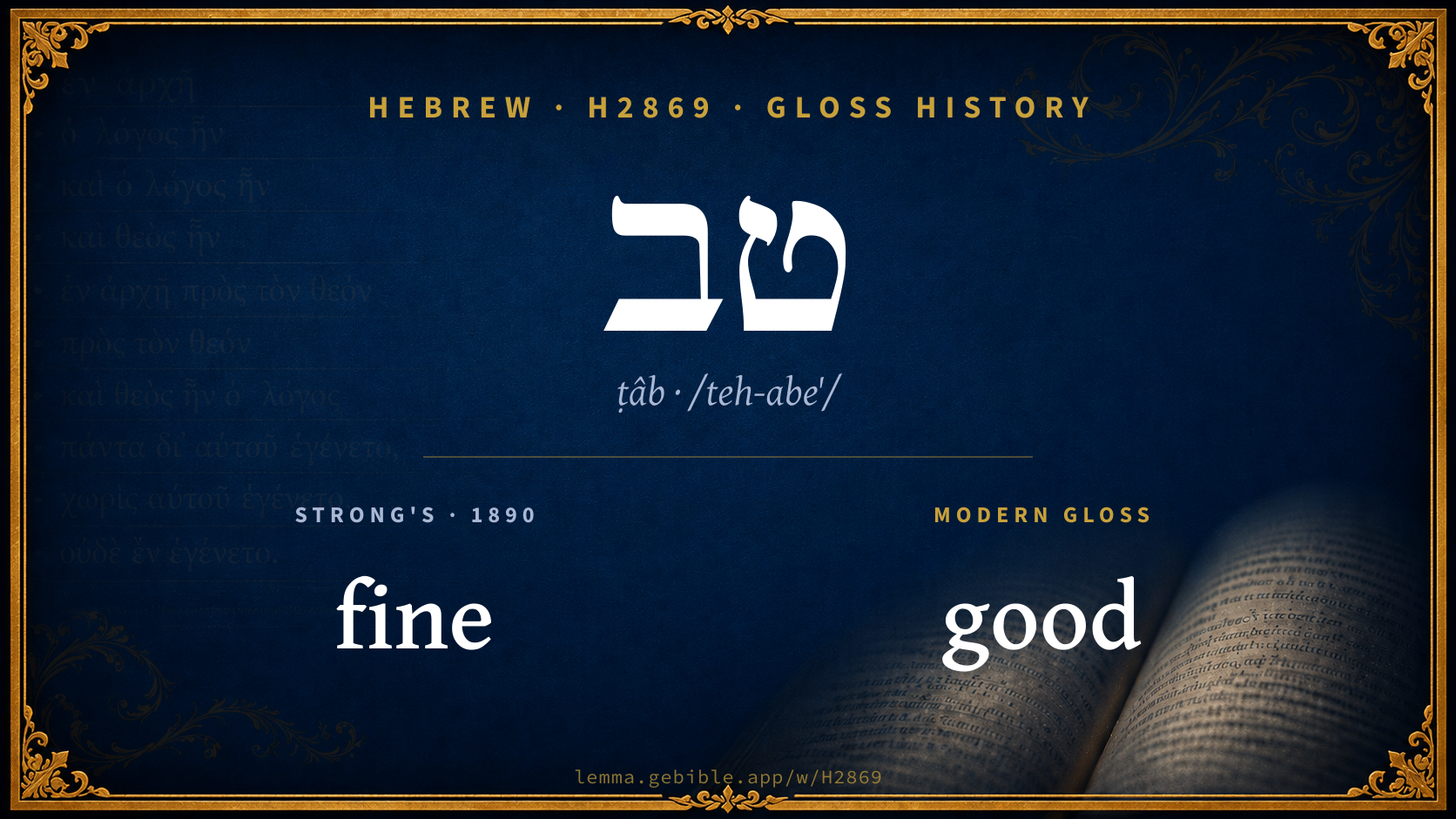
Gloss history
Strong's 1890 vs modern scholarship
About this word
Strong's H2869 catalogs a Hebrew word from the Hebrew Old Testament.
These counts are not copied from any lexicon or concordance. They are computed here, from the morphology-tagged Hebrew Old Testament. What Lemma adds →
- 2
- distinct verses
- The word appears in 2 distinct verses.
- 2 / 39
- OT books
- The word appears in 2 of 39 Old Testament books.
- #4,807
- by frequency
- Top 5000 most frequent Hebrew words (rank 4,807 of 8,640 Hebrew words by occurrence).
View all 2 occurrences in the concordance →
By traditional corpus
Conventional, traditional groupings — biblical authorship is debated, so this is a traditional corpus grouping, not an authorship claim. Each share is this word’s portion of its verses in that division of the Hebrew canon. Each figure is a share of the word’s 2 distinct verses.
- Writings (Ketuvim) 2 verses · 100%
How translations render this word
Counts come from each version’s own published word-to-Strong’s tagging or interlinear alignment — an approximate guide to how each version renders this word, not a word-level alignment the data otherwise carries. Because each total is that version’s own tagged count, the per-version totals vary from one another and need not match the appearance or distinct-verse counts above. These counts may also differ from a printed concordance because Lemma counts each distinctly tagged rendering and does not collapse phrase taggings into a single head-word total. This is a fixed set of word-tagged versions (KJV, ASV, BSB, ULT) and does not change with the reading translation you choose elsewhere. Each version’s license is shown beside its name below (and on Sources).
- King James Version: Seem good 1×, Was of fine 1×
- American Standard Version: Seem good 1×, Was of fine 1×
- Berean Standard Bible: Pleases 1×, Was pure 1×
- unfoldingWord Literal Text: Fine 1×, Is good 1×
King James Version Public Domain
Renders H2869 across 2 tagged occurrences — most commonly:
American Standard Version Public Domain
Renders H2869 across 2 tagged occurrences — most commonly:
Berean Standard Bible Public Domain
Renders H2869 across 2 tagged occurrences — most commonly:
unfoldingWord Literal Text CC BY-SA 4.0
Renders H2869 across 2 tagged occurrences — most commonly:
Senses in BDB
The 1 sense BDB distinguishes for this word, in lexicon order (not ranked by frequency or importance). The full entry — with sub-senses — is in the Lexicon Entry tab.
- good
Word origin
Derived from טאב (ṭᵉʼêb) (H2868) — to be glad.
Jastrow Dictionary
A second Hebrew/Aramaic lexicon for comparison, covering Aramaic and post-biblical (Talmudic, Targumic, Midrashic) usage that the biblical-Hebrew BDB does not. Matched by lemma rather than by Strong’s number, so a lemma may carry more than one Jastrow headword (shown separately below), and the entries cover usage well beyond the Bible.
טַב I
- (contr. of טאב) = h. טוֹב, to be good, well.—טב ל־ to feel well, be satisfied, fare well. Targ. Deut. XV, 16; a. e.
- to do good. Targ. Zech. XII, 4 לַאֲטָבָא (ed. Lag. לאיט׳). V. טוּב, a. יְטַב.
טַב II
- (preced.)
- 1. good, precious. Targ. Gen. II, 9.—Targ. II, Esth. I, 19 דטבא ed. Lag. (oth. ed. דטָבַת)—Targ. Jud. V, 26 (missing in ed. Lag.); a. v. fr.—Gen. R. s. 22; Lev. R. s. 22, v. בִּישׁ. Ber. 60ᵇ כל מאי דעביד … לטב (v. Rabb. D. S. a. l. note) whatever God does is for a good purpose. Tam. 32ᵃ דידי טבא וכ׳ my advice is better than yours.—Lev. R. s. 33, beg. מינה ט׳ וכ׳ from it (the tongue) comes what is good &c.; a. v. fr. e.g. Esther 1:19
- 2. worth, valued. Y. Keth. IV, end, 29ᵇ חד בית בטב וכ׳ (ed. Krot. בדב, read: חד ביתא טב) a house worth &c. Ib. מכיון דלית ביתא טב וכ׳ as the house is not worth more than &c.—Y. Peah I, 15ᵈ bot. מילא דט׳ דכוותה something of equal value; Gen. R. s. 35, end (corr. acc.); a. fr.
- 3. best man, elder, officer. Y. Taan. IV, 68ᵈ top טב קרתא an officer of the town.—Pl. טָבִין, טָבַיָּיא, טָבֵי; fem. טָבָתָא, טָבָאתָא, טָבָן. Targ. Mic. VII, 1. Targ. Ps. CXXV, 4; a. fr.—B. Mets. 44ᵇ שלים לה ט׳ וכ׳ pay her in good and full-weight coin. Y. Snh. X, 28ᵇ bot. כל טָבָן וכ׳, v. נֶחֶמְתָּא. Lam. R. to I, 1 רבתי (חד מאת׳ 1) טבאתא the good fruits; a. fr.
- 4. (adv.) much, more. Targ. Prov. XVII, 10.—Gitt. 14ᵇ טב טב רמו ליה Ar. (ed. only one טב) strike him more (or, it is right, v. Rashi a. l.)—Y. Shek. IV, 48ᵃ top, v. טָבָאוּת.
טַב III
- En Tab, a place where the New Moon was proclaimed in the days of Rabbi (v. Neub. Géogr. p. 272). R. Hash. 25ᵃ; Y. ib. II, 58ᵃ bot.; Y. Taan. II, 66ᵃ bot. עייני טב; Pesik. R. s. 41 עֵינְטַב.
A Dictionary of the Targumim, the Talmud Babli and Yerushalmi, and the Midrashic Literature (Marcus Jastrow; London, Luzac, 1903) — Public Domain. Digitized via Sefaria. Digitized via Sefaria. Full attribution on Sources.
Forms in the corpus
The 2 distinct written forms H2869 takes in the Hebrew Bible, most frequent first — each parse links to that state’s occurrences in the concordance. Hebrew forms include their vowel points and cantillation, so a single lemma takes many written forms.
| Form | Parsing | Example | Uses |
|---|---|---|---|
| טָ֔ב | Adjective, Adjective, Masculine, Singular, Absolute | Daniel 2:32 | 1 |
| טָ֗ב | Adjective, Adjective, Masculine, Singular, Absolute | Ezra 5:17 | 1 |
Septuagint verse parallels
This word appears in 2 verses that also exist in the Greek Old Testament (Septuagint), out of the 2 Hebrew verses it occurs in. You can read those verses in Greek by switching the Old Testament edition to the Septuagint.
Read these verses in the Septuagint
This is a verse-level parallel only — the same verses exist in both the Hebrew and Greek Old Testaments. No word-level Hebrew↔Greek correspondence is claimed: the data carries no such alignment, so no Greek word is shown as this Hebrew word’s translation. Coverage is not total — the Septuagint omits the deuterocanon and renumbers the Psalms, so some Hebrew verses have no direct Greek parallel.