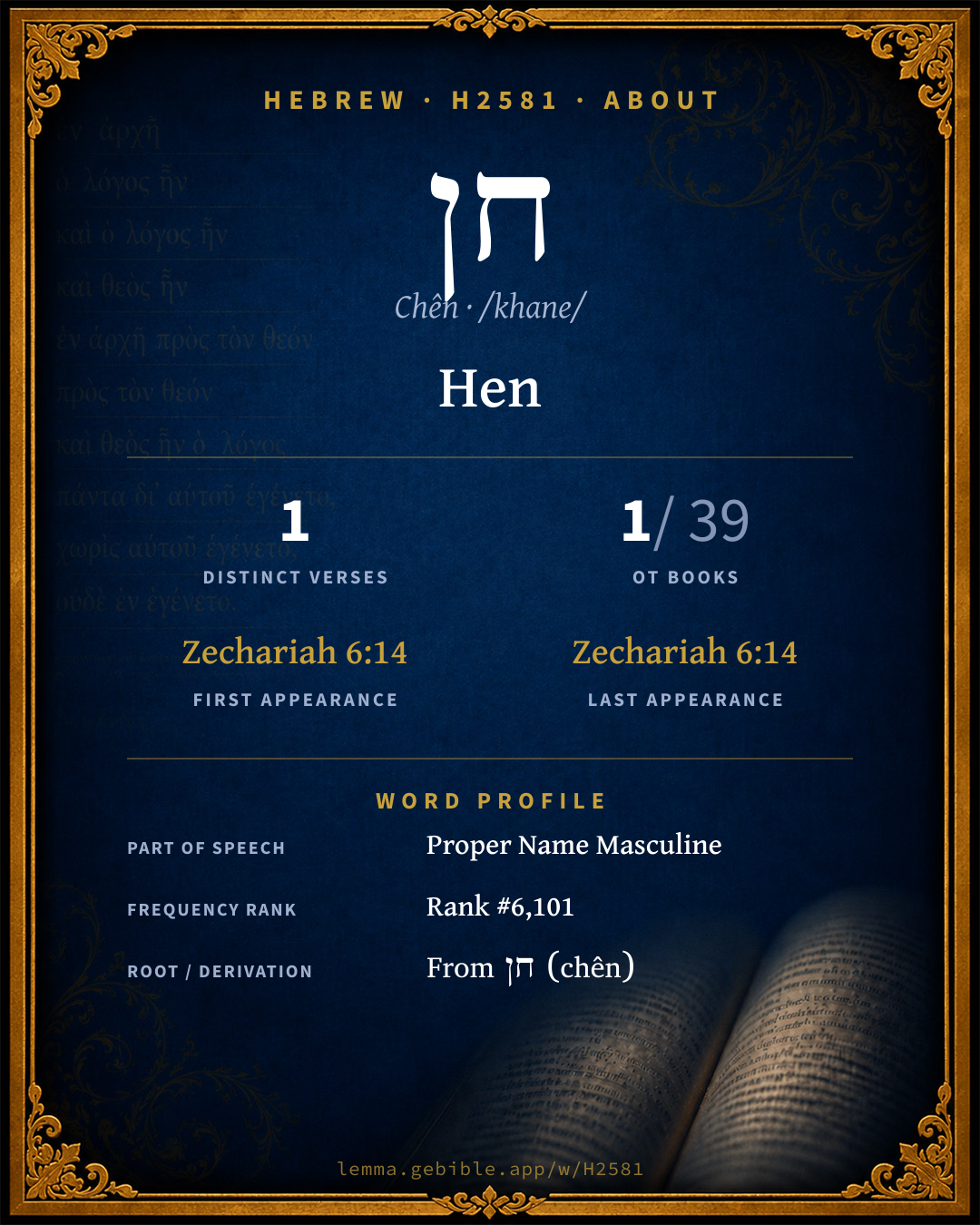
חֵן
Hen
BDB lists 2 entries for ‘Hen’ fuller range ↓
Full lexicon entry — Brown-Driver-Briggs (BDB)
From Brown-Driver-Briggs (BDB)
Where this word appears
Grammar key — what these labels mean
Noun type
- Proper
- A name of a specific person, place, or people (e.g. Abraham, Zion, Israel).
Every verse where H2581 appears — 1 distinct verse across 1 book. Click any verse to open its interlinear word-by-word view. Verse text shown in the World English Bible for context — . Each verse’s Hebrew form is shown with its reference; the English is not keyword-highlighted, since the data carries no word-level English alignment. Use “Compare translations” on any verse to read it across multiple English versions. This concordance covers the Hebrew Bible; Septuagint (Greek Old Testament) occurrences are not indexed here.
Zechariah 1 verse
About this entry
At a glance — auto-summarized from this page’s data, not written by a person. Every figure links to its source below. This summary describes the numbers; it doesn’t interpret them.
At its core, חן (Chên) means “Hen.” With only 1 verse it sits in the long tail of Hebrew Bible vocabulary. Its uses cluster heavily in Zechariah (100% of all occurrences). Its lone occurrence is Zechariah 6:14. Each statement above links to its evidence; the full detail follows below.
Gloss history
Strong's 1890 vs modern scholarship
About this word
Strong's H2581 catalogs a Hebrew word from the Hebrew Old Testament.
These counts are not copied from any lexicon or concordance. They are computed here, from the morphology-tagged Hebrew Old Testament. What Lemma adds →
- 1
- distinct verses
- The word appears in 1 distinct verse.
- 1 / 39
- OT books
- The word appears in 1 of 39 Old Testament books.
- #6,101
- by frequency
- Rank #6,101 (rank 6,101 of 8,640 Hebrew words by occurrence).
View all 1 occurrence in the concordance →
Most concentrated in
- Zechariah 1 verse 100%
By section of the Old Testament
By traditional corpus
Conventional, traditional groupings — biblical authorship is debated, so this is a traditional corpus grouping, not an authorship claim. Each share is this word’s portion of its verses in that division of the Hebrew canon. Each figure is a share of the word’s 1 distinct verse.
- Prophets (Nevi'im) 1 verse · 100%
How translations render this word
Counts come from each version’s own published word-to-Strong’s tagging or interlinear alignment — an approximate guide to how each version renders this word, not a word-level alignment the data otherwise carries. Because each total is that version’s own tagged count, the per-version totals vary from one another and need not match the appearance or distinct-verse counts above. These counts may also differ from a printed concordance because Lemma counts each distinctly tagged rendering and does not collapse phrase taggings into a single head-word total. This is a fixed set of word-tagged versions (KJV, ASV, BSB, ULT) and does not change with the reading translation you choose elsewhere. Each version’s license is shown beside its name below (and on Sources).
BDB lists this Strong’s number as 3 distinct words (homographs). Each count above pools all of them and is not split by sense — see the Senses section below. A low-frequency rendering may belong to a different one of those words, not the primary meaning.
- King James Version†: Hen 1×
- American Standard Version†: Hen 1×
- Berean Standard Bible†: Gracious 1×
- unfoldingWord Literal Text†: Hen 1×
King James Version Public Domain
Renders H2581 across 1† tagged occurrence — most commonly:
American Standard Version Public Domain
Renders H2581 across 1† tagged occurrence — most commonly:
Berean Standard Bible Public Domain
Renders H2581 across 1† tagged occurrence — most commonly:
unfoldingWord Literal Text CC BY-SA 4.0
Renders H2581 across 1† tagged occurrence — most commonly:
Senses in the full BDB
What do BDB’s symbols mean?
BDB uses these scholarly abbreviations:
| Symbol | Meaning |
|---|---|
| 𝔊 | the Septuagint (the ancient Greek translation, LXX) |
| 𝔙 | the Vulgate (the Latin translation) |
| 𝔖 | the Syriac version (the Peshitta) |
| 𝔗 | the Targum (the Aramaic translation) |
| ψ | the Psalms |
| √ | root (the underlying root or stem) |
| ‖ | parallel passage (a synonymous or contrasted parallel) |
| † | the dagger: every passage where the word occurs is cited |
The 6 senses and sub-senses the full Brown-Driver-Briggs lexicon distinguishes for this word, in lexicon order (not ranked by frequency), with BDB’s own verbatim wording and sub-sense lettering. Shown in Hebrew script with BDB’s own scholarly abbreviations. The condensed entry is in the Lexicon Entry tab.
חן I
- 1. favour, grace, elegance:
- a. of form and appearance, of a woman ‖ יֹ֑פִי Pr 31:30; אֵשֶׁת חֵן Pr 11:16; זונה טובת חן Na 3:4; of a doe Pr 5:19; precious stone אבן חן Pr 17:8; of ornaments Pr 1:9 = 4:9, 3:22. e.g. Proverbs 31:30
- b. of speech, lips ψ 45:3 Pr 22:11; words Ec 10:12. e.g. Psalms 45:3
- 2. favour, acceptance:
- a. with men Pr 13:15; 22:1; Ec 9:11. e.g. Proverbs 13:15
- b. with God Zc 4:7(×2); 12:10; chiefly in phrases: מצא חן בעיני find favour in the eyes of: (1) men Gn 30:27; 32:6; 33:8, 10, 15; 34:11; 39:4; 47:25, 29; 50:4 Nu 32:5 (all J); Dt 24:1; Ru 2:2, 10, 13; 1 S 1:18; 16:22; 20:3, 29; 25:8; 27:5; 2 S 14:22; 16:4; 1 K 11:19; Est 5:8; 7:3; (2) of God Gn 6:8; 18:3; 19:19; Ex 33:12, 13(×2), 16, 17; 34:9 Nu 11:11, 15 (all J); Ju 6:17; 2 S 15:25; Pr 3:4; abs. מצא חן (with man) Pr 28:23; (with God) Je 31:2; מצא חן לפניו Est 8:5 (i.e. of the king); נתן חן בעיני give favour in the eyes of (1) man Gn 39:21; Ex 3:21; 11:3; 12:36 (J); abs. נתן חן of man ψ 84:12; (2) of God Pr 3:34; נשׂא חֵן בְּעֵינֵי obtain favour in the eyes of Est 2:15; of the king 5:2; so וַתִּשָּׂא־חֵן וָחֶסֶד לְפָנָיו Est 2:17. e.g. Zechariah 4:7
חן II m. (favour)
Senses from the full Brown-Driver-Briggs lexicon (Brown, Driver, Briggs; Oxford 1906 — public domain), digitized via Sefaria, supplemented by the OpenScriptures HebrewLexicon (CC BY 4.0). Full attribution on Sources.
Word origin
II. n.m. ψ 45:3 favour, grace;—ח׳ Gn 6:8 + 67 times; sf. חִנּוֹ Gn 39:21;—
III. n.pr.m. (favour)—contemp. of Zerubbabel Zc 6:14, so RV SS We, but RVm Ew Hi Ke Or grace, favour, kindness.
— Brown-Driver-Briggs (Oxford 1906, public domain), digitized via Sefaria, supplemented by the OpenScriptures HebrewLexicon (CC BY 4.0). See Sources.
Derived from חן (chên) (H2580) — grace.
Jastrow Dictionary
A second Hebrew/Aramaic lexicon for comparison, covering Aramaic and post-biblical (Talmudic, Targumic, Midrashic) usage that the biblical-Hebrew BDB does not. Matched by lemma rather than by Strong’s number, so a lemma may carry more than one Jastrow headword (shown separately below), and the entries cover usage well beyond the Bible.
חָן
- , v. חָנָה a. חָנַן.
חַן
- , v. חֲנַן
חֵן
- grace, favor; loveliness. Ab. Zar. 20ᵃ (ref. to תחנם, Deut. VII, 2) לא תתן להם חן ascribe no gracefulness to them (pay no attention to their beauty). Yeb. 63ᵇ (quot. fr. Ben. Sira) אשת חן coquette. Keth. 17ᵃ; Snh. 14ᵃ, v. יַעֲלָה. Succ. 49ᵇ אדם שיש עליו חן (Ms. M. לו; Var. חסד) a person that makes a favorable impression on men. Ber. 60ᵇ ותנני … לחן וכ׳ and let me find grace and favor &c. Keth. 77ᵇ אם חן מעלה וכ׳ if the Law makes pleasing those who study it, will it not also protect them?—Y. Gitt. V, 46ᵈ top מפני חִינָּהּ וכ׳ for the sake of her grace (to raise her estimation in the eyes of men), that people may be anxious to marry her; v. next w.—Gen. R. s. 34, end שנתן חן וכ׳ who made every place attractive to its inhabitants; a. fr.—Pl. חִינּוֹת, חִינִּין. Sot. 47ᵃ ג׳ ח׳ הן וכ׳ there are three remarkable favors, the favor in which the inhabitants hold their place &c.; Y. Yoma IV, beg. 41ᵇ e.g. Deuteronomy 7:2
A Dictionary of the Targumim, the Talmud Babli and Yerushalmi, and the Midrashic Literature (Marcus Jastrow; London, Luzac, 1903) — Public Domain. Digitized via Sefaria. Digitized via Sefaria. Full attribution on Sources.
Same root — word family
Other BDB entries built from the same root as H2581, grouped by Strong’s listed origin. These share a root / origin per the lexicon — not necessarily a shared meaning. Each links to that word’s own entry.
Derives from
Shares the same root
Compare all same-root words → They share a root, not necessarily a meaning.
Bible dictionary
Public-domain dictionary articles matched to this entry by name (Hen). A biblical name can be shared by more than one person or place, so an article may treat several.
Easton's Bible Dictionary · M. G. Easton, 1897
Common in later times among the Jews in Palestine (Matt. 23:37; Luke 13:34). It is noticeable that this familiar bird is only mentioned in these passages in connection with our Lord's lamentation over the impenitence of Jerusalem.
Smith's Bible Dictionary · William Smith, 1863
The hen is nowhere noticed in the Bible except in (Matthew 23:37; Luke 13:34) That a bird so common in Palestine should receive such slight notice is certainly peculiar.
(rest), probably a son of Zephaniah, and apparently the same who is called Josiah in (Zechariah 6:10)
Hitchcock's Bible Names Dictionary · Roswell D. Hitchcock, 1869
grace; quiet; rest
Classic public-domain reference works; full attribution on Sources.
Septuagint verse parallels
This word appears in 1 verse that also exists in the Greek Old Testament (Septuagint), out of the 1 Hebrew verse it occurs in. You can read those verses in Greek by switching the Old Testament edition to the Septuagint.
Read these verses in the Septuagint
This is a verse-level parallel only — the same verses exist in both the Hebrew and Greek Old Testaments. No word-level Hebrew↔Greek correspondence is claimed: the data carries no such alignment, so no Greek word is shown as this Hebrew word’s translation. Coverage is not total — the Septuagint omits the deuterocanon and renumbers the Psalms, so some Hebrew verses have no direct Greek parallel.