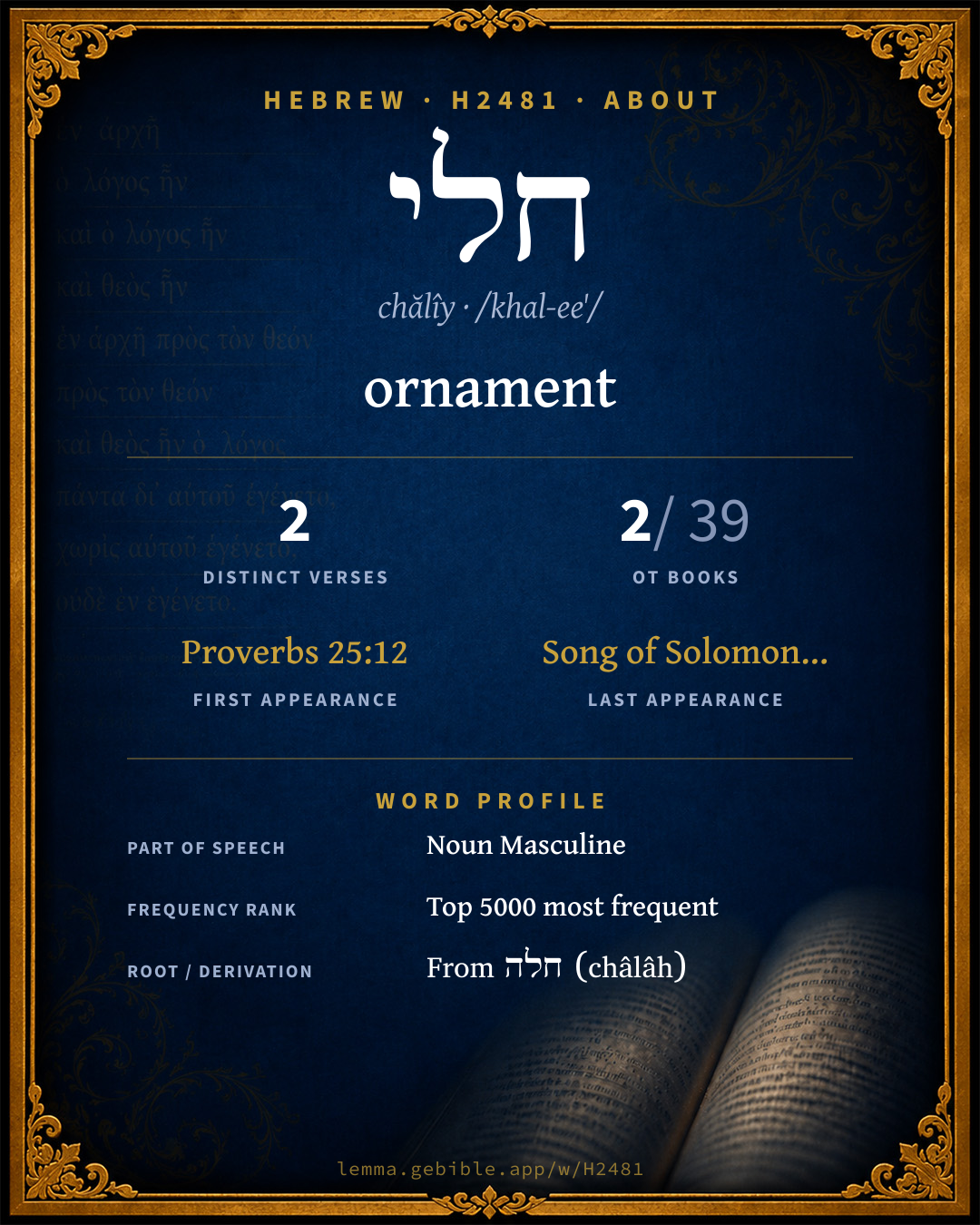
חֲלִי
ornament
Full lexicon entry — Brown-Driver-Briggs (BDB)
From Brown-Driver-Briggs (BDB)
Where this word appears
Grammar key — what these labels mean
Part of speech
- Noun
- A naming word — a person, place, thing, or idea.
Noun type
- Common
- A common noun — a general class of person, place, or thing (“king,” “city,” “water”), not a specific name.
State
- Construct
- A noun bound to a following noun in a possessive / “of” relationship (the construct chain).
- Absolute
- The independent form of a noun, not bound to a following word.
Gender
- Masculine
- Grammatically masculine.
Number
- Singular
- One.
- Plural
- More than one (in Hebrew, generally three or more).
Every verse where H2481 appears in the Book of Song of Solomon — 1 distinct verse. Click any verse to open its interlinear word-by-word view. Verse text shown in the World English Bible for context — . Each verse’s Hebrew form is shown with its reference; the English is not keyword-highlighted, since the data carries no word-level English alignment. Use “Compare translations” on any verse to read it across multiple English versions. This concordance covers the Hebrew Bible; Septuagint (Greek Old Testament) occurrences are not indexed here.
Song of Solomon
About this entry
At a glance — auto-summarized from this page’s data, not written by a person. Every figure links to its source below. This summary describes the numbers; it doesn’t interpret them.
חלי (chălîy) is a Hebrew noun most often rendered “ornament.” It occurs a mere 2 verses across Scripture. Proverbs dominates its distribution — 1 of 2 verses. It first appears in Proverbs 25:12. Related forms include חלה, חלא and חלי. For the data behind this summary, explore the sense tree and the renderings breakdown below.
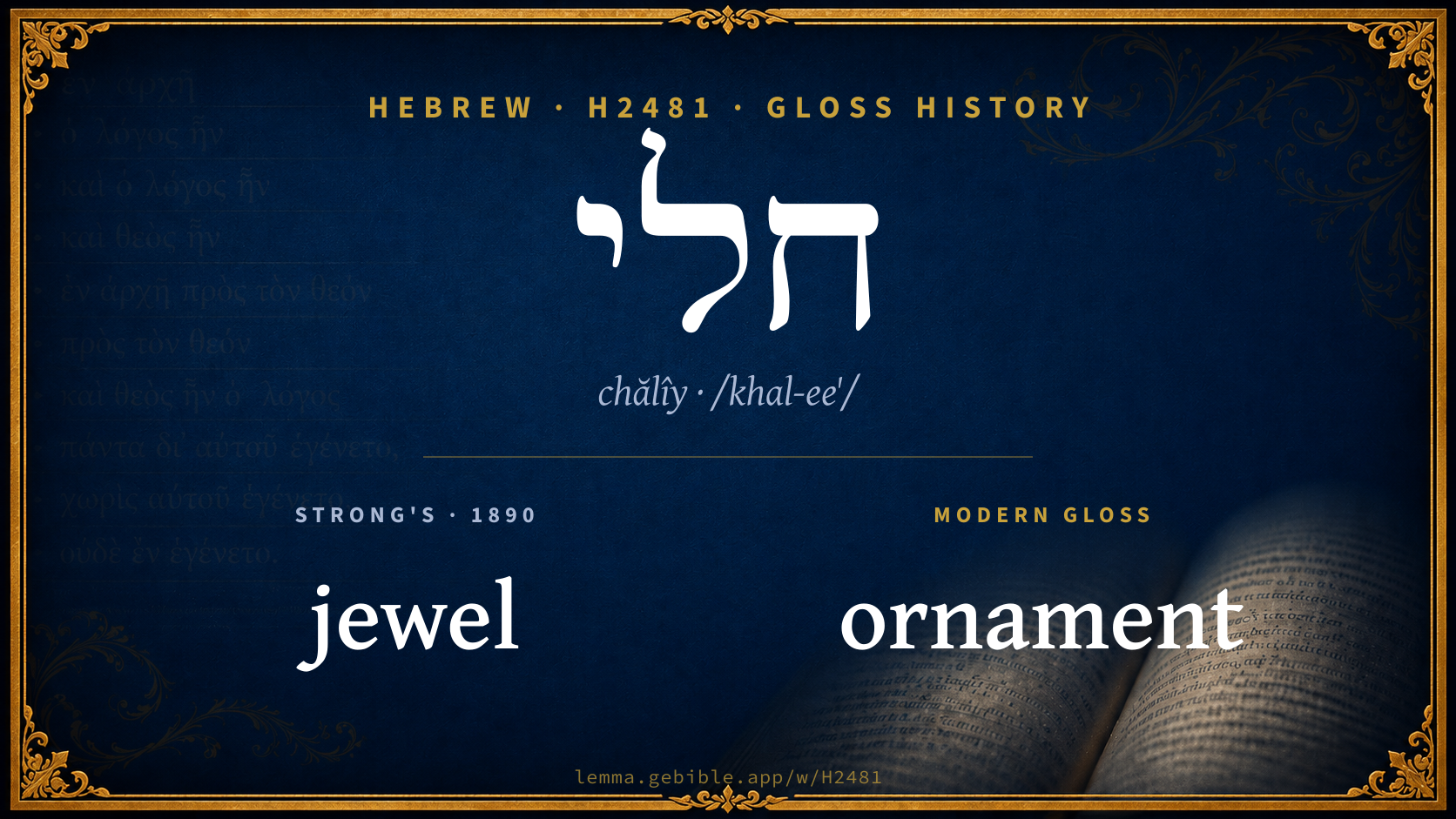
Gloss history
Strong's 1890 vs modern scholarship
About this word
Strong's H2481 catalogs a Hebrew word from the Hebrew Old Testament.
These counts are not copied from any lexicon or concordance. They are computed here, from the morphology-tagged Hebrew Old Testament. What Lemma adds →
- 2
- distinct verses
- The word appears in 2 distinct verses.
- 2 / 39
- OT books
- The word appears in 2 of 39 Old Testament books.
- #4,807
- by frequency
- Top 5000 most frequent Hebrew words (rank 4,807 of 8,640 Hebrew words by occurrence).
View all 2 occurrences in the concordance →
Most concentrated in
- Proverbs 1 verse 50%
- Song of Solomon 1 verse 50%
By section of the Old Testament
By traditional corpus
Conventional, traditional groupings — biblical authorship is debated, so this is a traditional corpus grouping, not an authorship claim. Each share is this word’s portion of its verses in that division of the Hebrew canon. Each figure is a share of the word’s 2 distinct verses.
- Writings (Ketuvim) 2 verses · 100%
How translations render this word
Counts come from each version’s own published word-to-Strong’s tagging or interlinear alignment — an approximate guide to how each version renders this word, not a word-level alignment the data otherwise carries. Because each total is that version’s own tagged count, the per-version totals vary from one another and need not match the appearance or distinct-verse counts above. These counts may also differ from a printed concordance because Lemma counts each distinctly tagged rendering and does not collapse phrase taggings into a single head-word total. This is a fixed set of word-tagged versions (KJV, ASV, BSB, ULT) and does not change with the reading translation you choose elsewhere. Each version’s license is shown beside its name below (and on Sources).
- King James Version: Are like jewels 1×, Ornament 1×
- American Standard Version: Are like jewels 1×, Ornament 1×
- Berean Standard Bible: Jewels 1×, Or an ornament 1×
- unfoldingWord Literal Text: Jewelry of 1×, Ornaments 1×
King James Version Public Domain
Renders H2481 across 2 tagged occurrences — most commonly:
American Standard Version Public Domain
Renders H2481 across 2 tagged occurrences — most commonly:
Berean Standard Bible Public Domain
Renders H2481 across 2 tagged occurrences — most commonly:
unfoldingWord Literal Text CC BY-SA 4.0
Renders H2481 across 2 tagged occurrences — most commonly:
Senses in BDB
The 1 sense BDB distinguishes for this word, in lexicon order (not ranked by frequency or importance). The full entry — with sub-senses — is in the Lexicon Entry tab.
- jewellery, ornament
Word origin
n.m. ornament, נֶזֶם זָהָב וַחֲלִי־כָּ֑תֶם Pr 25:12 a (nose- or ear-) ring of gold and (neck- or breast-) ornament of fine gold; pl. חֲלָאִים Ct 7:2, in sim. of grace and beauty.
— Brown-Driver-Briggs (Oxford 1906, public domain), digitized via Sefaria, supplemented by the OpenScriptures HebrewLexicon (CC BY 4.0). See Sources.
Derived from חלה (châlâh) (H2470) — to be sick.
Jastrow Dictionary
A second Hebrew/Aramaic lexicon for comparison, covering Aramaic and post-biblical (Talmudic, Targumic, Midrashic) usage that the biblical-Hebrew BDB does not. Matched by lemma rather than by Strong’s number, so a lemma may carry more than one Jastrow headword (shown separately below), and the entries cover usage well beyond the Bible.
חַלָּא
- (חלל, cmp. גלל) a globular concretion.—Pl. חַלֵּי. Bekh. 7ᵇ ח׳ דיחמורתא ball-like concretions found in the yaḥmur (fallow-deer), v. יַחְמוּרָא.
חלי
- 1. to be lax, to be sick, faint away, grieve. Ex. R. s. 43 (expl. ויחל, Ex. XXXII, 11 ח׳ משה Moses was sick (grieved). Kidd. 71ᵇ, a. e. מדי חוֹלָה Media is sick, v. גּוֹסֵס.—Ber. 28ᵇ כשח׳ וכ׳ when R. … fell sick; a. fr.—V. חוֹלֶה. e.g. Exodus 32:11
- 2. to be smooth (to the taste), sweet.
- 1. to soften, sweeten; to soothe, assuage (by prayer, gifts &c.). Ex. R. l. c. מהו וַיְחַל שהכניס וכ׳ what does vayḥal (Ex. l. c.) mean? He offered &c. (ref. to Ps. XLV, 13). Ib. מהו ויחל עשה את המר וכ׳ he made sweet what was bitter. Ib. חַלֵּי מרירתן וכ׳ sweeten thou the bitterness (sin) of Israel &c.—Ib. מי שיְחַלֶּה וכ׳ one to sweeten the bitterness &c. (by prayer). Yalk. Ex. 392 אביי אמר עד שחִילֵּהוּ להקב"ה בתפילתו (v. infra) Ab. explained vayḥal, until he assuaged (the anger of) the Lord &c. Deut. R. s. 3 הרי בניך מרים חַלֵּה אותן thy children are bitter, sweeten them. Ib. היאך יהא א"ל הוי חל אתה רחמים, read: היאך אהא אומר א"ל הוי אומר חַלֵּה את המרים what shall I say? Said He, Say, sweeten &c.; Yalk. Ex. 392. Lam. R. to I, 2 לא חִלִּינוּ פניך we did not assuage thee by repentance; Ex. R. s. 45 חלִּינוּ מלפני הקב"ה we prayed &c.; a. fr. e.g. Psalms 45:13
- 1. to assuage, soften. Ber. 32ᵃ אביי אמר עד שהֶחֱלֵהוּ להקב"ה בתפלה Ms. M. (v. D. S. a. l.) until he assuaged &c., v. supra. [Ib. שה׳ עליהם וכ׳, read: שהֵחֵל, v. חָלַל.]
- 2. to make sick, wear out. Ib. עמד משה … עד שהחלהו (Ms. M. עד שחלה) Moses stood in prayer … until He wore Him out (by his persistency, v. Rashi a. l. a. Rabb. D. S. a. l. note 3).—3) (v. חָלַל a. חִלְחֵל) to permeate, affect. B. Mets. 107ᵇ bile is called maḥlah (v. מַחְלָה) שהיא מַחְלָה וכ׳ (Ms. F. שמְחַלֶּלֶת) for it goes through the entire body [perh. מְחַלָּה, fr. חָלַל].
- to be made sick. Ber. l. c. עמד … עד שה׳ ed. Sonc. a. oth. (v. supra) until He was worn out.
חֲלִי
- 1. to be soft, sweet. Targ. Prov. XXVII, 7. Targ. Y. II, Lev. II, 11 (h. text דבש); a. e.—
- 2. to be sick, grieve. Yoma 22ᵇ; B. Kam. 20ᵇ כמה לא ח׳ וכ׳ how little does he whom the Lord supports need to grieve or trouble himself!
- 3. to remit. Keth. 86ᵃ top ותִיחֲלָה, v. חוּל II ch.
- 1. to sweeten.—Part. pass. f. מְחַלְיָא. Cant. R. to III, 4 בשעת מְחַלְיַית שינתא during the sweetest sleep. Ab. Zar. 39ᵃ מח׳ שמנוניתא Ms. M. the fatty substance (absorbed in the knife) becomes sweet again (loses its bad taste); ed. מְחַלְּיָּא ליה ש׳ (read: לש׳) it (the strong taste of assa foetida) sweetens &c. [Ber. 6ᵇ קא מחליין ed., Ms. מחללי, v. חֲלַל I.]
- to become sweet. Targ. Y. II, Ex. XV, 25.
חָלֵי
- (preced.) sweet. Targ. Y. II, Gen. XLIX, 21. Targ. Y. II, Deut. XXIX, 17 (ed. Amst. חֲלֵי; Y. I חוֹלֵי, חוּלֵי).—Arakh. 10ᵇ (play on חָלִיל) דח׳ קליה because its sound is sweet.—Fem. חַלְיָא, חֲלִיאֲתָא, חֲלִיתָא. Targ. Prov. XXIV, 13 דחליא ed. Lag. (ed. Wil. דחֵילָא, corr. acc.).—Targ. Ps. XIX, 11 (Ms. חֲלָיָיאתָא, pl.)—Sabb. 109ᵇ אתרוגא חליתא a sweet orange.—Pl. חַלְיָן, (חוּלְיֵי) חַלְיָין. Targ. Ps. CXIX, 103. Targ. Prov. IX, 17 (some ed. חלים, corr. acc.) Ib. II, 16.—Ab. Zar. 38ᵇ חוּלְיֵי as to sweet ones, v. אֲהִינָא.
חֳלִי
- 1. disease. Snh. 64ᵃ אם תעמוד … מחָלְיָהּ if this woman (I) shall rise from her sickness. Ib. מוטב שתחזור … לחוֹלְיָהּ I would rather relapse into my disease; a. fr.—B. Mets. 87ᵃ דחָלָה ח׳ אחריתי (missing in Mss., v. Rabb. D. S. a. l. note) that he had been sick once before.—Pl. חֳלָאִים, חֳלָאִין, חֳלָיִם, חֳלָיִים. Sot. 47ᵃ. Gen. R. s. 56; a. fr.
- 2. (sub. בעל) patient, sufferer. Ḥull. 110ᵃ; a. fr.
A Dictionary of the Targumim, the Talmud Babli and Yerushalmi, and the Midrashic Literature (Marcus Jastrow; London, Luzac, 1903) — Public Domain. Digitized via Sefaria. Digitized via Sefaria. Full attribution on Sources.
Forms in the corpus
The 2 distinct written forms H2481 takes in the Hebrew Bible, most frequent first — each parse links to that state’s occurrences in the concordance. Hebrew forms include their vowel points and cantillation, so a single lemma takes many written forms.
| Form | Parsing | Example | Uses |
|---|---|---|---|
| וַ/חֲלִי | Noun, Common, Masculine, Singular, Construct | Proverbs 25:12 | 1 |
| חֲלָאִ֔ים | Noun, Common, Masculine, Plural, Absolute | Song of Solomon 7:1 | 1 |
Same root — word family
Other BDB entries built from the same root as H2481, grouped by Strong’s listed origin. These share a root / origin per the lexicon — not necessarily a shared meaning. Each links to that word’s own entry.
Derives from
Shares the same root
- חלא châlâʼ H2456 to be sick
- חלי chŏlîy H2483 sickness
- חלל châlal H2490 to profane
- מחלה machăleh H4245 disease
- מחלי machluy H4251 sickness
Derived from this word
Proper names from this root
People and places named from this root — a name, not an additional meaning of the word.
- מחלה Machlâh H4244 Mahlah
- מחלון Machlôwn H4248 Mahlon
- מחלי Machlîy H4249 Mahli
- מחלת machălath H4257 Mahalath
- חלי Chălîy H2482 Hali
Compare all same-root words → Showing 4 of 13 — not the complete family. 5 of the same-root words are proper names (people or places). They share a root, not necessarily a meaning.
Septuagint verse parallels
This word appears in 2 verses that also exist in the Greek Old Testament (Septuagint), out of the 2 Hebrew verses it occurs in. You can read those verses in Greek by switching the Old Testament edition to the Septuagint.
Read these verses in the Septuagint
This is a verse-level parallel only — the same verses exist in both the Hebrew and Greek Old Testaments. No word-level Hebrew↔Greek correspondence is claimed: the data carries no such alignment, so no Greek word is shown as this Hebrew word’s translation. Coverage is not total — the Septuagint omits the deuterocanon and renumbers the Psalms, so some Hebrew verses have no direct Greek parallel.