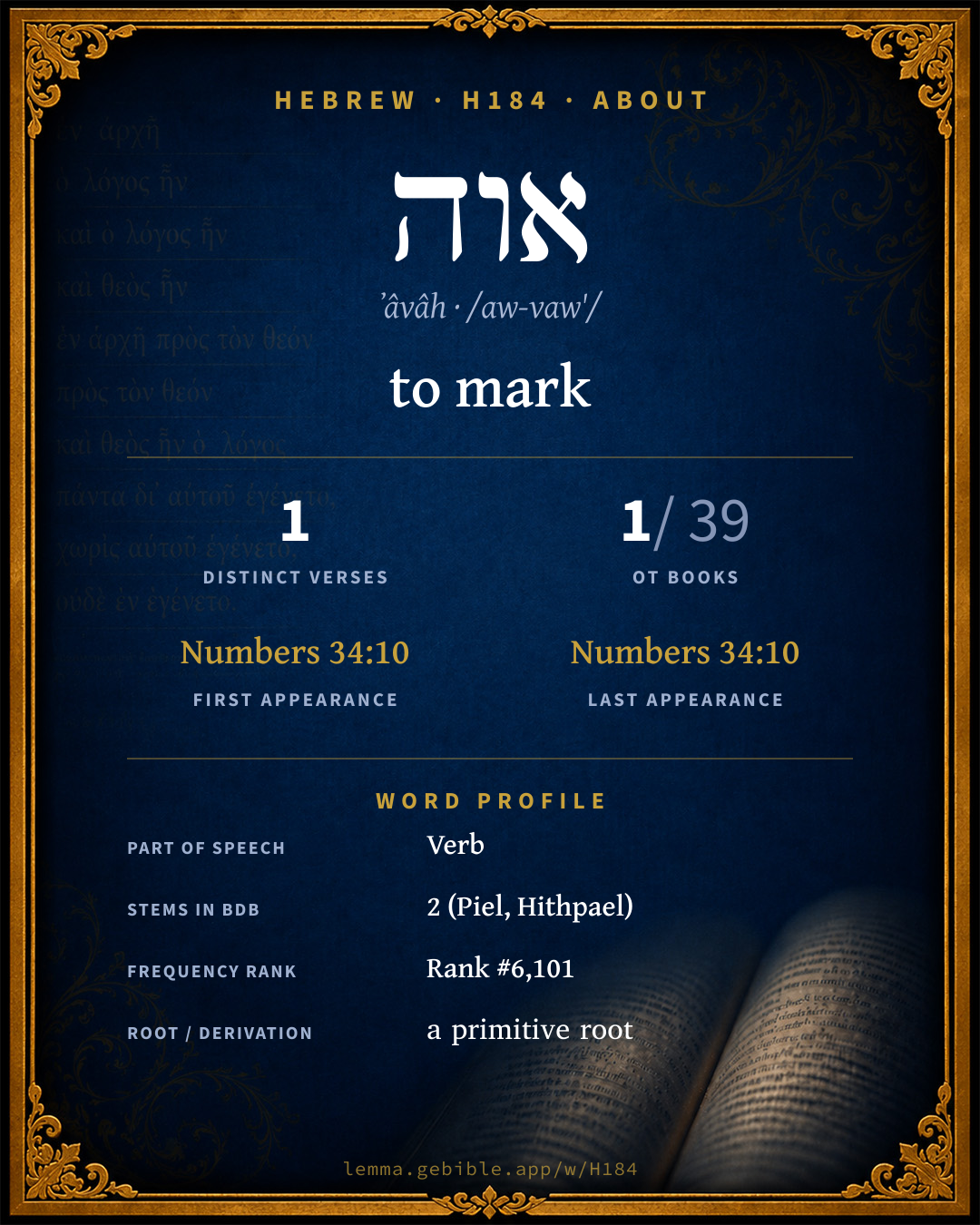
אָוָה
to mark
‘to mark’ is one of 2 main senses fuller range ↓
Full lexicon entry — Brown-Driver-Briggs (BDB)
From Brown-Driver-Briggs (BDB)
Where this word appears
Grammar key — what these labels mean
Stem
- Hithpael
- The reflexive or reciprocal stem (the subject acts on itself).
Form
- Sequential Perfect
- A perfect with prefixed waw continuing a preceding imperfect or command (waw-consecutive perfect).
Person
- 2nd Person
- The one addressed (“you”).
Gender
- Masculine
- Grammatically masculine.
Number
- Plural
- More than one (in Hebrew, generally three or more).
Every verse where H184 appears — 1 distinct verse across 1 book. Click any verse to open its interlinear word-by-word view. Verse text shown in the World English Bible for context — . Each verse’s Hebrew form is shown with its reference; the English is not keyword-highlighted, since the data carries no word-level English alignment. Use “Compare translations” on any verse to read it across multiple English versions. This concordance covers the Hebrew Bible; Septuagint (Greek Old Testament) occurrences are not indexed here.
Numbers 1 verse
About this entry
At a glance — auto-summarized from this page’s data, not written by a person. Every figure links to its source below. This summary describes the numbers; it doesn’t interpret them.
The Hebrew verb אוה centers on the idea of “to mark.” A scarce word — 1 verse in all of the Hebrew Bible. The word gravitates to Numbers (100%). Scripture uses it exactly once, at Numbers 34:10. The verb spans 2 stems, from Piel to Hithpael. Dig into 1-verse concordance and the renderings breakdown below.
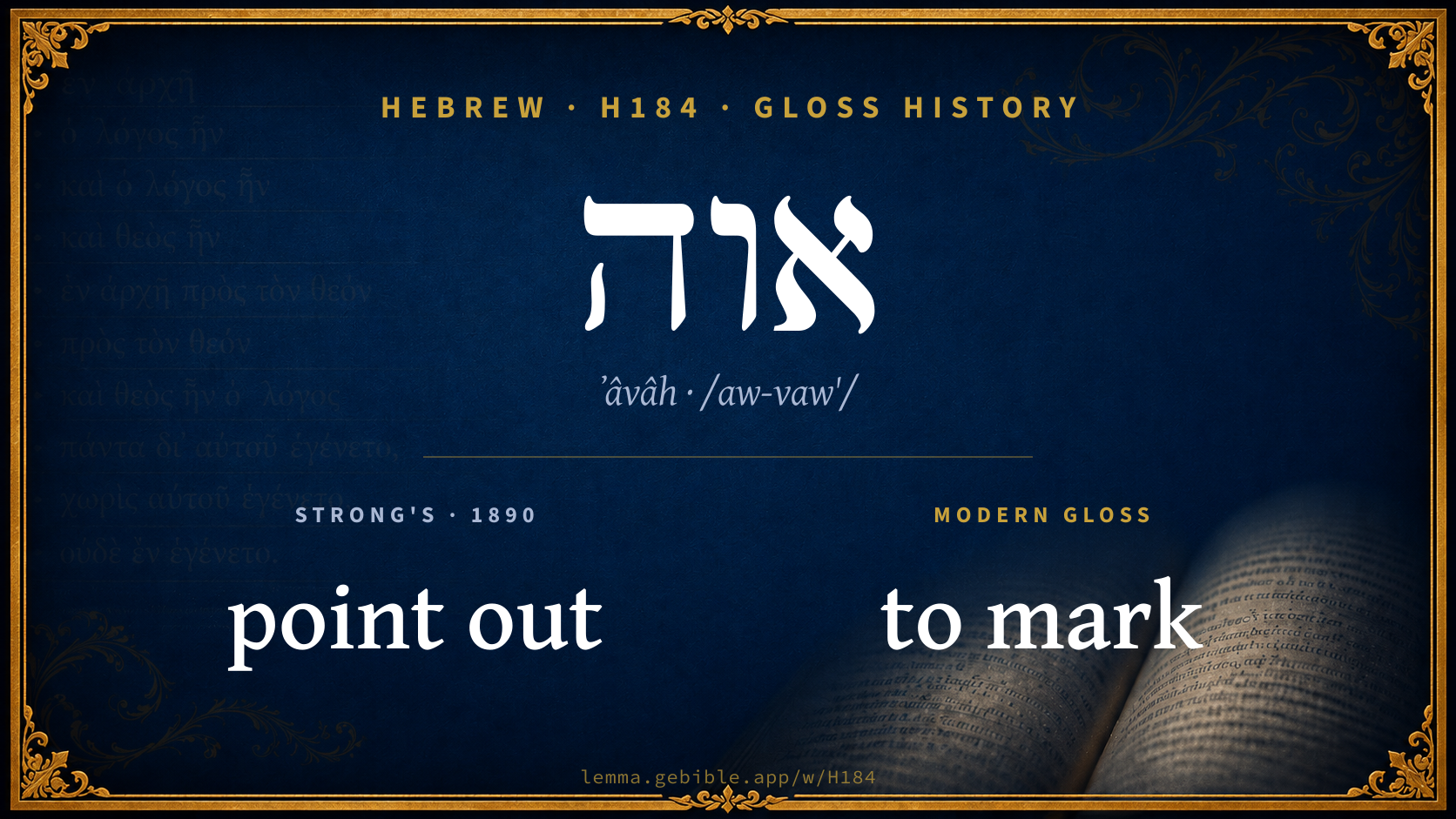
Gloss history
Strong's 1890 vs modern scholarship
About this word
Strong's H184 catalogs a Hebrew word from the Hebrew Old Testament.
These counts are not copied from any lexicon or concordance. They are computed here, from the morphology-tagged Hebrew Old Testament. What Lemma adds →
- 1
- distinct verses
- The word appears in 1 distinct verse.
- 1 / 39
- OT books
- The word appears in 1 of 39 Old Testament books.
- #6,101
- by frequency
- Rank #6,101 (rank 6,101 of 8,640 Hebrew words by occurrence).
View all 1 occurrence in the concordance →
Most concentrated in
- Numbers 1 verse 100%
By section of the Old Testament
By traditional corpus
Conventional, traditional groupings — biblical authorship is debated, so this is a traditional corpus grouping, not an authorship claim. Each share is this word’s portion of its verses in that division of the Hebrew canon. Each figure is a share of the word’s 1 distinct verse.
- Torah (Pentateuch) 1 verse · 100%
How translations render this word
Counts come from each version’s own published word-to-Strong’s tagging or interlinear alignment — an approximate guide to how each version renders this word, not a word-level alignment the data otherwise carries. Because each total is that version’s own tagged count, the per-version totals vary from one another and need not match the appearance or distinct-verse counts above. These counts may also differ from a printed concordance because Lemma counts each distinctly tagged rendering and does not collapse phrase taggings into a single head-word total. This is a fixed set of word-tagged versions (KJV, ASV, BSB, ULT) and does not change with the reading translation you choose elsewhere. Each version’s license is shown beside its name below (and on Sources).
BDB lists this Strong’s number as 2 distinct words (homographs). Each count above pools all of them and is not split by sense — see the Senses section below. A low-frequency rendering may belong to a different one of those words, not the primary meaning.
- King James Version†: Ye shall point out 1×
- American Standard Version†: Ye shall mark out 1×
- unfoldingWord Literal Text†: You shall mark out 1×
King James Version Public Domain
Renders H184 across 1† tagged occurrence — most commonly:
American Standard Version Public Domain
Renders H184 across 1† tagged occurrence — most commonly:
unfoldingWord Literal Text CC BY-SA 4.0
Renders H184 across 1† tagged occurrence — most commonly:
Senses in the full BDB
Hebrew verbs can shift meaning by stem (binyan): Qal is the basic action, Niphal is often passive or reflexive, Piel often intensifies or makes it factitive, and Hiphil is typically causative. The senses below are grouped under the stem BDB assigns to each. This entry also uses Hithpael (reflexive or reciprocal).
What do BDB’s symbols mean?
BDB uses these scholarly abbreviations:
| Symbol | Meaning |
|---|---|
| 𝔊 | the Septuagint (the ancient Greek translation, LXX) |
| 𝔙 | the Vulgate (the Latin translation) |
| 𝔖 | the Syriac version (the Peshitta) |
| 𝔗 | the Targum (the Aramaic translation) |
| ψ | the Psalms |
| √ | root (the underlying root or stem) |
| ‖ | parallel passage (a synonymous or contrasted parallel) |
| † | the dagger: every passage where the word occurs is cited |
The 3 senses and sub-senses the full Brown-Driver-Briggs lexicon distinguishes for this word, in lexicon order (not ranked by frequency), with BDB’s own verbatim wording and sub-sense lettering. Shown in Hebrew script with BDB’s own scholarly abbreviations. The condensed entry is in the Lexicon Entry tab.
אוה I incline, desire (cf. Stem 2).
Piel
- Pf. אִוָּה ψ 132:13; אִוְּתָה Mi 7:1 +, etc.; Impf. 3 fs. תְּאַוֶּה Dt 12:20 + 4 times—desire subj. usually נֶפֶשׁ, obj. fruit Mi 7:1 (in metaph.); flesh (to eat) 1 S 2:16, cf. Dt 12:20 (sq. inf. לֶאֱכֹל בָּשָׂר); food & drink Dt 14:26; of king desiring rule, וּמָלַכְתָּ בְּכֹל אֲשֶׁר־תְּאַוֶּה נַפְשֶׁ֑ךָ 2 S 3:21; 1 K 11:37; obj. evil (רַע) Pr 21:10; once obj. י׳ Is 26:9 נַפְשִׁי אִוִּיתִךָ בַּלַּיְלָה; of God וְנַפְשׁוֹ אִוְּתָה וַיַּעַשׂ Jb 23:13; as desiring Zion for dwelling-place (late, only cases without נפשׁ) ψ 132:13, 14; e.g. Psalms 132:13
Hithpael
- Pf. הִתְאַוָּה Pr 21:26; הִתְאַוֵּיתִי Je 17:16; הִתְאַוּוּ Nu 11:4; וְהִתְאַוִּיתֶם Nu 34:10; Impf. יִתְאַוֶּה Ec 6:2; וַיִּתְאַוֶּה 2 S 23:15; apoc. וְיִתְאַו ψ 45:12, וַיִּתְאַו 1 Ch 11:17, etc.—Pt. fs. מִתְאַוָּה Pr 13:4; mpl. מִתְאַוִּים Am 5:18; Nu 11:34—desire, long for, lust after, of bodily appetites; for dainty food Nu 11:4 (E; sq. acc. cogn.) = ψ 106:14, Nu 11:34 (E); sq. ל Pr 23:3, 6 cf. Ec 6:2 (sq. acc.), v. also Pr 13:4 (abs., subj. נֶפֶשׁ); abs. of extreme thirst 2 S 23:15 = 1 Ch 11:17; of king desiring the beauty (יֳפִי) of princess ψ 45:12 (sq. acc.); of covetous man Pr 21:26 (sq. acc. cogn.); obj. בֵּית רֵעֲךָ Dt 5:18 (‖ חמד); sq. inf. Pr 24:1 (of desiring evil companionship); obj. יוֹם י׳ Am 5:18 (acc.; of presumptuous, reckless longing) cf. Je 17:16. (Nu 34:7, 8 for תְּתָאוּ—Pi. of תאה—Di proposes תִּתְאַוֻּ, & queries whether this & הִתְאַוִּיתֶם v 10 are not from אוה, = desire for yourselves.) e.g. Proverbs 21:26
אוה II sign, mark, describe with a mark (so Ges (who compares תאה, תוה) DlPr 116 (not W)) only
Hithpael
- Pf. הִתְאַוִּיתֶם לָכֶם mark you out, measure, Nu 34:10 (P), so Vrss (cf. תְּתָאוּ לָכֶם v 7, 8; v. however Di, & sub I. אוה).—V. also [תָּאַר] on p. 1061. e.g. Numbers 34:10
Senses from the full Brown-Driver-Briggs lexicon (Brown, Driver, Briggs; Oxford 1906 — public domain), digitized via Sefaria, supplemented by the OpenScriptures HebrewLexicon (CC BY 4.0). Full attribution on Sources.
Word origin
I. vb. incline, desire (cf. Stem 2).
II. vb. sign, mark, describe with a mark (so Ges (who compares תאה, תוה) DlPr 116 (not W)) only
— Brown-Driver-Briggs (Oxford 1906, public domain), digitized via Sefaria, supplemented by the OpenScriptures HebrewLexicon (CC BY 4.0). See Sources.
Origin: a primitive root
Jastrow Dictionary
A second Hebrew/Aramaic lexicon for comparison, covering Aramaic and post-biblical (Talmudic, Targumic, Midrashic) usage that the biblical-Hebrew BDB does not. Matched by lemma rather than by Strong’s number, so a lemma may carry more than one Jastrow headword (shown separately below), and the entries cover usage well beyond the Bible.
אָוָה
- , v. אוי
אוי
- , Pi. אִיוָּה to desire, covet. Snh. 63ᵃ אִיוּוּ אלוהות וכ׳ (Ab. Zar. 53ᵇ לאלוהות, v. Rabb. D. S. a. l. note 8) they had a desire for many deities. Denom. תַּאֲוָה. Cmp. אוּת.
- (b. h.), Nithpa. נִתְאַוֶּה (denom. of תַּאֲוָה) to desire, to be seized with a desire. Num. R. s. 10 (play on י̇ת̇א̇ד̇ם̇ Prov. XXIII, 31) the drunken man וכ׳ לד̇ם̇ יִ֗תְ֗אַ֗וֶּה will covet blood (forbidden intercourse). Gen. R. s. 51. Ex. R. s. 24, end.—Num. R. s. 2 התחילו מִתְאַוִּים וכ׳ they began to express a desire for standards (in imitation of the angelic hosts). Ib. divide them into standards כמו שנִתְאַוּוּ as they desired. e.g. Proverbs 23:31
אוי ²
- , a. Ges. H. Dict. s. v. אָוָה III) to point, mark. Denom. אוֹת II, תְּאָו, תַּאֲוָה.
- (denom. of תַּאֲוָה, תְּאָו) to mark, to mark out. Koh. R. to XII, 7 התחיל מִתְאַוֶּה תאוים he began to put up marks.
A Dictionary of the Targumim, the Talmud Babli and Yerushalmi, and the Midrashic Literature (Marcus Jastrow; London, Luzac, 1903) — Public Domain. Digitized via Sefaria. Digitized via Sefaria. Full attribution on Sources.
Septuagint verse parallels
This word appears in 1 verse that also exists in the Greek Old Testament (Septuagint), out of the 1 Hebrew verse it occurs in. You can read those verses in Greek by switching the Old Testament edition to the Septuagint.
Read these verses in the Septuagint
This is a verse-level parallel only — the same verses exist in both the Hebrew and Greek Old Testaments. No word-level Hebrew↔Greek correspondence is claimed: the data carries no such alignment, so no Greek word is shown as this Hebrew word’s translation. Coverage is not total — the Septuagint omits the deuterocanon and renumbers the Psalms, so some Hebrew verses have no direct Greek parallel.