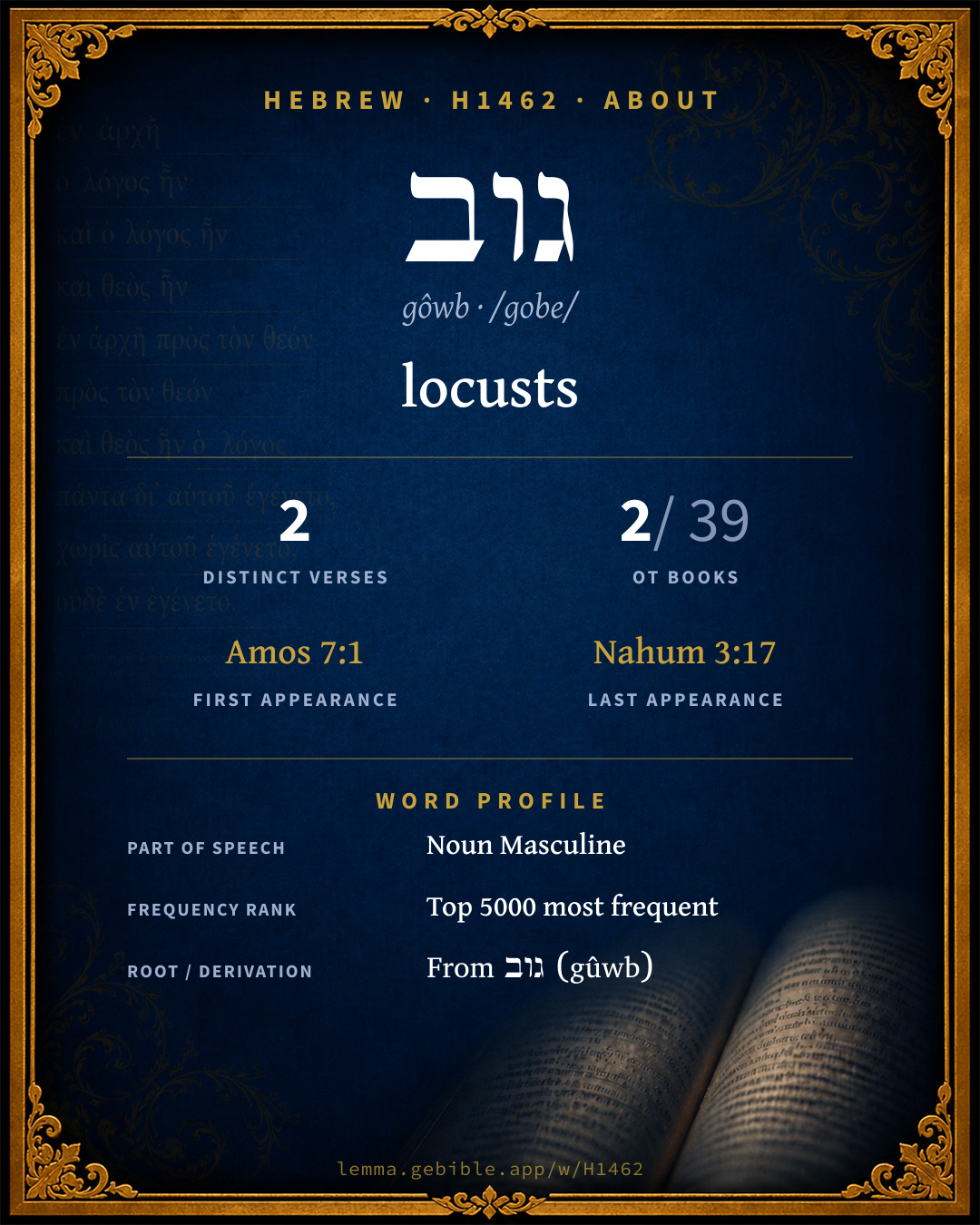
גּוֹב
locusts
Full lexicon entry — Brown-Driver-Briggs (BDB)
From Brown-Driver-Briggs (BDB)
Where this word appears
Grammar key — what these labels mean
Part of speech
- Noun
- A naming word — a person, place, thing, or idea.
Noun type
- Common
- A common noun — a general class of person, place, or thing (“king,” “city,” “water”), not a specific name.
State
- Absolute
- The independent form of a noun, not bound to a following word.
- Construct
- A noun bound to a following noun in a possessive / “of” relationship (the construct chain).
Gender
- Masculine
- Grammatically masculine.
Number
- Plural
- More than one (in Hebrew, generally three or more).
- Singular
- One.
Every verse where H1462 appears in the Book of Amos — 1 distinct verse. Click any verse to open its interlinear word-by-word view. Verse text shown in the World English Bible for context — . Each verse’s Hebrew form is shown with its reference; the English is not keyword-highlighted, since the data carries no word-level English alignment. Use “Compare translations” on any verse to read it across multiple English versions. This concordance covers the Hebrew Bible; Septuagint (Greek Old Testament) occurrences are not indexed here.
Amos
About this entry
At a glance — auto-summarized from this page’s data, not written by a person. Every figure links to its source below. This summary describes the numbers; it doesn’t interpret them.
The Hebrew noun גוב centers on the idea of “locusts.” A scarce word — 2 verses in all of the Hebrew Bible. The word gravitates to Amos (50%), then Nahum. Debuting at Amos 7:1, it then recurs through the corpus. It shares a root with גוב, גב and גב. For the data behind this summary, explore the sense tree and the renderings breakdown below.
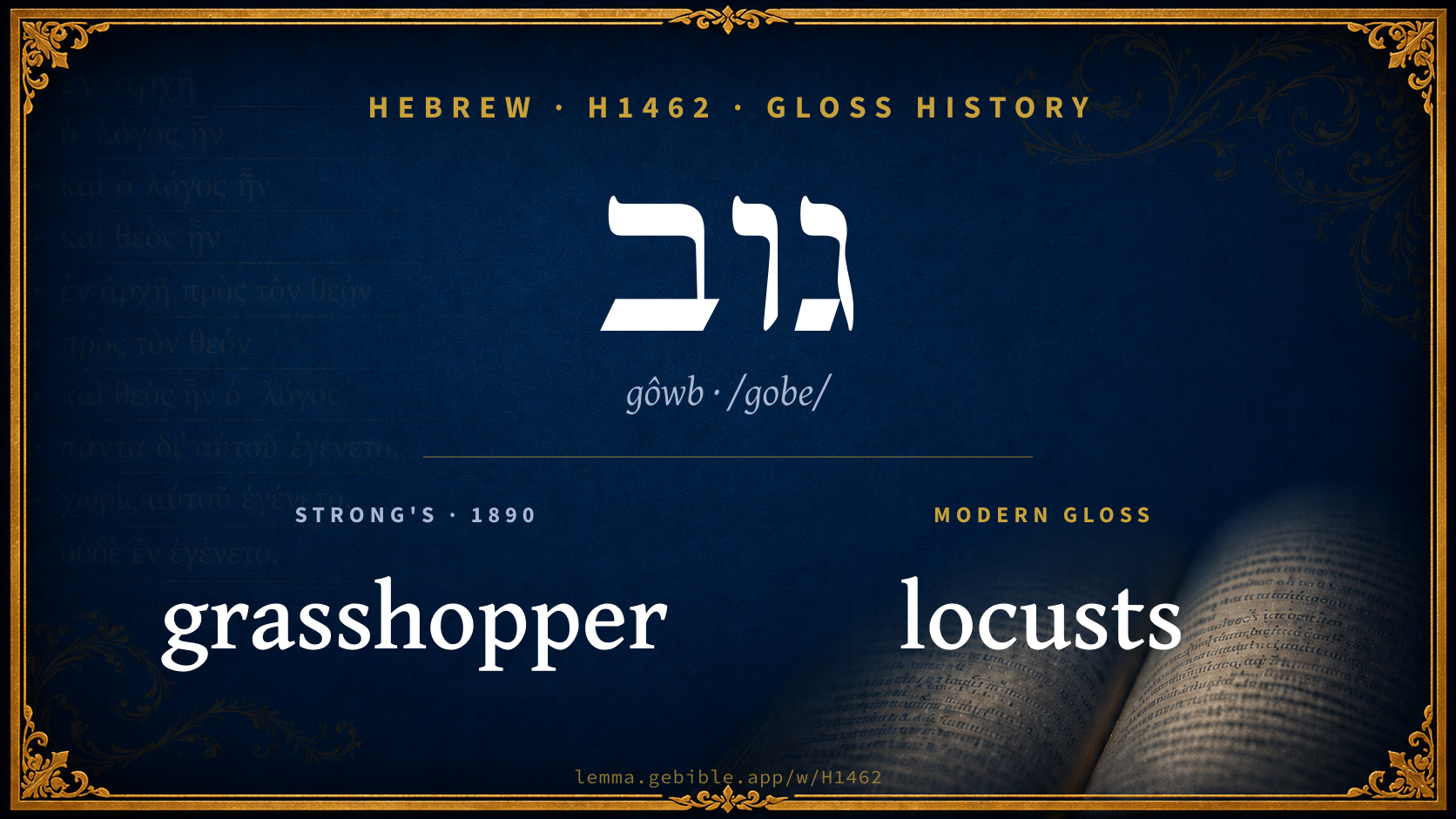
Gloss history
Strong's 1890 vs modern scholarship
About this word
Strong's H1462 catalogs a Hebrew word from the Hebrew Old Testament.
These counts are not copied from any lexicon or concordance. They are computed here, from the morphology-tagged Hebrew Old Testament. What Lemma adds →
- 2
- distinct verses
- The word appears in 2 distinct verses.
- 2 / 39
- OT books
- The word appears in 2 of 39 Old Testament books.
- #4,179
- by frequency
- Top 5000 most frequent Hebrew words (rank 4,179 of 8,640 Hebrew words by occurrence).
View all 2 occurrences in the concordance →
By traditional corpus
Conventional, traditional groupings — biblical authorship is debated, so this is a traditional corpus grouping, not an authorship claim. Each share is this word’s portion of its verses in that division of the Hebrew canon. Each figure is a share of the word’s 2 distinct verses.
- Prophets (Nevi'im) 2 verses · 100%
How translations render this word
Counts come from each version’s own published word-to-Strong’s tagging or interlinear alignment — an approximate guide to how each version renders this word, not a word-level alignment the data otherwise carries. Because each total is that version’s own tagged count, the per-version totals vary from one another and need not match the appearance or distinct-verse counts above. These counts may also differ from a printed concordance because Lemma counts each distinctly tagged rendering and does not collapse phrase taggings into a single head-word total. This is a fixed set of word-tagged versions (KJV, ASV, BSB, ULT) and does not change with the reading translation you choose elsewhere. Each version’s license is shown beside its name below (and on Sources).
BDB lists this Strong’s number as 5 distinct words (homographs). Each count above pools all of them and is not split by sense — see the Senses section below. A low-frequency rendering may belong to a different one of those words, not the primary meaning.
- King James Version†: Grasshoppers 1×, Great grasshoppers 1×
- American Standard Version†: Behold he formed locusts 1×, Swarms of grasshoppers 1×
- Berean Standard Bible†: Like clouds of locusts 1×, Swarms of locusts 1×
- unfoldingWord Literal Text†: Like a swarm of locusts 2×
King James Version Public Domain
Renders H1462 across 2† tagged occurrences — most commonly:
American Standard Version Public Domain
Renders H1462 across 2† tagged occurrences — most commonly:
Berean Standard Bible Public Domain
Renders H1462 across 2† tagged occurrences — most commonly:
Not rendered by a distinct English word in 1 further occurrence.
unfoldingWord Literal Text CC BY-SA 4.0
Renders H1462 across 3† tagged occurrences — most commonly:
Plus 1 rendering that appears only once — usually multi-word phrases or single function words the recovered tagging swept in, not distinct renderings.
Senses in the full BDB
What do BDB’s symbols mean?
BDB uses these scholarly abbreviations:
| Symbol | Meaning |
|---|---|
| 𝔊 | the Septuagint (the ancient Greek translation, LXX) |
| 𝔙 | the Vulgate (the Latin translation) |
| 𝔖 | the Syriac version (the Peshitta) |
| 𝔗 | the Targum (the Aramaic translation) |
| ψ | the Psalms |
| √ | root (the underlying root or stem) |
| ‖ | parallel passage (a synonymous or contrasted parallel) |
| † | the dagger: every passage where the word occurs is cited |
The 0 senses and sub-senses the full Brown-Driver-Briggs lexicon distinguishes for this word, in lexicon order (not ranked by frequency), with BDB’s own verbatim wording and sub-sense lettering. Shown in Hebrew script with BDB’s own scholarly abbreviations. The condensed entry is in the Lexicon Entry tab. See also the Forms in the corpus table below.
גוב I loc. v. sub גבב.
גוב II [m.] locusts, Na 3
Senses from the full Brown-Driver-Briggs lexicon (Brown, Driver, Briggs; Oxford 1906 — public domain), digitized via Sefaria, supplemented by the OpenScriptures HebrewLexicon (CC BY 4.0). Full attribution on Sources.
Word origin
I. n.[m.] locusts, Na 3:17; cf. גֹּבַי.
I. n.m.; Am. 7:1 cf. v. 2 coll. locusts (swarm, multitude; Aramaic גּוּבָא, pl. גוּבָאֵי; on format. v. Ol§ 216 d), גֹּבַי symbol of Yahweh’s judgment on Isr. Am 7:1; in sim. of disappearance of Assyrian leaders at destruction of Nineveh גּוֹב גּוֹבָ֑י Na 3:17 (locust-) swarm of locusts (‖ אַרְבֶּה); but del. גּוֹב as dittogr. We al.
— Brown-Driver-Briggs (Oxford 1906, public domain), digitized via Sefaria, supplemented by the OpenScriptures HebrewLexicon (CC BY 4.0). See Sources.
Derived from גוב (gûwb) (H1461) — to dig.
Jastrow Dictionary
A second Hebrew/Aramaic lexicon for comparison, covering Aramaic and post-biblical (Talmudic, Targumic, Midrashic) usage that the biblical-Hebrew BDB does not. Matched by lemma rather than by Strong’s number, so a lemma may carry more than one Jastrow headword (shown separately below), and the entries cover usage well beyond the Bible.
גּוּב
- , Pa. גַּיֵּיב, v. גִּיב I. [Targ. Prov. IX, 3 Ms., v. גִּיב II.]
גּוֹב
- (גבב, cmp. גֶּבֶא) pit; ג׳ אריות lions’den. Ex. R. s. 18, end הציל לדניאל מג׳ א׳ He rescued Daniel from the lions’ den. Deut. R. s. 2; a. e.
גּוֹב ²
- 1. same. Dan. VI, 8; 13; 17 sq.—Targ. Ex. XXI, 33 sq. (some ed. גּוֹבָא); Targ. Ps. XLIV, 26 (ed. Vien. גּוּבָא); a. e.—Y. Ab. Zar. IV, 44ᵃ bot. נפל לג׳ fell into a wine pit, v. זְחַל.—Pl. גּוּבִּין, גּוּבַּיָּא, גּוּבֵּי, גוֹב׳. Targ. Jer. II, 13. Targ. Gen. XXXVII, 20 ed. Berl. גּוּבַּ׳ (Y. גּוֹבַ׳). e.g. Daniel 6:8
- 2. (cmp. גַּב, גַּבָּא) body, trunk, untrimmed log.—Pl. גּוּבֵּי or גּוֹבֵי. B. Kam. 96ᵃ ג׳ דדיקלא logs of a date-tree. Ib. ג׳ ועבדינהו וכ׳, v. כָּשׁוֹרָא. Sabb. 109ᵇ the swallowed serpent came out of his body ג׳ ג׳ in single trunks (sections of the body). M. Kat. 24ᵃ ג׳ דדיקנא chin, v. גַּב (Rashi: the dimples of the chin).
- 3. back, top. Targ. Prov. IX, 3 Ms. על ג׳ (cmp. על גַּב; ed. גִּיב, h. text גַּפֵּי).
- 4. *prep. (cmp. גַּבֵּי־ s. v. גַּב) מן גובי־ out of. Y. Keth. II, 35ᵃ ומן גוביהן עבד וכ׳ and out of these (seventeen years) he spent thirteen years suffering with tooth-ache; Y. Kil. IX, 32ᵇ ומן גובעין (corr. acc.).
גִּיב
- (denom. of גַּב; cmp. דברים בגב s. v. גַּב), Pa. גַּיֵּיב to reply. Gen. R. s. 80 מְגַּיֵּיב will he be able to reply (argue)?
- same. Y. Ber. I, 3ᵇ top מֵגִיב ליה חבריה upon which his colleague remarked. Ib. IV, 8ᵇ top. Y. Kidd. I, 61ᵇ [read:] אימיה … אמרה לכון אכין ואגיבונתה אכין … אמרה לון אכין ואגיבונה אכין R. Tarfon’s mother spoke to you thus (as reported), and ye answered her accordingly; R. Yishmael’s mother spoke to us thus, and we &c. [Nidd. 65ᵇ דמגבי, read דמְגִיבֵי; v. גִּיחַ.]
A Dictionary of the Targumim, the Talmud Babli and Yerushalmi, and the Midrashic Literature (Marcus Jastrow; London, Luzac, 1903) — Public Domain. Digitized via Sefaria. Digitized via Sefaria. Full attribution on Sources.
Forms in the corpus
The 3 distinct written forms H1462 takes in the Hebrew Bible, most frequent first — each parse links to that state’s occurrences in the concordance. Hebrew forms include their vowel points and cantillation, so a single lemma takes many written forms.
| Form | Parsing | Example | Uses |
|---|---|---|---|
| גֹּבַ֔י | Noun, Common, Masculine, Singular, Absolute | Amos 7:1 | 1 |
| גֹּבָ֑י | Noun, Common, Masculine, Plural, Absolute | Nahum 3:17 | 1 |
| כְּ/ג֣וֹב | Noun, Common, Masculine, Singular, Construct | Nahum 3:17 | 1 |
Same root — word family
Other BDB entries built from the same root as H1462, grouped by Strong’s listed origin. These share a root / origin per the lexicon — not necessarily a shared meaning. Each links to that word’s own entry.
Derives from
Shares the same root
Proper names from this root
People and places named from this root — a name, not an additional meaning of the word.
Compare all same-root words → Showing 4 of 6 — not the complete family. 1 of the same-root words is a proper name (a person or place). They share a root, not necessarily a meaning.
Septuagint verse parallels
This word appears in 2 verses that also exist in the Greek Old Testament (Septuagint), out of the 2 Hebrew verses it occurs in. You can read those verses in Greek by switching the Old Testament edition to the Septuagint.
Read these verses in the Septuagint
This is a verse-level parallel only — the same verses exist in both the Hebrew and Greek Old Testaments. No word-level Hebrew↔Greek correspondence is claimed: the data carries no such alignment, so no Greek word is shown as this Hebrew word’s translation. Coverage is not total — the Septuagint omits the deuterocanon and renumbers the Psalms, so some Hebrew verses have no direct Greek parallel.