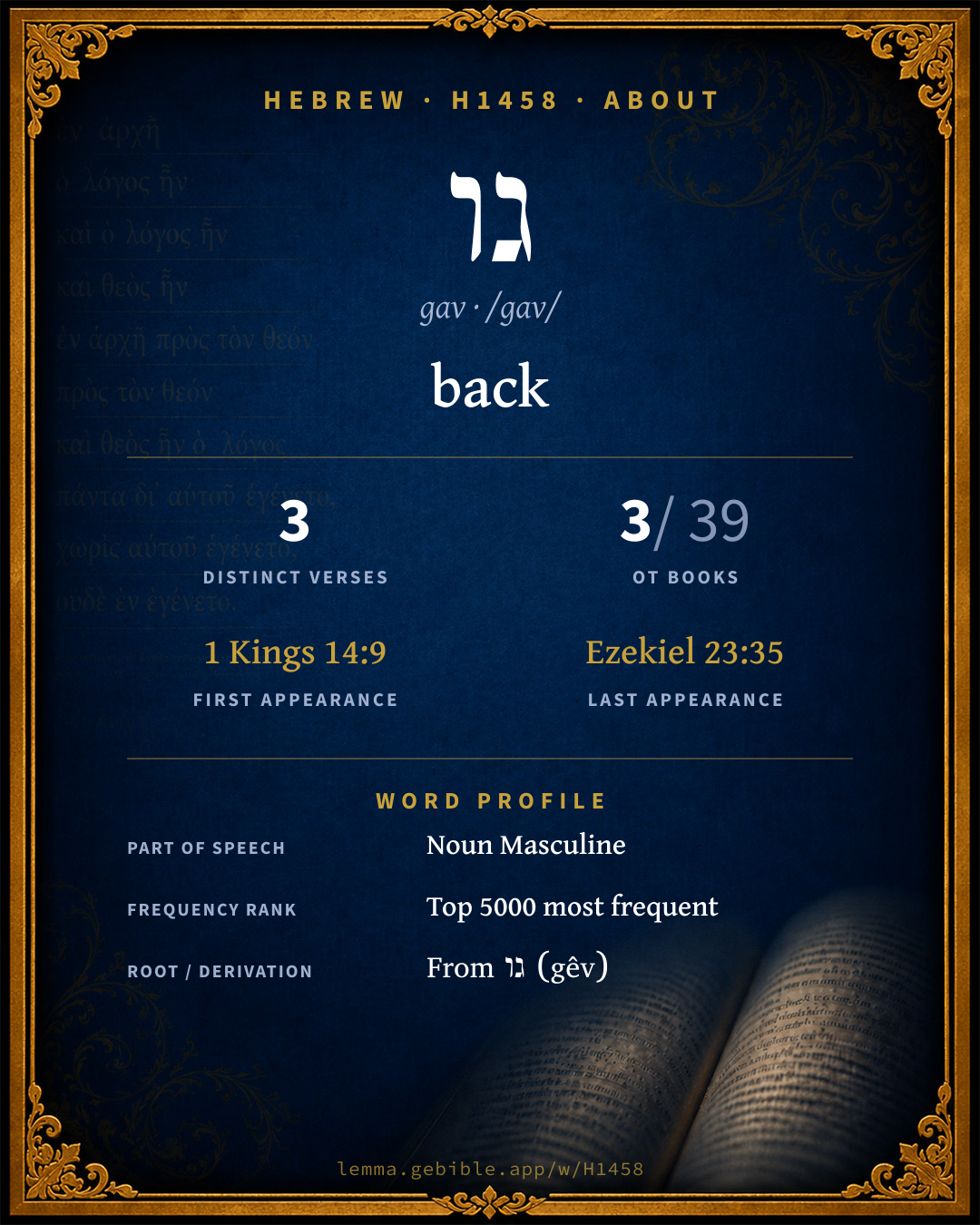
גַּו
back
Full lexicon entry — Brown-Driver-Briggs (BDB)
From Brown-Driver-Briggs (BDB)
Where this word appears
Grammar key — what these labels mean
Part of speech
- Noun
- A naming word — a person, place, thing, or idea.
Noun type
- Common
- A common noun — a general class of person, place, or thing (“king,” “city,” “water”), not a specific name.
State
- Construct
- A noun bound to a following noun in a possessive / “of” relationship (the construct chain).
Gender
- Masculine
- Grammatically masculine.
Number
- Singular
- One.
Every verse where H1458 appears in the Book of 1 Kings — 1 distinct verse. Click any verse to open its interlinear word-by-word view. Verse text shown in the World English Bible for context — . Each verse’s Hebrew form is shown with its reference; the English is not keyword-highlighted, since the data carries no word-level English alignment. Use “Compare translations” on any verse to read it across multiple English versions. This concordance covers the Hebrew Bible; Septuagint (Greek Old Testament) occurrences are not indexed here.
1 Kings
About this entry
At a glance — auto-summarized from this page’s data, not written by a person. Every figure links to its source below. This summary describes the numbers; it doesn’t interpret them.
At its core, גו (gav) means “back.” It is rare — just 3 verses in the entire Hebrew Bible. The word gravitates to 1 Kings (33%), then Nehemiah and Ezekiel. It first appears in 1 Kings 14:9. It clusters with גו, גו and גוה under a shared root. Dig into 3-verse concordance and the renderings breakdown below.
Gloss history
Strong's 1890 vs modern scholarship
About this word
Strong's H1458 catalogs a Hebrew word from the Hebrew Old Testament.
These counts are not copied from any lexicon or concordance. They are computed here, from the morphology-tagged Hebrew Old Testament. What Lemma adds →
- 3
- distinct verses
- The word appears in 3 distinct verses.
- 3 / 39
- OT books
- The word appears in 3 of 39 Old Testament books.
- #4,179
- by frequency
- Top 5000 most frequent Hebrew words (rank 4,179 of 8,640 Hebrew words by occurrence).
View all 3 occurrences in the concordance →
By section of the Old Testament
By traditional corpus
Conventional, traditional groupings — biblical authorship is debated, so this is a traditional corpus grouping, not an authorship claim. Each share is this word’s portion of its verses in that division of the Hebrew canon. Each figure is a share of the word’s 3 distinct verses.
- Prophets (Nevi'im) 2 verses · 67%
- Writings (Ketuvim) 1 verse · 33%
How translations render this word
Counts come from each version’s own published word-to-Strong’s tagging or interlinear alignment — an approximate guide to how each version renders this word, not a word-level alignment the data otherwise carries. Because each total is that version’s own tagged count, the per-version totals vary from one another and need not match the appearance or distinct-verse counts above. These counts may also differ from a printed concordance because Lemma counts each distinctly tagged rendering and does not collapse phrase taggings into a single head-word total. This is a fixed set of word-tagged versions (KJV, ASV, BSB, ULT) and does not change with the reading translation you choose elsewhere. Each version’s license is shown beside its name below (and on Sources).
- King James Version: Back 2×
- American Standard Version: Back 3×
- Berean Standard Bible: Back 2×
- unfoldingWord Literal Text: Back 3×
King James Version Public Domain
Renders H1458 across 3 tagged occurrences — most commonly:
Plus 1 rendering that appears only once — usually multi-word phrases or single function words the recovered tagging swept in, not distinct renderings.
American Standard Version Public Domain
Renders H1458 across 3 tagged occurrences — most commonly:
Berean Standard Bible Public Domain
Renders H1458 across 3 tagged occurrences — most commonly:
Plus 1 rendering that appears only once — usually multi-word phrases or single function words the recovered tagging swept in, not distinct renderings.
unfoldingWord Literal Text CC BY-SA 4.0
Renders H1458 across 3 tagged occurrences — most commonly:
Senses in BDB
The 1 sense BDB distinguishes for this word, in lexicon order (not ranked by frequency or importance). The full entry — with sub-senses — is in the Lexicon Entry tab.
- the back
Word origin
Derived from גו (gêv) (H1460) — back.
Jastrow Dictionary
A second Hebrew/Aramaic lexicon for comparison, covering Aramaic and post-biblical (Talmudic, Targumic, Midrashic) usage that the biblical-Hebrew BDB does not. Matched by lemma rather than by Strong’s number, so a lemma may carry more than one Jastrow headword (shown separately below), and the entries cover usage well beyond the Bible.
גֵּו
- belly, body; prep. within, among. Keth. 15ᵃ; B. Kam. 44ᵇ, a. e. זורק אבן לגו one who throws a stone into (a crowd); Yalk. Deut. 921 לגוי (corr. acc.). Keth. 111ᵃ; Kidd. 44ᵇ דברים בגו there is something in it, v. גַּב end.
גֵּו ²
- 1. (= h. קֶרֶב) belly; innermost. Targ. Ex. XXIX, 13; a. e. Targ. Prov. XXVI, 24. Targ. O. Deut. III, 16 (h. text תּוֹךְ); a. fr.—Sabb. 152ᵇ לגַוֵּיה דביתא (insert וליזול) and go home. Cant. R. to IV, 8 like the hen דמנערא גפה מגווא קטמא (read מִגּוֹא) that shakes her wings off (rising) from between the ashes (Gen. R. s. 75 beg. מן קיטמא). Cant. R. to I, 7 יומא דהוה קאים בגַוֵּיה the day on which he stood, i.e. that every day; a. fr.—Pl. גַּוַּיָּא. Targ. Prov. XX, 27 (ed. Lag. גַּוַּיָּיה).
- 2. (with or without ב) among, amid; in, into. Targ. Ex. XIV, 22; a. fr.—Y. Peah VIII, 20ᵈ bot. מן גּוֹא לפסא out of the pot. Ḥull. 41ᵃ אית ליה שותפות בגַוָּהּ he owns a share in it. Ib. 48ᵇ קופא לגֵיו if the head of the pin is towards the inside. Lev. R. s. 12 את מפני מלגאו … מלבר pour thou out from inside (the hole), and I shall drink from outside. B. Mets. 53ᵇ sq., v. בַּר I ch. a. חוּמְשָׁא.—Pes. 110ᵇ אתית לגו, אתית לגאו I have come among (you). Y. Keth. XII, 35ᵇ; Y. Kil. IX, 32ᶜ bot. גוא ארעא וכ׳ in a unclean land. Y. Keth. l. c.ᵃ bot.; Y. Kil. l. c.ᵇ bot. (גובני) גו בני in the bath-house. Y. Ned. IX, 41ᵇ bot. גו שמשא in the sun (in sunlight); a. v. fr.—מן גו, מִגּוֹ, מִיגּוֹ because, in consequence of. Y. Taan. II, 65ᵇ, v. בּוּךְ. Y. Ber. I, 3ᵇ top מן גו דאינון ציבחר because they are brief.—B. Mets. 39ᵇ מיגו דמוקמינן וכ׳ since we have to appoint a guardian for &c. Ib. 5ᵇ, a. fr. מ׳ דחשיד אממונא וכ׳ since he is suspected of wrong-doing in money matters, he is also suspected of swearing falsely; a. fr.—Hence מִיגּוֹ, מִגּוֹ Miggo, 1) (= h. מִתּוֹךְ, Shebu. 45ᵇ, and מֵאַחַר, v. אַחַר) a legal rule according to which a deponent’s statement is accepted as true on the ground that, if he had intended to tell a lie, he might have invented one more advantageous to his case (cmp. B. Bath. 31ᵃ מה לו לשקר אי בעי וכ׳ why should he lie? If he wanted to lie, he might have said &c.). Keth. 16ᵃ התם מאי מ׳ איכא what miggo is there in that case, i.e. what choice did she have in inventing a statement, if she intended to tell a lie? Ib. מכדי האי מ׳ והאי מ׳ וכ׳ since in this case there is the legal presumption of a miggo, and so is in the other, what is the difference between the one miggo and the other?; a. fr.—2) (cmp. אַגַּב) an action declared valid because one part of it was indisputably legitimate, or because the legal status required for its legitimacy might easily have been obtained. B. Mets. 9ᵇ מ׳ דאי בעי מפקר וכ׳ since, if he wanted, he might have declared his possession public property, in which case he would have obtained the legal status of poverty entitling him to the corner of the field (פֵּאָה), and since (if he had resigned his property) he would have been entitled to take possession of the corner for himself, he has a right also to take possession of it in behalf of his neighbor. Ib. תרי מ׳ לא אמרינן two miggos cannot be accepted, i.e. two conditions required to make an action legitimate cannot be dispensed with. Ib. 8ᵃ. Ned. 88ᵇ; a. e.
A Dictionary of the Targumim, the Talmud Babli and Yerushalmi, and the Midrashic Literature (Marcus Jastrow; London, Luzac, 1903) — Public Domain. Digitized via Sefaria. Digitized via Sefaria. Full attribution on Sources.
Forms in the corpus
The 3 distinct written forms H1458 takes in the Hebrew Bible, most frequent first — each parse links to that state’s occurrences in the concordance. Hebrew forms include their vowel points and cantillation, so a single lemma takes many written forms.
| Form | Parsing | Example | Uses |
|---|---|---|---|
| גַוֵּ֑/ךְ | Noun, Common, Masculine, Singular, Construct | Ezekiel 23:35 | 1 |
| גַוֶּֽ/ךָ | Noun, Common, Masculine, Singular, Construct | 1 Kings 14:9 | 1 |
| גַוָּ֔/ם | Noun, Common, Masculine, Singular, Construct | Nehemiah 9:26 | 1 |
Same root — word family
Other BDB entries built from the same root as H1458, grouped by Strong’s listed origin. These share a root / origin per the lexicon — not necessarily a shared meaning. Each links to that word’s own entry.
Derives from
Shares the same root
Compare all same-root words → They share a root, not necessarily a meaning.
Septuagint verse parallels
This word appears in 2 verses that also exist in the Greek Old Testament (Septuagint), out of the 3 Hebrew verses it occurs in. You can read those verses in Greek by switching the Old Testament edition to the Septuagint.
Read these verses in the Septuagint
This is a verse-level parallel only — the same verses exist in both the Hebrew and Greek Old Testaments. No word-level Hebrew↔Greek correspondence is claimed: the data carries no such alignment, so no Greek word is shown as this Hebrew word’s translation. Coverage is not total — the Septuagint omits the deuterocanon and renumbers the Psalms, so some Hebrew verses have no direct Greek parallel.