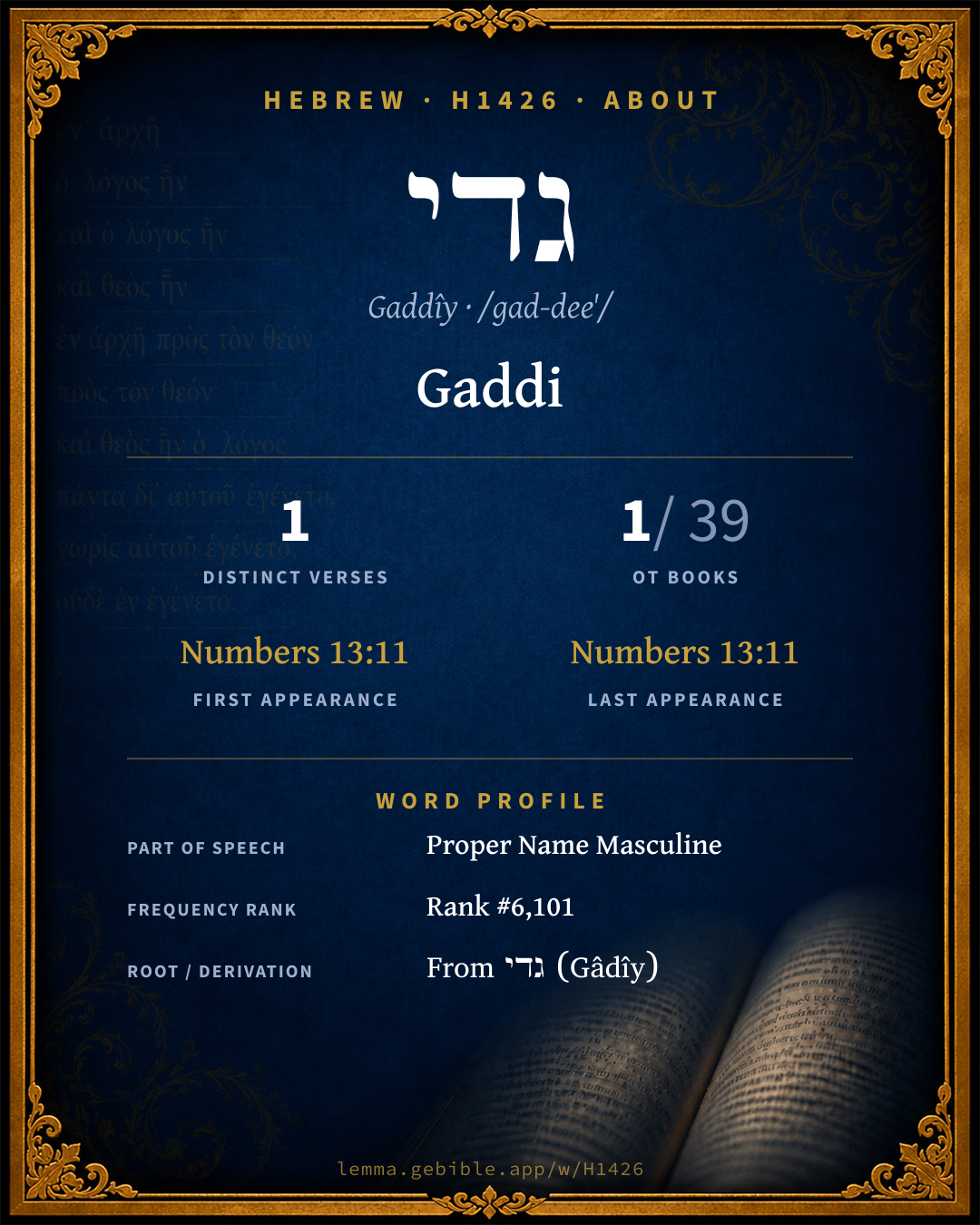
גַּדִּי
Gaddi
BDB lists 2 entries for ‘Gaddi’ fuller range ↓
Full lexicon entry — Brown-Driver-Briggs (BDB)
From Brown-Driver-Briggs (BDB)
Where this word appears
Grammar key — what these labels mean
Part of speech
- Noun
- A naming word — a person, place, thing, or idea.
Noun type
- Proper
- A name of a specific person, place, or people (e.g. Abraham, Zion, Israel).
Every verse where H1426 appears — 1 distinct verse across 1 book. Click any verse to open its interlinear word-by-word view. Verse text shown in the World English Bible for context — . Each verse’s Hebrew form is shown with its reference; the English is not keyword-highlighted, since the data carries no word-level English alignment. Use “Compare translations” on any verse to read it across multiple English versions. This concordance covers the Hebrew Bible; Septuagint (Greek Old Testament) occurrences are not indexed here.
Numbers 1 verse
About this entry
At a glance — auto-summarized from this page’s data, not written by a person. Every figure links to its source below. This summary describes the numbers; it doesn’t interpret them.
גדי — transliterated Gaddîy — is a Hebrew name carrying the sense “Gaddi.” It occurs a mere 1 verse across Scripture. More than three-quarters of its appearances fall in Numbers. Found nowhere else but Numbers 13:11. See 1-verse concordance and the renderings breakdown below.
Gloss history
Strong's 1890 vs modern scholarship
About this word
Strong's H1426 catalogs a Hebrew word from the Hebrew Old Testament.
These counts are not copied from any lexicon or concordance. They are computed here, from the morphology-tagged Hebrew Old Testament. What Lemma adds →
- 1
- distinct verses
- The word appears in 1 distinct verse.
- 1 / 39
- OT books
- The word appears in 1 of 39 Old Testament books.
- #6,101
- by frequency
- Rank #6,101 (rank 6,101 of 8,640 Hebrew words by occurrence).
View all 1 occurrence in the concordance →
Most concentrated in
- Numbers 1 verse 100%
By section of the Old Testament
By traditional corpus
Conventional, traditional groupings — biblical authorship is debated, so this is a traditional corpus grouping, not an authorship claim. Each share is this word’s portion of its verses in that division of the Hebrew canon. Each figure is a share of the word’s 1 distinct verse.
- Torah (Pentateuch) 1 verse · 100%
How translations render this word
Counts come from each version’s own published word-to-Strong’s tagging or interlinear alignment — an approximate guide to how each version renders this word, not a word-level alignment the data otherwise carries. Because each total is that version’s own tagged count, the per-version totals vary from one another and need not match the appearance or distinct-verse counts above. These counts may also differ from a printed concordance because Lemma counts each distinctly tagged rendering and does not collapse phrase taggings into a single head-word total. This is a fixed set of word-tagged versions (KJV, ASV, BSB, ULT) and does not change with the reading translation you choose elsewhere. Each version’s license is shown beside its name below (and on Sources).
- King James Version: Gaddi 1×
- American Standard Version: Gaddi 1×
- Berean Standard Bible: Gaddi 1×
- unfoldingWord Literal Text: Gaddi 1×
King James Version Public Domain
Renders H1426 across 1 tagged occurrence — most commonly:
American Standard Version Public Domain
Renders H1426 across 1 tagged occurrence — most commonly:
Berean Standard Bible Public Domain
Renders H1426 across 1 tagged occurrence — most commonly:
unfoldingWord Literal Text CC BY-SA 4.0
Renders H1426 across 1 tagged occurrence — most commonly:
Senses in BDB
The 2 senses BDB distinguishes for this word, in lexicon order (not ranked by frequency or importance). The full entry — with sub-senses — is in the Lexicon Entry tab.
- Gaddi = "my fortune"
- the son of Susi, spy from the tribe of Manasseh sent by Moses to spy out the land of Canaan
Word origin
n.pr.m. (my fortune) a man of Manasseh Nu 13:11.
— Brown-Driver-Briggs (Oxford 1906, public domain), digitized via Sefaria, supplemented by the OpenScriptures HebrewLexicon (CC BY 4.0). See Sources.
Derived from גדי (Gâdîy) (H1424) — Gadi.
Jastrow Dictionary
A second Hebrew/Aramaic lexicon for comparison, covering Aramaic and post-biblical (Talmudic, Targumic, Midrashic) usage that the biblical-Hebrew BDB does not. Matched by lemma rather than by Strong’s number, so a lemma may carry more than one Jastrow headword (shown separately below), and the entries cover usage well beyond the Bible.
*גְּדֵי
- (v. גדד I) to cut, divide, assign.
- to cut off, excommunicate. Nidd. 36ᵇ ואי לא צאית גַּרְיֵיה הוא סבר גַּדְּיֵיה א"ל and if he does not obey, drag him over (v. גרי, i.e. force him with arguments), but he (R. Assé) understood that he told him gadd’yeh (excommunicate him). Ib. לא ציית גדייה he (Shila bar Abina) did not obey, and he (R. Assé) excommunicated him (Rashi). [Tosaf. read for גרייה: גַּדְיֵיה, fr. גדי, a sec. form of נגד, draw him over.—Ar. s. v. צנע 2 reads גַּדְּדֵיה lash him (ref. to Deut. XIV, 1), without referring to any misapprehension, while s. v. גר 10 הוא סבר גרייה א"ל is quoted—obviously a later insertion of a copyist.] e.g. Deuteronomy 14:1
גְּדִי
- (b. h.)
- 1. kid, in gen. young animal. Ḥull. 113ᵃ; 113ᵇ (ref. to Gen. XXXVIII, 17) כאן ג׳ עזים וכ׳ here it reads g’di izzim from which we learn that wherever g’di without any qualification is used, it includes cow and sheep. Men. XIII, 7; a. fr.—Pl. גְּדָיִם, גְּדָיִים. Snh. 11ᵃ; Tosef. ib. II, 4 מפני הג׳ וכ׳ on account of the kids or lambs (being too young for offerings on Passover).—Y. ib. X, 28ᵇ bot.; Gen. R. s. 42, a. e. אם אין ג׳ אין תישים when there will be no kids (young students), there will be no wethers (leaders, scholars). Y. ib. I, 19ᵃ top ג׳ שהנחת וכ׳ the kids (young scholars) thou hast left behind (in Palestine) have grown to be wethers; a. e.—Trnsf. the tender grain in its husks. Pesik. Asser p. 99ᵇ; Tanḥ. R’eh 17; Yalk. Deut. 892 (homiletic interpret. of Deut. XV, 21) אל תגרמו לי לבשל ג׳ וכ׳ do not cause me to ripen the grains in their mothers’ womb (husks, so as to be blown out by the East wind). e.g. Genesis 38:17
- 2. the Capricorn, a sign in the Zodiac. Pesik. R. s. 20. Yalk. Ex. 418; Kings 185. [Yalk. Num. 785 הרי נכנס הזאב לגדי, v. גדיגוד.]
גְּדִי ²
- Targ. O. Gen. XXXVIII, 17; 20 (Y. גידי, גירי (?)); 23 O. a. Y. גַּדְיָא.—Pes. 3ᵇ גדי מסנקן, v. סְנַק. Sabb. 18ᵇ דג׳ (בשרא) meat of a kid. Ib. 20ᵃ. Ḥull. 51ᵃ—Pl. גְּדִין, גְּדָאִין, גַּדְיָין, constr. גַּדְיֵי, גְּדָיֵי. Targ. Deut. XIV, 4. Targ. Gen. XXVII, 16 ed. Berl. גְּדֵי; 9 גַּדְיֵי; a. e. Midr. Sam. ch. XX (expl. חריצי החלב I Sam. XVII, 18) גדיין מניעין וכ׳ kids taken away from their mothers.—גַּדְיָיתָא. Targ. Y. Num. XV, 27 (h. text עֵז). e.g. 1 Samuel 17:18
A Dictionary of the Targumim, the Talmud Babli and Yerushalmi, and the Midrashic Literature (Marcus Jastrow; London, Luzac, 1903) — Public Domain. Digitized via Sefaria. Digitized via Sefaria. Full attribution on Sources.
Bible dictionary
Public-domain dictionary articles matched to this entry by name (Gaddi). A biblical name can be shared by more than one person or place, so an article may treat several.
Easton's Bible Dictionary · M. G. Easton, 1897
Fortunate, the representative of the tribe of Manasseh among the twelve "spies" sent by Moses to spy the land (Num. 13:11).
Smith's Bible Dictionary · William Smith, 1863
(fortunate), son of Susi; the Manassite spy sent by Moses to explore Canaan. (Numbers 13:11) (B.C. 1490.)
Hitchcock's Bible Names Dictionary · Roswell D. Hitchcock, 1869
my troop; a kid
Classic public-domain reference works; full attribution on Sources.
Septuagint verse parallels
This word appears in 1 verse that also exists in the Greek Old Testament (Septuagint), out of the 1 Hebrew verse it occurs in. You can read those verses in Greek by switching the Old Testament edition to the Septuagint.
Read these verses in the Septuagint
This is a verse-level parallel only — the same verses exist in both the Hebrew and Greek Old Testaments. No word-level Hebrew↔Greek correspondence is claimed: the data carries no such alignment, so no Greek word is shown as this Hebrew word’s translation. Coverage is not total — the Septuagint omits the deuterocanon and renumbers the Psalms, so some Hebrew verses have no direct Greek parallel.