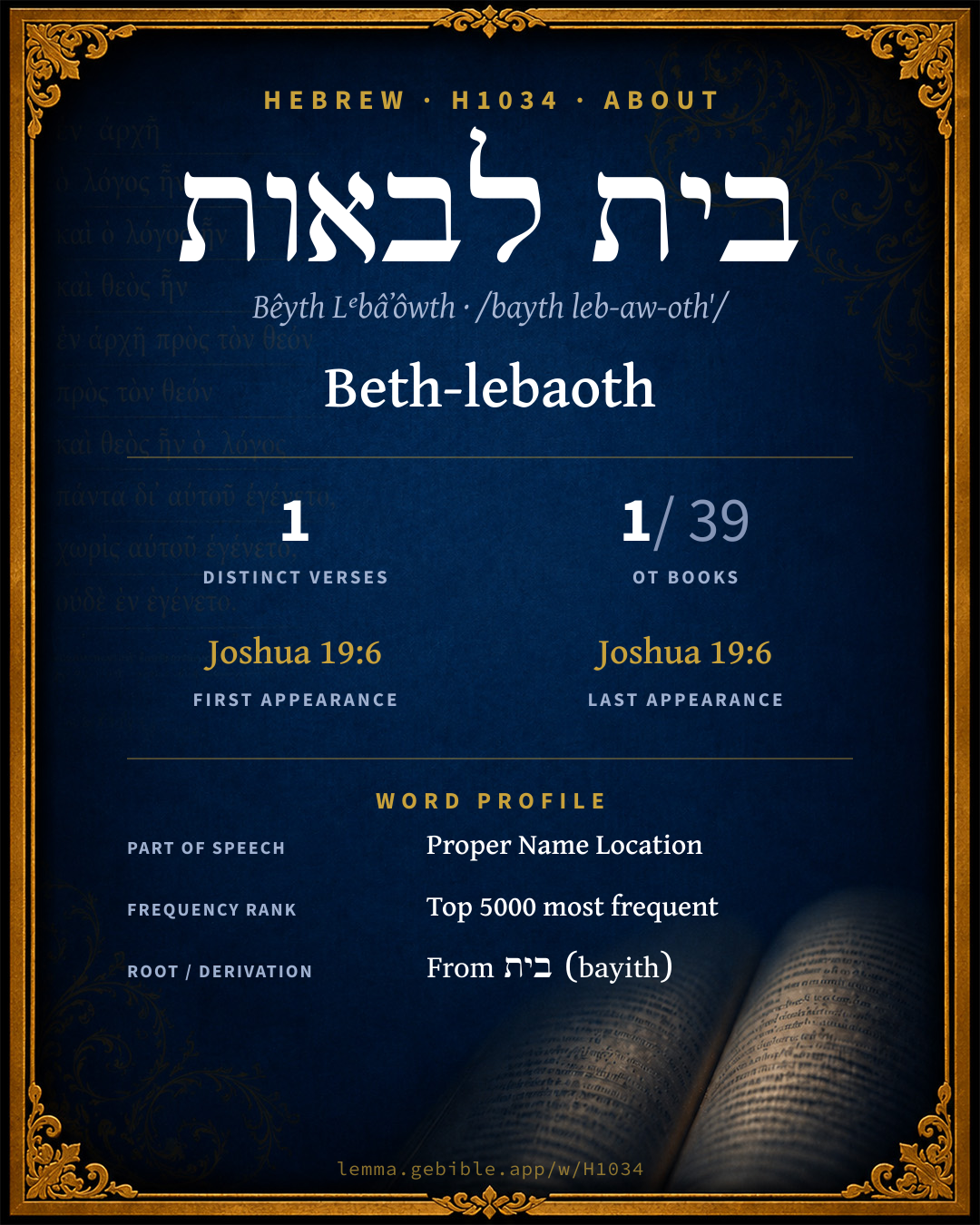
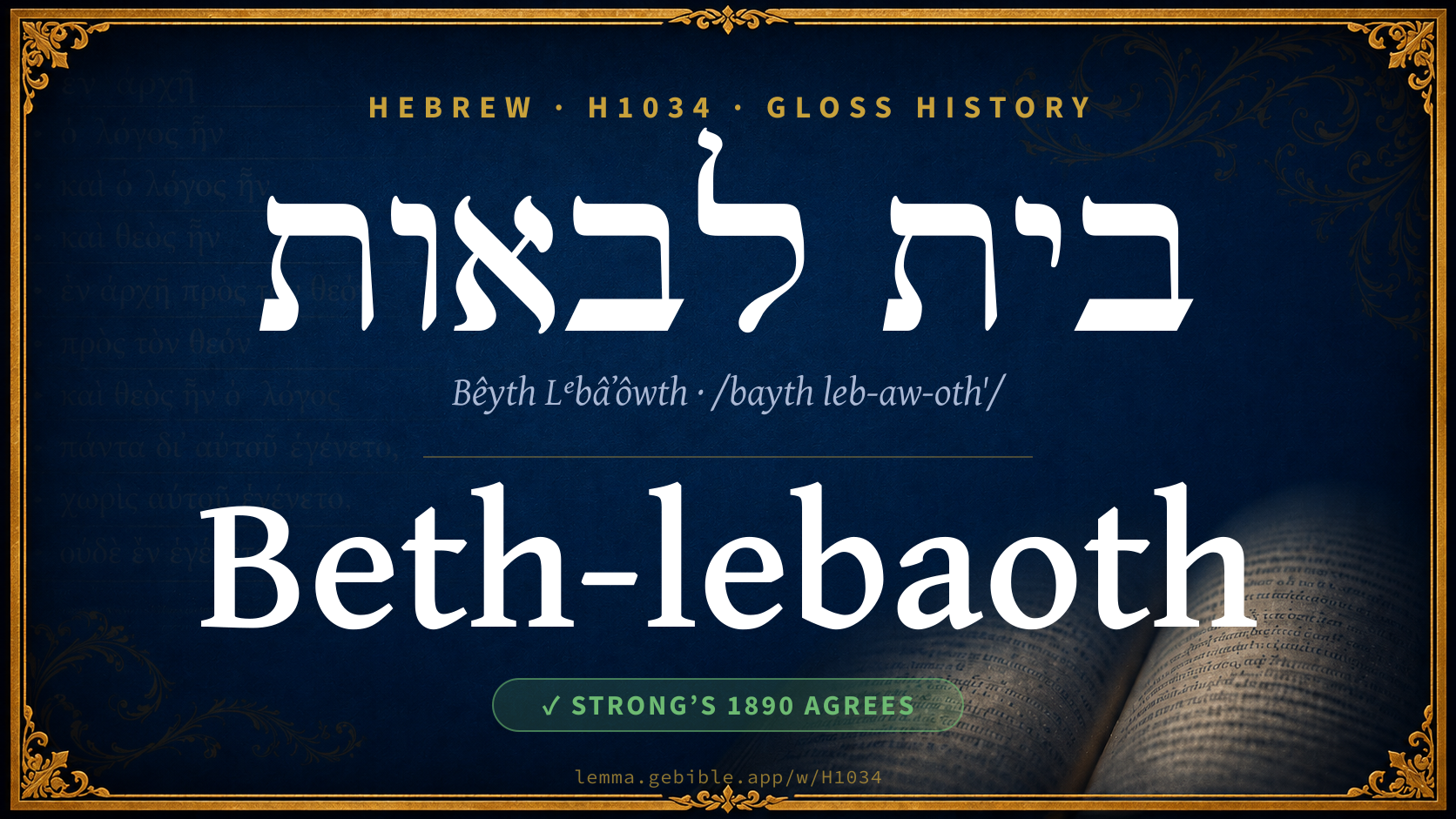
בֵּית לְבָאוֹת
Beth-lebaoth
BDB lists 2 entries for ‘Beth-lebaoth’ fuller range ↓
Full lexicon entry — Brown-Driver-Briggs (BDB)
From Brown-Driver-Briggs (BDB)
Where this word appears
Grammar key — what these labels mean
Part of speech
- Noun
- A naming word — a person, place, thing, or idea.
Noun type
- Proper
- A name of a specific person, place, or people (e.g. Abraham, Zion, Israel).
Every verse where H1034 appears — 1 distinct verse across 1 book. Click any verse to open its interlinear word-by-word view. Verse text shown in the World English Bible for context — . Each verse’s Hebrew form is shown with its reference; the English is not keyword-highlighted, since the data carries no word-level English alignment. Use “Compare translations” on any verse to read it across multiple English versions. This concordance covers the Hebrew Bible; Septuagint (Greek Old Testament) occurrences are not indexed here.
Joshua 1 verse
About this entry
At a glance — auto-summarized from this page’s data, not written by a person. Every figure links to its source below. This summary describes the numbers; it doesn’t interpret them.
At its core, בית לבאות (Bêyth Lᵉbâʼôwth) means “Beth-lebaoth.” It is rare — just 1 verse in the entire Hebrew Bible. Its uses cluster heavily in Joshua (100% of all occurrences). A true hapax — its single appearance is Joshua 19:6. Dig into 1-verse concordance and the renderings breakdown below.
Gloss history
Strong's 1890 vs modern scholarship
About this word
Strong's H1034 catalogs a Hebrew word from the Hebrew Old Testament.
These counts are not copied from any lexicon or concordance. They are computed here, from the morphology-tagged Hebrew Old Testament. What Lemma adds →
- 1
- distinct verses
- The word appears in 1 distinct verse.
- 1 / 39
- OT books
- The word appears in 1 of 39 Old Testament books.
- #4,807
- by frequency
- Top 5000 most frequent Hebrew words (rank 4,807 of 8,640 Hebrew words by occurrence).
View all 1 occurrence in the concordance →
Most concentrated in
- Joshua 1 verse 100%
By section of the Old Testament
By traditional corpus
Conventional, traditional groupings — biblical authorship is debated, so this is a traditional corpus grouping, not an authorship claim. Each share is this word’s portion of its verses in that division of the Hebrew canon. Each figure is a share of the word’s 1 distinct verse.
- Prophets (Nevi'im) 1 verse · 100%
How translations render this word
Counts come from each version’s own published word-to-Strong’s tagging or interlinear alignment — an approximate guide to how each version renders this word, not a word-level alignment the data otherwise carries. Because each total is that version’s own tagged count, the per-version totals vary from one another and need not match the appearance or distinct-verse counts above. These counts may also differ from a printed concordance because Lemma counts each distinctly tagged rendering and does not collapse phrase taggings into a single head-word total. This is a fixed set of word-tagged versions (KJV, ASV, BSB, ULT) and does not change with the reading translation you choose elsewhere. Each version’s license is shown beside its name below (and on Sources).
- King James Version: Bethlebaoth 1×
- American Standard Version: Beth-lebaoth 1×
- Berean Standard Bible: Beth-lebaoth 1×
- unfoldingWord Literal Text: Beth lebaoth 2×
King James Version Public Domain
Renders H1034 across 1 tagged occurrence — most commonly:
American Standard Version Public Domain
Renders H1034 across 1 tagged occurrence — most commonly:
Berean Standard Bible Public Domain
Renders H1034 across 1 tagged occurrence — most commonly:
unfoldingWord Literal Text CC BY-SA 4.0
Renders H1034 across 2 tagged occurrences — most commonly:
Senses in BDB
The 2 senses BDB distinguishes for this word, in lexicon order (not ranked by frequency or importance). The full entry — with sub-senses — is in the Lexicon Entry tab.
- Beth-lebaoth = "house of lionesses"
- a place in Simeon
Word origin
בֵּית לְבָאוֹת n.pr.loc. in Simeon ( place of lioness ?) Jos 19:6 = ב׳ בִּרְאִי (perh. text. err.) 1 Ch 4:31; = לְבָאוֹת (in Judah) Jos 15:32.
— Brown-Driver-Briggs (Oxford 1906, public domain), digitized via Sefaria, supplemented by the OpenScriptures HebrewLexicon (CC BY 4.0). See Sources.
Derived from בית (bayith) (H1004) — house.
Jastrow Dictionary
A second Hebrew/Aramaic lexicon for comparison, covering Aramaic and post-biblical (Talmudic, Targumic, Midrashic) usage that the biblical-Hebrew BDB does not. Matched by lemma rather than by Strong’s number, so a lemma may carry more than one Jastrow headword (shown separately below), and the entries cover usage well beyond the Bible.
בִּית
- , inf. בּוּת (sec. r. of בוא) to go in, lodge, pass the night. Dan. VI, 19. Targ. Gen. XXXII, 22; a. fr.—Pes. 107ᵃ בת טוות (Dan. l. c.) he went to bed without tasting food. Snh. 95ᵃ (prov.) בת דינא וכ׳ if punishment is procrastinated, punishment is gone. Taan. 24ᵇ ביתו כולי וכ׳ go ye all to bed fasting. Pes. 42ᵃ מיא דביתו (Chald. transl. of the ambiguous מים שֶׁלָּנוּ) water kept in vessels over night. Ber. 60ᵇ בת בדברא he slept in the open field. Snh. 63ᵇ.—Ib. 109ᵃ top בעי למֵיבַת he wanted to stay over night; a. e.—Part. בָּאֵית. Targ. Is. LVIII, 5. e.g. Daniel 6:19
- same. Erub. 73ᵃ (opp. to taking meals).
- to keep over night, postpone burial. Snh. 47ᵃ מֵבִית ליה למת dare one postpone the burial of the dead?
בַּיִת
- cmp. preced.; v. Ges. H. Dict. s. v. as to various etymological attempts), constr. בֵּית, pl. בָּתִּים.
- 1. house, household, home. Yoma 11ᵇ ב׳ מיוחד לדירה bayith means a building intended for a dwelling. Ib. מי שמייחד ביתו לו (Var. v. Rabb. D. S. a. l. note) he who devotes his house (its contents) to himself exclusively (unaccommodating); Arakh. 16ᵃ מי שמיוחד וכ׳.—בעל הב׳ (abbrev. בע"ה) owner, landlord; host; private man, opp. to trader, artisan &c. Ber. 46ᵃ בע"ה בוצע וכ׳ the host breaks the bread, and the guest says the blessing. Tosef. ib. IV, 14 של בע"ה home-made (bread), opp. גלוסקין; Y. ib. VI, 10ᵇ bot.—Sabb. I, 1 בע"ה the donor, opp. עני the recipient. Gen. R. s. 22; a. v. fr.—בן ב׳ inmate, attendant. Ab. I, 5; a. fr.—פסול הב׳ the degraded (slave) of the house. Gen. R. s. 70.
- 2. Esp. (הַ)בַּ׳ the Temple. בפני הב׳ in days when the Temple exists, שלא בפני הב׳ when it does not exist. Ḥull. V, 1; a. fr.—ב׳ שני or ב׳ אחרון the Second Temple. Cant. R. to VIII, 9; a. fr.—הר הב׳ Temple Mount, v. הַר.
- 3. school, college, (collect.) disciples; בֵּית הלל Hillelites &c. Bets. I, 1; a. fr. Treat. Sof’rim IV, 1 של ב׳ וכ׳ those of the house of &c. [Y. Shebi. II, 33ᵈ bot., a. e. דבית … ר׳, usu. דבי, v. בֵּי].
- 4. body. Ber. 44ᵇ אוי לו לב׳ וכ׳ that human body (Rashi: stomach) is to be pitied where vegetables are a constant guest (being the only food).
- 5. wife. Yoma I, 1 ביתו זו וכ׳ ‘his house’—that means his wife. Ib. 13ᵃ והך לאו ביתו היא but this one (designated for him in case of his wife’s death) cannot be called ‘his house’. Sabb. 118ᵇ; a. fr.
- 6. Euphem. pudenda; marital intercourse. Y. Sabb. IX, 12ᵃ top; Mikv. VIII, 4 שמשה את בֵּיתָהּ she had intercourse. Ib. כבדה את הב׳ she washed &c. Y. Sot. I, 16ᶜ bot. אסורה לביתה is forbidden to her husband. Nidd. 5ᵃ מהומת לביתה she hastens to perform her marital duty. Y. ib. I, beg. 48ᵈ. Cmp. חֶדֶר.
- 7. store-house, store-room. בֵּית העצים wood-room; ב׳ התבן straw-magazine; ב׳ הבקר stable; &c. Yoma 11ᵃ; a. fr.
- 8. (geogr.) place, town, in compounds (for which see the respective determinants), e.g. ב׳ בוקיא Beth-Bukya &c.
- 9. (anat.) limb, organ, in compounds (v. supra 8)), e.g. ב׳ הבליעה œsophagus, &c.
- 10. shed for plants, covering. Shebi. II, 4 (pl.). Y. ib. 33ᵈ.—Y. Sabb. VII, 10ᵃ.—1
- receptacle, cover &c., e.g. ב׳ הדיו inkstand. Tosef. Kel. B. Mets. IV, 11; ב׳ יד sleeve, v. אוּנְקְלַי II, &c.—Men. 34ᵇ, a. e. cases of the T’fillin
- , pl. בָּתֵּי אָבוֹת
- 1. paternal home, family. Snh. 38ᵃ שני ב׳ א׳ two families (dynasties); a. fr.—Tosef. Ter. II, 11 בתי אבות = אריסי ב׳ א׳ hereditary land-tenants; B. Bath. 46ᵇ
- 2. priest’s division. Taan. II, 6; a. fr.; v. אֱנוֹשׁ pl.
- 3. origin of a law, rule &c.; cmp. אָב II. Cant. R. to II, 4 ב׳ א׳ של הלכה the origin (principle) of a legal rule. Midr. Till. to Ps. CIV, 29 wherever the root רעש is used, it means cessation of government, ואיזהו ב׳ א׳ שלהם וכ׳ and where is the origin (determining the meaning) of all of them? (Answ. Jer. LI, 29). Lev. R. s. 1, beg. מב׳ א׳ שלהן וכ׳ from the chief passage (Hag. I, 13 ‘Haggai, the messenger’ &c.) we learn that prophets are called messengers (or angels).—בֵּית דִּין (abbr. ב"ד) court.—ב"ד של שבעים ואחד or ב"ד הגדול the Great Sanedrin of seventy one members. Snh. I, 5. Y. ib. 19ᵃ bot.; a. fr.—ב"ד נוטה court of an odd number of judges. ב"ד שקול of an even number of judges. Snh. 3ᵇ.—ב"ד שריא a permitting court, opprobrious name of a court too lax in religious affairs. Y. Gitt. VII, 48ᵈ top; Y. Nidd. III, 50ᵈ bot.—[For all other compounds not self-evident, v. respective determinants.] [בית תר, v. בִּיתֵּר.—Gen. R. s. 12 בית שלו, בית של עולם, v. בִּיָּא.] e.g. Jeremiah 51:29
A Dictionary of the Targumim, the Talmud Babli and Yerushalmi, and the Midrashic Literature (Marcus Jastrow; London, Luzac, 1903) — Public Domain. Digitized via Sefaria. Digitized via Sefaria. Full attribution on Sources.
Forms in the corpus
The 2 distinct written forms H1034 takes in the Hebrew Bible, most frequent first — each parse links to that state’s occurrences in the concordance. Hebrew forms include their vowel points and cantillation, so a single lemma takes many written forms.
| Form | Parsing | Example | Uses |
|---|---|---|---|
| וּ/בֵ֥ית | Noun, Proper | Joshua 19:6 | 1 |
| לְבָא֖וֹת | Noun, Proper | Joshua 19:6 | 1 |
Same root — word family
Other BDB entries built from the same root as H1034, grouped by Strong’s listed origin. These share a root / origin per the lexicon — not necessarily a shared meaning. Each links to that word’s own entry.
Derives from
Shares the same root
Proper names from this root
People and places named from this root — a name, not an additional meaning of the word.
- Βηθαβαρα Bēthabará G962 Bethabara
- בית Bayith H1006 Bajith
- בית און Bêyth ʼÂven H1007 Beth-aven
- ביתאל Bêyth-ʼÊl H1008 Bethel
- בית ארבאל Bêyth ʼArbêʼl H1009 Beth-Arbel
- בית בעל מעון Bêyth Baʻal Mᵉʻôwn H1010 Beth-baal-meon
- בית בראי Bêyth Birʼîy H1011 Beth-birei
- בית ברה Bêyth Bârâh H1012 Beth-barah
- ביתגדר Bêyth-Gâdêr H1013 Beth-gader
- בית גמול Bêyth Gâmûwl H1014 Beth-gamul
- בית דבלתים Bêyth Diblâthayim H1015 Beth-diblathaim
- ביתדגון Bêyth-Dâgôwn H1016 Beth-dagon
- בית האצל Bêyth hâʼêtsel H1018 Beth-ezel
- בית הגלגל Bêyth hag-Gilgâl H1019 Beth-gilgal
- בית הישימות Bêyth ha-Yshîy-môwth H1020 Beth-jesimoth
- בית הכרם Bêyth hak-Kerem H1021 Beth-haccerem
- בית המרחק Bêyth ham-Merchâq H1023 Beth Ham-merchaq
- בית המרכבות Bêyth ham-Markâbôwth H1024 Beth-marcaboth
- בית העמק Bêyth hâ-ʻÊmeq H1025 Beth-emek
- בית הערבה Bêyth hâ-ʻĂrâbâh H1026 Beth-arabah
- בית הרם Bêyth hâ-Râm H1027 Beth-aram
- בית השטה Bêyth hash-Shiṭṭâh H1029 Beth-shittah
- בית חגלה Bêyth Choglâh H1031 Beth-hoglah
- בית חורון Bêyth Chôwrôwn H1032 Beth-horon
+20 more proper names from this root (not shown).
Compare all same-root words → Showing 4 of 48 — not the complete family. 44 of the same-root words are proper names (people or places). They share a root, not necessarily a meaning.
Bible dictionary
Public-domain dictionary articles matched to this entry by name (Beth-lebaoth). A biblical name can be shared by more than one person or place, so an article may treat several.
Smith's Bible Dictionary · William Smith, 1863
(house of lionesses), a town in the lot of Simeon, (Joshua 19:6) in the extreme south of Judah. [ (Joshua 15:32) Lebaoth] In (1 Chronicles 4:31) the name is given BETH-BIREI.
Hitchcock's Bible Names Dictionary · Roswell D. Hitchcock, 1869
house of lionesses
Classic public-domain reference works; full attribution on Sources.
Septuagint verse parallels
This word appears in 1 verse that also exists in the Greek Old Testament (Septuagint), out of the 1 Hebrew verse it occurs in. You can read those verses in Greek by switching the Old Testament edition to the Septuagint.
Read these verses in the Septuagint
This is a verse-level parallel only — the same verses exist in both the Hebrew and Greek Old Testaments. No word-level Hebrew↔Greek correspondence is claimed: the data carries no such alignment, so no Greek word is shown as this Hebrew word’s translation. Coverage is not total — the Septuagint omits the deuterocanon and renumbers the Psalms, so some Hebrew verses have no direct Greek parallel.