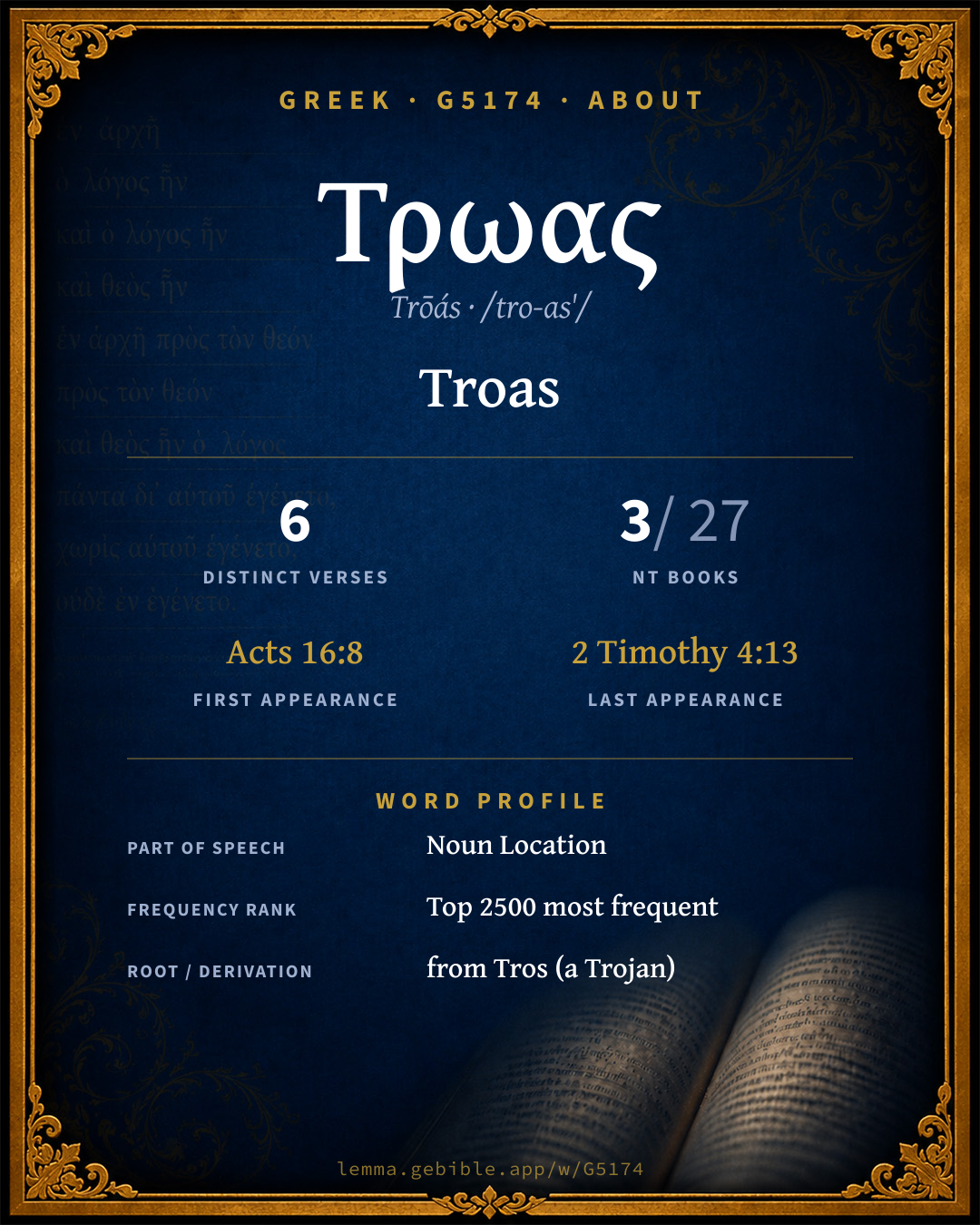
Τρωάς
Troas
Thayer's lists 2 entries for ‘Troas’ fuller range ↓
Full lexicon entry — Thayer's Greek Lexicon
From Thayer's Greek Lexicon
Where this word appears
See every Accusative-case word in the Greek New Testament →
Grammar key — what these labels mean
Part of speech
- Noun
- A naming word — a person, place, thing, or idea.
Case
- Accusative
- The case of the direct object and of extent.
- Dative
- The case of the indirect object, means, or location — “to / for / with / in.”
- Genitive
- The case of source, possession, or “of” — answers “whose / from what.”
Gender
- Feminine
- Grammatically feminine.
Number
- Singular
- One.
Grammatical forms
- Noun, Accusative, Singular, Feminine 3 times (50%)
- Noun, Dative, Singular, Feminine 2 times (33%)
- Noun, Genitive, Singular, Feminine 1 time (17%)
Parsed forms decoded from the imported morphology (Robinson–Tischendorf, public domain), counted across 6 parsed occurrences — not distinct verses.
Every verse where G5174 appears — 6 distinct verses across 3 books. Click any verse to open its interlinear word-by-word view. Verse text shown in the World English Bible for context — . Each verse’s Greek form is shown with its reference; the English is not keyword-highlighted, since the data carries no word-level English alignment. Use “Compare translations” on any verse to read it across multiple English versions. This concordance covers the Greek New Testament; Septuagint (Greek Old Testament) occurrences of this word are not indexed here.
Acts 4 verses
- Acts 16:8 Τρῳάδα n acc sg fem Passing by Mysia, they came down to Troas.
- Acts 16:11 Τρῳάδος n gen sg fem Setting sail therefore from Troas, we made a straight course to Samothrace, and the day following to Neapolis;
- Acts 20:5 Τρῳάδι n dat sg fem But these had gone ahead, and were waiting for us at Troas.
- Acts 20:6 Τρῳάδα n acc sg fem We sailed away from Philippi after the days of Unleavened Bread, and came to them at Troas in five days, where we stayed seven days.
2 Corinthians 1 verse
2 Timothy 1 verse
About this entry
At a glance — auto-summarized from this page’s data, not written by a person. Every figure links to its source below. This summary describes the numbers; it doesn’t interpret them.
Τρωας (Trōás) is a Greek name most often rendered “Troas.” It clusters heavily in Acts, which alone accounts for 67% of its uses. With 6 verses in 3 books, it is an uncommon word in the Greek New Testament. It first appears in Acts 16:8. The sections below give every occurrence and version rendering.
Gloss history
Strong's 1890 vs modern scholarship
About this word
Strong's G5174 catalogs a Greek word from the Greek New Testament.
These counts are not copied from any lexicon or concordance. They are computed here, from the morphology-tagged Greek New Testament. What Lemma adds →
- 6
- distinct verses
- The word appears in 6 distinct verses.
- 3 / 27
- NT books
- The word appears in 3 of 27 New Testament books.
- #1,476
- by frequency
- Top 2500 most frequent Greek words (rank 1,476 of 5,347 Greek words by occurrence).
View all 6 occurrences in the concordance →
Most concentrated in
- Acts 4 verses 67%
- 2 Corinthians 1 verse 17%
- 2 Timothy 1 verse 17%
By section of the New Testament
By traditional corpus
Conventional, traditional groupings — biblical authorship is debated, so this is a traditional corpus grouping, not an authorship claim. Some books belong to more than one corpus (Luke is in both the Gospels and the Lukan corpus, and so on), so these shares overlap and need not total 100%. Each figure is a share of the word’s 6 distinct verses.
- Lukan (Luke–Acts) 4 verses · 67%
- Pauline corpus 2 verses · 33%
How translations render this word
Counts come from each version’s own published word-to-Strong’s tagging or interlinear alignment — an approximate guide to how each version renders this word, not a word-level alignment the data otherwise carries. Because each total is that version’s own tagged count, the per-version totals vary from one another and need not match the appearance or distinct-verse counts above. These counts may also differ from a printed concordance because Lemma counts each distinctly tagged rendering and does not collapse phrase taggings into a single head-word total. This is a fixed set of word-tagged versions (KJV, ASV, BSB, ULT) and does not change with the reading translation you choose elsewhere. Each version’s license is shown beside its name below (and on Sources).
- King James Version: Troas 6×
- American Standard Version: Troas 6×
- Berean Standard Bible: Troas 6×
- unfoldingWord Literal Text: Troas 6×
King James Version Public Domain
Renders G5174 across 6 tagged occurrences — most commonly:
American Standard Version Public Domain
Renders G5174 across 6 tagged occurrences — most commonly:
Berean Standard Bible Public Domain
Renders G5174 across 6 tagged occurrences — most commonly:
unfoldingWord Literal Text CC BY-SA 4.0
Renders G5174 across 6 tagged occurrences — most commonly:
Senses in Thayer's
The 2 senses Thayer's distinguishes for this word, in lexicon order (not ranked by frequency or importance). The full entry — with sub-senses — is in the Lexicon Entry tab.
- Troas = "a Trojan"
- a city near Hellespont
Word origin
Origin: from Tros (a Trojan)
From Τρός Tros (a Trojan ); the Troad (or plain of Troy) that is Troas a place in Asia Minor : - Troas.
— Strong’s Exhaustive Concordance (1890), public domain.
Forms in the corpus
The 3 distinct written forms G5174 takes in the Greek New Testament, most frequent first — each parse links to that case’s occurrences in the concordance.
| Form | Parsing | Example | Uses |
|---|---|---|---|
| Τρῳάδα Trōáda | Noun, Accusative, Singular, Feminine | Acts 16:8 | 3 |
| Τρῳάδι Trōádi | Noun, Dative, Singular, Feminine | Acts 20:5 | 2 |
| Τρῳάδος Trōádos | Noun, Genitive, Singular, Feminine | Acts 16:11 | 1 |
Bible dictionary
Public-domain dictionary articles matched to this entry by name (Troas). A biblical name can be shared by more than one person or place, so an article may treat several.
Easton's Bible Dictionary · M. G. Easton, 1897
A city on the coast of Mysia, in the north-west of Asia Minor, named after ancient Troy, which was at some little distance from it (about 4 miles) to the north. Here Paul, on his second missionary journey, saw the vision of a "man of Macedonia," who appeared to him, saying, "Come over, and help us" (Acts 16:8-11). He visited this place also on other occasions, and on one of these visits he left his cloak and some books there (2 Cor. 2:12; 2 Tim. 4:13). The ruins of Troas extend over many miles, the site being now mostly covered with a forest of oak trees. The modern name of the ruins is Eski Stamboul i.e., Old Constantinople.
Smith's Bible Dictionary · William Smith, 1863
the city from which St. Paul first sailed, in consequence of a divine intimation, to carry the gospel from Asia to Europe. (Acts 16:8,11) It is mentioned on other occasions. (Acts 20:5,6; 2 Corinthians 2:12,13; 2 Timothy 4:13) Its full name was Alexandria Troas (Liv. xxxv. 42), and sometimes it was called simply Alexandria sometimes simply Troas. It was first built by Antigonus under the name of Antigonea Troas, and peopled with the inhabitants of some neighboring cities. Afterward it was embellished by Lysimachus, and named Alexandria Troas. Its situation was on the coast of Mysia, opposite the southeast extremity of the island of Tenedos. Under the Romans it was one of the most important towns of the province of Asia. In the time of St. Paul it was a colonia with the Jus Italicum . The modern name is Eski-Stamboul, with considerable ruins. We can still trace the harbor in a basin about 400 feet long and 200 broad.
Hitchcock's Bible Names Dictionary · Roswell D. Hitchcock, 1869
penetrated
Classic public-domain reference works; full attribution on Sources.