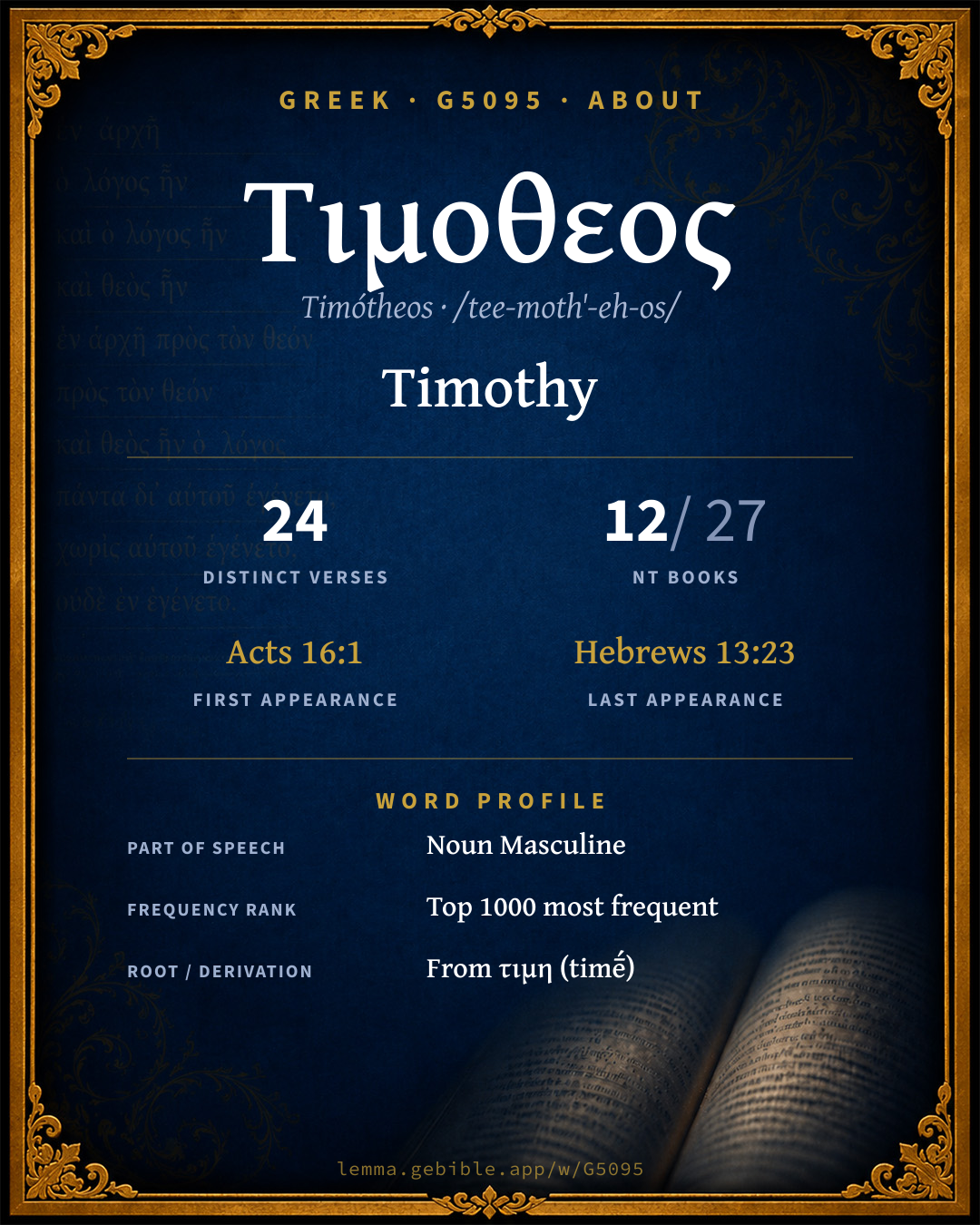
Τιμόθεος
Timothy
Thayer's lists 2 entries for ‘Timothy’ fuller range ↓
Full lexicon entry — Thayer's Greek Lexicon
From Thayer's Greek Lexicon
Where this word appears
Grammar key — what these labels mean
Part of speech
- Noun
- A naming word — a person, place, thing, or idea.
Case
- Nominative
- The case of the subject (and the predicate nominative).
- Accusative
- The case of the direct object and of extent.
- Dative
- The case of the indirect object, means, or location — “to / for / with / in.”
- Genitive
- The case of source, possession, or “of” — answers “whose / from what.”
- Vocative
- The case of direct address (“O Lord”).
Gender
- Masculine
- Grammatically masculine.
Number
- Singular
- One.
Every verse where G5095 appears in the Book of Romans — 1 distinct verse. Click any verse to open its interlinear word-by-word view. Verse text shown in the World English Bible for context — . Each verse’s Greek form is shown with its reference; the English is not keyword-highlighted, since the data carries no word-level English alignment. Use “Compare translations” on any verse to read it across multiple English versions. This concordance covers the Greek New Testament; Septuagint (Greek Old Testament) occurrences of this word are not indexed here.
Romans
About this entry
At a glance — auto-summarized from this page’s data, not written by a person. Every figure links to its source below. This summary describes the numbers; it doesn’t interpret them.
The Greek name Τιμοθεος centers on the idea of “Timothy.” Its earliest occurrence is Acts 16:1. It turns up in 24 verses across 12 books, an uncommon footprint. The word gravitates to Acts (25%), then 1 Thessalonians and 1 Timothy. Dig into 24-verse concordance and the renderings breakdown below.
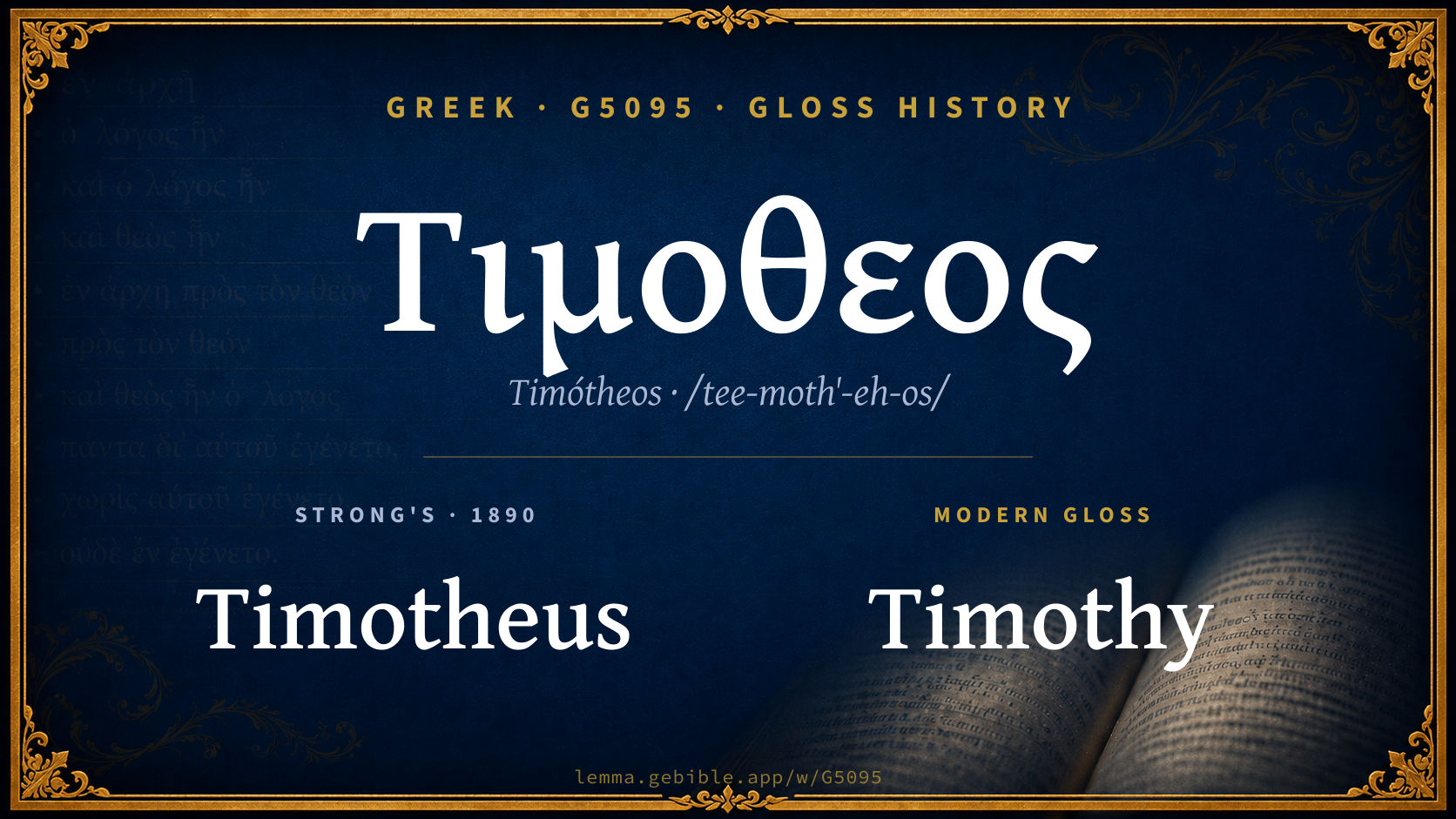
Gloss history
Strong's 1890 vs modern scholarship
About this word
Strong's G5095 catalogs a Greek word from the Greek New Testament.
These counts are not copied from any lexicon or concordance. They are computed here, from the morphology-tagged Greek New Testament. What Lemma adds →
- 24
- distinct verses
- The word appears in 24 distinct verses.
- 12 / 27
- NT books
- The word appears in 12 of 27 New Testament books.
- #548
- by frequency
- Top 1000 most frequent Greek words (rank 548 of 5,347 Greek words by occurrence).
View all 24 occurrences in the concordance →
Most concentrated in
- Acts 6 verses 25%
- 1 Thessalonians 3 verses 13%
- 1 Timothy 3 verses 13%
By section of the New Testament
By traditional corpus
Conventional, traditional groupings — biblical authorship is debated, so this is a traditional corpus grouping, not an authorship claim. Some books belong to more than one corpus (Luke is in both the Gospels and the Lukan corpus, and so on), so these shares overlap and need not total 100%. Each figure is a share of the word’s 24 distinct verses.
- Pauline corpus 17 verses · 71%
- Lukan (Luke–Acts) 6 verses · 25%
- Hebrews 1 verse · 4%
How translations render this word
Counts come from each version’s own published word-to-Strong’s tagging or interlinear alignment — an approximate guide to how each version renders this word, not a word-level alignment the data otherwise carries. Because each total is that version’s own tagged count, the per-version totals vary from one another and need not match the appearance or distinct-verse counts above. These counts may also differ from a printed concordance because Lemma counts each distinctly tagged rendering and does not collapse phrase taggings into a single head-word total. This is a fixed set of word-tagged versions (KJV, ASV, BSB, ULT) and does not change with the reading translation you choose elsewhere. Each version’s license is shown beside its name below (and on Sources).
- King James Version: Timotheus 17×, Timothy 7×
- American Standard Version: Timothy 24×
- Berean Standard Bible: Timothy 24×
- unfoldingWord Literal Text: Timothy 24×
King James Version Public Domain
Renders G5095 across 24 tagged occurrences — most commonly:
American Standard Version Public Domain
Renders G5095 across 24 tagged occurrences — most commonly:
Berean Standard Bible Public Domain
Renders G5095 across 24 tagged occurrences — most commonly:
unfoldingWord Literal Text CC BY-SA 4.0
Renders G5095 across 24 tagged occurrences — most commonly:
Senses in Thayer's
The 2 senses Thayer's distinguishes for this word, in lexicon order (not ranked by frequency or importance). The full entry — with sub-senses — is in the Lexicon Entry tab.
- Timothy = "honouring God"
- a resident of Lystra…
Word origin
Derived from τιμη (timḗ) (G5092) — honor.
Forms in the corpus
The 5 distinct written forms G5095 takes in the Greek New Testament, most frequent first — each parse links to that case’s occurrences in the concordance.
| Form | Parsing | Example | Uses |
|---|---|---|---|
| Τιμόθεος Timótheos | Noun, Nominative, Singular, Masculine | Acts 16:1 | 12 |
| Τιμόθεον Timótheon | Noun, Accusative, Singular, Masculine | Acts 17:15 | 6 |
| Τιμοθέου Timothéou | Noun, Genitive, Singular, Masculine | 2 Corinthians 1:19 | 2 |
| Τιμοθέῳ Timothéō | Noun, Dative, Singular, Masculine | 1 Timothy 1:2 | 2 |
| Τιμόθεε Timóthee | Noun, Vocative, Singular, Masculine | 1 Timothy 1:18 | 2 |
Same root — word family
Other Thayer's entries built from the same root as G5095, grouped by Strong’s listed origin. These share a root / origin per the lexicon — not necessarily a shared meaning. Each links to that word’s own entry.
Derives from
Shares the same root
Proper names from this root
People and places named from this root — a name, not an additional meaning of the word.
Compare all same-root words → Showing 4 of 5 — not the complete family. 1 of the same-root words is a proper name (a person or place). They share a root, not necessarily a meaning.
Bible dictionary
Public-domain dictionary articles matched to this entry by name (Timothy). A biblical name can be shared by more than one person or place, so an article may treat several.
Easton's Bible Dictionary · M. G. Easton, 1897
Honouring God, a young disciple who was Paul's companion in many of his journeyings. His mother, Eunice, and his grandmother, Lois, are mentioned as eminent for their piety (2 Tim. 1:5). We know nothing of his father but that he was a Greek (Acts 16:1). He is first brought into notice at the time of Paul's second visit to Lystra (16:2), where he probably resided, and where it seems he was converted during Paul's first visit to that place (1 Tim. 1:2; 2 Tim. 3:11). The apostle having formed a high opinion of his "own son in the faith," arranged that he should become his companion (Acts 16:3), and took and circumcised him, so that he might conciliate the Jews. He was designated to the office of an evangelist (1 Tim. 4:14), and went with Paul in his journey through Phrygia, Galatia, and Mysia; also to Troas and Philippi and Berea (Acts 17:14). Thence he followed Paul to Athens, and was sent by him with Silas on a mission to Thessalonica (17:15; 1 Thess. 3:2). We next find him at Corinth (1 Thess. 1:1; 2 Thess. 1:1) with Paul. He passes now out of sight for a few years, and is again noticed as with the apostle at Ephesus (Acts 19:22), whence he is sent on a mission into Macedonia. He accompanied Paul afterwards into Asia (20:4), where he was with him for some time. When the apostle was a prisoner at Rome, Timothy joined him (Phil. 1:1), where it appears he also suffered imprisonment (Heb. 13:23). During the apostle's second imprisonment he wrote to Timothy, asking him to rejoin him as soon as possible, and to bring with him certain things which he had left at Troas, his cloak and parchments (2 Tim. 4:13). According to tradition, after the apostle's death he settled in Ephesus as his sphere of labour, and there found a martyr's grave.
Smith's Bible Dictionary · William Smith, 1863
The disciple thus named was the son of one of those mixed marriages which, though condemned by stricter Jewish opinion were yet not uncommon in the later periods of Jewish history. The father's name is unknown; he was a Greek, i.e. a Gentile, by descent. (Acts 16:1,3) The absence of any personal allusion to the father in the Acts or Epistles suggests the inference that he must have died or disappeared during his son's infancy. The care of the boy thus devolved upon his mother Eunice and her mother Lois. (2 Timothy 1:5) Under their training his education was emphatically Jewish. "From a child" he learned to "know the Holy Scriptures" daily. The language of the Acts leaves it uncertain whether Lystra or Derbe was the residence of the devout family. The arrival of Paul and Barnabas in Lycaonia, A.D. 44, (Acts 14:6) brought the message of glad tidings to Timothy and his mother, and they received it with "unfeigned faith." (2 Timothy 1:5) During the interval of seven years between the apostle's first and second journeys the boy grew up to manhood. Those who had the deepest insight into character, and spoke with a prophetic utterance, pointed to him, (1 Timothy 1:18; 4:14) as others had pointed before to Paul and Barnabas, (Acts 13:2) as specially fit for the missionary work in which the apostle was engaged. Personal feeling led St. Paul to the same conclusion, (Acts 16:3) and he was solemnly set apart to do the work and possibly to bear the title of evangelist. (1 Timothy 4:14; 2 Timothy 1:6; 4:5) A great obstacle, however, presented itself. Timothy, though reckoned as one of the seed of Abraham, had been allowed to grow up to the age of manhood without the sign of circumcision. With a special view to the feelings of the Jews making no sacrifice of principle, the apostle, who had refused to permit the circumcision of Titus, "took and circumcised" Timothy. (Acts 16:3) Henceforth Timothy was one of his most constant companions. They and Silvanus, and probably Luke also, journeyed to Philippi, (Acts 16:12) and there the young evangelist was conspicuous at once for his filial devotion and his zeal. (Philemon 2:22) His name does not appear in the account of St. Paul's work at Thessalonica, and it is possible that he remained some time at Philippi. He appears, however, at Berea, and remains there when Paul and Silas are obliged to leave, (Acts 17:14) going afterward to join his master at Athens. (1 Thessalonians 3:2) From Athens he is sent back to Thessalonica, ibid., as having special gifts for comforting and teaching. He returns from Thessalonica, not to Athens, but to Corinth, and his name appears united with St. Paul's in the opening words of both the letters written from that city to the Thessalonians, (1 Thessalonians 1:1; 2 Thessalonians 1:1) Of the next five years of his life we have no record. When we next meet with him, it is as being sent on in advance when the apostle was contemplating the long journey which was to include Macedonia, Achaia, Jerusalem and Rome. (Acts 19:22) It is probable that he returned by the same route and met St. Paul according to a previous arrangement, (1 Corinthians 16:11) and was thus with him when the Second Epistle was written to the church of Corinth. (2 Corinthians 1:1) He returns with the apostle to that city, and joins in messages of greeting to the disciples whom he had known personally at Corinth, and who had since found their way to Rome. (Romans 16:21) He forms one of the company of friends who go with St. Paul to Philippi, and then sail by themselves, waiting for his arrival by a different ship. (Acts 20:3-6) The absence of his name from (Acts 27:1) ... leads to the conclusion that he did not share in the perilous voyage to Italy. He must have joined the apostle, however, apparently soon after his arrival at Rome, and was with him when the Epistles to the Philippians, to the Colossians and to Philemon were written. (Philemon 1:1; 2:19; Colossians 1:1) Phil. ver. 1. All the indications of this period point to incessant missionary activity. From the two Epistles addressed to Timothy we are able to put together a few notices as to his later from (1 Timothy 1:3) that he and his master after the release of the latter from his imprisonment, A.D. 63, revisited proconsular Asia; that the apostle then continued his Journey to Macedonia, while the disciple remained, half reluctantly, even weeping at the separation, (2 Timothy 1:4) at Ephesus, to check, if possible, the outgrowth of heresy and licentiousness which had sprung up there. The position in which he found himself might well make him anxious. He used to rule presbyters most of whom were older than himself (1 Timothy 4:12) Leaders of rival sects were there. The name of his beloved teacher was no longer honored as it had been. We cannot wonder that the apostle, knowing these trials should be full of anxiety and fear for his disciple's steadfastness. In the Second Epistle to him, A.D. 67 or 68, this deep personal feeling utters itself yet more fully. The last recorded words of the apostle express the earnest hope, repented yet more earnestly, that he might see him once again. (2 Timothy 4:9,21) We may hazard the conjecture that he reached him in time, and that the last hours of the teacher were soothed by the presence of the disciple whom he loved so truly. Some writers have seen in (Hebrews 13:23) an indication that he even shared St. Paul's imprisonment, and was released from it by the death of Nero. Beyond this all is apocryphal and uncertain. He continued, according to the old traditions, to act as bishop of Ephesus, and died a martyr's death under Domitian or Nerva. A somewhat startling theory as to the intervening period of his life has found favor with some. If he continued, according to the received tradition, to be bishop of Ephesus, then he, and no other, must have been the "angel" of the church of Ephesus to whom the message of (Revelation 2:1-7) was addressed.
Classic public-domain reference works; full attribution on Sources.