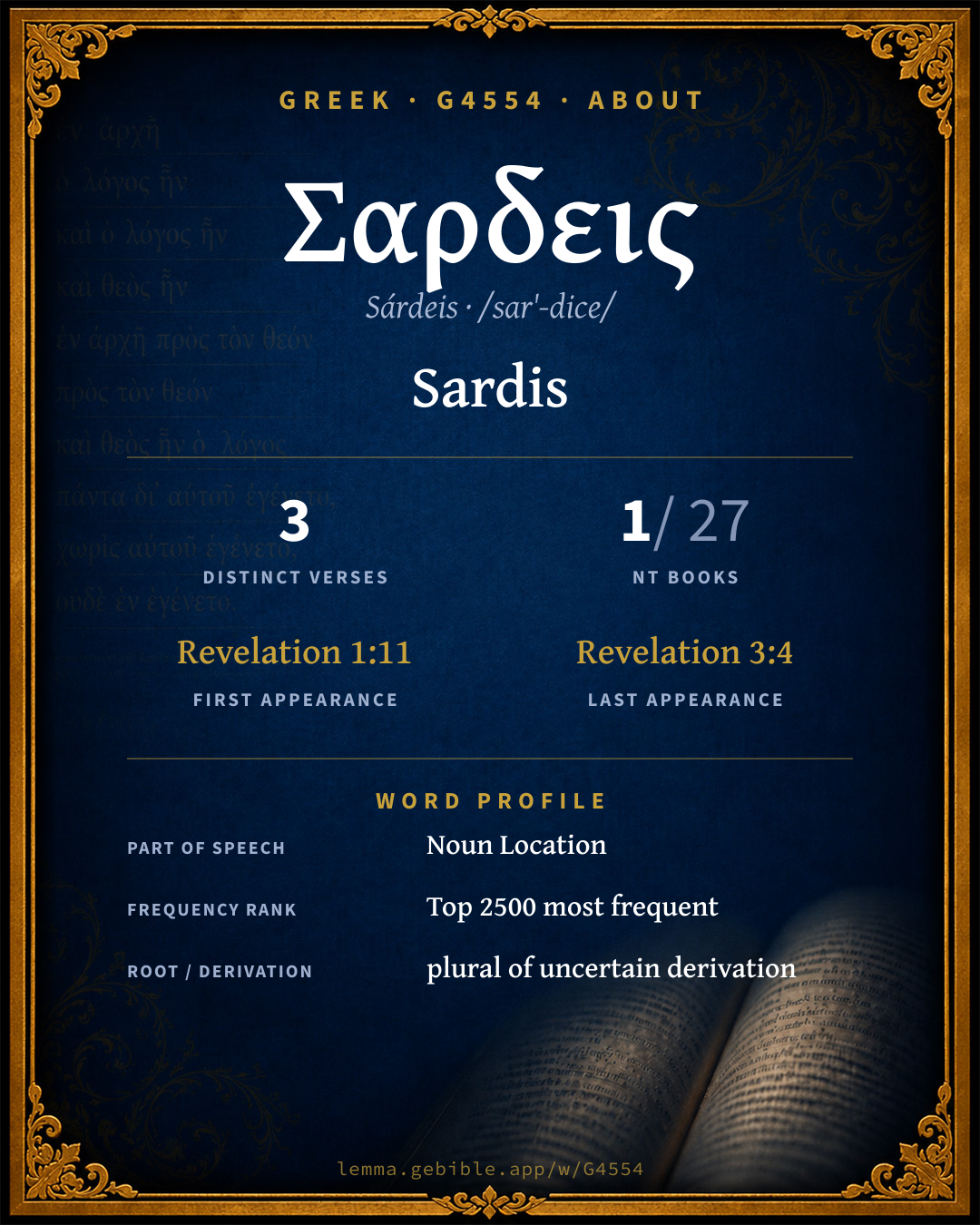
Σάρδεις
Sardis
Thayer's lists 2 entries for ‘Sardis’ fuller range ↓
Full lexicon entry — Thayer's Greek Lexicon
From Thayer's Greek Lexicon
Where this word appears
See every Dative-case word in the Greek New Testament →
Grammar key — what these labels mean
Part of speech
- Noun
- A naming word — a person, place, thing, or idea.
Case
- Dative
- The case of the indirect object, means, or location — “to / for / with / in.”
- Accusative
- The case of the direct object and of extent.
Gender
- Feminine
- Grammatically feminine.
Number
- Plural
- More than one.
2 distinct verses where G4554 appears in the Dative case, across 1 book. Filtered view — show all forms. Click any verse to open its interlinear word-by-word view. Verse text shown in the World English Bible for context — . Each verse’s Greek form is shown with its reference; the English is not keyword-highlighted, since the data carries no word-level English alignment. Use “Compare translations” on any verse to read it across multiple English versions. This concordance covers the Greek New Testament; Septuagint (Greek Old Testament) occurrences of this word are not indexed here.
Revelation 2 verses
- Revelation 3:1 Σάρδεσιν n dat pl fem "And to the angel of the assembly in Sardis write: He who has the seven Spirits of God, and the seven stars says these things: "I know your works, that you have a reputation of being alive, but you are dead.
- Revelation 3:4 Σάρδεσιν n dat pl fem Nevertheless you have a few names in Sardis that did not defile their garments. They will walk with me in white, for they are worthy.
About this entry
At a glance — auto-summarized from this page’s data, not written by a person. Every figure links to its source below. This summary describes the numbers; it doesn’t interpret them.
Σαρδεις (Sárdeis) is a Greek name most often rendered “Sardis.” The Greek New Testament uses it only 3 verses. It clusters heavily in Revelation, which alone accounts for 100% of its uses. It first appears in Revelation 1:11. For the data behind this summary, explore 3-verse concordance and the renderings breakdown below.
Gloss history
Strong's 1890 vs modern scholarship
About this word
Strong's G4554 catalogs a Greek word from the Greek New Testament.
These counts are not copied from any lexicon or concordance. They are computed here, from the morphology-tagged Greek New Testament. What Lemma adds →
- 3
- distinct verses
- The word appears in 3 distinct verses.
- 1 / 27
- NT books
- The word appears in 1 of 27 New Testament books.
- #2,203
- by frequency
- Top 2500 most frequent Greek words (rank 2,203 of 5,347 Greek words by occurrence).
View all 3 occurrences in the concordance →
Most concentrated in
- Revelation 3 verses 100%
By section of the New Testament
By traditional corpus
Conventional, traditional groupings — biblical authorship is debated, so this is a traditional corpus grouping, not an authorship claim. Some books belong to more than one corpus (Luke is in both the Gospels and the Lukan corpus, and so on), so these shares overlap and need not total 100%. Each figure is a share of the word’s 3 distinct verses.
- Johannine 3 verses · 100%
- Revelation 3 verses · 100%
How translations render this word
Counts come from each version’s own published word-to-Strong’s tagging or interlinear alignment — an approximate guide to how each version renders this word, not a word-level alignment the data otherwise carries. Because each total is that version’s own tagged count, the per-version totals vary from one another and need not match the appearance or distinct-verse counts above. These counts may also differ from a printed concordance because Lemma counts each distinctly tagged rendering and does not collapse phrase taggings into a single head-word total. This is a fixed set of word-tagged versions (KJV, ASV, BSB, ULT) and does not change with the reading translation you choose elsewhere. Each version’s license is shown beside its name below (and on Sources).
- King James Version: Sardis 3×
- American Standard Version: Sardis 3×
- Berean Standard Bible: Sardis 3×
- unfoldingWord Literal Text: Sardis 3×
King James Version Public Domain
Renders G4554 across 3 tagged occurrences — most commonly:
American Standard Version Public Domain
Renders G4554 across 3 tagged occurrences — most commonly:
Berean Standard Bible Public Domain
Renders G4554 across 3 tagged occurrences — most commonly:
unfoldingWord Literal Text CC BY-SA 4.0
Renders G4554 across 3 tagged occurrences — most commonly:
Senses in Thayer's
The 2 senses Thayer's distinguishes for this word, in lexicon order (not ranked by frequency or importance). The full entry — with sub-senses — is in the Lexicon Entry tab.
- Sardis = "red ones"
- a luxurious city in Asia Minor, the capital of Lydia
Word origin
Origin: plural of uncertain derivation
Plural of uncertain derivation; Sardis a place in Asia Minor : - Sardis.
— Strong’s Exhaustive Concordance (1890), public domain.
Forms in the corpus
The 2 distinct written forms G4554 takes in the Greek New Testament, most frequent first — each parse links to that case’s occurrences in the concordance.
| Form | Parsing | Example | Uses |
|---|---|---|---|
| Σάρδεσιν Sárdesin | Noun, Dative, Plural, Feminine | Revelation 3:1 | 2 |
| Σάρδεις Sárdeis | Noun, Accusative, Plural, Feminine | Revelation 1:11 | 1 |
Bible dictionary
Public-domain dictionary articles matched to this entry by name (Sardis). A biblical name can be shared by more than one person or place, so an article may treat several.
Easton's Bible Dictionary · M. G. Easton, 1897
The metropolis of Lydia in Asia Minor. It stood on the river Pactolus, at the foot of mount Tmolus. Here was one of the seven Asiatic churches (Rev. 3:1-6). It is now a ruin called Sert-Kalessi.
Smith's Bible Dictionary · William Smith, 1863
a city of Asia Minor and capital of Lydia, situated about two miles to the south of the river Hermus, just below the range of Tmolus, on a spur of which its acropolis was built. It was 60 miles northeast of Smyrna. It was the ancient residence of the kings of Lydia, among them Croesus, proverbial for his immense wealth. Cyrus is said to have taken,000,000 worth of treasure form the city when he captured it, B.C. 548. Sardis was in very early times, both from the extremely fertile character of the neighboring region and from its convenient position, a commercial mart of importance. The art of dyeing wool is said to have been invented there. In the year 214 B.C. it was taken and sacked by the army of Antiochus the Great. Afterward it passed under the dominion of the kings of Pergamos. Its productive soil must always have continued a source of wealth; but its importance as a central mart appears to have diminished from the time of the invasion of Asia by Alexander. The massive temple of Cybele still bears witness in its fragmentary remains to the wealth and architectural skill of the people that raised it. On the north side of the acropolis, overlooking the valley of the Hermus, is a theatre near 400 feet in diameter, attached to a stadium of about 1000. There are still considerable remains of the ancient city at Sert-Kalessi . Travellers describe the appearance of the locality as that of complete solitude. The only passage in which it is mentioned in the Bible is (Revelation 3:1-6)
Hitchcock's Bible Names Dictionary · Roswell D. Hitchcock, 1869
prince of joy
Classic public-domain reference works; full attribution on Sources.