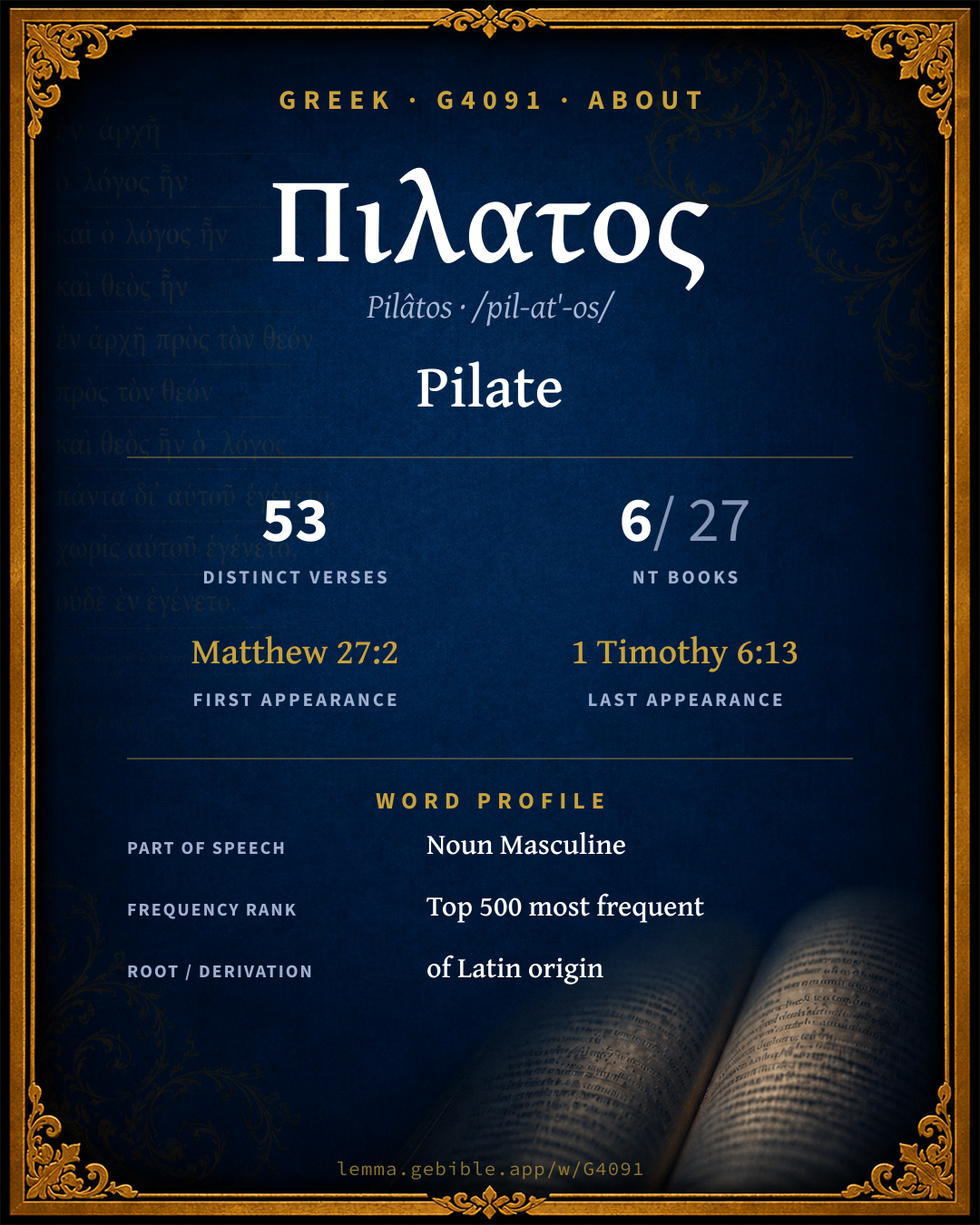
Πιλάτος
Pilate
Thayer's lists 2 entries for ‘Pilate’ fuller range ↓
Full lexicon entry — Thayer's Greek Lexicon
From Thayer's Greek Lexicon
Where this word appears
See every Nominative-case word in the Greek New Testament →
Grammar key — what these labels mean
Part of speech
- Noun
- A naming word — a person, place, thing, or idea.
Case
- Nominative
- The case of the subject (and the predicate nominative).
- Accusative
- The case of the direct object and of extent.
- Dative
- The case of the indirect object, means, or location — “to / for / with / in.”
- Genitive
- The case of source, possession, or “of” — answers “whose / from what.”
Gender
- Masculine
- Grammatically masculine.
Number
- Singular
- One.
7 verses where G4091 appears in the Nominative case in the Book of Mark. Filtered view — show all forms. Click any verse to open its interlinear word-by-word view. Verse text shown in the World English Bible for context — . Each verse’s Greek form is shown with its reference; the English is not keyword-highlighted, since the data carries no word-level English alignment. Use “Compare translations” on any verse to read it across multiple English versions. This concordance covers the Greek New Testament; Septuagint (Greek Old Testament) occurrences of this word are not indexed here.
Mark
- Mark 15:2 Πειλᾶτος n nom sg masc Pilate asked him, "Are you the King of the Jews?" He answered, "So you say."
- Mark 15:4 Πειλᾶτος n nom sg masc Pilate again asked him, "Have you no answer? See how many things they testify against you!"
- Mark 15:9 Πειλᾶτος n nom sg masc Pilate answered them, saying, "Do you want me to release to you the King of the Jews?"
- Mark 15:12 Πειλᾶτος n nom sg masc Pilate again asked them, "What then should I do to him whom you call the King of the Jews?"
- Mark 15:14 Πειλᾶτος n nom sg masc Pilate said to them, "Why, what evil has he done?" But they cried out exceedingly, "Crucify him!"
- Mark 15:15 Πειλᾶτος n nom sg masc Pilate, wishing to please the multitude, released Barabbas to them, and handed over Jesus, when he had flogged him, to be crucified.
- Mark 15:44 Πειλᾶτος n nom sg masc Pilate marveled if he were already dead; and summoning the centurion, he asked him whether he had been dead long.
About this entry
At a glance — auto-summarized from this page’s data, not written by a person. Every figure links to its source below. This summary describes the numbers; it doesn’t interpret them.
Πιλατος — transliterated Pilâtos — is a Greek name carrying the sense “Pilate.” Debuting at Matthew 27:2, it then recurs through the corpus. With 53 verses in 6 books, it is a moderately common word in the Greek New Testament. Its uses concentrate in John (36% of all occurrences). See 53-verse concordance and the renderings breakdown below.
Gloss history
Strong's 1890 vs modern scholarship
About this word
Strong's G4091 catalogs a Greek word from the Greek New Testament.
These counts are not copied from any lexicon or concordance. They are computed here, from the morphology-tagged Greek New Testament. What Lemma adds →
- 53
- distinct verses
- The word appears in 53 distinct verses.
- 6 / 27
- NT books
- The word appears in 6 of 27 New Testament books.
- #292
- by frequency
- Top 500 most frequent Greek words (rank 292 of 5,347 Greek words by occurrence).
View all 53 occurrences in the concordance →
By section of the New Testament
By traditional corpus
Conventional, traditional groupings — biblical authorship is debated, so this is a traditional corpus grouping, not an authorship claim. Some books belong to more than one corpus (Luke is in both the Gospels and the Lukan corpus, and so on), so these shares overlap and need not total 100%. Each figure is a share of the word’s 53 distinct verses.
- Gospels 49 verses · 92%
- Johannine 19 verses · 36%
- Lukan (Luke–Acts) 15 verses · 28%
- Pauline corpus 1 verse · 2%
How translations render this word
Counts come from each version’s own published word-to-Strong’s tagging or interlinear alignment — an approximate guide to how each version renders this word, not a word-level alignment the data otherwise carries. Because each total is that version’s own tagged count, the per-version totals vary from one another and need not match the appearance or distinct-verse counts above. These counts may also differ from a printed concordance because Lemma counts each distinctly tagged rendering and does not collapse phrase taggings into a single head-word total. This is a fixed set of word-tagged versions (KJV, ASV, BSB, ULT) and does not change with the reading translation you choose elsewhere. Each version’s license is shown beside its name below (and on Sources).
- King James Version: Pilate 55×
- American Standard Version: Pilate 49×, Up to pilate 2×
- Berean Standard Bible: Pilate 54×
- unfoldingWord Literal Text: Pilate 55×
King James Version Public Domain
Renders G4091 across 55 tagged occurrences — most commonly:
American Standard Version Public Domain
Renders G4091 across 55 tagged occurrences — most commonly:
Plus 4 renderings that appear only once — usually multi-word phrases or single function words the recovered tagging swept in, not distinct renderings.
Berean Standard Bible Public Domain
Renders G4091 across 55 tagged occurrences — most commonly:
Plus 1 rendering that appears only once — usually multi-word phrases or single function words the recovered tagging swept in, not distinct renderings.
unfoldingWord Literal Text CC BY-SA 4.0
Renders G4091 across 55 tagged occurrences — most commonly:
Senses in Thayer's
The 2 senses Thayer's distinguishes for this word, in lexicon order (not ranked by frequency or importance). The full entry — with sub-senses — is in the Lexicon Entry tab.
- Pilate = "armed with a spear"
- the sixth Roman procurator of Judah and Samaria who ordered Christ to be crucified
Word origin
Origin: of Latin origin
Of Latin origin; close pressed that is firm ; Pilatus a Roman : - Pilate.
— Strong’s Exhaustive Concordance (1890), public domain.
Forms in the corpus
The 4 distinct written forms G4091 takes in the Greek New Testament, most frequent first — each parse links to that case’s occurrences in the concordance.
| Form | Parsing | Example | Uses |
|---|---|---|---|
| Πειλᾶτος Peilâtos | Noun, Nominative, Singular, Masculine | Matthew 27:13 | 39 |
| Πειλᾶτον Peilâton | Noun, Accusative, Singular, Masculine | Matthew 27:62 | 7 |
| Πειλάτῳ Peilátō | Noun, Dative, Singular, Masculine | Matthew 27:2 | 6 |
| Πειλάτου Peilátou | Noun, Genitive, Singular, Masculine | Luke 3:1 | 3 |
Bible dictionary
Public-domain dictionary articles matched to this entry by name (Pilate). A biblical name can be shared by more than one person or place, so an article may treat several.
Smith's Bible Dictionary · William Smith, 1863
(armed with a spear), Pontius. Pontius Pilate was the sixth Roman procurator of Judea, and under him our Lord worked, suffered and died, as we learn not only from Scripture, but from Tacitus (Ann. xv. 44). was appointed A.D. 25-6, in the twelfth year of Tiberius. His arbitrary administration nearly drove the Jews to insurrection on two or three occasions. One of his first acts was to remove the headquarters of the army from Caesarea to Jerusalem. The soldiers of course took with them their standards, bearing the image of the emperor, into the holy city. No previous governor had ventured on such an outrage. The people poured down in crowds to Caesarea, where the procurator was then residing, and besought him to remove the images. After five days of discussion he gave the signal to some concealed soldiers to surround the petitioners and put them to death unless they ceased to trouble him; but this only strengthened their determination, and they declared themselves ready rather to submit to death than forego their resistance to aa idolatrous innovation. Pilate then yielded, and the standards were by his orders brought down to Caesarea. His slaughter of certain Galileans, (Luke 13:1) led to some remarks from our Lord on the connection between sin and calamity. It must have occurred at some feast at Jerusalem, in the outer court of the temple. It was the custom for the procurators to reside at Jerusalem during the great feasts, to preserve order, and accordingly, at the time of our Lord's last Passover, Pilate was occupying his official residence in Herod's palace. The history of his condemnation of our Lord is familiar to all. We learn from Josephus that Pilate's anxiety to avoid giving offence to Caesar did not save him from political disaster. The Samaritans were unquiet and rebellious Pilate led his troops against them, and defeated them enough. The Samaritans complained to Vitellius, then president of Syria, and he sent Pilate to Rome to answer their accusations before the emperor. When he reached it he found Tiberius dead and Caius (Caligula) on the throne A,D, 36. Eusebius adds that soon afterward "wearied with misfortunes," he killed himself. As to the scene of his death there are various traditions. One is that he was banished to Vienna Allobrogum (Vienne on the Rhone), where a singular monument--a pyramid on a quadrangular base, 52 feet high--is called Pontius Pilate"s tomb, An other is that he sought to hide his sorrows on the mountain by the lake of Lucerne, now called Mount Pilatus; and there) after spending years in its recesses, in remorse and despair rather than penitence, plunged into the dismal lake which occupies its summit.
Hitchcock's Bible Names Dictionary · Roswell D. Hitchcock, 1869
armed with a dart
Classic public-domain reference works; full attribution on Sources.