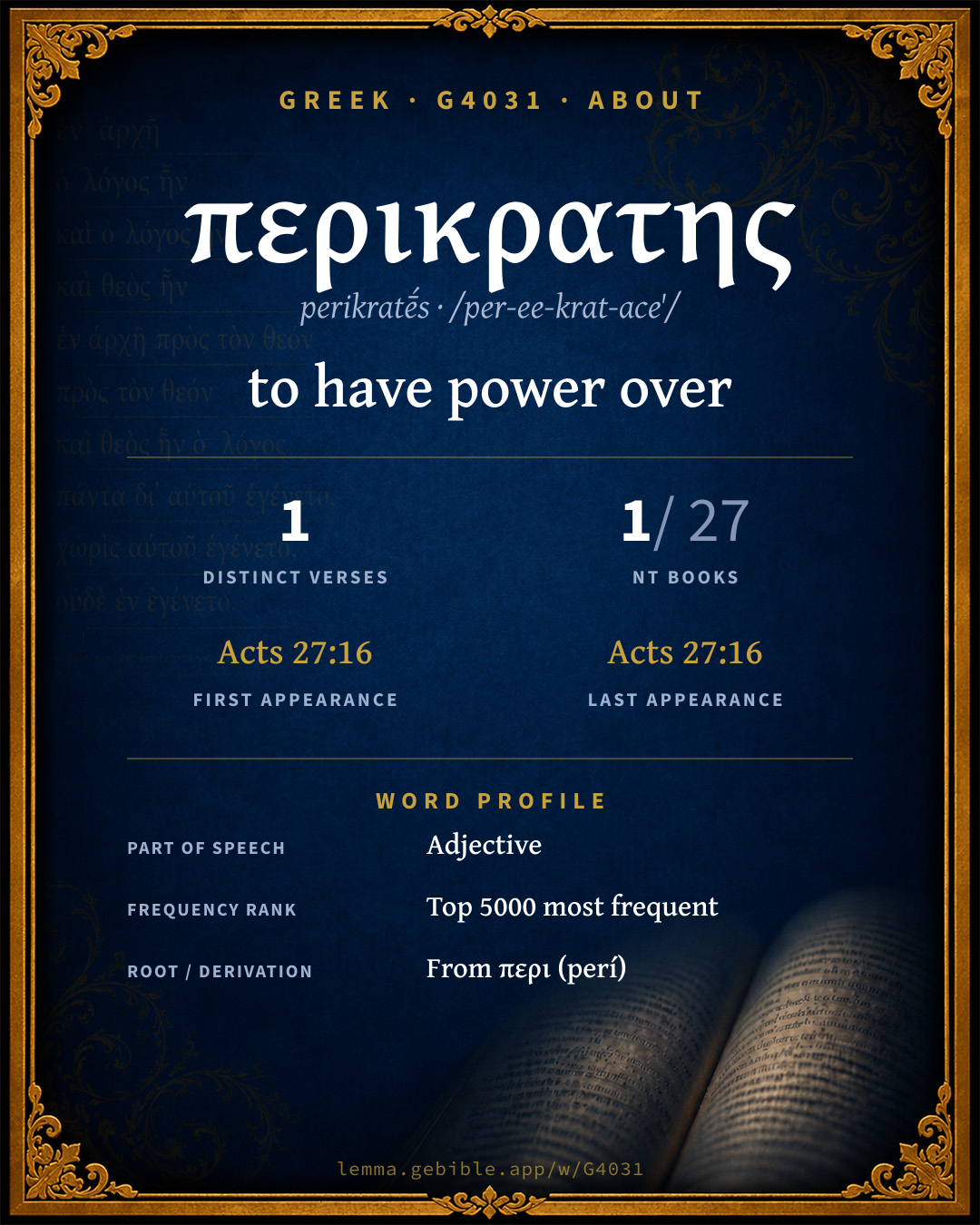
περικρατής
to have power over
Full lexicon entry — Thayer's Greek Lexicon
From Thayer's Greek Lexicon
Where this word appears
Grammar key — what these labels mean
Part of speech
- Adjective
- A word that describes or qualifies a noun.
Case
- Nominative
- The case of the subject (and the predicate nominative).
Gender
- Masculine
- Grammatically masculine.
Number
- Plural
- More than one.
Every verse where G4031 appears — 1 distinct verse across 1 book. Click any verse to open its interlinear word-by-word view. Verse text shown in the World English Bible for context — . Each verse’s Greek form is shown with its reference; the English is not keyword-highlighted, since the data carries no word-level English alignment. Use “Compare translations” on any verse to read it across multiple English versions. This concordance covers the Greek New Testament; Septuagint (Greek Old Testament) occurrences of this word are not indexed here.
Acts 1 verse
About this entry
At a glance — auto-summarized from this page’s data, not written by a person. Every figure links to its source below. This summary describes the numbers; it doesn’t interpret them.
περικρατης (perikratḗs) is a Greek adjective most often rendered “to have power over.” With only 1 verse it sits in the long tail of Greek New Testament vocabulary. Acts dominates its distribution — 1 of 1 verses. A true hapax — its single appearance is Acts 27:16. Related forms include περι, περιαγω and περιαιρεω. The sections below give every sense, occurrence, and version rendering.
Gloss history
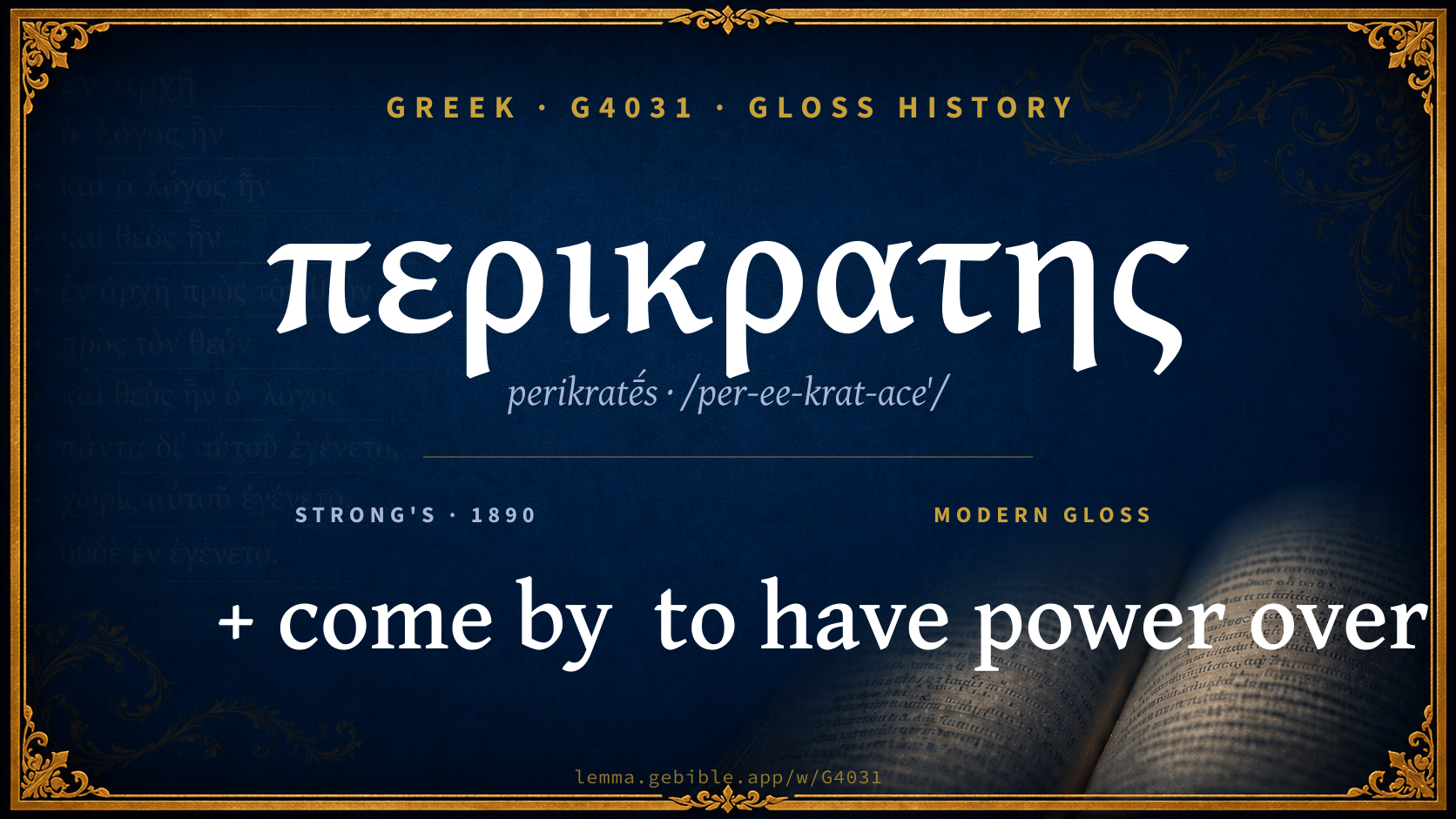
Strong's 1890 vs modern scholarship
About this word
Strong's G4031 catalogs a Greek word from the Greek New Testament.
These counts are not copied from any lexicon or concordance. They are computed here, from the morphology-tagged Greek New Testament. What Lemma adds →
- 1
- distinct verses
- The word appears in 1 distinct verse.
- 1 / 27
- NT books
- The word appears in 1 of 27 New Testament books.
- #3,503
- by frequency
- Top 5000 most frequent Greek words (rank 3,503 of 5,347 Greek words by occurrence).
View all 1 occurrence in the concordance →
Most concentrated in
- Acts 1 verse 100%
By section of the New Testament
By traditional corpus
Conventional, traditional groupings — biblical authorship is debated, so this is a traditional corpus grouping, not an authorship claim. Some books belong to more than one corpus (Luke is in both the Gospels and the Lukan corpus, and so on), so these shares overlap and need not total 100%. Each figure is a share of the word’s 1 distinct verse.
- Lukan (Luke–Acts) 1 verse · 100%
How translations render this word
Counts come from each version’s own published word-to-Strong’s tagging or interlinear alignment — an approximate guide to how each version renders this word, not a word-level alignment the data otherwise carries. Because each total is that version’s own tagged count, the per-version totals vary from one another and need not match the appearance or distinct-verse counts above. These counts may also differ from a printed concordance because Lemma counts each distinctly tagged rendering and does not collapse phrase taggings into a single head-word total. This is a fixed set of word-tagged versions (KJV, ASV, BSB, ULT) and does not change with the reading translation you choose elsewhere. Each version’s license is shown beside its name below (and on Sources).
- King James Version: Come by 1×
- American Standard Version: The 1×
- Berean Standard Bible: not separately translated
- unfoldingWord Literal Text: Controllers 1×
King James Version Public Domain
Renders G4031 across 1 tagged occurrence — most commonly:
American Standard Version Public Domain
Renders G4031 across 1 tagged occurrence — most commonly:
Berean Standard Bible Public Domain
Does not render G4031 with a distinct English word (not separately translated in its 1 tagged occurrence).
unfoldingWord Literal Text CC BY-SA 4.0
Renders G4031 across 1 tagged occurrence — most commonly:
Senses in Thayer's
The 1 sense Thayer's distinguishes for this word, in lexicon order (not ranked by frequency or importance). The full entry — with sub-senses — is in the Lexicon Entry tab.
- having power over a thing
Word origin
Derived from περι (perí) (G4012) — about.
Same root — word family
Other Thayer's entries built from the same root as G4031, grouped by Strong’s listed origin. These share a root / origin per the lexicon — not necessarily a shared meaning. Each links to that word’s own entry.
Derives from
Shares the same root
- περιαγω periágō G4013 to lead around
- περιαιρεω periairéō G4014 to take away
- περιαστραπτω periastráptō G4015 to shine around
- περιβαλλω peribállō G4016 to throw around
- περιβλεπω periblépō G4017 to look around
- περιδεω peridéō G4019 to bind around
- περιεργαζομαι periergázomai G4020 to bustle about
- περιεργος períergos G4021 busybody
- περιερχομαι periérchomai G4022 to go about
- περιεχω periéchō G4023 to surround
- περιζωννυμι perizṓnnymi G4024 to gird
- περιΐστημι periḯstēmi G4026 to stand around
- περικαθαρμα perikátharma G4027 scum
- περικαλυπτω perikalýptō G4028 to cover up
- περικειμαι períkeimai G4029 to lie around
- περικεφαλαια perikephalaía G4030 helmet
- περικρυπτω perikrýptō G4032 to hide
- περικυκλοω perikyklóō G4033 to encircle
- περιλαμπω perilámpō G4034 to shine around
- περιλειπω perileípō G4035 to remain over
- περιλυπος perílypos G4036 deeply sorrowful
- περιμενω periménō G4037 to wait for
- περιξ périx G4038 round about
- περιοικεω perioikéō G4039 to be neighbor
+17 more words share this root (not shown).
Compare all same-root words → Showing 4 of 43 — not the complete family. They share a root, not necessarily a meaning.