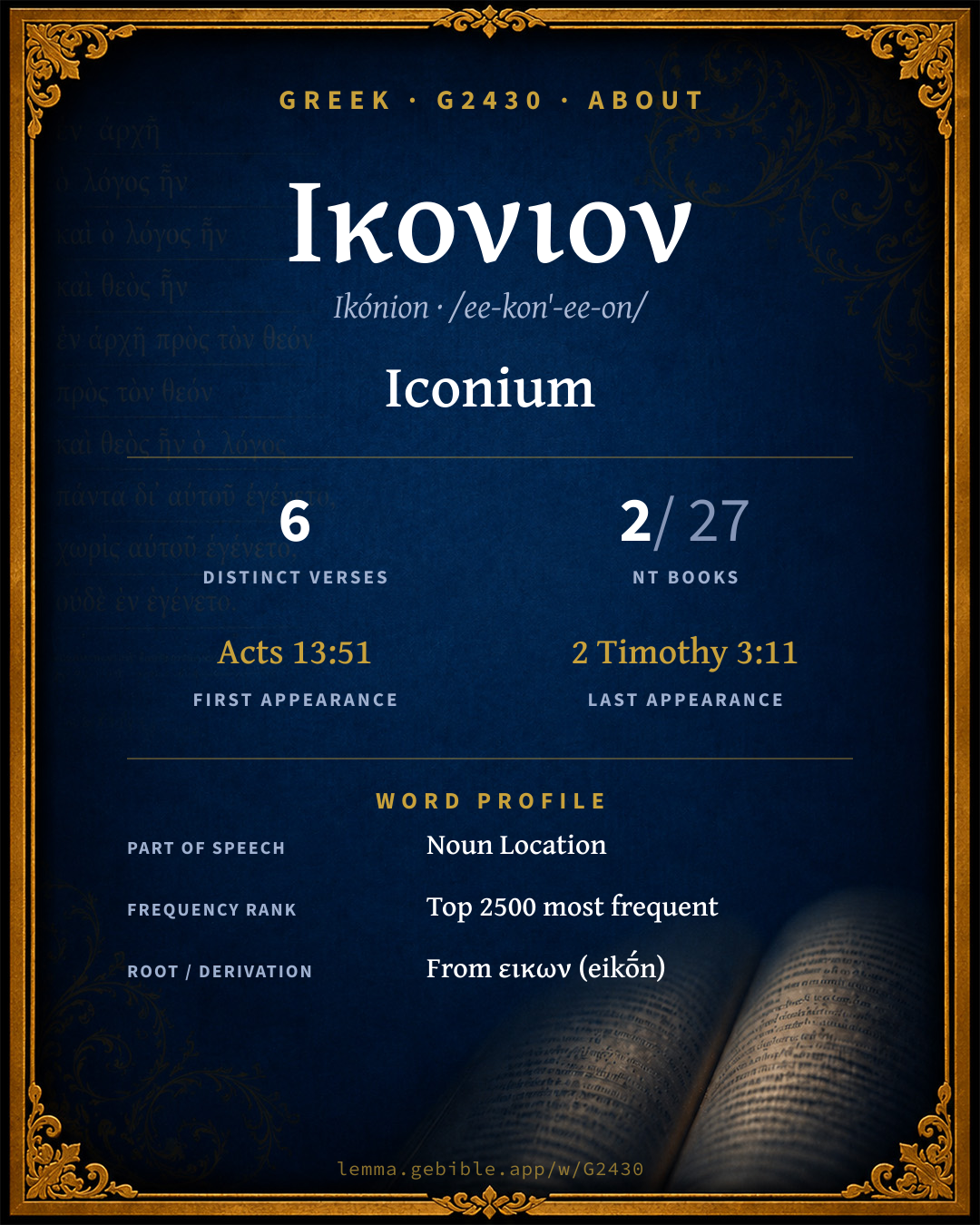
Ἰκόνιον
Iconium
Thayer's lists 2 entries for ‘Iconium’ fuller range ↓
Full lexicon entry — Thayer's Greek Lexicon
From Thayer's Greek Lexicon
Where this word appears
See every Dative-case word in the Greek New Testament →
Grammar key — what these labels mean
Part of speech
- Noun
- A naming word — a person, place, thing, or idea.
Case
- Dative
- The case of the indirect object, means, or location — “to / for / with / in.”
- Accusative
- The case of the direct object and of extent.
- Genitive
- The case of source, possession, or “of” — answers “whose / from what.”
Gender
- Neuter
- Grammatically neuter.
Number
- Singular
- One.
2 distinct verses where G2430 appears in the Accusative case, across 1 book. Filtered view — show all forms. Click any verse to open its interlinear word-by-word view. Verse text shown in the World English Bible for context — . Each verse’s Greek form is shown with its reference; the English is not keyword-highlighted, since the data carries no word-level English alignment. Use “Compare translations” on any verse to read it across multiple English versions. This concordance covers the Greek New Testament; Septuagint (Greek Old Testament) occurrences of this word are not indexed here.
Acts 2 verses
About this entry
At a glance — auto-summarized from this page’s data, not written by a person. Every figure links to its source below. This summary describes the numbers; it doesn’t interpret them.
The Greek name Ικονιον centers on the idea of “Iconium.” Acts dominates its distribution — 5 of 6 verses. The Greek New Testament uses it across 6 verses — uncommon. Its earliest occurrence is Acts 13:51. Dig into 6-verse concordance and the renderings breakdown below.
Gloss history
Strong's 1890 vs modern scholarship
About this word
Strong's G2430 catalogs a Greek word from the Greek New Testament.
These counts are not copied from any lexicon or concordance. They are computed here, from the morphology-tagged Greek New Testament. What Lemma adds →
- 6
- distinct verses
- The word appears in 6 distinct verses.
- 2 / 27
- NT books
- The word appears in 2 of 27 New Testament books.
- #1,476
- by frequency
- Top 2500 most frequent Greek words (rank 1,476 of 5,347 Greek words by occurrence).
View all 6 occurrences in the concordance →
By traditional corpus
Conventional, traditional groupings — biblical authorship is debated, so this is a traditional corpus grouping, not an authorship claim. Some books belong to more than one corpus (Luke is in both the Gospels and the Lukan corpus, and so on), so these shares overlap and need not total 100%. Each figure is a share of the word’s 6 distinct verses.
- Lukan (Luke–Acts) 5 verses · 83%
- Pauline corpus 1 verse · 17%
How translations render this word
Counts come from each version’s own published word-to-Strong’s tagging or interlinear alignment — an approximate guide to how each version renders this word, not a word-level alignment the data otherwise carries. Because each total is that version’s own tagged count, the per-version totals vary from one another and need not match the appearance or distinct-verse counts above. These counts may also differ from a printed concordance because Lemma counts each distinctly tagged rendering and does not collapse phrase taggings into a single head-word total. This is a fixed set of word-tagged versions (KJV, ASV, BSB, ULT) and does not change with the reading translation you choose elsewhere. Each version’s license is shown beside its name below (and on Sources).
- King James Version: Iconium 6×
- American Standard Version: Iconium 6×
- Berean Standard Bible: Iconium 6×
- unfoldingWord Literal Text: Iconium 6×
King James Version Public Domain
Renders G2430 across 6 tagged occurrences — most commonly:
American Standard Version Public Domain
Renders G2430 across 6 tagged occurrences — most commonly:
Berean Standard Bible Public Domain
Renders G2430 across 6 tagged occurrences — most commonly:
unfoldingWord Literal Text CC BY-SA 4.0
Renders G2430 across 6 tagged occurrences — most commonly:
Senses in Thayer's
The 2 senses Thayer's distinguishes for this word, in lexicon order (not ranked by frequency or importance). The full entry — with sub-senses — is in the Lexicon Entry tab.
- Iconium = "little image"
- a famous city of Asia Minor, which was the capital of Lycaonia
Word origin
Derived from εικων (eikṓn) (G1504) — image.
Perhaps from G1504 ; image like ; Iconium a place in Asia Minor : - Iconium.
— Strong’s Exhaustive Concordance (1890), public domain.
Forms in the corpus
The 3 distinct written forms G2430 takes in the Greek New Testament, most frequent first — each parse links to that case’s occurrences in the concordance.
| Form | Parsing | Example | Uses |
|---|---|---|---|
| Ἰκονίῳ Ikoníō | Noun, Dative, Singular, Neuter | Acts 14:1 | 3 |
| Ἰκόνιον Ikónion | Noun, Accusative, Singular, Neuter | Acts 13:51 | 2 |
| Ἰκονίου Ikoníou | Noun, Genitive, Singular, Neuter | Acts 14:19 | 1 |
Bible dictionary
Public-domain dictionary articles matched to this entry by name (Iconium). A biblical name can be shared by more than one person or place, so an article may treat several.
Easton's Bible Dictionary · M. G. Easton, 1897
The capital of ancient Lycaonia. It was first visited by Paul and Barnabas from Antioch-in-Pisidia during the apostle's first missionary journey (Acts 13:50, 51). Here they were persecuted by the Jews, and being driven from the city, they fled to Lystra. They afterwards returned to Iconium, and encouraged the church which had been founded there (14:21, 22). It was probably again visited by Paul during his third missionary journey along with Silas (18:23). It is the modern Konieh, at the foot of Mount Taurus, about 120 miles inland from the Mediterranean.
Smith's Bible Dictionary · William Smith, 1863
(little image), the modern Konieh, was the capital of Lycaonia, in Asia Minor. It was a large and rich city, 120 miles north from the Mediterranean Sea, at the foot of the Taurus mountains, and on the great line of communication between Ephesus and the western coast of the peninsula on one side, and Tarsus, Antioch and the Euphrates on the other. Iconium was a well-chosen place for missionary operations. (Acts 14:1,3,21,22; 16:1,2; 18:23) Paul's first visit here was on his first circuit, in company with Barnabas; and on this occasion he approached it from Antioch in Pisidia, which lay to the west. The modern Konieh is between two and three miles in circumference and contains over 30,000 inhabitants. It contains manufactories of carpets and leather.
Hitchcock's Bible Names Dictionary · Roswell D. Hitchcock, 1869
coming
Classic public-domain reference works; full attribution on Sources.