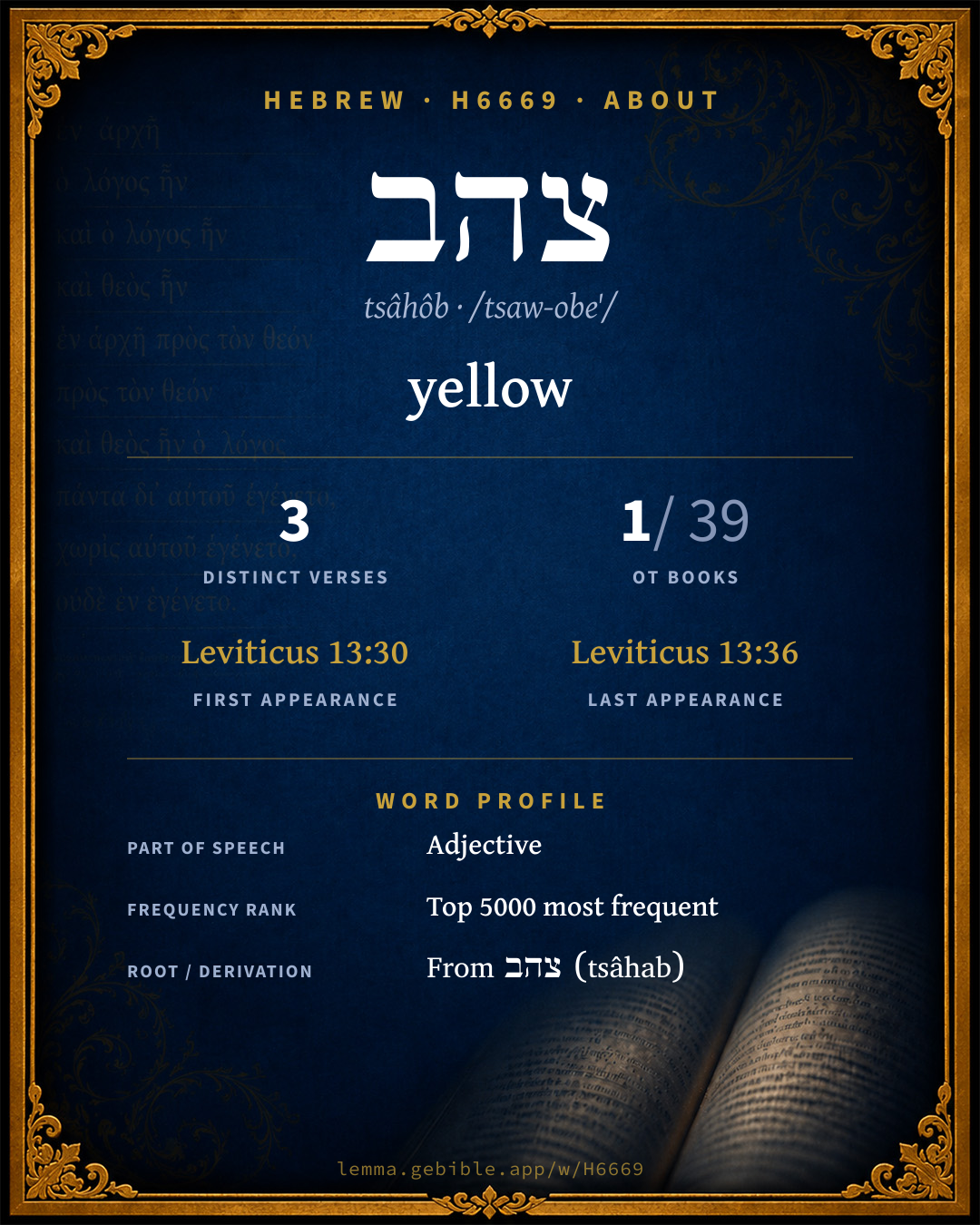
צָהֹב
yellow
Full lexicon entry — Brown-Driver-Briggs (BDB)
From Brown-Driver-Briggs (BDB)
Where this word appears
Grammar key — what these labels mean
Part of speech
- Adjective
- A word that describes or qualifies a noun.
State
- Absolute
- The independent form of a noun, not bound to a following word.
Gender
- Masculine
- Grammatically masculine.
Number
- Singular
- One.
Every verse where H6669 appears — 3 distinct verses across 1 book. Click any verse to open its interlinear word-by-word view. Verse text shown in the World English Bible for context — . Each verse’s Hebrew form is shown with its reference; the English is not keyword-highlighted, since the data carries no word-level English alignment. Use “Compare translations” on any verse to read it across multiple English versions. This concordance covers the Hebrew Bible; Septuagint (Greek Old Testament) occurrences are not indexed here.
Leviticus 3 verses
- Leviticus 13:30 צָהֹ֖ב adj Adjective ms then the priest shall examine the plague; and, behold, if the appearance of it is deeper than the skin, and the hair in it is yellow and thin, then the priest shall pronounce him unclean: it is an itch, it is leprosy of the head or of the beard.
- Leviticus 13:32 צָהֹ֑ב adj Adjective ms On the seventh day the priest shall examine the plague; and, behold, if the itch hasn't spread, and there is no yellow hair in it, and the appearance of the itch isn't deeper than the skin,
- Leviticus 13:36 הַ/צָּהֹ֖ב ptcl def.art + Adjective Adjective ms then the priest shall examine him; and, behold, if the itch has spread in the skin, the priest shall not look for the yellow hair; he is unclean.
About this entry
At a glance — auto-summarized from this page’s data, not written by a person. Every figure links to its source below. This summary describes the numbers; it doesn’t interpret them.
צהב — transliterated tsâhôb — is a Hebrew adjective carrying the sense “yellow.” The Hebrew Bible uses it only 3 verses. More than three-quarters of its appearances fall in Leviticus. Debuting at Leviticus 13:30, it then recurs through the corpus. Each statement above links to its evidence; the full detail follows below.
Gloss history
Strong's 1890 vs modern scholarship
About this word
Strong's H6669 catalogs a Hebrew word from the Hebrew Old Testament.
These counts are not copied from any lexicon or concordance. They are computed here, from the morphology-tagged Hebrew Old Testament. What Lemma adds →
- 3
- distinct verses
- The word appears in 3 distinct verses.
- 1 / 39
- OT books
- The word appears in 1 of 39 Old Testament books.
- #4,179
- by frequency
- Top 5000 most frequent Hebrew words (rank 4,179 of 8,640 Hebrew words by occurrence).
View all 3 occurrences in the concordance →
Most concentrated in
- Leviticus 3 verses 100%
By section of the Old Testament
By traditional corpus
Conventional, traditional groupings — biblical authorship is debated, so this is a traditional corpus grouping, not an authorship claim. Each share is this word’s portion of its verses in that division of the Hebrew canon. Each figure is a share of the word’s 3 distinct verses.
- Torah (Pentateuch) 3 verses · 100%
How translations render this word
Counts come from each version’s own published word-to-Strong’s tagging or interlinear alignment — an approximate guide to how each version renders this word, not a word-level alignment the data otherwise carries. Because each total is that version’s own tagged count, the per-version totals vary from one another and need not match the appearance or distinct-verse counts above. These counts may also differ from a printed concordance because Lemma counts each distinctly tagged rendering and does not collapse phrase taggings into a single head-word total. This is a fixed set of word-tagged versions (KJV, ASV, BSB, ULT) and does not change with the reading translation you choose elsewhere. Each version’s license is shown beside its name below (and on Sources).
BDB lists this Strong’s number as 2 distinct words (homographs). Each count above pools all of them and is not split by sense — see the Senses section below. A low-frequency rendering may belong to a different one of those words, not the primary meaning.
- King James Version†: Be in it a yellow 1×, Be in it no yellow 1×, Yellow 1×
- American Standard Version†: Be in it no yellow 1×, Be in it yellow 1×, Yellow 1×
- Berean Standard Bible†: Yellow 2×
- unfoldingWord Literal Text†: Yellow 3×
King James Version Public Domain
Renders H6669 across 3† tagged occurrences — most commonly:
American Standard Version Public Domain
Renders H6669 across 3† tagged occurrences — most commonly:
Berean Standard Bible Public Domain
Renders H6669 across 3† tagged occurrences — most commonly:
Plus 1 rendering that appears only once — usually multi-word phrases or single function words the recovered tagging swept in, not distinct renderings.
unfoldingWord Literal Text CC BY-SA 4.0
Renders H6669 across 3† tagged occurrences — most commonly:
Senses in the full BDB
What do BDB’s symbols mean?
BDB uses these scholarly abbreviations:
| Symbol | Meaning |
|---|---|
| 𝔊 | the Septuagint (the ancient Greek translation, LXX) |
| 𝔙 | the Vulgate (the Latin translation) |
| 𝔖 | the Syriac version (the Peshitta) |
| 𝔗 | the Targum (the Aramaic translation) |
| ψ | the Psalms |
| √ | root (the underlying root or stem) |
| ‖ | parallel passage (a synonymous or contrasted parallel) |
| † | the dagger: every passage where the word occurs is cited |
The 1 sense the full Brown-Driver-Briggs lexicon distinguishes for this word, in lexicon order (not ranked by frequency), with BDB’s own verbatim wording and sub-sense lettering. Shown in Hebrew script with BDB’s own scholarly abbreviations. The condensed entry is in the Lexicon Entry tab. See also the Forms in the corpus table below.
צהב I gleam (NH id. (of face, bronze, etc.)
Hophal
- Pt. נְחשֶׁת מֻצְהָב Ezr 8:27 bronze of gleaming ware (so NH and—appar. Hebraism—𝔗 2 Ch 4:16). e.g. Ezra 8:27
צהב II gleaming, yellow (of hair)
Senses from the full Brown-Driver-Briggs lexicon (Brown, Driver, Briggs; Oxford 1906 — public domain), digitized via Sefaria, supplemented by the OpenScriptures HebrewLexicon (CC BY 4.0). Full attribution on Sources.
Word origin
I. vb. gleam (NH id. (of face, bronze, etc.); Arabic صَهِبَ be red);—
I. adj. gleaming, yellow (of hair);—שֵׂעָר צ׳ Lv 13:30, 32, 36 (opp. שׂ׳ שָׁחֹר v 31, 37).
— Brown-Driver-Briggs (Oxford 1906, public domain), digitized via Sefaria, supplemented by the OpenScriptures HebrewLexicon (CC BY 4.0). See Sources.
Derived from צהב (tsâhab) (H6668) — to gleam.
Jastrow Dictionary
A second Hebrew/Aramaic lexicon for comparison, covering Aramaic and post-biblical (Talmudic, Targumic, Midrashic) usage that the biblical-Hebrew BDB does not. Matched by lemma rather than by Strong’s number, so a lemma may carry more than one Jastrow headword (shown separately below), and the entries cover usage well beyond the Bible.
צָהַב
- 1. to be bright, shine. Men. 18ᵃ צָהֲבוּ פניו וכ׳ the face of R. J. brightened up (with joy); Ḥull. 7ᵇ; a. e.—Part. pass. צָהוּב; pl. צְהוּבִין. Ned. 49ᵇ היום פניך צ׳ thou lookest bright to-day.—V. צָהוֹב.
- 2. (cmp. כִּרְכֵּם) to be defiant. Sifré Deut. 309 היה עומד וצוֹהֵב כנגד וכ׳ stood up and insulted a senator in the street; Yalk. ib. 942.—Part. pass. as ab. jealous, angry. Snh. 105ᵃ שני … צ׳ זה לזה (Ms. O. a. Ar. צוֹהֲבִין) two watchdogs … who were jealous of each other. Tanḥ. Vaëra 14 אש וברד צ׳ וכ׳ fire and hail are hostile to each other (cmp. דָּבַב).
- 1. to become shining. Sifra Vayikra, N’dab., Par. 6, ch. VIII משיַצְהִיבוּ when the feathers of the pigeons begin to be shining, contrad. to הזהיב (of grown doves) to shine, v. זָהַב; Ḥull. 22ᵇ
- 2. (of metal) to be bright, burnished, gold-like. Midd. II, 3, a. e., v. נְחוּשְׁתָּן I.—Part. pass. מוּצְהָב; f. מוּצְהֶבֶת. Yoma 38ᵃ (some ed. מְצוּהֶבֶת Pu.), v. נְחוּשְׁתָּן I. [Ib. והיתה מאירה, Ms. M. 2 מַצְהֶבֶת.]
- 3. (cmp. כִּרְכֵּם) to grieve. M. Kat. 24ᵇ כיוצא … רבים מַצְהִיבִין עליו וכ׳ (Ms. M. מצווחין, v. Rabb. D. S. a. l. note) if a corpse is carried out on a bier, the people grieve over it (in sympathy) &c.
צְהַב
- ; part. pass. צְהִיב grieved. Lev. R. s. 9 [read:] כדו דאפיך צְהִיבִין וכ׳ now that you grieve so much, we will go with you &c.
- to grieve, provoke. Targ. I Sam. I, 6.
- to be angry. Koh. R. to III, 6 עבד גרמיה מַצְהִיב עם בריה he pretended to be angry with his son.
A Dictionary of the Targumim, the Talmud Babli and Yerushalmi, and the Midrashic Literature (Marcus Jastrow; London, Luzac, 1903) — Public Domain. Digitized via Sefaria. Digitized via Sefaria. Full attribution on Sources.
Forms in the corpus
The 3 distinct written forms H6669 takes in the Hebrew Bible, most frequent first — each parse links to that state’s occurrences in the concordance. Hebrew forms include their vowel points and cantillation, so a single lemma takes many written forms.
| Form | Parsing | Example | Uses |
|---|---|---|---|
| הַ/צָּהֹ֖ב | Adjective, Adjective, Masculine, Singular, Absolute | Leviticus 13:36 | 1 |
| צָהֹ֑ב | Adjective, Adjective, Masculine, Singular, Absolute | Leviticus 13:32 | 1 |
| צָהֹ֖ב | Adjective, Adjective, Masculine, Singular, Absolute | Leviticus 13:30 | 1 |
Septuagint verse parallels
This word appears in 3 verses that also exist in the Greek Old Testament (Septuagint), out of the 3 Hebrew verses it occurs in. You can read those verses in Greek by switching the Old Testament edition to the Septuagint.
Read these verses in the Septuagint
This is a verse-level parallel only — the same verses exist in both the Hebrew and Greek Old Testaments. No word-level Hebrew↔Greek correspondence is claimed: the data carries no such alignment, so no Greek word is shown as this Hebrew word’s translation. Coverage is not total — the Septuagint omits the deuterocanon and renumbers the Psalms, so some Hebrew verses have no direct Greek parallel.