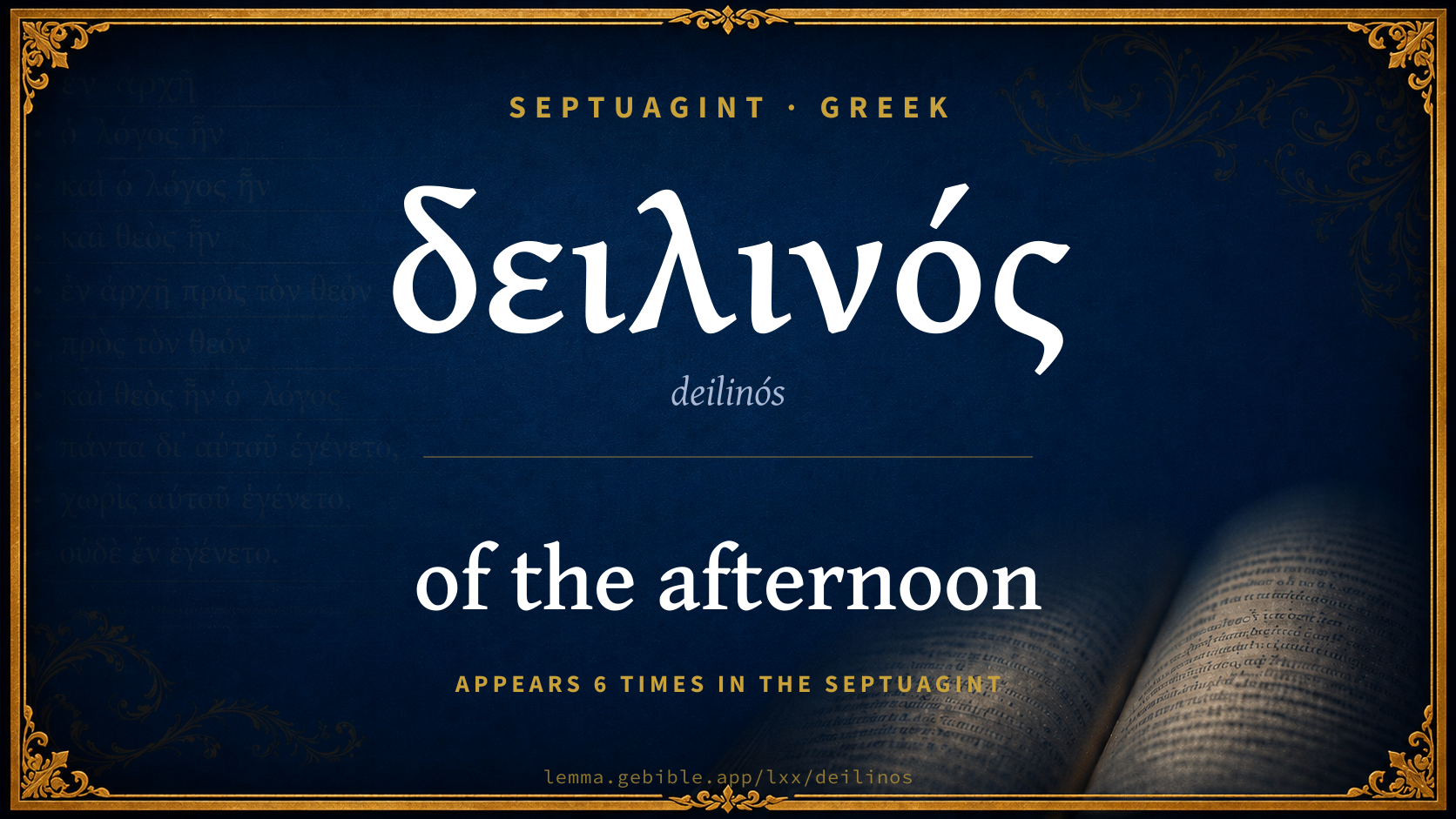
δειλινός
of the afternoon
Where this word appears
Every passage where δειλινός appears in the Greek Septuagint — 6 occurrences in all. Click any verse to open its interlinear word-by-word view. Verse text is shown in the LXX2012 (modern English Septuagint) for context; the Greek form is the matched word — the English is not keyword-highlighted.
- Genesis 3:8 δειλινός And they heard the voice of the Lord God walking in the garden in the afternoon; and both Adam and his wife hid themselves from the face of the Lord God in the midst of the trees of the garden.
- Exodus 29:39 δειλινός One lamb you shall offer in the morning, and the second lamb you shall offer in the evening.
- Exodus 29:41 δειλινός And you shall offer the second lamb in the evening, after the manner of the morning-offering, and according to the drink-offering of the morning lamb; you shall offer it an offering to the Lord for a sweet smelling savor,
- Leviticus 6:13 δειλινός And the fire shall always burn on the altar; it shall not be extinguished.
- 1 Kings 18:29 δειλινός And they prophesied until the evening came; and it came to pass as it was the time of the offering of the sacrifice, that Eliu the Thesbite spoke to the prophets of the abominations, saying, Stand by for the present, and I will offer my sacrifice. And they stood aside and departed.
- 2 Chronicles 31:3 δειλινός And the king's proportion out of his substance was appointed for the whole burnt offerings, the morning and the evening one, and the whole burnt offerings for the sabbaths, and for the new moons, and for the feasts that were ordered in the law of the Lord.
About this word
About this word
δειλινός (deilinós), “of the afternoon,” is a word from the Greek Septuagint — the ancient Greek translation of the Hebrew Old Testament. It does not occur in the Greek New Testament, so it carries no Strong’s number from Thayer’s (New-Testament) lexicon; the gloss shown here is a curated modern-English sense rather than a Strong’s definition. It appears 6 times across the Septuagint — open the Appearances tab to read it in context.
The gloss above is Lemma’s own curated sense — this word carries no Strong’s number, so no lexicon we ship has an entry for it. The transliteration and this passage list are computed here from the tagged Septuagint text. What Lemma adds →