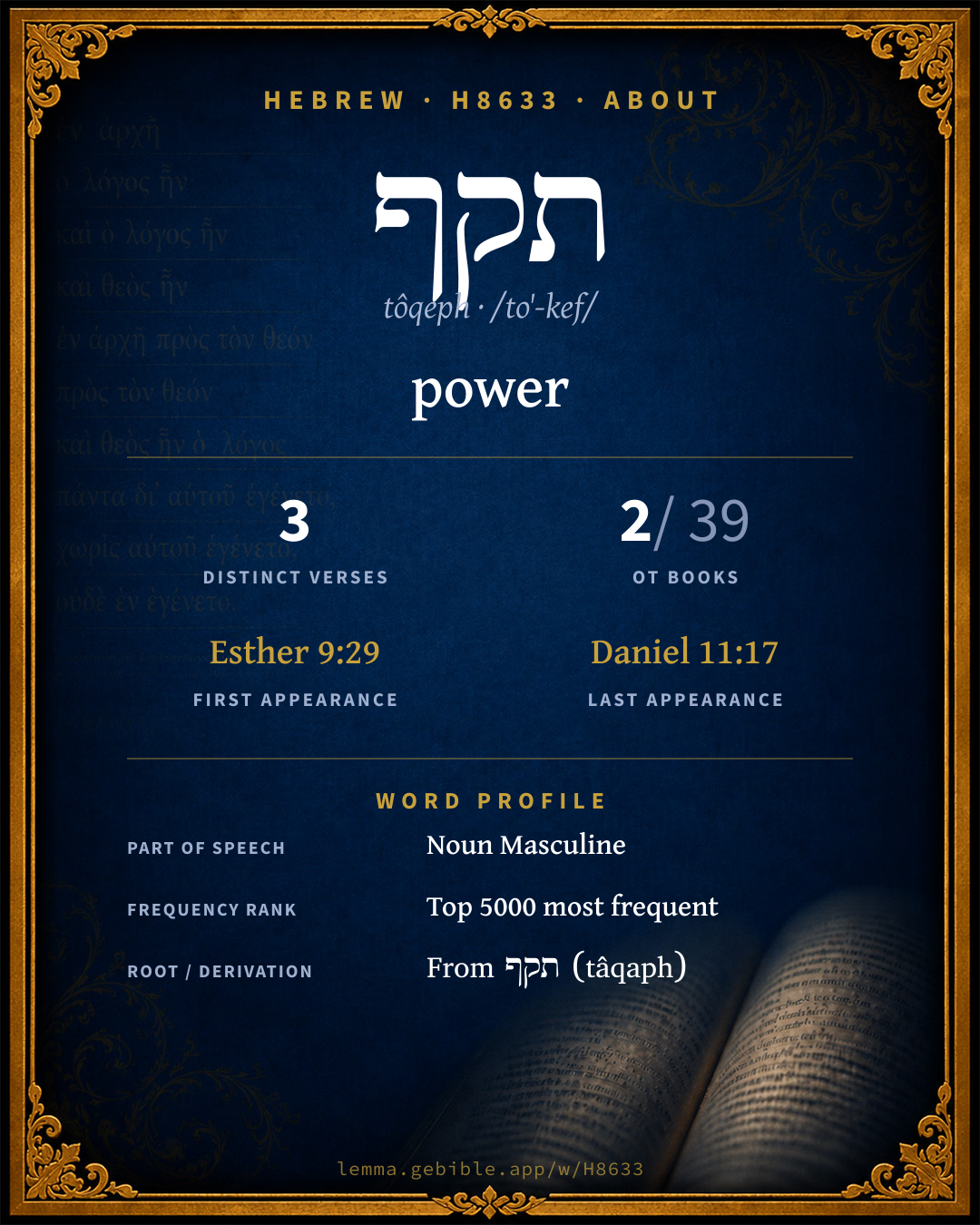
תֹּ֫קֶף
power
Full lexicon entry — Brown-Driver-Briggs (BDB)
From Brown-Driver-Briggs (BDB)
Where this word appears
See every Construct-state word in the Hebrew Bible →
Grammar key — what these labels mean
Part of speech
- Noun
- A naming word — a person, place, thing, or idea.
Noun type
- Common
- A common noun — a general class of person, place, or thing (“king,” “city,” “water”), not a specific name.
State
- Absolute
- The independent form of a noun, not bound to a following word.
- Construct
- A noun bound to a following noun in a possessive / “of” relationship (the construct chain).
Gender
- Masculine
- Grammatically masculine.
Number
- Singular
- One.
Grammatical forms
- Noun, Common, Masculine, Singular, Construct 2 times (67%)
- Noun, Common, Masculine, Singular, Absolute 1 time (33%)
Parsed forms decoded from the imported morphology (morphhb / Westminster Leningrad Codex — WLC text public domain, morphhb tagging CC BY 4.0), counted across 3 parsed occurrences — not distinct verses.
Every verse where H8633 appears — 3 distinct verses across 2 books. Click any verse to open its interlinear word-by-word view. Verse text shown in the World English Bible for context — . Each verse’s Hebrew form is shown with its reference; the English is not keyword-highlighted, since the data carries no word-level English alignment. Use “Compare translations” on any verse to read it across multiple English versions. This concordance covers the Hebrew Bible; Septuagint (Greek Old Testament) occurrences are not indexed here.
Esther 2 verses
- Esther 9:29 תֹּ֑קֶף n c ms Then Esther the queen, the daughter of Abihail, and Mordecai the Jew, wrote with all authority to confirm this second letter of Purim.
- Esther 10:2 תָקְפּ/וֹ֙ n c ms cs + sfx pers 3ms All the acts of his power and of his might, and the full account of the greatness of Mordecai, whereunto the king advanced him, aren't they written in the book of the chronicles of the kings of Media and Persia?
Daniel 1 verse
About this entry
At a glance — auto-summarized from this page’s data, not written by a person. Every figure links to its source below. This summary describes the numbers; it doesn’t interpret them.
תקף (tôqeph) is a Hebrew noun most often rendered “power.” It occurs a mere 3 verses across Scripture. It clusters heavily in Esther, which alone accounts for 67% of its uses. Debuting at Esther 9:29, it then recurs through the corpus. From the same root come תקף, תקיף and תקף. For the data behind this summary, explore the sense tree and the renderings breakdown below.
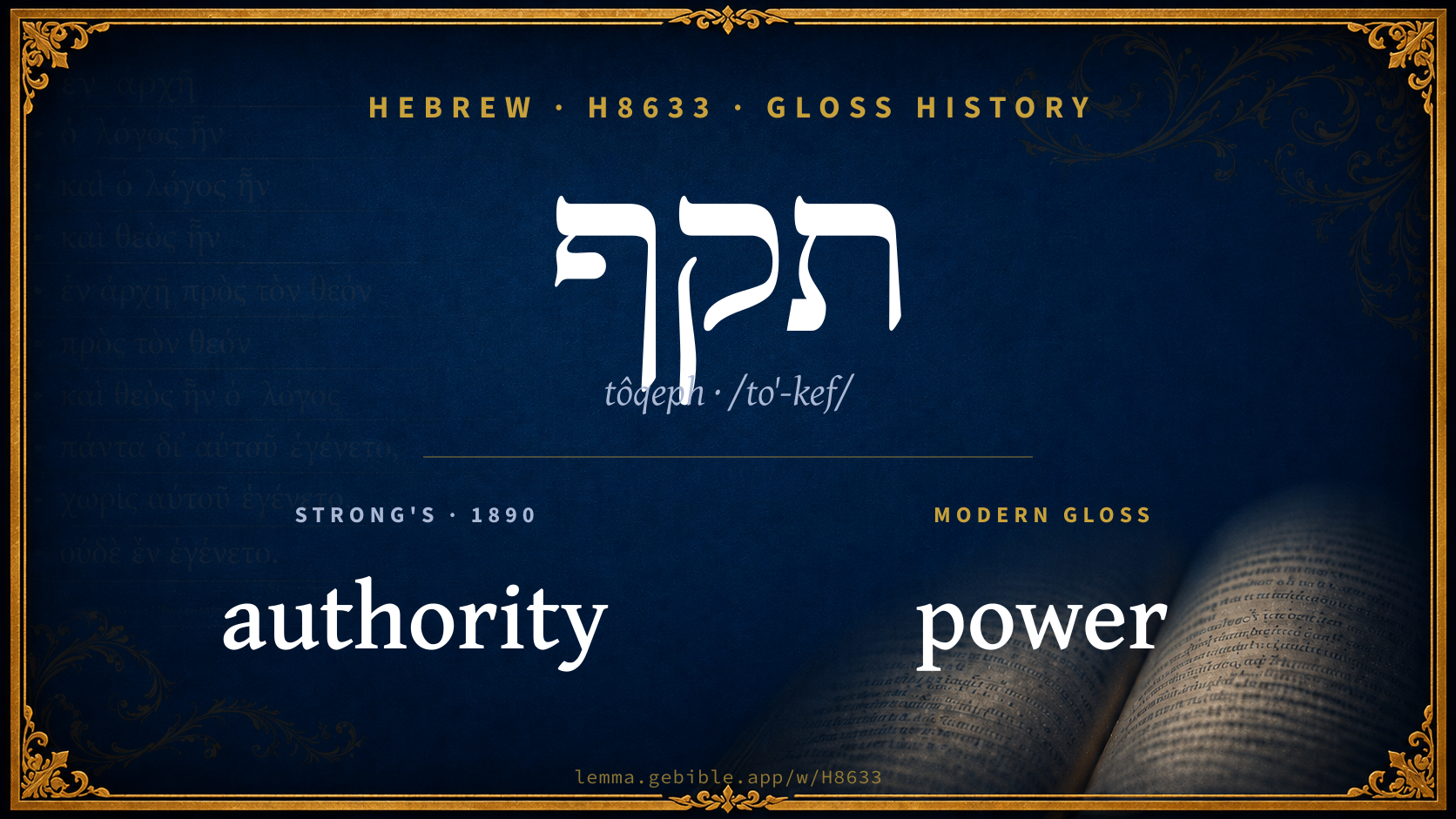
Gloss history
Strong's 1890 vs modern scholarship
About this word
Strong's H8633 catalogs a Hebrew word from the Hebrew Old Testament.
These counts are not copied from any lexicon or concordance. They are computed here, from the morphology-tagged Hebrew Old Testament. What Lemma adds →
- 3
- distinct verses
- The word appears in 3 distinct verses.
- 2 / 39
- OT books
- The word appears in 2 of 39 Old Testament books.
- #4,179
- by frequency
- Top 5000 most frequent Hebrew words (rank 4,179 of 8,640 Hebrew words by occurrence).
View all 3 occurrences in the concordance →
By traditional corpus
Conventional, traditional groupings — biblical authorship is debated, so this is a traditional corpus grouping, not an authorship claim. Each share is this word’s portion of its verses in that division of the Hebrew canon. Each figure is a share of the word’s 3 distinct verses.
- Writings (Ketuvim) 3 verses · 100%
How translations render this word
Counts come from each version’s own published word-to-Strong’s tagging or interlinear alignment — an approximate guide to how each version renders this word, not a word-level alignment the data otherwise carries. Because each total is that version’s own tagged count, the per-version totals vary from one another and need not match the appearance or distinct-verse counts above. These counts may also differ from a printed concordance because Lemma counts each distinctly tagged rendering and does not collapse phrase taggings into a single head-word total. This is a fixed set of word-tagged versions (KJV, ASV, BSB, ULT) and does not change with the reading translation you choose elsewhere. Each version’s license is shown beside its name below (and on Sources).
- King James Version: All authority 1×, Power 1×, Strength 1×
- American Standard Version: All authority 1×, Power 1×, Strength 1×
- Berean Standard Bible: Authority 1×, Powerful 1×, Strength 1×
- unfoldingWord Literal Text: Power 2×
King James Version Public Domain
Renders H8633 across 3 tagged occurrences — most commonly:
American Standard Version Public Domain
Renders H8633 across 3 tagged occurrences — most commonly:
Berean Standard Bible Public Domain
Renders H8633 across 3 tagged occurrences — most commonly:
unfoldingWord Literal Text CC BY-SA 4.0
Renders H8633 across 3 tagged occurrences — most commonly:
Plus 1 rendering that appears only once — usually multi-word phrases or single function words the recovered tagging swept in, not distinct renderings.
Senses in BDB
The 1 sense BDB distinguishes for this word, in lexicon order (not ranked by frequency or importance). The full entry — with sub-senses — is in the Lexicon Entry tab.
- authority, power, strength, energy
Word origin
n.m. power, strength, energy (Aramaic תְּקוֹף, תֹּקֶף, ܬܽܘܩܦܳܐ );—ת׳ abs. Est 9:29; cstr. Dn 11:17 the strength of his whole kingdom; sf. תָּקְפּוֹ Est 10:2 the deeds of his power (+ גְּבוּרָתוֹ, etc.).
— Brown-Driver-Briggs (Oxford 1906, public domain), digitized via Sefaria, supplemented by the OpenScriptures HebrewLexicon (CC BY 4.0). See Sources.
Derived from תקף (tâqaph) (H8630) — to overcome.
Jastrow Dictionary
A second Hebrew/Aramaic lexicon for comparison, covering Aramaic and post-biblical (Talmudic, Targumic, Midrashic) usage that the biblical-Hebrew BDB does not. Matched by lemma rather than by Strong’s number, so a lemma may carry more than one Jastrow headword (shown separately below), and the entries cover usage well beyond the Bible.
תּוֹקֶף
- strength, power. Mekh. B’shall., s. 6 (ref. to Ex. XIV, 25) אין איתנו אלא תָקְפוֹ ethans means its strength. Meg. 19ᵃ (ref. to Esth. IX, 29) תָּקְפוֹ של אחשורוש ‘the whole strength’ refers to the power of Ahasverus (as described in the first chapters of Esther); תּוֹקְפוֹ של מרדכי to the power of Mordecai (beginning with II, 5); תוקפו של המן to Haman’s power (beginning with III, 1); תקפו של נס the strength of the wonderful salvation (beginning with VI, 1). Gen. R. s. 16, beg. (ref. to Job XIV, 20) ת׳ שנתן הקב"ה וכ׳ the power which God gave Adam was to be for ever. Gen. R. s. 100 כל תקפו של אבל וכ׳ the height of mourning is on the third day (after burial); Y. M. Kat. III, 82ᵇ bot. אין תוקפו … עד שלשה ימים the height of mourning lasts only three days; a. e.—Snh. 19ᵇ תוקפו של יוסף ענוותנותו וכ׳ that which was with Joseph an achievement of strength (self-control) was with Boaz a humble (plain) act. Sifré Deut. 323 (ref. to Deut. XXXII, 31) לא כת׳ שאתה וכ׳ the power which thou givest us is not like the power which thou givest them (the gentiles); כשאתה ניתן להם את הת׳ וכ׳ when thou givest them the power, they deal with us with cruelty &c.; a. e. e.g. Exodus 14:25
תָּקַף
- 1. to seize, overpower. Yeb. 54ᵃ ותְקָפַתּוֹ יבמתו (not ותקפתה) and his sister-in-law seized (forced) him. Ib. תְּקָפוּהוּ נכרים וכ׳ gentiles seized him, and coupled them. B. Mets. 6ᵃ תְּקָפָהּ אחד בפנינו if one (of the two litigants) seized it (the object in dispute) in the presence of the court. Ib.ᵇ תְּקָפוֹ כהן if a priest seized it (the lamb of doubtful first birth). Ab. Zar. 23ᵃ יצרו תוֹקְפוֹ his passion overpowers him. Midr. Till. to Ps. XIX, 14 (ref. to איתם ib., with play on איתן) אלו תוֹקְפֵי עבירות this refers to those who conquer sin; a. fr.
- 2. (with על) to rest heavily upon, be hard. Ab. III, 8 תָּקְפָה עליו משנתו if his study was too hard for him (and therefore he forgot again what he had learned); Men. 99ᵇ; a. e.
תְּקַף
- 1. to seize, hold firmly. Targ. Job XXVII, 6 תְּקָפִית Ms. (ed. תַּקִּיפִית). Ib. VIII, 15 יִתְקֵיף ed. Lag. (ed. Wil. תתקיף, corr. acc.; Ms. יִתּוֹקַף Ittof.).
- 2. to be strong, become powerful. Targ. Ex. I, 7 (Y. ed. Vien. אַתְקִיפוּ Af.). Ib. XIX, 19 (Y. ed. Wil. תַּקִּיף, read: תָּקֵיף). Targ. Gen. XLI, 57. Targ. O. Deut. XXXI, 6, sq. Targ. Jud. VII, 11 יִתְקְפָן ed. Lag. (ed. Wil. יתקוף, corr. acc.); a. fr.
- 3. to be heavy, rest heavily upon, be hard. Targ. O. Gen. XLVII, 20 (Y. תַּקִּיף). Targ. I Sam. V, 7 (ed. Wil. תַּקִּרפַת).—Gitt. 77ᵇ ת׳ ליה עלמא the world was heavy for him, i.e. he felt very ill (v. קַלִּיל II). Kidd. 22ᵇ חזייה דתָקיף ליה עלמא טובא (or דתְקֵיף) he saw that he was very sick; a. fr.—Ned. 91ᵃ, v. infra.
- 4. (with רוגזא, or sub. רוגזא) to be vehement, hot, excited. Targ. Gen. XXX, 2. Targ. Ex. XXII, 23. Targ. Ps. XVIII, 8 ת׳ ליה; Targ. II Sam. XXII, 8 ת׳ רוגזיה. Targ. Jon. IV, 4; 9 תְּקוֹף ed. Lag. (ed. Wil. תְּקֵיף, a. תקוף). Targ. Gen. IV, 6 (Y. ed. Vien. תַּקִּיף); a. fr.—Yeb. 63ᵇ מִתְקֵיף תְּקִיפָא she is irascible, v. עֲבַר Ithpe.—Ned. 91ᵃ זמנין דתקיף לה מן גברא sometimes she has a strong feeling against her husband; [oth. interpret.: she has a strong passion for another man].—4) to get hot, ferment, get sour. B. Mets. 64ᵃ אי תַקְפָה ברשותך if it should get sour, it shall be considered in thy possession (it shall be thy loss). Ib. 83ᵃ זבני … ותְקִיפוּ להו I bought three hundred barrels of wine for thee, and they turned sour; ארבע … כי תְקִיפֵי וכ׳ (v. Rabb. D. S. a. l. note 4) if four hundred barrels turn sour, this must have been rumored about; Yalk. Ex. 346 כי תַקְפֵי; Ber. 5ᵇ (En Yaʿăḳob אִיתְּקוּף Ithpe); a. e.
- (cmp. חזק)
- 1. to strengthen; to repair; to harden (the heart of). Targ. Ps. CXLVII, 13. Targ. II Kings XII, 7; 9. Ib. 6 יְתַקְּפיּן (not יִתְקְ׳). Targ. Deut. I, 38. Targ. O. Ex. IV, 21 ed. Berl. (ed. Vien. Af.). Targ. Ps. LXXXIX, 41 (h. text פריצ׳!); a. fr.
- 2. to seize, force. Ḥag. 15ᵃ תַּקְּפֵיה עייליה וכ׳ he seized him and brought him to the school-house.
- 3. (v. תַּקִּיף) to be strong &c., v. supra.
- 1. to grow strong. Targ. Y. Ex. I, 7 (v. supra); a. e.
- 2. to strengthen, make strong, heavy; to harden. Targ. Ps. CV, 24. Targ. I Kings XII, 10; 14. Targ. Jer. V, 3; a. fr.—Part. pass. מַתְקַף. Targ. Is. XXX, 13.
- 3. to seize, take hold of, to cause to seize. Targ. Gen. XXI, 18. Targ. Ex. IV, 4. Ib. IX, 2; a. fr.
- 4. (scholastic term) [to seize, stop,] to raise an objection. Ḥull. 43ᵃ מַתְקִיף לה וכ׳ R. A. objected to it; a. v. fr.
- , Ittof. אִתּוֹקַף
- 1. to strengthen one’s self, be strong; to make an effort. Targ. Y. Deut. XXXI, 6, sq. Targ. II Chr. I, 1. Ib. XVIII, 34. Targ. Ps. CVI, 23 (some ed. Af. incorr.); a. fr.
- 2. to be hardened. Targ. Ex. VII, 13; a. e.
- 3. to get sour, v. supra.—[Targ. Y. Num. XXXVI, 7 תיתקף, read: תיסתקף, v. סְקַף I.]
תֹּקֶף
- , v. תּוֹקֶף, תּוּקְפָא.
A Dictionary of the Targumim, the Talmud Babli and Yerushalmi, and the Midrashic Literature (Marcus Jastrow; London, Luzac, 1903) — Public Domain. Digitized via Sefaria. Digitized via Sefaria. Full attribution on Sources.
Forms in the corpus
The 3 distinct written forms H8633 takes in the Hebrew Bible, most frequent first — each parse links to that state’s occurrences in the concordance. Hebrew forms include their vowel points and cantillation, so a single lemma takes many written forms.
| Form | Parsing | Example | Uses |
|---|---|---|---|
| בְּ/תֹ֧קֶף | Noun, Common, Masculine, Singular, Construct | Daniel 11:17 | 1 |
| תָקְפּ/וֹ֙ | Noun, Common, Masculine, Singular, Construct | Esther 10:2 | 1 |
| תֹּ֑קֶף | Noun, Common, Masculine, Singular, Absolute | Esther 9:29 | 1 |
Same root — word family
Other BDB entries built from the same root as H8633, grouped by Strong’s listed origin. These share a root / origin per the lexicon — not necessarily a shared meaning. Each links to that word’s own entry.
Derives from
Shares the same root
Derived from this word
Compare all same-root words → Showing 4 of 5 — not the complete family. They share a root, not necessarily a meaning.
Septuagint verse parallels
This word appears in 3 verses that also exist in the Greek Old Testament (Septuagint), out of the 3 Hebrew verses it occurs in. You can read those verses in Greek by switching the Old Testament edition to the Septuagint.
Read these verses in the Septuagint
This is a verse-level parallel only — the same verses exist in both the Hebrew and Greek Old Testaments. No word-level Hebrew↔Greek correspondence is claimed: the data carries no such alignment, so no Greek word is shown as this Hebrew word’s translation. Coverage is not total — the Septuagint omits the deuterocanon and renumbers the Psalms, so some Hebrew verses have no direct Greek parallel.