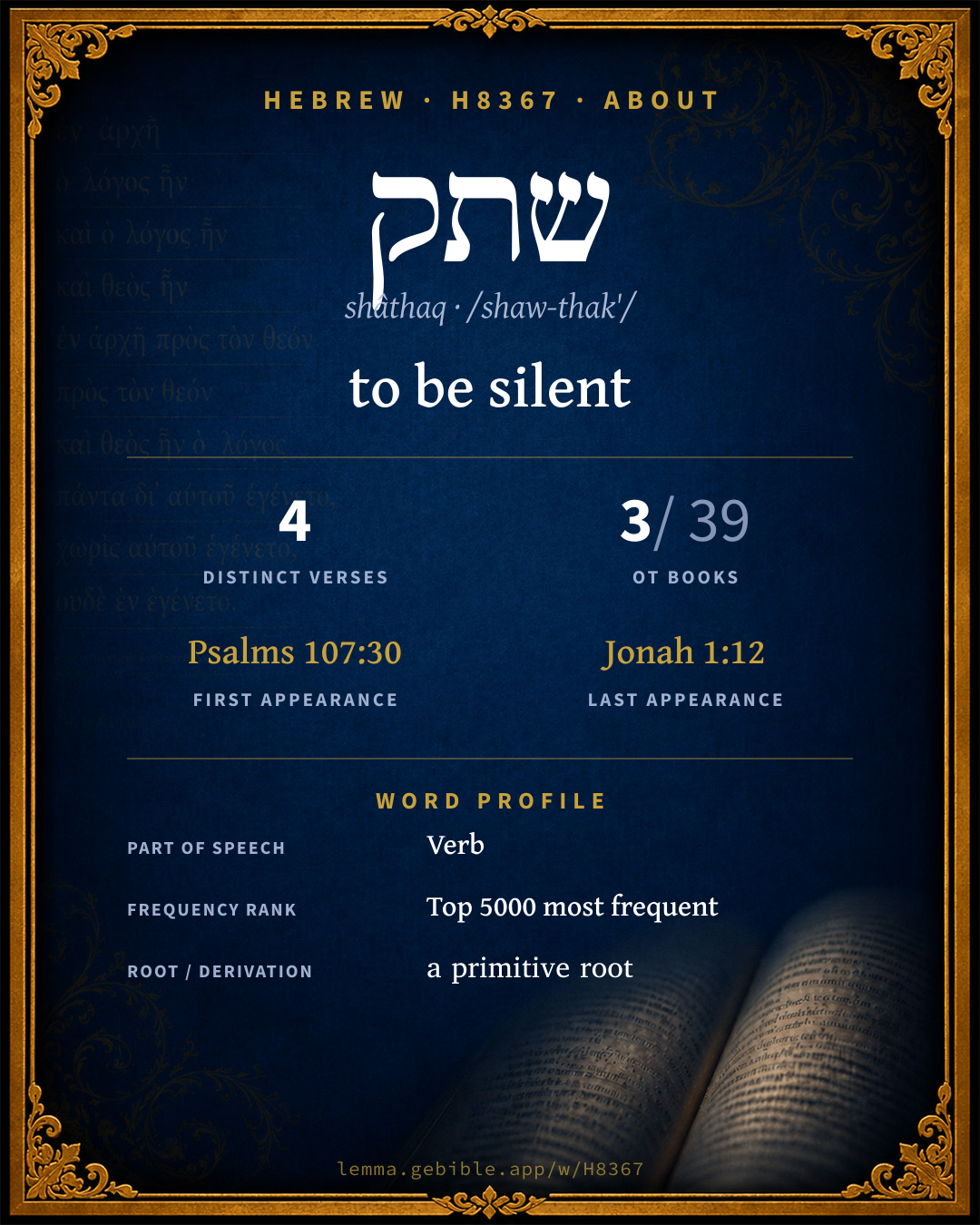
שָׁתַק
to be silent
Full lexicon entry — Brown-Driver-Briggs (BDB)
From Brown-Driver-Briggs (BDB)
Where this word appears
Grammar key — what these labels mean
Part of speech
- Verb
- An action or state-of-being word.
Stem
- Qal
- The basic, simple active stem — the plain form of the verb (“he wrote”).
Form
- Imperfect
- An incomplete, ongoing, or future action (“he will / would write”).
Person
- 3rd Person
- The one spoken about (“he / she / it / they”).
Gender
- Masculine
- Grammatically masculine.
Number
- Singular
- One.
- Plural
- More than one (in Hebrew, generally three or more).
Every verse where H8367 appears in the Book of Jonah — 2 distinct verses. Click any verse to open its interlinear word-by-word view. Verse text shown in the World English Bible for context — . Each verse’s Hebrew form is shown with its reference; the English is not keyword-highlighted, since the data carries no word-level English alignment. Use “Compare translations” on any verse to read it across multiple English versions. This concordance covers the Hebrew Bible; Septuagint (Greek Old Testament) occurrences are not indexed here.
Jonah
- Jonah 1:11 וְ/יִשְׁתֹּ֥ק conj + Qal impf 3ms Then said they to him, "What shall we do to you, that the sea may be calm to us?" For the sea grew more and more tempestuous.
- Jonah 1:12 וְ/יִשְׁתֹּ֥ק conj + Qal impf 3ms He said to them, "Take me up, and throw me into the sea. Then the sea will be calm for you; for I know that because of me this great tempest is on you."
About this entry
At a glance — auto-summarized from this page’s data, not written by a person. Every figure links to its source below. This summary describes the numbers; it doesn’t interpret them.
At its core, שתק (shâthaq) means “to be silent.” A scarce word — 4 verses in all of the Hebrew Bible. Its uses cluster heavily in Jonah (50% of all occurrences). Scripture first uses it in Psalms 107:30. Each statement above links to its evidence; the full detail follows below.
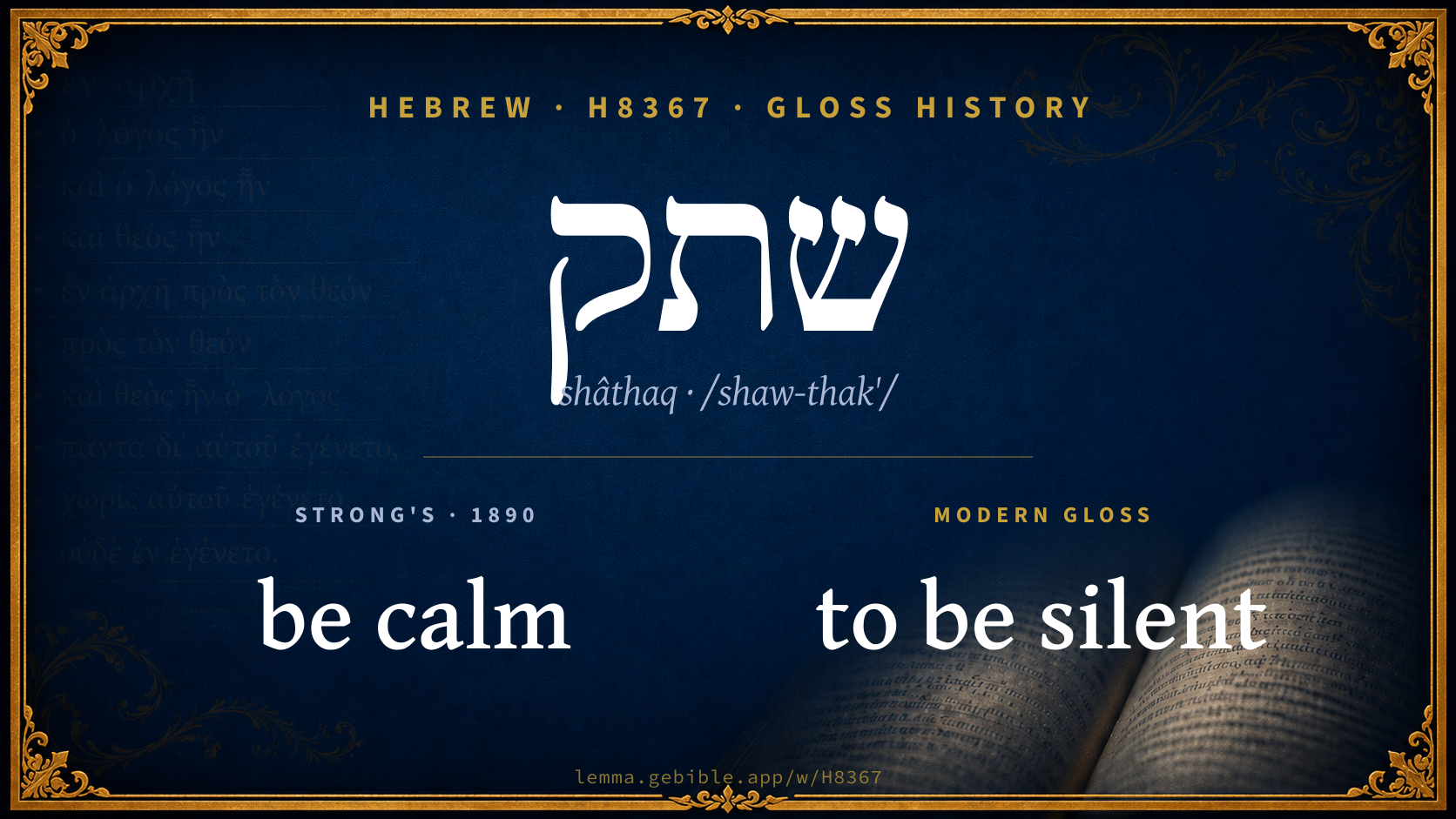
Gloss history
Strong's 1890 vs modern scholarship
About this word
Strong's H8367 catalogs a Hebrew word from the Hebrew Old Testament.
These counts are not copied from any lexicon or concordance. They are computed here, from the morphology-tagged Hebrew Old Testament. What Lemma adds →
- 4
- distinct verses
- The word appears in 4 distinct verses.
- 3 / 39
- OT books
- The word appears in 3 of 39 Old Testament books.
- #3,696
- by frequency
- Top 5000 most frequent Hebrew words (rank 3,696 of 8,640 Hebrew words by occurrence).
View all 4 occurrences in the concordance →
By section of the Old Testament
By traditional corpus
Conventional, traditional groupings — biblical authorship is debated, so this is a traditional corpus grouping, not an authorship claim. Each share is this word’s portion of its verses in that division of the Hebrew canon. Each figure is a share of the word’s 4 distinct verses.
- Prophets (Nevi'im) 2 verses · 50%
- Writings (Ketuvim) 2 verses · 50%
How translations render this word
Counts come from each version’s own published word-to-Strong’s tagging or interlinear alignment — an approximate guide to how each version renders this word, not a word-level alignment the data otherwise carries. Because each total is that version’s own tagged count, the per-version totals vary from one another and need not match the appearance or distinct-verse counts above. These counts may also differ from a printed concordance because Lemma counts each distinctly tagged rendering and does not collapse phrase taggings into a single head-word total. This is a fixed set of word-tagged versions (KJV, ASV, BSB, ULT) and does not change with the reading translation you choose elsewhere. Each version’s license is shown beside its name below (and on Sources).
- King James Version: Be calm 1×, Ceaseth 1×, May be calm 1×
- American Standard Version: Be calm 1×, Ceaseth 1×, Sea may be calm 1×
- Berean Standard Bible: Calm 1×, Ceases 1×, May quiet down 1×
- unfoldingWord Literal Text: Will calm down 2×
King James Version Public Domain
Renders H8367 across 4 tagged occurrences — most commonly:
American Standard Version Public Domain
Renders H8367 across 4 tagged occurrences — most commonly:
Berean Standard Bible Public Domain
Renders H8367 across 4 tagged occurrences — most commonly:
unfoldingWord Literal Text CC BY-SA 4.0
Renders H8367 across 6 tagged occurrences — most commonly:
Plus 4 renderings that appear only once — usually multi-word phrases or single function words the recovered tagging swept in, not distinct renderings.
Senses in BDB
The 1 sense BDB distinguishes for this word, in lexicon order (not ranked by frequency or importance). The full entry — with sub-senses — is in the Lexicon Entry tab.
- (Qal) to be quiet, be silent
Word origin
[ שָׁתַק ] vb. be quiet (late)
— Brown-Driver-Briggs (Oxford 1906, public domain), digitized via Sefaria, supplemented by the OpenScriptures HebrewLexicon (CC BY 4.0). See Sources.
Origin: a primitive root
Jastrow Dictionary
A second Hebrew/Aramaic lexicon for comparison, covering Aramaic and post-biblical (Talmudic, Targumic, Midrashic) usage that the biblical-Hebrew BDB does not. Matched by lemma rather than by Strong’s number, so a lemma may carry more than one Jastrow headword (shown separately below), and the entries cover usage well beyond the Bible.
שָׁתַק
- (b. h.) to be quiet, silent. Keth. 14ᵇ ממזר וצווח חלל ושׁוֹתֵק one who cries (protests) when called a bastard, but keeps his peace when called a ḥalal (v. חָלָל II). Sabb. 33ᵇ יוסי שש׳ וכ׳ Jose, who kept silence (when the Roman government was criticised), shall be exiled to Sepphoris. Men. 72ᵃ הוי פקח ושְׁתוֹק be wise and keep thy peace. Gen. R. s. 51 שתיקה שש׳ לאברהם וכ׳ (God remembered to Lot) the silence which he observed towards Abraham when he said &c.; a. fr.
- to cause to be silent, silence, stop. Tosef. Ḥag. II, 12 שִׁיתְּקוֹ בגערה he silenced him with a rebuke; Y. ib. II, 78ᵃ bot. ושִׁתְּקוֹ בנזיפה. Sabb. 67ᵇ המְשַׁתֶּקֶת (or המַשְׁתֶּקֶת Hif.), v. צָוַוח; Tosef. ib. VI (VII), 15 השׁוֹתֶקֶת. Ber. V, 3 האומר … מְשַׁתְּקִין אותו he who (in reading the prayers) says … modim modim (we offer thanks, twice) must be stopped (as suspected of heresy). Tanḥ. Aḥăré 9 בקש יהושע לשַׁתֵּק וכ׳ Joshua wanted to silence the sun (keep him from giving praise, ref. to Josh. X, 12); a. fr.—Esp. to deny the claim of, dismiss. Yeb. 100ᵇ מאי שתוקי … שמשתקים אותו מנכסי אביו in what respect is he considered a sh’thuḳi (v. שְׁתוּקִי)? Is it that we deny him a share in his father’s estate?; ib. משתקין אותו מדיני כהונה we deny him the privileges of priesthood (declare him a ḥalal); Keth. 13ᵇ מַשְׁתִּיקִין Hif. e.g. Joshua 10:12
- 1. to stop speaking, close the argument. Gen. R. s. 49, end נ׳ הסניגור וכ׳ when the defense stops, the judge rises; עמד … נ׳ הסניגור when the judge rises, the defense is bound to stop; Yalk. ib. 84; a. e.
- 2. to become speechless, be struck dumb. Gitt. VII, 1 נ׳ ואמרו לו וכ׳ if a man has lost his speech, and they say to him, shall we write a letter of divorce &c.? Y. Snh. VI, beg. 23ᵇ; Bab. Snh. 43ᵃ; a. e.
שְׁתֵק
- with prefixed א: אִשְׁתּיק, אִישְׁ׳ same,
- 1. to be silent. Targ. Lev. X, 3. Targ. Job XIII, 5 מִשְׁתַּק תִּשְׁתְּקוּן (ed. Lag. מִשְׁתּוֹק; Ms. מַשְׁתּוֹקי Af.). Targ. I Sam. VII, 8 (ed. Wil. תַּשְׁתִּיק Af.). Targ. Ez. XXIV, 17; a. fr.—B. Mets. 37ᵇ האי דשְׁתִיקִי וכ׳ the reason why I was silent at the claim of both &c. Keth. 14ᵇ דקרו ליה ממזר וש׳ they called him a bastard, and he kept his peace; והאי דש׳ וכ׳ and the reason why he was silent &c. Shebu. 40ᵃ, a. e. מישהא … וש׳, v. שְׁהֵי. Ib. איכא דאמרי מישתא … וש׳ some say, he was just taking a drink, and kept silence (and in the meanwhile the reporter left). Ned. 77ᵃ א"ל אי׳ he said to him, he (Rab, did not say so, but) was silent (seemed to assent); אי׳ קאמרת או שתי קאמרת dost thou say, he kept silence, or dost thou say, he was taking a drink (and he may have decided differently after thou wast gone)?; [differ. vers., v. infra].
- 2. to silence, quiet. Targ. Y. Num. XIII, 30. Targ. Ps. CXXXI, 2 (Bxt. שַׁתֵּיק׳ Pa.).
- 1. to be silent, v. supra.
- 2. intercb. with Pa. שַׁתֵּיק to silence, quiet. Targ. Job XI, 3 (Ms. Pa.). Targ. Ez. I, 24 מְשַׁתְּקָן (not מְשַׁתְ׳; some ed. Af.).—Keth. 104ᵇ אַשְׁתִּיקָן קאמרת או אַשְׁקְיָאן קאמרת (some ed. אִישְׁ׳) (in asking me, ‘did Rab say so’?) didst thou mean to say, ‘I will silence them’ (show them my disapproval), or didst thou mean to say, ‘I will give them to drink’ (show my approval)?; Ned. l. c. (Vers. in Asheri and Tosaf.). Ber. 33ᵇ מגונה … שַׁתּוּקֵי לא מְשַׁתְּקִינָן ליה he is blameworthy, but we do not stop him (in his prayer); a. e.
- to become mute, still. Targ. Ps. XXXI, 18 Ms. (ed. Pe.). Targ. Y. I Ex. XV, 16.—Y. Taan. IV, 68ᵈ bot. ואינון בכיי ומִשְׁתַּתְּקִין וקיימין and they (the old men among his hearers) wept, and they were quieted (by Rabbi), and they (the assembly) rose.
A Dictionary of the Targumim, the Talmud Babli and Yerushalmi, and the Midrashic Literature (Marcus Jastrow; London, Luzac, 1903) — Public Domain. Digitized via Sefaria. Digitized via Sefaria. Full attribution on Sources.
Forms in the corpus
The 3 distinct written forms H8367 takes in the Hebrew Bible, most frequent first — each parse links to that stem’s occurrences in the concordance. Hebrew forms include their vowel points and cantillation, so a single lemma takes many written forms.
| Form | Parsing | Example | Uses |
|---|---|---|---|
| וְ/יִשְׁתֹּ֥ק | Verb, Qal, Imperfect, 3rd Person, Masculine, Singular | Jonah 1:11 | 2 |
| יִשְׁתֹּ֑קוּ | Verb, Qal, Imperfect, 3rd Person, Masculine, Plural | Psalms 107:30 | 1 |
| יִשְׁתֹּ֥ק | Verb, Qal, Imperfect, 3rd Person, Masculine, Singular | Proverbs 26:20 | 1 |
Septuagint verse parallels
This word appears in 3 verses that also exist in the Greek Old Testament (Septuagint), out of the 4 Hebrew verses it occurs in. You can read those verses in Greek by switching the Old Testament edition to the Septuagint.
Read these verses in the Septuagint
This is a verse-level parallel only — the same verses exist in both the Hebrew and Greek Old Testaments. No word-level Hebrew↔Greek correspondence is claimed: the data carries no such alignment, so no Greek word is shown as this Hebrew word’s translation. Coverage is not total — the Septuagint omits the deuterocanon and renumbers the Psalms, so some Hebrew verses have no direct Greek parallel.