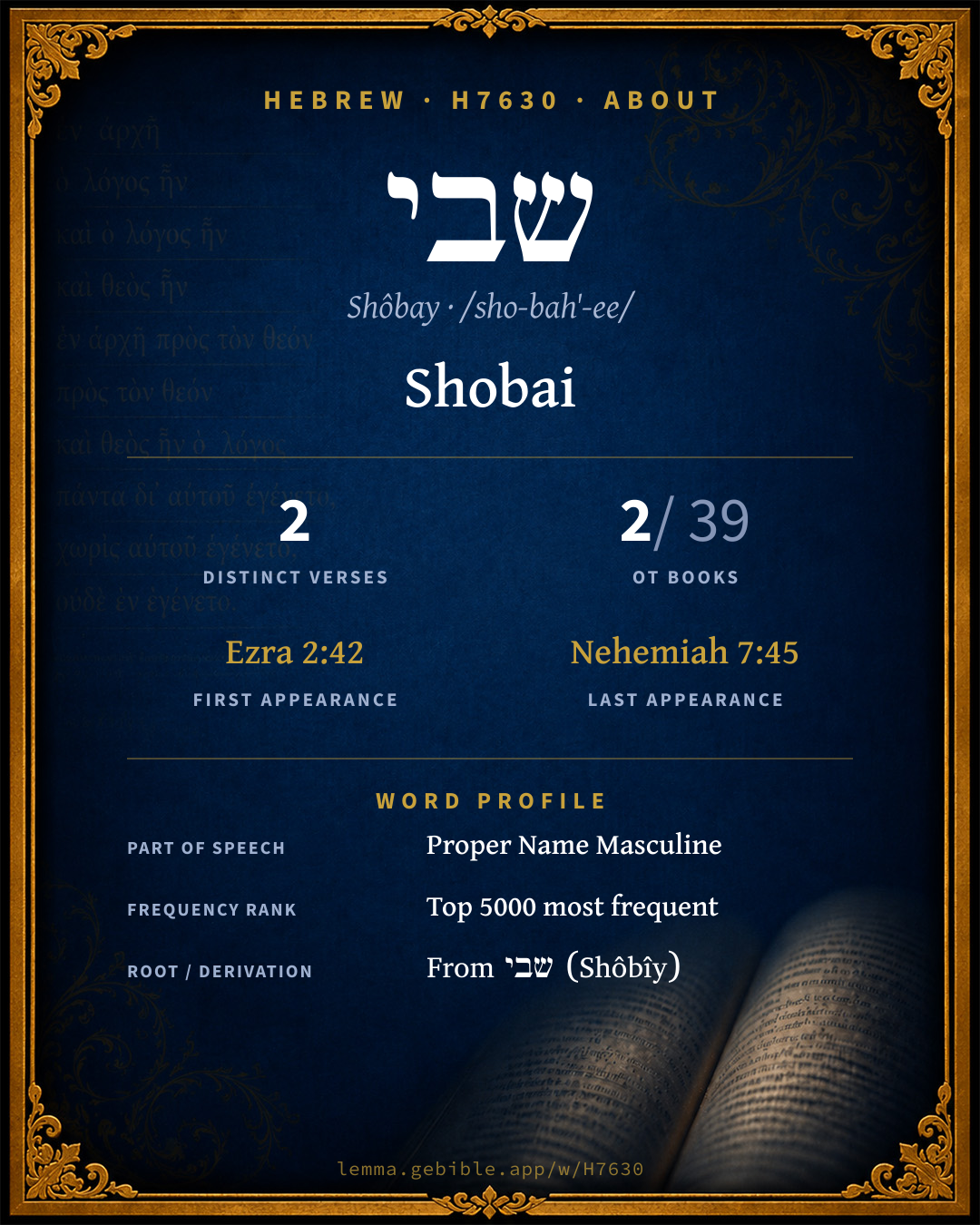
שֹׁבָ֑י
Shobai
BDB lists 2 entries for ‘Shobai’ fuller range ↓
Full lexicon entry — Brown-Driver-Briggs (BDB)
From Brown-Driver-Briggs (BDB)
Where this word appears
Grammar key — what these labels mean
Part of speech
- Noun
- A naming word — a person, place, thing, or idea.
Noun type
- Proper
- A name of a specific person, place, or people (e.g. Abraham, Zion, Israel).
Every verse where H7630 appears in the Book of Ezra — 1 distinct verse. Click any verse to open its interlinear word-by-word view. Verse text shown in the World English Bible for context — . Each verse’s Hebrew form is shown with its reference; the English is not keyword-highlighted, since the data carries no word-level English alignment. Use “Compare translations” on any verse to read it across multiple English versions. This concordance covers the Hebrew Bible; Septuagint (Greek Old Testament) occurrences are not indexed here.
Ezra
About this entry
At a glance — auto-summarized from this page’s data, not written by a person. Every figure links to its source below. This summary describes the numbers; it doesn’t interpret them.
“Shobai” is the headline sense of the Hebrew name שבי (Shôbay). It is rare — just 2 verses in the entire Hebrew Bible. It clusters heavily in Ezra, which alone accounts for 50% of its uses. First canonically at Ezra 2:42, it enters the text early. The sections below give every occurrence and version rendering.
Gloss history
Strong's 1890 vs modern scholarship
About this word
Strong's H7630 catalogs a Hebrew word from the Hebrew Old Testament.
These counts are not copied from any lexicon or concordance. They are computed here, from the morphology-tagged Hebrew Old Testament. What Lemma adds →
- 2
- distinct verses
- The word appears in 2 distinct verses.
- 2 / 39
- OT books
- The word appears in 2 of 39 Old Testament books.
- #4,807
- by frequency
- Top 5000 most frequent Hebrew words (rank 4,807 of 8,640 Hebrew words by occurrence).
View all 2 occurrences in the concordance →
By traditional corpus
Conventional, traditional groupings — biblical authorship is debated, so this is a traditional corpus grouping, not an authorship claim. Each share is this word’s portion of its verses in that division of the Hebrew canon. Each figure is a share of the word’s 2 distinct verses.
- Writings (Ketuvim) 2 verses · 100%
How translations render this word
Counts come from each version’s own published word-to-Strong’s tagging or interlinear alignment — an approximate guide to how each version renders this word, not a word-level alignment the data otherwise carries. Because each total is that version’s own tagged count, the per-version totals vary from one another and need not match the appearance or distinct-verse counts above. These counts may also differ from a printed concordance because Lemma counts each distinctly tagged rendering and does not collapse phrase taggings into a single head-word total. This is a fixed set of word-tagged versions (KJV, ASV, BSB, ULT) and does not change with the reading translation you choose elsewhere. Each version’s license is shown beside its name below (and on Sources).
- King James Version: Shobai 2×
- American Standard Version: Shobai 2×
- Berean Standard Bible: Shobai 2×
- unfoldingWord Literal Text: Shobai 2×
King James Version Public Domain
Renders H7630 across 2 tagged occurrences — most commonly:
American Standard Version Public Domain
Renders H7630 across 2 tagged occurrences — most commonly:
Berean Standard Bible Public Domain
Renders H7630 across 2 tagged occurrences — most commonly:
unfoldingWord Literal Text CC BY-SA 4.0
Renders H7630 across 2 tagged occurrences — most commonly:
Senses in BDB
The 2 senses BDB distinguishes for this word, in lexicon order (not ranked by frequency or importance). The full entry — with sub-senses — is in the Lexicon Entry tab.
- Shobai = "glorious"
- ancestor of a family of doorkeepers of the temple who returned with Zerubbabel
Word origin
שֹׁבָ֑י n.pr.m. in post-ex. Israel
— Brown-Driver-Briggs (Oxford 1906, public domain), digitized via Sefaria, supplemented by the OpenScriptures HebrewLexicon (CC BY 4.0). See Sources.
Derived from שבי (Shôbîy) (H7629) — Shobi.
Jastrow Dictionary
A second Hebrew/Aramaic lexicon for comparison, covering Aramaic and post-biblical (Talmudic, Targumic, Midrashic) usage that the biblical-Hebrew BDB does not. Matched by lemma rather than by Strong’s number, so a lemma may carry more than one Jastrow headword (shown separately below), and the entries cover usage well beyond the Bible.
בֵּי
- 1. (= (= בְּ־ I) in, with, at. Targ. Y. Num. XXII, 28 בי ההיא שעתא at that time. Targ. Cant. I, 9; 13; 14 (ed. Vien. בההיא).
- 2. (= בין) between, among. Sot. 10ᵃ; Meg. 12ᵃ; v. בּוּצִינָא.—Sabb. 109ᵇ בי מיללי (Ms. במ׳) between the embers; a. fr.—בי שמשי (= h. בין השמשות) during sunset. Ber. 43ᵇ קדושא דבי ש׳ the Kiddush said on Friday night. Keth. 103ᵃ כל בי ש׳ every Friday night.
- 3. (= בְּ II) son of; v. בְּרַבִּי. Y. Ber. IV, 7ᶜ bot.; a. fr.
- 4. (= בֵּית) house of, school of; home, place of &c. Targ. Job VII, 9; a. e.—… תנא דבי ר׳ (sub. תני) a student of the school of R. … taught. Ḥull. 42ᵃ; a. fr.—Ab. Zar. 6ᵇ בדבי ר׳ או׳ (Ms. M. ב"ר) in (the Boraitha) of the school of R. O.—Yeb. 21ᵇ דבי אימא רבתי one of the family of the grandmother (whether mother’s or father’s mother). Ib. דבי אבא רבה of the grandfather’s family; דבי דודי one of the uncle’s relation.—דבי רב the Boraitha of Be Rab (Sifra). Ḥull. 66ᵃ (v. Rashi a. l.); a. fr.—בי רבנן college. Ber. 17ᵃ; a. fr. [For other compounds with בי, v. respective determinants.]
פַּגֵּי
- pr. n. pl., v. פָּאגֵי
שַׁב ²
- (preced.)
- 1. = h. שָׁבוּעַ. week. Targ. II Esth. III, 7; a. fr.—Sabb. 156ᵃ האי מאן דבחד בש׳ a person born on the first day of the week; בתרי בש׳ on Monday &c. Bets. 16ᵃ מחד שֵׁבָּיךְ לשבתך from thy first day of the week begin to set aside good things for thy Sabbath; a. fr.
- 2. the seventh day, the Sabbath; day of rest. Targ. Y. Deut. V, 14 שב ונייח a day of rest and repose; Targ. Y. Ex. XX, 10 שבא ונ׳. Targ. Y. Lev. XXIII, 32 שבא ונייחא; Targ. O. ש׳ שבתא (h. text שבת שבתון); a. fr.—Y. Taan. I, 64ᵃ בשׁוּבָּה וכ׳, v. נְיָיח. Y. Sot. I, 16ᵈ bot. כל לילי ש׳ every Sabbath night. Y. Ab. Zar. V, 44ᵈ bot. ערובת ש׳ Sabbath eve; בפוקי ש׳ at the exit of the Sabbath; a. fr.—Y. Taan. IV, 69ᵃ bot. כל ארובת שובאי (corr. acc.).—Pl. שַׁבִּין, שַׁבַּיָּא, שַׁבֵּי. Targ. Is. I, 13 (ed. Wil. שַׁבְּאִין). Targ. I Chr. XXIII, 31; a. fr.—Sabb. 119ᵃ יוסף מוקיר שבי Joseph, the honorer of the Sabbaths; a. e.
שבי
- (b. h.) to capture, carry off.—Part. pass. שָׁבוּי; f. שְׁבוּיָה; pl. שְׁבוּיִים, שְׁבוּיִם, שְׁבוּיִין; שְׁבוּיוֹת. Keth. I, 2 הגיורת והש׳ וכ׳ a proselyte, a captive, and a slave, converted, redeemed, or freed at an age of less than three years and one day. Ib. 4. B. Bath. 8ᵃ bot.; Ḥull. 7ᵃ, a. e. פדיון ש׳, v. פִּדְיוֹן. Shek. II, 5 מותר שבויים לש׳ what is left over from a fund collected for the ransom of captives, must be reserved for the ransom of other captives; מותר שבוי לאותו ש׳ what is left over from a collection for a certain captive, belongs to that captive. Y. ib. II, 47ᵃ top אין פודין ש׳ בש׳ you dare not redeem a captive by surrendering another captive. Keth. 51ᵇ בש׳ הקלו with regard to a woman redeemed from captivity the practice is more lenient (allowing her husband to live with her again). Ib. שְׁבוּיֵי מלכות הרי הן כש׳ women forced by (Roman) officials come under the law of redeemed captives (are permitted to live with their husbands). Gitt. IV, 6, v. פָּדָה; a. fr.
- to be captured. B. Mets. 39ᵃ שבוי שנ׳ מורידין וכ׳ if a person has been captured (banished), we appoint a relative to manage his property. Snh. 104ᵃ שני בני אדם שנִשְׁבּוּ וכ׳ two persons were captured on Mount Carmel. Lam. R. to I, 16 מעשה במרים … שנִשְׁבֵּית וכ׳ it came to pass that Miriam … was carried off (by the Romans), herself and her seven sons. Keth. II, 5 נִשְׁבֵּתִי וטהורה אני I was a captive (among gentiles), but I remained pure; ib. 23ᵃ נִשְׁבֵּיתִי; a. fr.
שְׁבֵי
- Targ. Num. XXI, 1. Targ. I Chr V, 21. Targ. Ps. CVI, 46. Targ. II Chr. VI, 36. Targ. Is. XIV, 2; a. fr.—Part. pass. שָׁבֵי, pl. שָׁבָן, שְׁבָן. Targ. O. Deut. XXXII, 42 שָׁ׳ Ms. I (ed. Berl. שְׁ׳; oth. ed. שִׁבְיָן; Y. שִׁיבִין; v. שִׁבְיָא).—Ber. 56ᵃ דאתו רומאי ושָׁבוּ לך that the Romans came and made thee captive, v. שְׁחַר IV. e.g. 1 Chronicles 5:21
- to be taken captive, be carried off. Targ. Gen. XIV, 14. Targ. I Sam. XXX, 3; a. fr.—B. Mets. 39ᵇ אִשְׁתַּבָּאִי איהי וכ׳ she was captured and one of her daughters. Keth. 23ᵃ אִישְׁתַּבְּיָין בנתיה וכ׳ the daughters of Mar Samuel were captured. Keth. IV, 8 אם תִּשְׁתַּבָּאִי וכ׳, v. פְּרַק; a. e.
שְׁבִי
- preced.) captivity, prison. Hor. III, 7 האשה … מבית הש׳ a woman has the precedence of a man with regard to clothes and to relief from prison.
שְׁבִי ²
- , captivity; (collect. noun) captives. Targ. O. Ex. XII, 29. Targ. Is. XX, 4. Targ. O. Deut. XXI, 10. Ib. 11 (ed. Vien. שִׁבְיָה). Targ. Is. LII, 2 שְׁבִיָא ed. Wil. (ed. Lag. a. oth. שְׁבוּיֵי or שְׁבוֹיֵי); a. fr.—Pl. שִׁבְיָין, שִׁבְיָן. Targ. O. Deut. XXXII, 42, v. שְׁבֵי.—V. שִׁבְיְיתָא.
שָׁבֵי
- (preced.) captor, marauder.—Pl. שָׁבְיָין. Targ. II Chr. VI, 36 שָׁבֵיהוֹן. Targ. Is. XIV, 2 (ed. Wil. שׁוֹבֵיהוֹן).—Y. Ter. VIII, 46ᵃ ש׳ עלון לקרתא וכ׳ marauders invaded a town, and one of them &c.
A Dictionary of the Targumim, the Talmud Babli and Yerushalmi, and the Midrashic Literature (Marcus Jastrow; London, Luzac, 1903) — Public Domain. Digitized via Sefaria. Digitized via Sefaria. Full attribution on Sources.
Same root — word family
Other BDB entries built from the same root as H7630, grouped by Strong’s listed origin. These share a root / origin per the lexicon — not necessarily a shared meaning. Each links to that word’s own entry.
Derives from
Proper names from this root
People and places named from this root — a name, not an additional meaning of the word.
Compare all same-root words → 2 of the same-root words are proper names (people or places). They share a root, not necessarily a meaning.
Bible dictionary
Public-domain dictionary articles matched to this entry by name (Shobai). A biblical name can be shared by more than one person or place, so an article may treat several.
Easton's Bible Dictionary · M. G. Easton, 1897
Captors (Ezra 2:42).
Smith's Bible Dictionary · William Smith, 1863
(glorious). The children of Shobai were a family of the door-keepers of the temple, who returned with Zerubbabel. (Ezra 2:42; Nehemiah 7:45) (B.C. before 536.)
Hitchcock's Bible Names Dictionary · Roswell D. Hitchcock, 1869
turning captivity
Classic public-domain reference works; full attribution on Sources.
Septuagint verse parallels
This word appears in 1 verse that also exists in the Greek Old Testament (Septuagint), out of the 2 Hebrew verses it occurs in. You can read those verses in Greek by switching the Old Testament edition to the Septuagint.
Read these verses in the Septuagint
This is a verse-level parallel only — the same verses exist in both the Hebrew and Greek Old Testaments. No word-level Hebrew↔Greek correspondence is claimed: the data carries no such alignment, so no Greek word is shown as this Hebrew word’s translation. Coverage is not total — the Septuagint omits the deuterocanon and renumbers the Psalms, so some Hebrew verses have no direct Greek parallel.