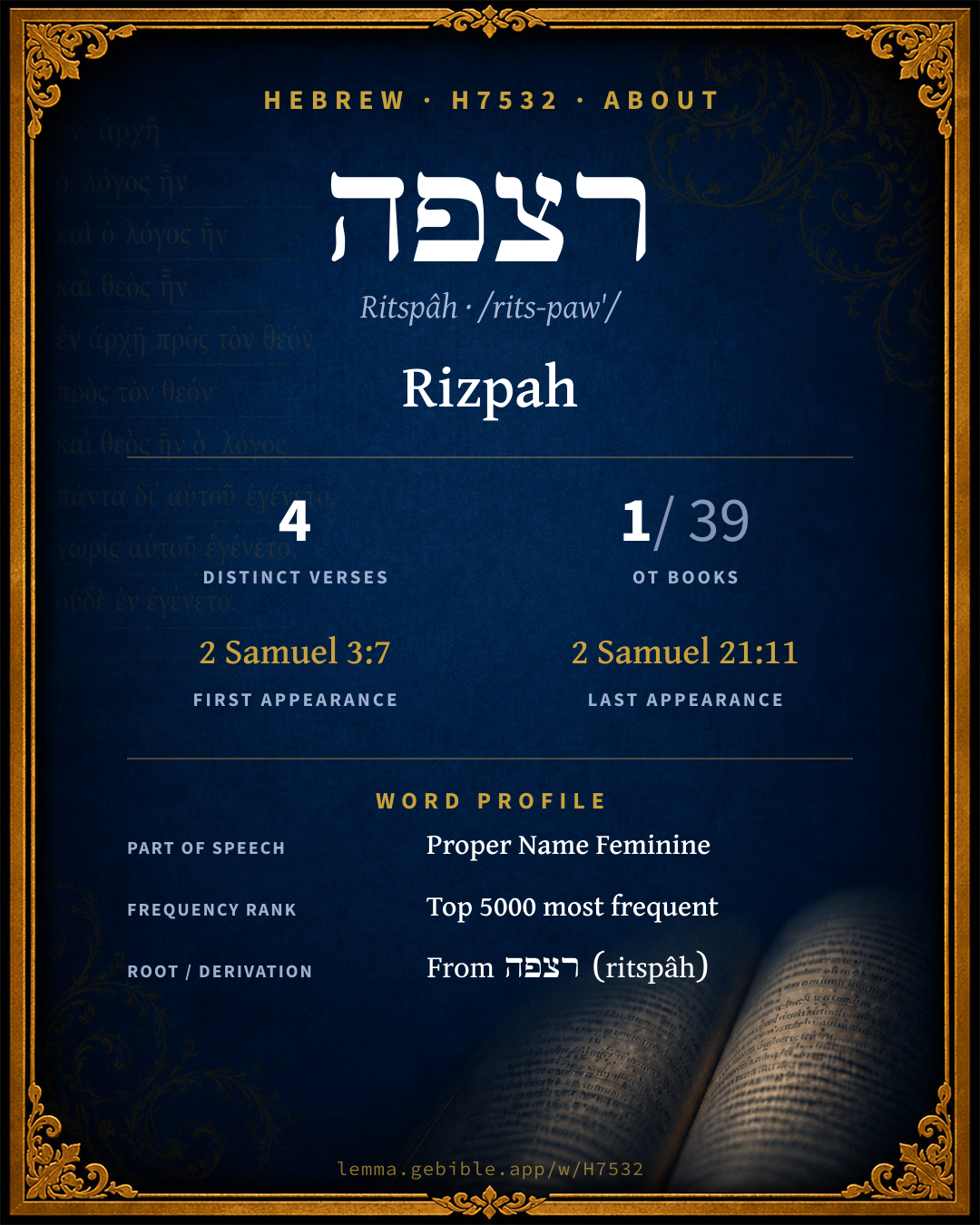
רִצְפָּה
Rizpah
BDB lists 2 entries for ‘Rizpah’ fuller range ↓
Full lexicon entry — Brown-Driver-Briggs (BDB)
From Brown-Driver-Briggs (BDB)
Where this word appears
Grammar key — what these labels mean
Part of speech
- Noun
- A naming word — a person, place, thing, or idea.
Noun type
- Proper
- A name of a specific person, place, or people (e.g. Abraham, Zion, Israel).
Every verse where H7532 appears — 4 distinct verses across 1 book. Click any verse to open its interlinear word-by-word view. Verse text shown in the World English Bible for context — . Each verse’s Hebrew form is shown with its reference; the English is not keyword-highlighted, since the data carries no word-level English alignment. Use “Compare translations” on any verse to read it across multiple English versions. This concordance covers the Hebrew Bible; Septuagint (Greek Old Testament) occurrences are not indexed here.
2 Samuel 4 verses
- 2 Samuel 3:7 רִצְפָּ֣ה n Proper Now Saul had a concubine, whose name was Rizpah, the daughter of Aiah: and [Ish-bosheth] said to Abner, Why have you gone in to my father's concubine?
- 2 Samuel 21:8 רִצְפָּ֤ה n Proper But the king took the two sons of Rizpah the daughter of Aiah, whom she bore to Saul, Armoni and Mephibosheth; and the five sons of Michal the daughter of Saul, whom she bore to Adriel the son of Barzillai the Meholathite:
- 2 Samuel 21:10 רִצְפָּה֩ n Proper Rizpah the daughter of Aiah took sackcloth, and spread it for her on the rock, from the beginning of harvest until water was poured on them from the sky; and she allowed neither the birds of the sky to rest on them by day, nor the animals of the field by night.
- 2 Samuel 21:11 רִצְפָּ֥ה n Proper It was told David what Rizpah the daughter of Aiah, the concubine of Saul, had done.
About this entry
At a glance — auto-summarized from this page’s data, not written by a person. Every figure links to its source below. This summary describes the numbers; it doesn’t interpret them.
“Rizpah” is the headline sense of the Hebrew name רצפה (Ritspâh). It is rare — just 4 verses in the entire Hebrew Bible. It clusters heavily in 2 Samuel, which alone accounts for 100% of its uses. Its earliest occurrence is 2 Samuel 3:7. The sections below give every occurrence and version rendering.
Gloss history
Strong's 1890 vs modern scholarship
About this word
Strong's H7532 catalogs a Hebrew word from the Hebrew Old Testament.
These counts are not copied from any lexicon or concordance. They are computed here, from the morphology-tagged Hebrew Old Testament. What Lemma adds →
- 4
- distinct verses
- The word appears in 4 distinct verses.
- 1 / 39
- OT books
- The word appears in 1 of 39 Old Testament books.
- #3,696
- by frequency
- Top 5000 most frequent Hebrew words (rank 3,696 of 8,640 Hebrew words by occurrence).
View all 4 occurrences in the concordance →
Most concentrated in
- 2 Samuel 4 verses 100%
By section of the Old Testament
By traditional corpus
Conventional, traditional groupings — biblical authorship is debated, so this is a traditional corpus grouping, not an authorship claim. Each share is this word’s portion of its verses in that division of the Hebrew canon. Each figure is a share of the word’s 4 distinct verses.
- Prophets (Nevi'im) 4 verses · 100%
How translations render this word
Counts come from each version’s own published word-to-Strong’s tagging or interlinear alignment — an approximate guide to how each version renders this word, not a word-level alignment the data otherwise carries. Because each total is that version’s own tagged count, the per-version totals vary from one another and need not match the appearance or distinct-verse counts above. These counts may also differ from a printed concordance because Lemma counts each distinctly tagged rendering and does not collapse phrase taggings into a single head-word total. This is a fixed set of word-tagged versions (KJV, ASV, BSB, ULT) and does not change with the reading translation you choose elsewhere. Each version’s license is shown beside its name below (and on Sources).
BDB lists this Strong’s number as 2 distinct words (homographs). Each count above pools all of them and is not split by sense — see the Senses section below. A low-frequency rendering may belong to a different one of those words, not the primary meaning.
- King James Version†: Rizpah 3×
- American Standard Version†: Rizpah 3×
- Berean Standard Bible†: Rizpah 4×
- unfoldingWord Literal Text†: Rizpah 3×
King James Version Public Domain
Renders H7532 across 4† tagged occurrences — most commonly:
Plus 1 rendering that appears only once — usually multi-word phrases or single function words the recovered tagging swept in, not distinct renderings.
American Standard Version Public Domain
Renders H7532 across 4† tagged occurrences — most commonly:
Plus 1 rendering that appears only once — usually multi-word phrases or single function words the recovered tagging swept in, not distinct renderings.
Berean Standard Bible Public Domain
Renders H7532 across 4† tagged occurrences — most commonly:
unfoldingWord Literal Text CC BY-SA 4.0
Renders H7532 across 4† tagged occurrences — most commonly:
Plus 1 rendering that appears only once — usually multi-word phrases or single function words the recovered tagging swept in, not distinct renderings.
Senses in the full BDB
What do BDB’s symbols mean?
BDB uses these scholarly abbreviations:
| Symbol | Meaning |
|---|---|
| 𝔊 | the Septuagint (the ancient Greek translation, LXX) |
| 𝔙 | the Vulgate (the Latin translation) |
| 𝔖 | the Syriac version (the Peshitta) |
| 𝔗 | the Targum (the Aramaic translation) |
| ψ | the Psalms |
| √ | root (the underlying root or stem) |
| ‖ | parallel passage (a synonymous or contrasted parallel) |
| † | the dagger: every passage where the word occurs is cited |
The 0 senses and sub-senses the full Brown-Driver-Briggs lexicon distinguishes for this word, in lexicon order (not ranked by frequency), with BDB’s own verbatim wording and sub-sense lettering. Shown in Hebrew script with BDB’s own scholarly abbreviations. The condensed entry is in the Lexicon Entry tab. See also the Forms in the corpus table below.
רצפה I glowing stone (or coal) (WeIsr. u. Jüd. Gesch.(3) 83)
רצפה II f. concubine of Saul, 2 S 3
Senses from the full Brown-Driver-Briggs lexicon (Brown, Driver, Briggs; Oxford 1906 — public domain), digitized via Sefaria, supplemented by the OpenScriptures HebrewLexicon (CC BY 4.0). Full attribution on Sources.
Word origin
I. n.f. glowing stone (or coal) (WeIsr. u. Jüd. Gesch.(3) 83);—ר׳ abs. Is 6:6; pl. עֻגַת רְצָפִים 1 K 19:6 (cf. Syriac supr.).
II. n.pr.f. concubine of Saul, 2 S 3:7; 21:8, 10, 11, Ρεσφα.
— Brown-Driver-Briggs (Oxford 1906, public domain), digitized via Sefaria, supplemented by the OpenScriptures HebrewLexicon (CC BY 4.0). See Sources.
Derived from רצפה (ritspâh) (H7531) — pavement.
Jastrow Dictionary
A second Hebrew/Aramaic lexicon for comparison, covering Aramaic and post-biblical (Talmudic, Targumic, Midrashic) usage that the biblical-Hebrew BDB does not. Matched by lemma rather than by Strong’s number, so a lemma may carry more than one Jastrow headword (shown separately below), and the entries cover usage well beyond the Bible.
רִצְפָה
- v. Baer to Ez. XL,
- 1. block pavement. Meg. 22ᵇ (ref. to Lev. XXVI, 1 אבן משכית) לא אסרה תורה אלא ר׳ של וכ׳ the Torah forbids only prostration on a stone pavement (in a synagogue). Shek. VI, 2; Y. ib. 49ᶜ a priest was splitting wood in the wood cell of the Temple וראה את הר׳ וכ׳ and noticed that the pavement there was different from the others. Y. Naz. VII, 56ᵇ bot. הנקבר ערום בארון … או ע"ג רי׳ וכ׳ a body buried naked in a marble coffin, or on a paved floor, or on a marble plate; Bab. Naz. 51ᵃ. Ib. ר׳ של לבנים brick pavement. Yoma I, 7; a. fr. e.g. Leviticus 26:1
- 2. (from its resemblance to a block pavement) cobweb.—Pl. רִצְפוֹת Ukts. I, 2 (Ar. רִצְפִית); Tosef. ib. I, 2 (T’bul Yom III), v. סִיג II.
A Dictionary of the Targumim, the Talmud Babli and Yerushalmi, and the Midrashic Literature (Marcus Jastrow; London, Luzac, 1903) — Public Domain. Digitized via Sefaria. Digitized via Sefaria. Full attribution on Sources.
Forms in the corpus
The 4 distinct written forms H7532 takes in the Hebrew Bible, most frequent first — each parse links to that state’s occurrences in the concordance. Hebrew forms include their vowel points and cantillation, so a single lemma takes many written forms.
| Form | Parsing | Example | Uses |
|---|---|---|---|
| רִצְפָּ֣ה | Noun, Proper | 2 Samuel 3:7 | 1 |
| רִצְפָּ֤ה | Noun, Proper | 2 Samuel 21:8 | 1 |
| רִצְפָּ֥ה | Noun, Proper | 2 Samuel 21:11 | 1 |
| רִצְפָּה֩ | Noun, Proper | 2 Samuel 21:10 | 1 |
Bible dictionary
Public-domain dictionary articles matched to this entry by name (Rizpah). A biblical name can be shared by more than one person or place, so an article may treat several.
Easton's Bible Dictionary · M. G. Easton, 1897
Coal; hot stone, the daughter of Aiah, and one of Saul's concubines. She was the mother of Armoni and Mephibosheth (2 Sam. 3:7; 21:8, 10, 11).
It happened that a grievous famine, which lasted for three years, fell upon the land during the earlier half of David's reign at Jerusalem. This calamity was sent "for Saul and for his bloody house, because he slew the Gibeonites." David inquired of the Gibeonites what satisfaction they demanded, and was answered that nothing would compensate for the wrong Saul had done to them but the death of seven of Saul's sons. David accordingly delivered up to them the two sons of Rizpah and five of the sons of Merab (q.v.), Saul's eldest daughter, whom she bore to Adriel. These the Gibeonites put to death, and hung up their bodies before the Lord at the sanctuary at Gibeah. Rizpah thereupon took her place on the rock of Gibeah (q.v.), and for five months watched the suspended bodies of her children, to prevent them from being devoured by the beasts and birds of prey, till they were at length taken down and buried by David.
Her marriage to Abner was the occasion of a quarrel between him and Ishbosheth, which led to Abner's going over to the side of David (2 Sam. 3:17-21).
Smith's Bible Dictionary · William Smith, 1863
concubine to King Saul, and mother of his two sons Armoni and Mephibosheth. (B.C. 1080.) The tragic story of the love and endurance with which she watched over the bodies of her two sons, who were killed by the Gibeonites, (2 Samuel 21:8-11) has made Rizpah one of the most familiar objects in the whole Bible.
Hitchcock's Bible Names Dictionary · Roswell D. Hitchcock, 1869
bed; extension; a coal
Classic public-domain reference works; full attribution on Sources.
Septuagint verse parallels
This word appears in 4 verses that also exist in the Greek Old Testament (Septuagint), out of the 4 Hebrew verses it occurs in. You can read those verses in Greek by switching the Old Testament edition to the Septuagint.
Read these verses in the Septuagint
This is a verse-level parallel only — the same verses exist in both the Hebrew and Greek Old Testaments. No word-level Hebrew↔Greek correspondence is claimed: the data carries no such alignment, so no Greek word is shown as this Hebrew word’s translation. Coverage is not total — the Septuagint omits the deuterocanon and renumbers the Psalms, so some Hebrew verses have no direct Greek parallel.