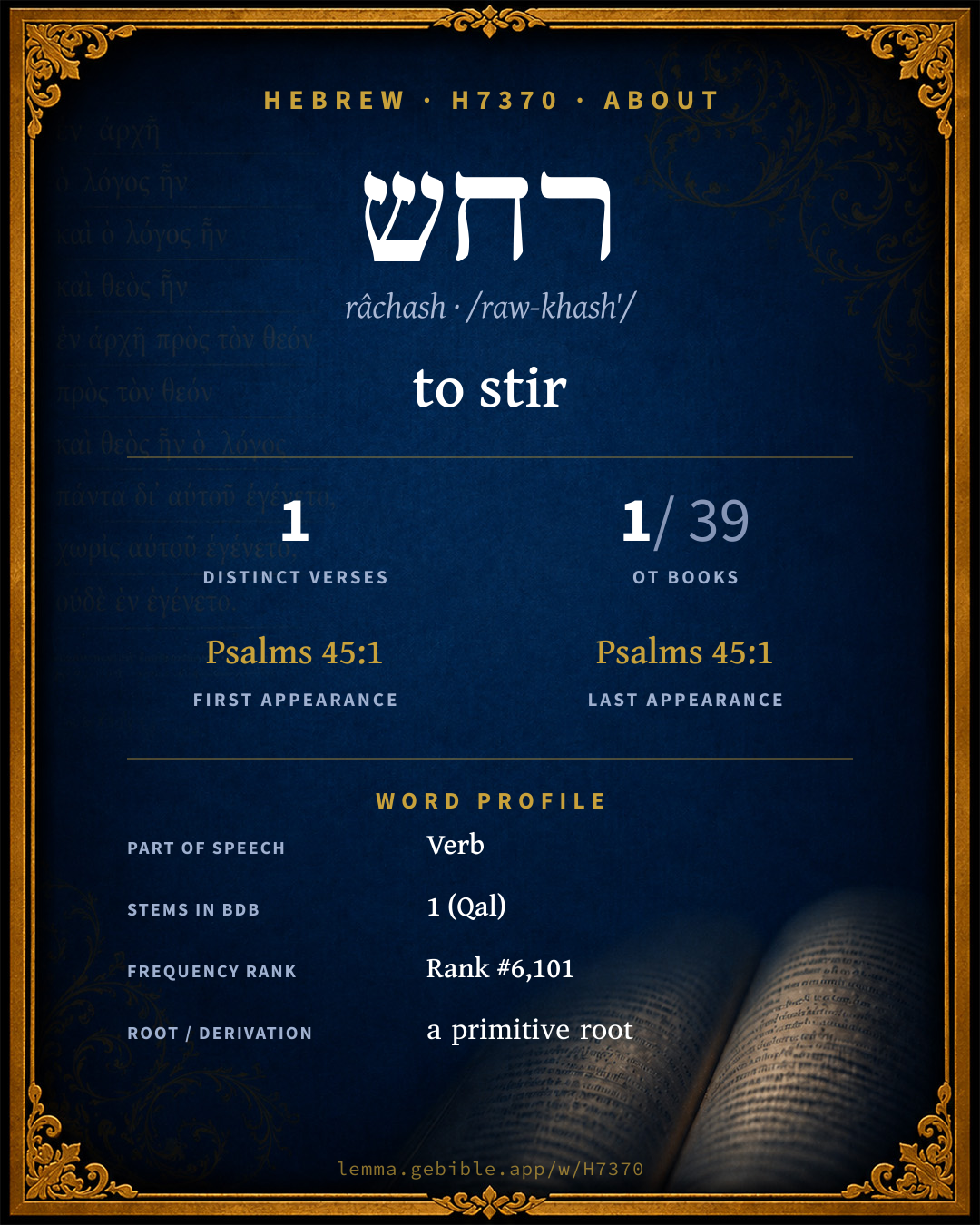
רָחַשׁ
to stir
Full lexicon entry — Brown-Driver-Briggs (BDB)
From Brown-Driver-Briggs (BDB)
Where this word appears
Grammar key — what these labels mean
Part of speech
- Verb
- An action or state-of-being word.
Stem
- Qal
- The basic, simple active stem — the plain form of the verb (“he wrote”).
Form
- Perfect
- A completed action or state — Hebrew marks aspect (completeness) more than strict tense (“he wrote”).
Person
- 3rd Person
- The one spoken about (“he / she / it / they”).
Gender
- Masculine
- Grammatically masculine.
Number
- Singular
- One.
Every verse where H7370 appears — 1 distinct verse across 1 book. Click any verse to open its interlinear word-by-word view. Verse text shown in the World English Bible for context — . Each verse’s Hebrew form is shown with its reference; the English is not keyword-highlighted, since the data carries no word-level English alignment. Use “Compare translations” on any verse to read it across multiple English versions. This concordance covers the Hebrew Bible; Septuagint (Greek Old Testament) occurrences are not indexed here.
Psalms 1 verse
About this entry
At a glance — auto-summarized from this page’s data, not written by a person. Every figure links to its source below. This summary describes the numbers; it doesn’t interpret them.
רחש — transliterated râchash — is a Hebrew verb carrying the sense “to stir.” A scarce word — 1 verse in all of the Hebrew Bible. More than three-quarters of its appearances fall in Psalms. Its lone occurrence is Psalms 45:1. It shares a root with מרחשת. See the sense tree, 1-verse concordance, and the renderings breakdown below.
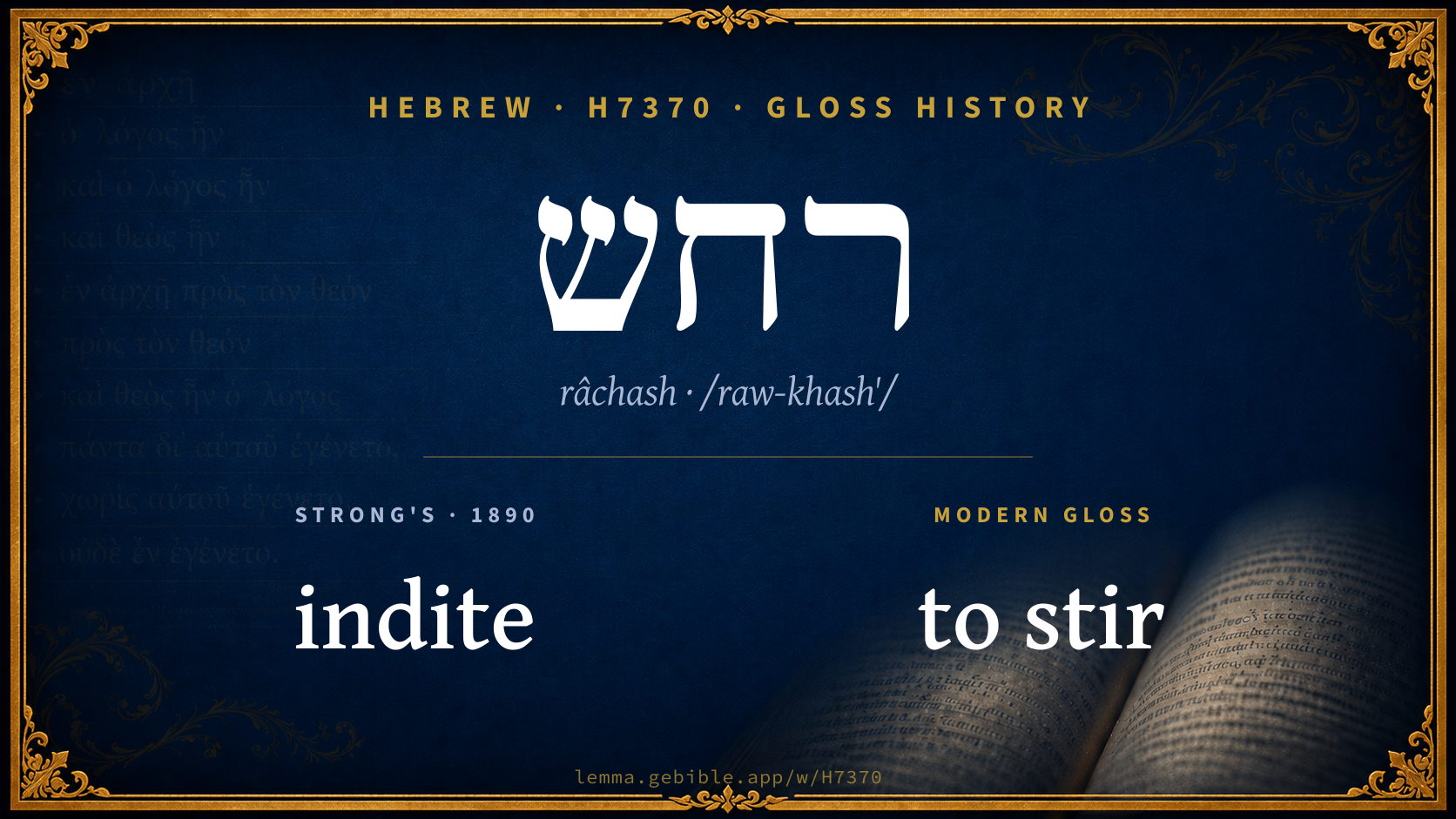
Gloss history
Strong's 1890 vs modern scholarship
About this word
Strong's H7370 catalogs a Hebrew word from the Hebrew Old Testament.
These counts are not copied from any lexicon or concordance. They are computed here, from the morphology-tagged Hebrew Old Testament. What Lemma adds →
- 1
- distinct verses
- The word appears in 1 distinct verse.
- 1 / 39
- OT books
- The word appears in 1 of 39 Old Testament books.
- #6,101
- by frequency
- Rank #6,101 (rank 6,101 of 8,640 Hebrew words by occurrence).
View all 1 occurrence in the concordance →
Most concentrated in
- Psalms 1 verse 100%
By section of the Old Testament
By traditional corpus
Conventional, traditional groupings — biblical authorship is debated, so this is a traditional corpus grouping, not an authorship claim. Each share is this word’s portion of its verses in that division of the Hebrew canon. Each figure is a share of the word’s 1 distinct verse.
- Writings (Ketuvim) 1 verse · 100%
How translations render this word
Counts come from each version’s own published word-to-Strong’s tagging or interlinear alignment — an approximate guide to how each version renders this word, not a word-level alignment the data otherwise carries. Because each total is that version’s own tagged count, the per-version totals vary from one another and need not match the appearance or distinct-verse counts above. These counts may also differ from a printed concordance because Lemma counts each distinctly tagged rendering and does not collapse phrase taggings into a single head-word total. This is a fixed set of word-tagged versions (KJV, ASV, BSB, ULT) and does not change with the reading translation you choose elsewhere. Each version’s license is shown beside its name below (and on Sources).
- King James Version: Is inditing 1×
- American Standard Version: Overfloweth 1×
- Berean Standard Bible: Is stirred 1×
- unfoldingWord Literal Text: Boils over 1×
King James Version Public Domain
Renders H7370 across 1 tagged occurrence — most commonly:
American Standard Version Public Domain
Renders H7370 across 1 tagged occurrence — most commonly:
Berean Standard Bible Public Domain
Renders H7370 across 1 tagged occurrence — most commonly:
unfoldingWord Literal Text CC BY-SA 4.0
Renders H7370 across 1 tagged occurrence — most commonly:
Senses in the full BDB
What do BDB’s symbols mean?
BDB uses these scholarly abbreviations:
| Symbol | Meaning |
|---|---|
| 𝔊 | the Septuagint (the ancient Greek translation, LXX) |
| 𝔙 | the Vulgate (the Latin translation) |
| 𝔖 | the Syriac version (the Peshitta) |
| 𝔗 | the Targum (the Aramaic translation) |
| ψ | the Psalms |
| √ | root (the underlying root or stem) |
| ‖ | parallel passage (a synonymous or contrasted parallel) |
| † | the dagger: every passage where the word occurs is cited |
The 1 sense the full Brown-Driver-Briggs lexicon distinguishes for this word, in lexicon order (not ranked by frequency), with BDB’s own verbatim wording and sub-sense lettering. Shown in Hebrew script with BDB’s own scholarly abbreviations. The condensed entry is in the Lexicon Entry tab.
Qal
- Pf. 3 ms. ר׳ לִבִּי דָּבָר טוֹב ψ 45:2 is astir. e.g. Psalms 45:2
Senses from the full Brown-Driver-Briggs lexicon (Brown, Driver, Briggs; Oxford 1906 — public domain), digitized via Sefaria, supplemented by the OpenScriptures HebrewLexicon (CC BY 4.0). Full attribution on Sources.
Word origin
vb. keep moving, stir (NH stir, move, especially of lips in speech, also, in expl. of מרחשׁת, of stewing, boiling; Aramaic רְחֵישׁ, ܪܚܶܫ, ܪܚܰܫ, creep, more, flutter, ܪܰܚܫܳܐ reptile);—
— Brown-Driver-Briggs (Oxford 1906, public domain), digitized via Sefaria, supplemented by the OpenScriptures HebrewLexicon (CC BY 4.0). See Sources.
Origin: a primitive root
Jastrow Dictionary
A second Hebrew/Aramaic lexicon for comparison, covering Aramaic and post-biblical (Talmudic, Targumic, Midrashic) usage that the biblical-Hebrew BDB does not. Matched by lemma rather than by Strong’s number, so a lemma may carry more than one Jastrow headword (shown separately below), and the entries cover usage well beyond the Bible.
רָחַשׁ
- (b. h.)
- 1. to move, vibrate. Y. Ber. II, 4ᵇ bot. האומר … שפתותיו רוֹחֲשׁוֹת עמו בקבר if one reports a tradition in the name of its author, his (the author’s) lips move in the grave with him (the reporter); Y. M. Kat. III, 83ᶜ bot.; Y. Shek. II, end, 47ᵃ. Ib. מְרַחֲשׁוֹת (Pi., v. דָּבַב). Men. V, 8 (63ᵃ) מרחשת … ומעשיה רוֹחֲשִׁין (Bab. ed. רוחשין רכין; Ms. M. only רכין, v. Rabb. D. S. a. l. note) a marḥesheth is deep, and the pastry made in it vibrates (like jelly), opp. קשין; Sifra Vayikra, N’dab., Par. 10, ch. XII; Lev. R. s. 3, end; Yalk. ib. 451.
- 2. to swarm.—Part. pass. רָחוּשׁ; f. רְחוּשָׁה crowded. Lev. R. s. 30; Pesik. Ul’ḳaḥ., p. 184ᵃ sq., v. דָּחַס.
- 3. with לב, to be moved, to feel, think. Midr. Till. to Ps. XLV, 2 לא יכלו … אלא כיון שר׳ לבם בתשובה וכ׳ they could not confess with their lips, but when their heart was moved in repentance, the Lord received them. Ib. אם בלבנו רָחַשְׁנוּ וכ׳ if we only have been thinking in our hearts, we have already told our deeds to the Lord; a. e.
- same, to move. Pes. 88ᵇ הטילו … ורִיחֲשָׁה they poured cold water upon it (the lizard), and it moved. Y. Shek. l. c., v. supra.
- 1. to move (the lips); to whisper, think. Y. Ber. IV, beg. 7ᵃ (ref. to I Sam. I, 13) מיכן … להַרְחִישׁ בשפתותיו from this we learn that he who prays must move his lips. Ib. מַרְחִישׁ בשפתותיו. Pesik. R. s. 13 (ref. to Ex. XVII, 7) [read:] אם מַרְחִישִׁים אנו בקרבנו דברים והוא יודע מה אנו מרחישים בקרבנו וכ׳ if we think words in our hearts, and he knows what we think in our hearts, we will worship him; (Ex. R. s. 26 מהרהרים). e.g. 1 Samuel 1:13
- 2. to swarm, come forth (of worms); to bring forth (worms). Koh. R. to V, 10 (ref. to Job XXV, 6) אלו תולעים שמַרְחִישִׁין תחתיו במותו that means the worms which come forth under him when he is dead. Gen. R. s. 23 התחיל המת מרחיש (not מרחש) corpses began to beget worms; a. e.—Trnsf. to bring forth in abundance. Ber. 17ᵃ יַרְחִישׁ, v. רְנָנָה. e.g. Job 25:6
רְחַשׁ
- 1. to move, creep; to swarm, bring forth. Targ. Gen. I, 26; 28; 30 (h. text רמש). Ib. O. 20 (Y. יְרַחֲשׁוּן Pa.; h. text שרץ). Targ. Ps. CV, 30; a. fr.
- 2. to move (the lips); to be moved. Targ. Lam. I, 18. Targ. Y. Gen. XLIII, 29; a. e.—[Targ. Ps. XIV, 7 יִרְחַשׁ Ms., v. infra.]
- 1. to bring forth (worms &c.). (worms &c.). Targ. Gen. I, 21. Ib. IX, 2. Targ. Y. Ex. XVI, 20.
- 2. to cause to come forth, bring about. Targ. Ps. XIV, 7 (Ms. Pe.). Targ. Lam. III, 23. Targ. Ps. LV, 9 (h. text אחישה).
- 1. to bring forth. Targ. Y. Gen. I, 20 (v. supra).
- 2. to move. Ḥag. 3ᵃ מניידי … ומְרַחֲשִׁין שפוותייהו (mutes) nodded their heads and moved their lips.—Part. pass. מְרַחַשׁ; f. מְרַחְשָׁא; pl. f. מְרַחְשָׁן. Snh. 67ᵇ חזא דקא מר׳ שפוותה (not שפוותיה) he saw that her lips were moving (she was mumbling a charm). Ib. 90ᵇ דילמא רַחוּשֵׁי מר׳ שפוותייהו בעלמא (not שפוותיה) perhaps only their lips moved (in the grave)?, v. preced.; (Ms. F. מְרַחֲשִׁין וכ׳ they moved their lips). Men. 63ᵃ כדאמרי אינשי קמרחשן וכ׳ Ms. M. (ed. הוה מר׳ וכ׳) as people say, his lips are moving (he is excited).
- to be brought about, to occur. א׳ ניסא a miracle happened. Targ. Ps. XVIII, 1. Targ. Koh. IV, 13.—B. Mets. 106ᵃ אי הוות חזית לאִתְרַחוּשֵׁי לך ניסא הוה א׳ וכ׳ if thou wert worthy of a miracle to happen to thee, a miracle would have happened to thee like that &c. Meg. 7ᵇ לא בכל … מִתְרְחִישׁ ניסא not always does a miracle happen. Gitt. 45ᵃ; a. fr.
רַחַשׁ
- (preced.)
- 1. a creeping thing, reptile. Ter. VIII, 4 כדי שיצא הר׳ וכ׳ as long as it would take a poisonous reptile to come forth … and drink; Ḥull. 10ᵃ.—V. רָחוֹשׁ.
- 2. emotion, thought. Midr. Till. to Ps. XLV, 2 אם ר׳ למה אמירה ואם אמירה למה ר׳ if thought is meant, why does the text mention speech, and if speech, why thought?; a. e.—V. רַחֲשׁוּשׁ.
רְחֵשׁ
- , worm, reptile, insect. Targ. Gen. I, 20 (h. text שרץ). Targ. O. Ex. XVI, 20 (h. text תולעים). Targ. ib. 24 (h. text רמה). Targ. Lev. XI, 20, sq. Ib. V, 2 (O. ed. Vien. רָחִיש); a. fr.—B. Mets. 84ᵇ חזאי ר׳ דקא וכ׳ I saw a worm come out of his ear. Y. Yeb. XV, 14ᵈ דר׳ שכיח at a season when the bite of a reptile is of frequent occurrence; a. e.—In gen. a living thing, noxious animal. Sabb. 146ᵃ sq. לא אתי לאוסופי משום ר׳ one will not enlarge the hole for fear that an animal may creep in.—Pl. רַחֲשִׁין, רַחֲשֵׁי, רִי׳. Targ. Y. Gen. I, 24. Targ. Y. Deut. XVIII, 11.
A Dictionary of the Targumim, the Talmud Babli and Yerushalmi, and the Midrashic Literature (Marcus Jastrow; London, Luzac, 1903) — Public Domain. Digitized via Sefaria. Digitized via Sefaria. Full attribution on Sources.
Same root — word family
Other BDB entries built from the same root as H7370, grouped by Strong’s listed origin. These share a root / origin per the lexicon — not necessarily a shared meaning. Each links to that word’s own entry.
Derived from this word
Compare all same-root words → They share a root, not necessarily a meaning.
Septuagint verse parallels
This word appears in 1 verse that also exists in the Greek Old Testament (Septuagint), out of the 1 Hebrew verse it occurs in. You can read those verses in Greek by switching the Old Testament edition to the Septuagint.
Read these verses in the Septuagint
This is a verse-level parallel only — the same verses exist in both the Hebrew and Greek Old Testaments. No word-level Hebrew↔Greek correspondence is claimed: the data carries no such alignment, so no Greek word is shown as this Hebrew word’s translation. Coverage is not total — the Septuagint omits the deuterocanon and renumbers the Psalms, so some Hebrew verses have no direct Greek parallel.