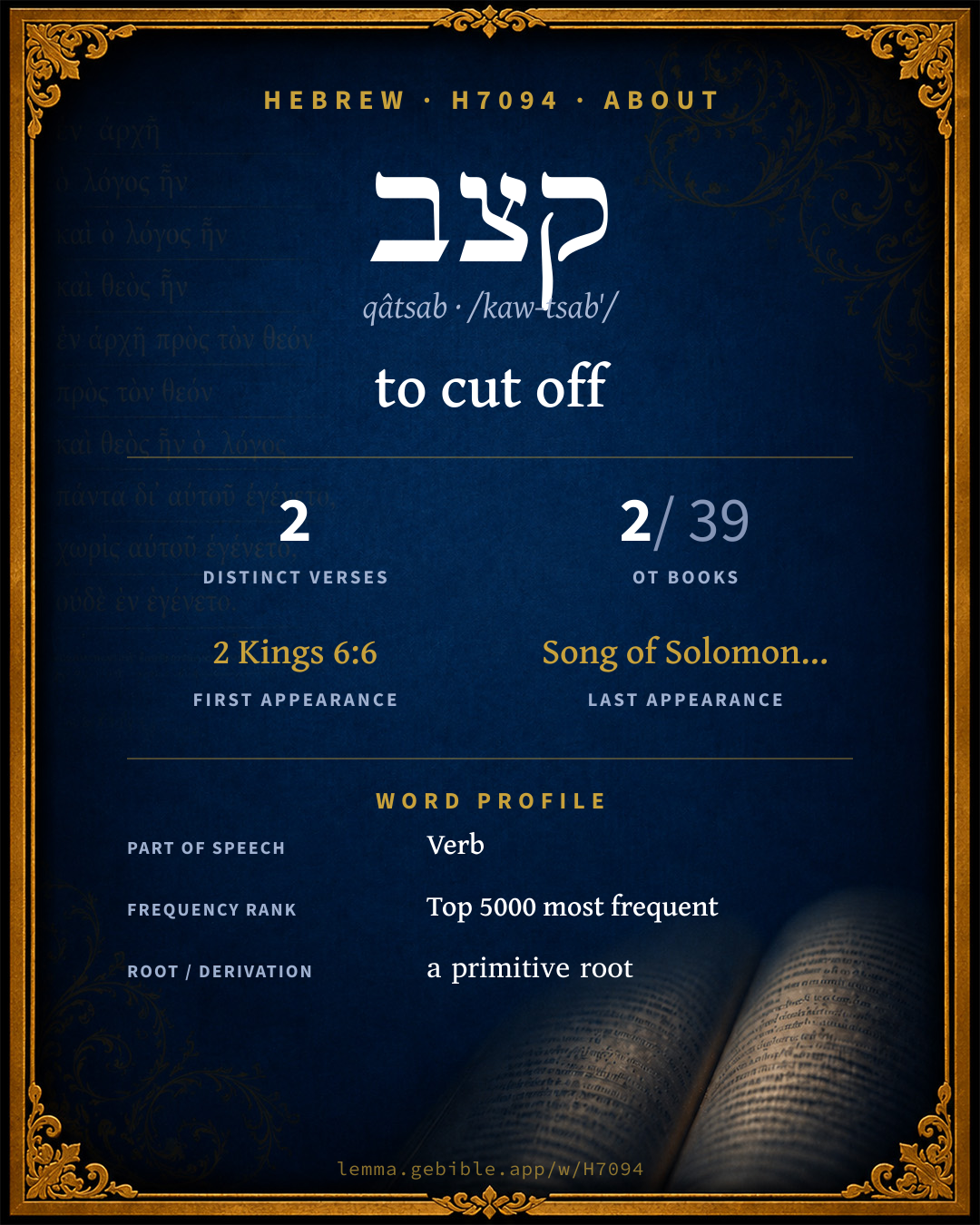
קָצַב
to cut off
Full lexicon entry — Brown-Driver-Briggs (BDB)
From Brown-Driver-Briggs (BDB)
Where this word appears
Grammar key — what these labels mean
Stem
- Qal
- The basic, simple active stem — the plain form of the verb (“he wrote”).
Form
- Sequential Imperfect
- An imperfect with prefixed waw — the standard past-narrative form (waw-consecutive imperfect).
- Participle Passive
- A verbal adjective expressing action received (“written”).
State
- Absolute
- The independent form of a noun, not bound to a following word.
Person
- 3rd Person
- The one spoken about (“he / she / it / they”).
Gender
- Masculine
- Grammatically masculine.
- Feminine
- Grammatically feminine.
Number
- Singular
- One.
- Plural
- More than one (in Hebrew, generally three or more).
Every verse where H7094 appears in the Book of 2 Kings — 1 distinct verse. Click any verse to open its interlinear word-by-word view. Verse text shown in the World English Bible for context — . Each verse’s Hebrew form is shown with its reference; the English is not keyword-highlighted, since the data carries no word-level English alignment. Use “Compare translations” on any verse to read it across multiple English versions. This concordance covers the Hebrew Bible; Septuagint (Greek Old Testament) occurrences are not indexed here.
2 Kings
About this entry
At a glance — auto-summarized from this page’s data, not written by a person. Every figure links to its source below. This summary describes the numbers; it doesn’t interpret them.
קצב — transliterated qâtsab — is a Hebrew verb carrying the sense “to cut off.” The Hebrew Bible uses it only 2 verses. More than half of its appearances fall in 2 Kings. Its earliest occurrence is 2 Kings 6:6. It shares a root with קצב. Each statement above links to its evidence; the full detail follows below.
Gloss history
Strong's 1890 vs modern scholarship
About this word
Strong's H7094 catalogs a Hebrew word from the Hebrew Old Testament.
These counts are not copied from any lexicon or concordance. They are computed here, from the morphology-tagged Hebrew Old Testament. What Lemma adds →
- 2
- distinct verses
- The word appears in 2 distinct verses.
- 2 / 39
- OT books
- The word appears in 2 of 39 Old Testament books.
- #4,807
- by frequency
- Top 5000 most frequent Hebrew words (rank 4,807 of 8,640 Hebrew words by occurrence).
View all 2 occurrences in the concordance →
Most concentrated in
- 2 Kings 1 verse 50%
- Song of Solomon 1 verse 50%
By section of the Old Testament
By traditional corpus
Conventional, traditional groupings — biblical authorship is debated, so this is a traditional corpus grouping, not an authorship claim. Each share is this word’s portion of its verses in that division of the Hebrew canon. Each figure is a share of the word’s 2 distinct verses.
- Prophets (Nevi'im) 1 verse · 50%
- Writings (Ketuvim) 1 verse · 50%
How translations render this word
Counts come from each version’s own published word-to-Strong’s tagging or interlinear alignment — an approximate guide to how each version renders this word, not a word-level alignment the data otherwise carries. Because each total is that version’s own tagged count, the per-version totals vary from one another and need not match the appearance or distinct-verse counts above. These counts may also differ from a printed concordance because Lemma counts each distinctly tagged rendering and does not collapse phrase taggings into a single head-word total. This is a fixed set of word-tagged versions (KJV, ASV, BSB, ULT) and does not change with the reading translation you choose elsewhere. Each version’s license is shown beside its name below (and on Sources).
- King James Version: He cut down 1×, Sheep that are even shorn 1×
- American Standard Version: Ewes that are newly shorn 1×, He cut down 1×
- Berean Standard Bible: Man of god cut 1×, Newly shorn sheep 1×
- unfoldingWord Literal Text: He cut off 1×, Sheep 1×, Shorn 1×
King James Version Public Domain
Renders H7094 across 2 tagged occurrences — most commonly:
American Standard Version Public Domain
Renders H7094 across 2 tagged occurrences — most commonly:
Berean Standard Bible Public Domain
Renders H7094 across 2 tagged occurrences — most commonly:
unfoldingWord Literal Text CC BY-SA 4.0
Renders H7094 across 3 tagged occurrences — most commonly:
Senses in BDB
The 1 sense BDB distinguishes for this word, in lexicon order (not ranked by frequency or importance). The full entry — with sub-senses — is in the Lexicon Entry tab.
- (Qal) to cut off, shear
Word origin
[ קָצַב ] vb. cut off, shear (?)
— Brown-Driver-Briggs (Oxford 1906, public domain), digitized via Sefaria, supplemented by the OpenScriptures HebrewLexicon (CC BY 4.0). See Sources.
Origin: a primitive root
Jastrow Dictionary
A second Hebrew/Aramaic lexicon for comparison, covering Aramaic and post-biblical (Talmudic, Targumic, Midrashic) usage that the biblical-Hebrew BDB does not. Matched by lemma rather than by Strong’s number, so a lemma may carry more than one Jastrow headword (shown separately below), and the entries cover usage well beyond the Bible.
קָצַב
- (b. h.) to cut, decide, determine, limit, bound. Y. Maasr. IV, 51ᵇ top ק׳ להיסב וכ׳ if he had determined to recline for a meal, but did not do so. [Y. Ḥag. II, 78ᵃ bot. חוגג וקוצב, read: וקוֹצֵר.]—Part. pass. קָצוּב; f. קְצוּבָה; pl. קְצוּבִים, קְצוּבִין; קְצוּבוֹת. Tosef. Ter. I, 10 דבר הק׳ מן התורה a thing (duty) the scope of which is clearly defined in the Torah, v. קִצְבָה. Gitt. 50ᵇ לפי שאין ק׳ because they (the alimonies of a widow and of orphaned daughters) are not definite (vary according to social position). Bets. 16ᵃ top כל … ק׳ וכ׳ the means of support are definitely assigned to man from the beginning of the year, except the expenses for the Sabbaths … and for education &c. Cant. R. to IV, 2 (ref. to קצובות, ib.) מלין ק׳ definitely regulated things (laws); ib. 4 (some ed. קְצִי׳). Y. Ber. V, beg. 8ᵈ הלכות ק׳ decided (settled) questions of law; (Bab. ib. 31ᵃ הלכה פסוקה); a. fr.
- to carve, chop (meat). Bets. I, 5 לקַצֵּב עליו בשר to carve meat on it. Tosef. ib. I, 11 אם קי׳ על העלי if he used the pestle to carve meat on it. Y. Macc. II, beg. 31ᶜ טבח שהוא מְקַצֵּב וכ׳ a butcher that chops meat and kills a man (by a slip of the hatchet &c.); a. e.
קַצָּב
- (preced.) butcher. Eduy. VIII, 2, a. fr. זכריה בן הק׳.—Pl. קַצָּבִים. Bets. 25ᵃ והוא הדין לק׳ but it applies also to the butchers (that they must not sell meat before flaying and dissecting).
A Dictionary of the Targumim, the Talmud Babli and Yerushalmi, and the Midrashic Literature (Marcus Jastrow; London, Luzac, 1903) — Public Domain. Digitized via Sefaria. Digitized via Sefaria. Full attribution on Sources.
Forms in the corpus
The 2 distinct written forms H7094 takes in the Hebrew Bible, most frequent first — each parse links to that stem’s occurrences in the concordance. Hebrew forms include their vowel points and cantillation, so a single lemma takes many written forms.
| Form | Parsing | Example | Uses |
|---|---|---|---|
| הַ/קְּצוּב֔וֹת | Verb, Qal, Participle Passive, Feminine, Plural, Absolute | Song of Solomon 4:2 | 1 |
| וַ/יִּקְצָב | Verb, Qal, Sequential Imperfect, 3rd Person, Masculine, Singular | 2 Kings 6:6 | 1 |
Same root — word family
Other BDB entries built from the same root as H7094, grouped by Strong’s listed origin. These share a root / origin per the lexicon — not necessarily a shared meaning. Each links to that word’s own entry.
Derived from this word
Compare all same-root words → They share a root, not necessarily a meaning.
Septuagint verse parallels
This word appears in 2 verses that also exist in the Greek Old Testament (Septuagint), out of the 2 Hebrew verses it occurs in. You can read those verses in Greek by switching the Old Testament edition to the Septuagint.
Read these verses in the Septuagint
This is a verse-level parallel only — the same verses exist in both the Hebrew and Greek Old Testaments. No word-level Hebrew↔Greek correspondence is claimed: the data carries no such alignment, so no Greek word is shown as this Hebrew word’s translation. Coverage is not total — the Septuagint omits the deuterocanon and renumbers the Psalms, so some Hebrew verses have no direct Greek parallel.