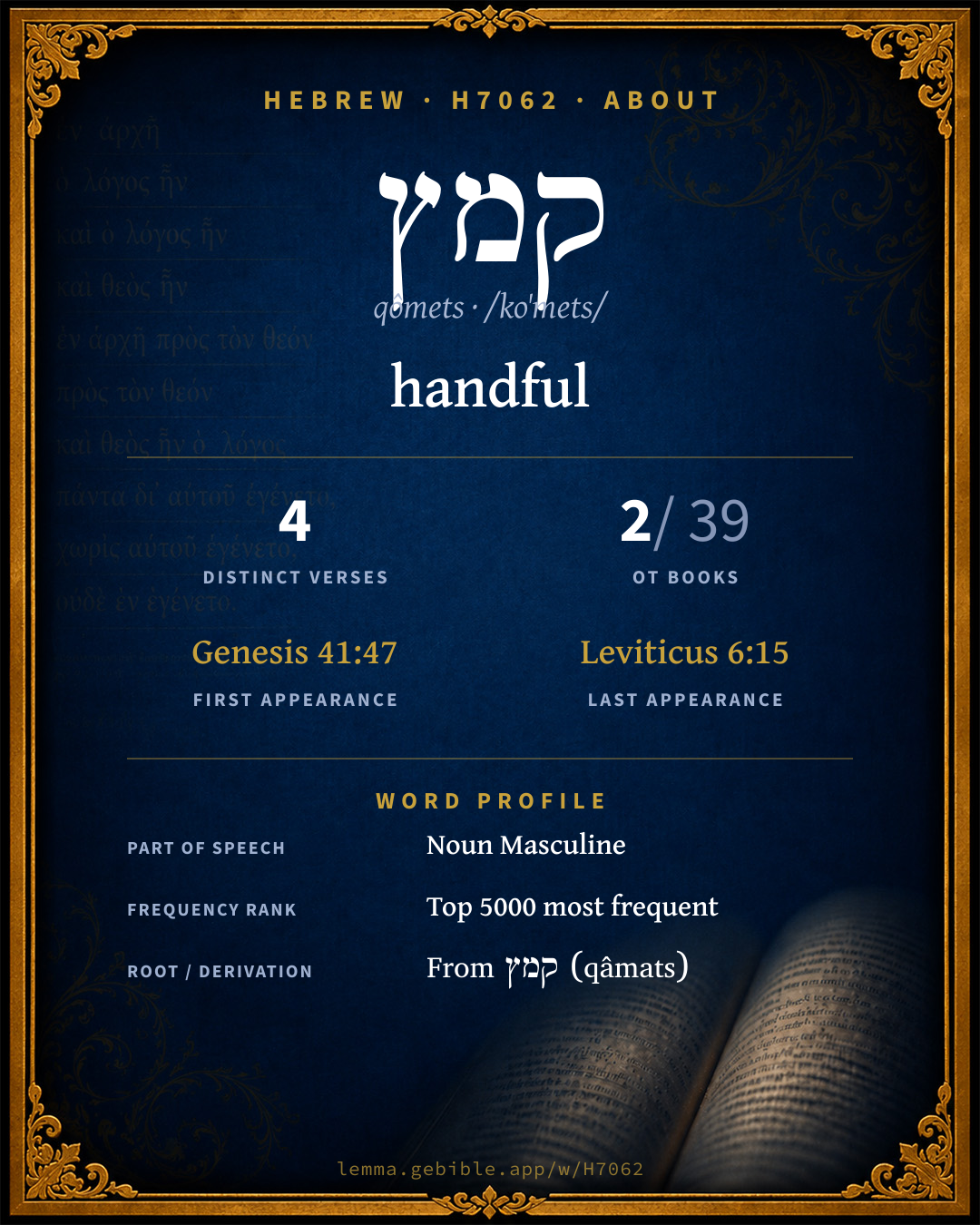
קֹ֫מֶץ
handful
Full lexicon entry — Brown-Driver-Briggs (BDB)
From Brown-Driver-Briggs (BDB)
Where this word appears
Grammar key — what these labels mean
Part of speech
- Noun
- A naming word — a person, place, thing, or idea.
Noun type
- Common
- A common noun — a general class of person, place, or thing (“king,” “city,” “water”), not a specific name.
State
- Construct
- A noun bound to a following noun in a possessive / “of” relationship (the construct chain).
- Absolute
- The independent form of a noun, not bound to a following word.
Gender
- Masculine
- Grammatically masculine.
Number
- Singular
- One.
- Plural
- More than one (in Hebrew, generally three or more).
Every verse where H7062 appears in the Book of Leviticus — 3 distinct verses. Click any verse to open its interlinear word-by-word view. Verse text shown in the World English Bible for context — . Each verse’s Hebrew form is shown with its reference; the English is not keyword-highlighted, since the data carries no word-level English alignment. Use “Compare translations” on any verse to read it across multiple English versions. This concordance covers the Hebrew Bible; Septuagint (Greek Old Testament) occurrences are not indexed here.
Leviticus
- Leviticus 2:2 קֻמְצ֗/וֹ n c ms cs + sfx pers 3ms He shall bring it to Aaron's sons the priests; and he shall take his handful of its fine flour, and of its oil, with all its frankincense; and the priest shall burn the memorial of it on the altar, an offering made by fire, of a sweet savor to Yahweh.
- Leviticus 5:12 קֻמְצ֜/וֹ n c ms cs + sfx pers 3ms He shall bring it to the priest, and the priest shall take his handful of it as the memorial portion, and burn it on the altar, on the offerings of Yahweh made by fire. It is a sin offering.
- Leviticus 6:15 בְּ/קֻמְצ֗/וֹ prep + n c ms cs + sfx pers 3ms He shall take from there his handful of the fine flour of the meal offering, and of its oil, and all the frankincense which is on the meal offering, and shall burn it on the altar for a sweet savor, as its memorial, to Yahweh.
About this entry
At a glance — auto-summarized from this page’s data, not written by a person. Every figure links to its source below. This summary describes the numbers; it doesn’t interpret them.
At its core, קמץ (qômets) means “handful.” The Hebrew Bible uses it only 4 verses. The word gravitates to Leviticus (75%), then Genesis. Scripture first uses it in Genesis 41:47. Each statement above links to its evidence; the full detail follows below.
Gloss history
Strong's 1890 vs modern scholarship
About this word
Strong's H7062 catalogs a Hebrew word from the Hebrew Old Testament.
These counts are not copied from any lexicon or concordance. They are computed here, from the morphology-tagged Hebrew Old Testament. What Lemma adds →
- 4
- distinct verses
- The word appears in 4 distinct verses.
- 2 / 39
- OT books
- The word appears in 2 of 39 Old Testament books.
- #3,696
- by frequency
- Top 5000 most frequent Hebrew words (rank 3,696 of 8,640 Hebrew words by occurrence).
View all 4 occurrences in the concordance →
By traditional corpus
Conventional, traditional groupings — biblical authorship is debated, so this is a traditional corpus grouping, not an authorship claim. Each share is this word’s portion of its verses in that division of the Hebrew canon. Each figure is a share of the word’s 4 distinct verses.
- Torah (Pentateuch) 4 verses · 100%
How translations render this word
Counts come from each version’s own published word-to-Strong’s tagging or interlinear alignment — an approximate guide to how each version renders this word, not a word-level alignment the data otherwise carries. Because each total is that version’s own tagged count, the per-version totals vary from one another and need not match the appearance or distinct-verse counts above. These counts may also differ from a printed concordance because Lemma counts each distinctly tagged rendering and does not collapse phrase taggings into a single head-word total. This is a fixed set of word-tagged versions (KJV, ASV, BSB, ULT) and does not change with the reading translation you choose elsewhere. Each version’s license is shown beside its name below (and on Sources).
- King James Version: Handful 2×
- American Standard Version: Handful 1×, Handfuls 1×, Up therefrom his handful 1×
- Berean Standard Bible: Bountifully 1×, Handful 1×
- unfoldingWord Literal Text: Handful 3×
King James Version Public Domain
Renders H7062 across 3 tagged occurrences — most commonly:
Plus 1 rendering that appears only once — usually multi-word phrases or single function words the recovered tagging swept in, not distinct renderings. Not rendered by a distinct English word in 1 further occurrence.
American Standard Version Public Domain
Renders H7062 across 3 tagged occurrences — most commonly:
Berean Standard Bible Public Domain
Renders H7062 across 2 tagged occurrences — most commonly:
Not rendered by a distinct English word in 2 further occurrences.
unfoldingWord Literal Text CC BY-SA 4.0
Renders H7062 across 4 tagged occurrences — most commonly:
Plus 1 rendering that appears only once — usually multi-word phrases or single function words the recovered tagging swept in, not distinct renderings.
Senses in BDB
The 1 sense BDB distinguishes for this word, in lexicon order (not ranked by frequency or importance). The full entry — with sub-senses — is in the Lexicon Entry tab.
- closed hand, fist, handful
Word origin
[ קֹ֫מֶץ ] n.[m.] closed hand, fist
— Brown-Driver-Briggs (Oxford 1906, public domain), digitized via Sefaria, supplemented by the OpenScriptures HebrewLexicon (CC BY 4.0). See Sources.
Derived from קמץ (qâmats) (H7061) — to grasp.
Jastrow Dictionary
A second Hebrew/Aramaic lexicon for comparison, covering Aramaic and post-biblical (Talmudic, Targumic, Midrashic) usage that the biblical-Hebrew BDB does not. Matched by lemma rather than by Strong’s number, so a lemma may carry more than one Jastrow headword (shown separately below), and the entries cover usage well beyond the Bible.
קָמַץ
- (b. h.)
- 1. to compress, close the hand, grasp. Pes. VII, 2 יִקְמוֹץ את מקומו he must grab (take a handful of the flour from) its place (where the juice has dripped on it).—Esp. to take a fistful (קוֹמֶץ) of the meal-offering (by bending three fingers over to the wrist and striking the flour off with the thumb on top and with the little finger below). Sifra Vayikra, N’dab., ch. X, Par. 9 יכול יקמוץ וכ׳ you may think he may grab with the tips of his fingers. Ib. יכול מצוה שיִקְמְצֶנָּה … קְמָצָהּ וכ׳ you may think the proper thing is for the priest to take off the fistful, but if a layman did it, it is legal. Men. II, 1 הקוֹמֵץ את וכ׳ if the priest takes a grab of the meal-offering with the intention of eating &c.; a. fr.—Part. pass. קָמוּץ closed. Cant. R. to VIII, 14 צבי … ועינו אחת קְמוּצָה the deer when sleeping has one eye open and one closed.
- 2. to leap. Yalk. Ps. 685 קומץ כאיל, v. קָפַץ.
- to perform the קְמִיצָה. Lev. R. s. 3 ה׳ ואכל וכ׳ he took the handful for the altar, and ate the rest.
- to be grabbed from. Men. III, 3 שתי … שלא נִקְמְצוּ וכ׳ two meal-offerings which were mixed up before the altar’s share had been taken off. Ib. 18ᵇ בנִקְמָצוֹת concerning such offerings as are subject to קְמִיצָה; a. fr.
- 1. to scrape off (with bent fingers). Ḥull. 50ᵃ מְקַמְּצִין you must take off a little from the surface.—Trnsf. to take off a share. B. Bath. 106ᵇ שני אחין שחלקו … מקמצין if two brothers divide an estate, and then a third brother comes from abroad …, they have to give him each a share from their portion, opp. בטלה מחלוקת the division is null and void (and a new division by lot has to be made); ib. 107ᵃ; a. e.
- 2. to scrape together, collect. Pesik. R. s. 20 מְקַמֵּץ (not מקמיץ), v. סַרְֹטָן. Keth. VII, 10 אלו … והמקמץ the following are those whom the court forces to release their wives, … and the scraper; expl. ib. 77ᵃ המקבץ צואת כלבים he that collects excrements of dogs; (another interpret.) המק׳ זה בורסי ‘the scraper’ (of excrements) means the tanner; Tosef. ib. VII, 11 המקמץ את הצואה (not הצועה) who collects excrements; Y. ib. VII, end, 31ᵈ. Ḥag. 4ᵃ; 7ᵇ
- 3. to be parsimonious. Ḥull. 46ᵃ וסימניך עשירין מקמצין and as a mnemonical sign (to remember which of the two it was that threw the liver away, and which used it) it may serve thee: ‘the rich are parsimonious’ (R. Simon who was rich used it); Men. 86ᵃ
קְמַץ
- 1. to grab, take a fistful. Targ. Lev. II, 2; V, 12.—Men. 11ᵃ כדקַמְצֵי אינשי as people ordinarily grab (putting the hand in and taking a handful of flower out). Gen. R. s. 5, v. חֲפַן; a. fr.
- 2. to press, close (the eye). Y. Sabb. XIV, beg. 14ᵇ דו קָמֵיץ חדא וכ׳ for it (the deer in sleep) closes one eye &c., v. preced.—Part. pass. קְמִיץ. Targ. Cant. VIII, 14.
- 3. to scrape off. Ḥull. 50ᵃ קְמוֹץ הב וכ׳ scrape the surface off and give me (the fat) to eat. Ib. קַמְצוּ וכ׳ they scraped the surface off and &c.
- 4. to leap. Ber. 63ᵃ קְמֹץ Ms. M. (ed. קבוץ; Ms. F. קפוץ), v. זוּל I ch.
קֹמֶץ
- , v. קוֹמֶץ
A Dictionary of the Targumim, the Talmud Babli and Yerushalmi, and the Midrashic Literature (Marcus Jastrow; London, Luzac, 1903) — Public Domain. Digitized via Sefaria. Digitized via Sefaria. Full attribution on Sources.
Forms in the corpus
The 4 distinct written forms H7062 takes in the Hebrew Bible, most frequent first — each parse links to that state’s occurrences in the concordance. Hebrew forms include their vowel points and cantillation, so a single lemma takes many written forms.
| Form | Parsing | Example | Uses |
|---|---|---|---|
| בְּ/קֻמְצ֗/וֹ | Noun, Common, Masculine, Singular, Construct | Leviticus 6:15 | 1 |
| לִ/קְמָצִֽים | Noun, Common, Masculine, Plural, Absolute | Genesis 41:47 | 1 |
| קֻמְצ֗/וֹ | Noun, Common, Masculine, Singular, Construct | Leviticus 2:2 | 1 |
| קֻמְצ֜/וֹ | Noun, Common, Masculine, Singular, Construct | Leviticus 5:12 | 1 |
Septuagint verse parallels
This word appears in 4 verses that also exist in the Greek Old Testament (Septuagint), out of the 4 Hebrew verses it occurs in. You can read those verses in Greek by switching the Old Testament edition to the Septuagint.
Read these verses in the Septuagint
This is a verse-level parallel only — the same verses exist in both the Hebrew and Greek Old Testaments. No word-level Hebrew↔Greek correspondence is claimed: the data carries no such alignment, so no Greek word is shown as this Hebrew word’s translation. Coverage is not total — the Septuagint omits the deuterocanon and renumbers the Psalms, so some Hebrew verses have no direct Greek parallel.