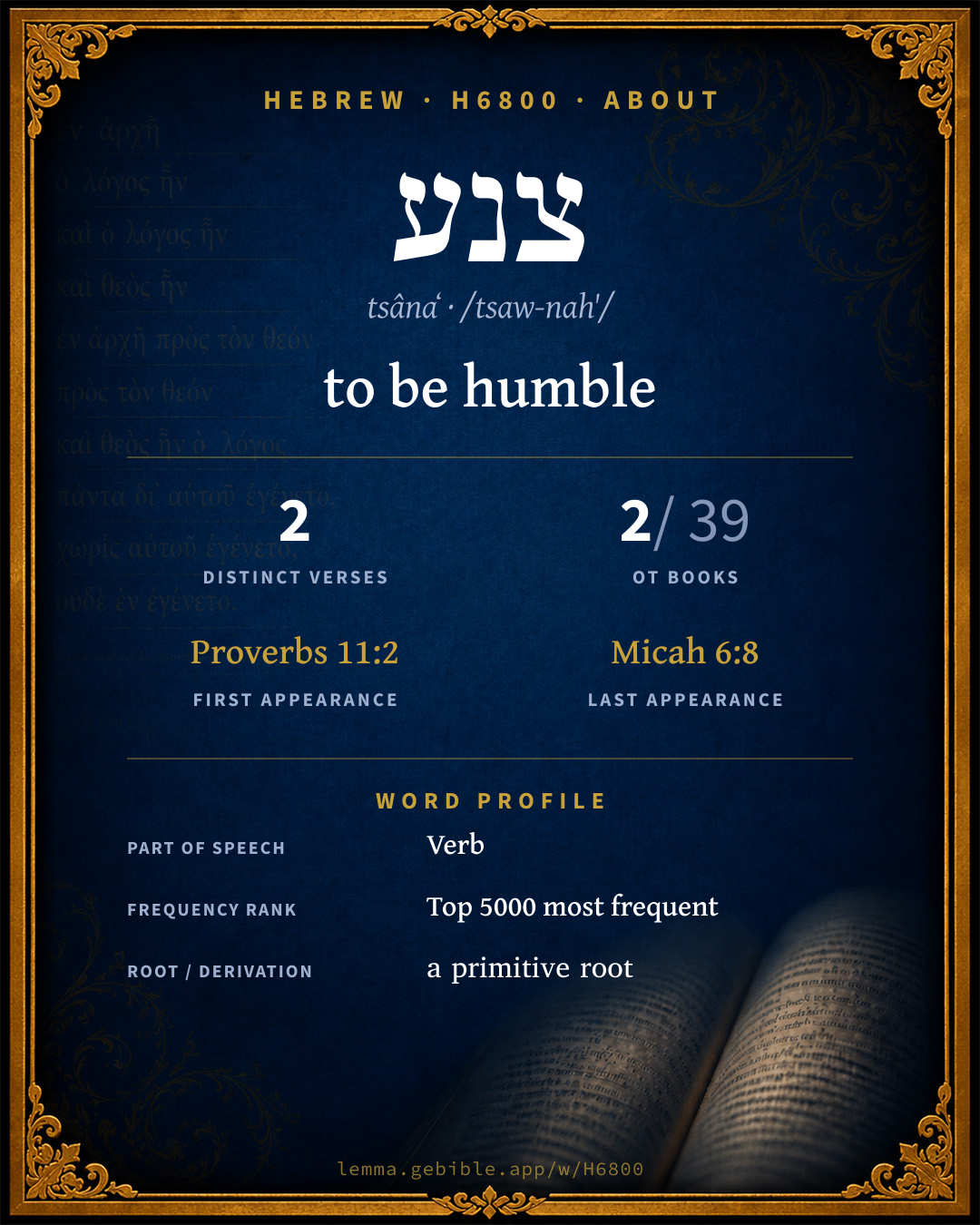
צָנַע
to be humble
also: be modest, be lowly fuller range ↓
Full lexicon entry — Brown-Driver-Briggs (BDB)
From Brown-Driver-Briggs (BDB)
Where this word appears
Grammar key — what these labels mean
Part of speech
- Adjective
- A word that describes or qualifies a noun.
Stem
- Hiphil
- The causative active stem (“he caused / brought about”).
Form
- Infinitive Absolute
- An unbound verbal noun, often intensifying or standing in for a finite verb.
State
- Absolute
- The independent form of a noun, not bound to a following word.
Gender
- Masculine
- Grammatically masculine.
Number
- Plural
- More than one (in Hebrew, generally three or more).
Grammatical forms
- Adjective, Adjective, Masculine, Plural, Absolute 1 time (50%)
- Verb, Hiphil, Infinitive Absolute 1 time (50%)
Parsed forms decoded from the imported morphology (morphhb / Westminster Leningrad Codex — WLC text public domain, morphhb tagging CC BY 4.0), counted across 2 parsed occurrences — not distinct verses.
Every verse where H6800 appears — 2 distinct verses across 2 books. Click any verse to open its interlinear word-by-word view. Verse text shown in the World English Bible for context — . Each verse’s Hebrew form is shown with its reference; the English is not keyword-highlighted, since the data carries no word-level English alignment. Use “Compare translations” on any verse to read it across multiple English versions. This concordance covers the Hebrew Bible; Septuagint (Greek Old Testament) occurrences are not indexed here.
Proverbs 1 verse
Micah 1 verse
About this entry
At a glance — auto-summarized from this page’s data, not written by a person. Every figure links to its source below. This summary describes the numbers; it doesn’t interpret them.
At its core, צנע (tsânaʻ) means “to be humble.” It is rare — just 2 verses in the entire Hebrew Bible. Its uses cluster heavily in Proverbs (50% of all occurrences). Scripture first uses it in Proverbs 11:2. Not a single-sense word, it carries 2 senses, among them “be modest” and “be lowly”. Each statement above links to its evidence; the full detail follows below.
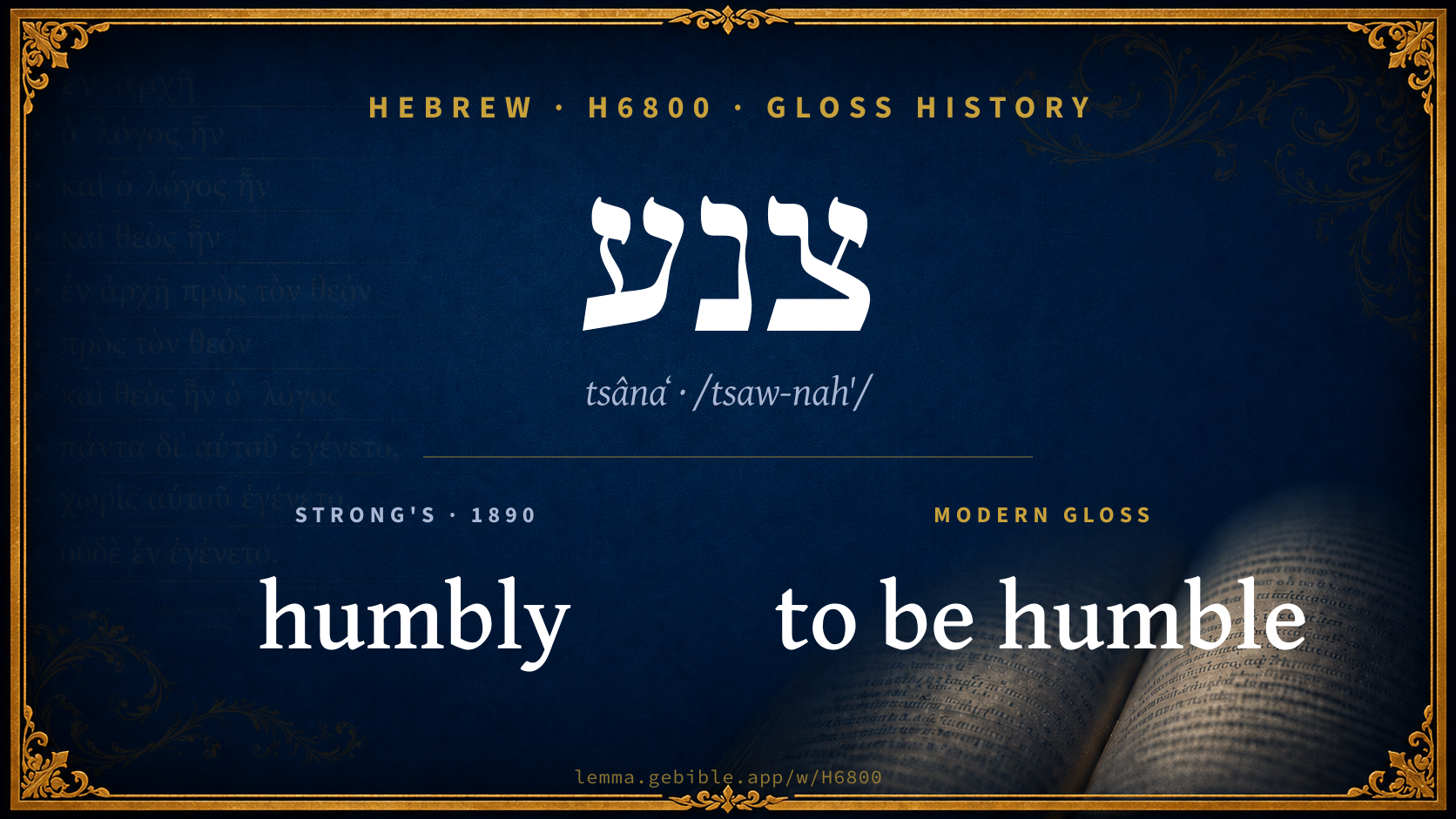
Gloss history
Strong's 1890 vs modern scholarship
About this word
Strong's H6800 catalogs a Hebrew word from the Hebrew Old Testament.
These counts are not copied from any lexicon or concordance. They are computed here, from the morphology-tagged Hebrew Old Testament. What Lemma adds →
- 2
- distinct verses
- The word appears in 2 distinct verses.
- 2 / 39
- OT books
- The word appears in 2 of 39 Old Testament books.
- #4,807
- by frequency
- Top 5000 most frequent Hebrew words (rank 4,807 of 8,640 Hebrew words by occurrence).
View all 2 occurrences in the concordance →
By traditional corpus
Conventional, traditional groupings — biblical authorship is debated, so this is a traditional corpus grouping, not an authorship claim. Each share is this word’s portion of its verses in that division of the Hebrew canon. Each figure is a share of the word’s 2 distinct verses.
- Prophets (Nevi'im) 1 verse · 50%
- Writings (Ketuvim) 1 verse · 50%
How translations render this word
Counts come from each version’s own published word-to-Strong’s tagging or interlinear alignment — an approximate guide to how each version renders this word, not a word-level alignment the data otherwise carries. Because each total is that version’s own tagged count, the per-version totals vary from one another and need not match the appearance or distinct-verse counts above. These counts may also differ from a printed concordance because Lemma counts each distinctly tagged rendering and does not collapse phrase taggings into a single head-word total. This is a fixed set of word-tagged versions (KJV, ASV, BSB, ULT) and does not change with the reading translation you choose elsewhere. Each version’s license is shown beside its name below (and on Sources).
BDB lists this Strong’s number as 2 distinct words (homographs). Each count above pools all of them and is not split by sense — see the Senses section below. A low-frequency rendering may belong to a different one of those words, not the primary meaning.
- King James Version†: Humbly 1×, Lowly 1×
- American Standard Version†: Humbly 1×, Lowly 1×
- Berean Standard Bible†: Humbly 1×, Humility 1×
- unfoldingWord Literal Text†: Modest ones 1×, Walk humbly 1×
King James Version Public Domain
Renders H6800 across 2† tagged occurrences — most commonly:
American Standard Version Public Domain
Renders H6800 across 2† tagged occurrences — most commonly:
Berean Standard Bible Public Domain
Renders H6800 across 2† tagged occurrences — most commonly:
unfoldingWord Literal Text CC BY-SA 4.0
Renders H6800 across 2† tagged occurrences — most commonly:
Senses in the full BDB
What do BDB’s symbols mean?
BDB uses these scholarly abbreviations:
| Symbol | Meaning |
|---|---|
| 𝔊 | the Septuagint (the ancient Greek translation, LXX) |
| 𝔙 | the Vulgate (the Latin translation) |
| 𝔖 | the Syriac version (the Peshitta) |
| 𝔗 | the Targum (the Aramaic translation) |
| ψ | the Psalms |
| √ | root (the underlying root or stem) |
| ‖ | parallel passage (a synonymous or contrasted parallel) |
| † | the dagger: every passage where the word occurs is cited |
The 0 senses and sub-senses the full Brown-Driver-Briggs lexicon distinguishes for this word, in lexicon order (not ranked by frequency), with BDB’s own verbatim wording and sub-sense lettering. Shown in Hebrew script with BDB’s own scholarly abbreviations. The condensed entry is in the Lexicon Entry tab. See also the Forms in the corpus table below.
צנע I be modest, humble, be retired
צנע II modest
Senses from the full Brown-Driver-Briggs lexicon (Brown, Driver, Briggs; Oxford 1906 — public domain), digitized via Sefaria, supplemented by the OpenScriptures HebrewLexicon (CC BY 4.0). Full attribution on Sources.
Word origin
[ צָנַע ] vb. be modest, humble (perhaps prop. be retired );— Hiph. Mi 6:8
— Brown-Driver-Briggs (Oxford 1906, public domain), digitized via Sefaria, supplemented by the OpenScriptures HebrewLexicon (CC BY 4.0). See Sources.
Origin: a primitive root
Jastrow Dictionary
A second Hebrew/Aramaic lexicon for comparison, covering Aramaic and post-biblical (Talmudic, Targumic, Midrashic) usage that the biblical-Hebrew BDB does not. Matched by lemma rather than by Strong’s number, so a lemma may carry more than one Jastrow headword (shown separately below), and the entries cover usage well beyond the Bible.
צָנַע
- (b. h.) to hide; to retire.—Part. pass. צָנוּעַ. Taan. 16ᵃ (commenting on the custom of bringing the chest containing the Torah scrolls to the open place of the town for fasts and prayers) לומר כלי צ׳ היה לנו וכ׳ as if saying, we had a vessel kept in reverential retirement, and it has been exposed on account of our sins.—V. צָנוּעַ.
- to withdraw (from use); to reserve, hide. Sabb. X, 1 המַצְנִיעַ לזרע וכ׳ if a person had laid aside something for seed, or for a sample, or for medicinal purposes, and takes it out into the street &c. Ib. 90ᵇ שהִצְנִיעוֹ ושכח וכ׳ if he had laid it aside, but forgot for what purpose &c. Ib. 91ᵃ כל … להַצְנִיעוֹ ואין מַצְנִיעִין וכ׳ a thing not fit for reservation, or of the kind not usually reserved, but this person considered it fit &c. Num. R. s. 1 מַצְנַעַת עצמה keeps herself in retirement (chastity). Num. R. s. 20 הִצְנִיעוּ עצמן contained themselves (remained chaste); a. e.—Part. pass. מוּצְנָע; f. מוּצְנַעַת &c. Ter. VIII, 8 מקום המ׳ a retired (well-guarded and clean) place; Bekh. 33ᵇ, a. e.—Gen. R. s. 94; Cant. R. to I, 12 (ref. to Ex. XXXV, 24) מלמד שהיו מ׳ וכ׳ this shows that acacia wood was kept by them in reserve from the days of Jacob; a. e.—Gen. R. s. 1 (ref. to אמון, Prov. VIII, 30) אמון מוצנע amon (= amun) means well cared for (by ref. to אֹמֵן, Esth. II, 7). e.g. Exodus 35:24
- to restrain. Y. Bets. V, 63ᵃ מי הוא זה שבא לצַנְּעֵינוּ וכ׳ who is he that comes to put us under restrictions in our own house?
צְנַע
- , to guard. B. Kam. 23ᵇ זיל … דלִיצְנְעִינְהוּ (Ar. אַצְנְעִינְהוּ Af.) go and tell the owner of the goats to guard them (from trespassing on my property).—Part. pass. צְנִיעַ; pl. צְנִיעִין a) reserved, kept, guarded. Targ. Y. Deut. X, 5.—B. Bath. 58ᵃ אמאי לא צְנִיעַת באיסורא why art thou not more guarded in thy immoral conduct?—b) retired, chaste, v. צְנִיעַ.
- to put aside, deposit, withdraw (from use). Targ. Num. XVII, 22. Targ. Lev. XVI, 23; a. fr.—B. Mets. 25ᵇ אטו אמוריים מַצְנְעֵי וכ׳ is it only Amorites that hide (their treasures in walls) &c.? B. Bath. 24ᵃ דמיגניב מניה ואִיצַּנּוּעֵי בגויה לא מצנעי Ms. M. (v. Rabb. D. S. a. l. note for Var. Lect.) as to being stolen from there and hidden, they would not hide it in the same grounds from the surface of which they had taken it. Ib. אבל עינבי מַצְנְעֵי (or מִיצְנְעֵי) but grapes they may hide in the same grounds; a. e.—B. Kam. l. c. אַצְנְעִינְהוּ guard them, v. supra.—[Cant. R. to I, 16 מצנעה, v. נְעַץ.]
- 1. to restrain, make a person respect authority. Nidd. 36ᵇ זיל צַנְּעֵיה go and make him respect my authority.
- 2. to cause a person to live in retirement (a mild method of excommunication). Kidd. 25ᵃ זיל צַנְּעִינְהוּ go and tell them to withdraw (cmp. הכבד ושב בביתך, M. Kat. 17ᵃ).
- 1. to restrain one’s self. Targ. Y. Gen. XIV, 15 (not אַצְטִינְעָא).
- 2. to be private, to be hidden. B. Bath. 60ᵃ מצינא לאִצְטַנּוּעֵי מינך I can be private (protect myself) from thy gaze. Ib. 24ᵃ, v. supra.
A Dictionary of the Targumim, the Talmud Babli and Yerushalmi, and the Midrashic Literature (Marcus Jastrow; London, Luzac, 1903) — Public Domain. Digitized via Sefaria. Digitized via Sefaria. Full attribution on Sources.
Forms in the corpus
The 2 distinct written forms H6800 takes in the Hebrew Bible, most frequent first — each parse links to that stem’s occurrences in the concordance. Hebrew forms include their vowel points and cantillation, so a single lemma takes many written forms.
| Form | Parsing | Example | Uses |
|---|---|---|---|
| וְ/הַצְנֵ֥עַ | Verb, Hiphil, Infinitive Absolute | Micah 6:8 | 1 |
| צְנוּעִ֥ים | Adjective, Adjective, Masculine, Plural, Absolute | Proverbs 11:2 | 1 |
Septuagint verse parallels
This word appears in 2 verses that also exist in the Greek Old Testament (Septuagint), out of the 2 Hebrew verses it occurs in. You can read those verses in Greek by switching the Old Testament edition to the Septuagint.
Read these verses in the Septuagint
This is a verse-level parallel only — the same verses exist in both the Hebrew and Greek Old Testaments. No word-level Hebrew↔Greek correspondence is claimed: the data carries no such alignment, so no Greek word is shown as this Hebrew word’s translation. Coverage is not total — the Septuagint omits the deuterocanon and renumbers the Psalms, so some Hebrew verses have no direct Greek parallel.