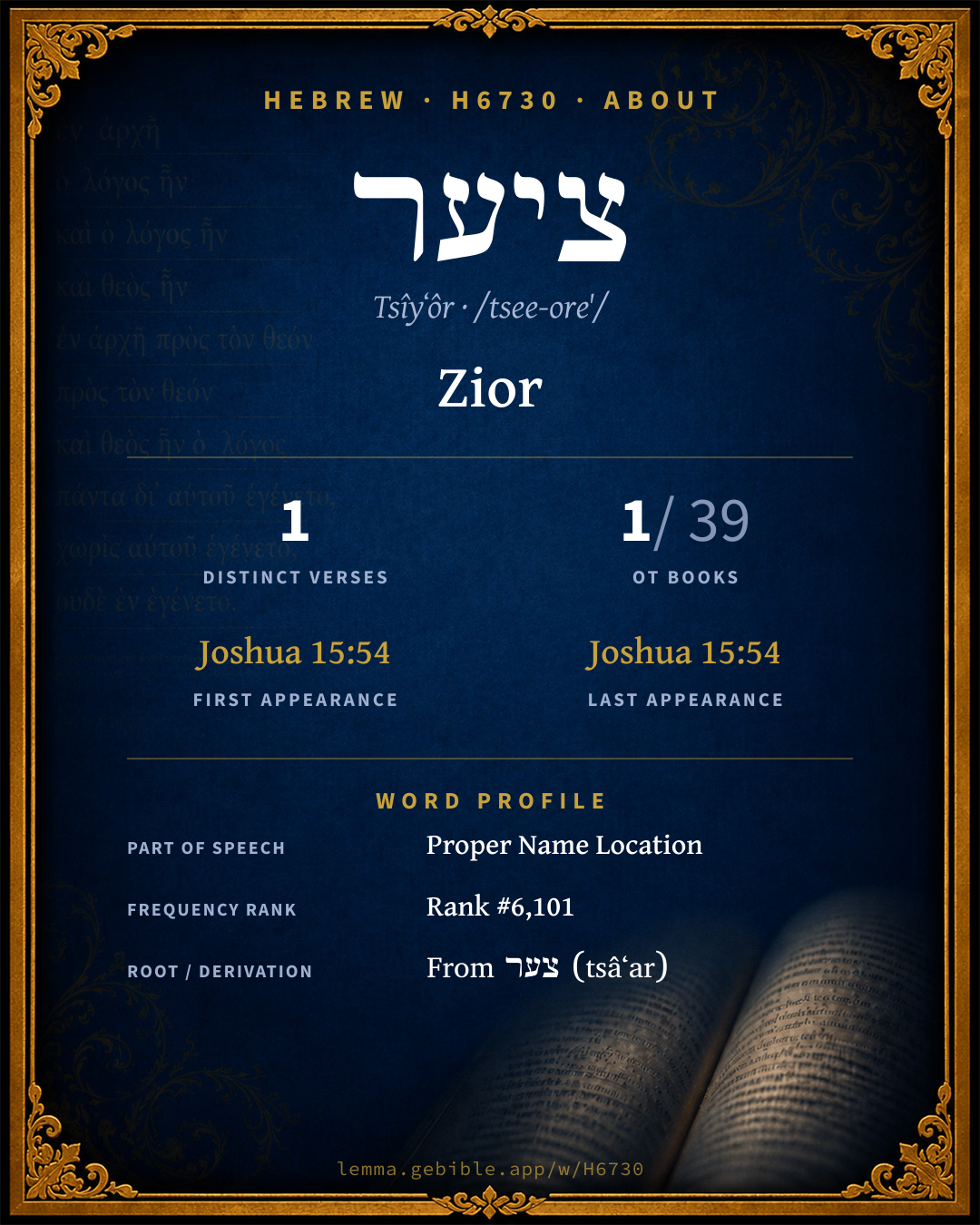
צִיעֹר
Zior
BDB lists 2 entries for ‘Zior’ fuller range ↓
Full lexicon entry — Brown-Driver-Briggs (BDB)
From Brown-Driver-Briggs (BDB)
Where this word appears
Grammar key — what these labels mean
Noun type
- Proper
- A name of a specific person, place, or people (e.g. Abraham, Zion, Israel).
Every verse where H6730 appears — 1 distinct verse across 1 book. Click any verse to open its interlinear word-by-word view. Verse text shown in the World English Bible for context — . Each verse’s Hebrew form is shown with its reference; the English is not keyword-highlighted, since the data carries no word-level English alignment. Use “Compare translations” on any verse to read it across multiple English versions. This concordance covers the Hebrew Bible; Septuagint (Greek Old Testament) occurrences are not indexed here.
Joshua 1 verse
About this entry
At a glance — auto-summarized from this page’s data, not written by a person. Every figure links to its source below. This summary describes the numbers; it doesn’t interpret them.
“Zior” is the headline sense of the Hebrew name ציער (Tsîyʻôr). It occurs a mere 1 verse across Scripture. More than three-quarters of its appearances fall in Joshua. Scripture uses it exactly once, at Joshua 15:54. See 1-verse concordance and the renderings breakdown below.
Gloss history
Strong's 1890 vs modern scholarship
About this word
Strong's H6730 catalogs a Hebrew word from the Hebrew Old Testament.
These counts are not copied from any lexicon or concordance. They are computed here, from the morphology-tagged Hebrew Old Testament. What Lemma adds →
- 1
- distinct verses
- The word appears in 1 distinct verse.
- 1 / 39
- OT books
- The word appears in 1 of 39 Old Testament books.
- #6,101
- by frequency
- Rank #6,101 (rank 6,101 of 8,640 Hebrew words by occurrence).
View all 1 occurrence in the concordance →
Most concentrated in
- Joshua 1 verse 100%
By section of the Old Testament
By traditional corpus
Conventional, traditional groupings — biblical authorship is debated, so this is a traditional corpus grouping, not an authorship claim. Each share is this word’s portion of its verses in that division of the Hebrew canon. Each figure is a share of the word’s 1 distinct verse.
- Prophets (Nevi'im) 1 verse · 100%
How translations render this word
Counts come from each version’s own published word-to-Strong’s tagging or interlinear alignment — an approximate guide to how each version renders this word, not a word-level alignment the data otherwise carries. Because each total is that version’s own tagged count, the per-version totals vary from one another and need not match the appearance or distinct-verse counts above. These counts may also differ from a printed concordance because Lemma counts each distinctly tagged rendering and does not collapse phrase taggings into a single head-word total. This is a fixed set of word-tagged versions (KJV, ASV, BSB, ULT) and does not change with the reading translation you choose elsewhere. Each version’s license is shown beside its name below (and on Sources).
- King James Version: Zior 1×
- American Standard Version: Zior 1×
- Berean Standard Bible: Zior 1×
- unfoldingWord Literal Text: Zior 1×
King James Version Public Domain
Renders H6730 across 1 tagged occurrence — most commonly:
American Standard Version Public Domain
Renders H6730 across 1 tagged occurrence — most commonly:
Berean Standard Bible Public Domain
Renders H6730 across 1 tagged occurrence — most commonly:
unfoldingWord Literal Text CC BY-SA 4.0
Renders H6730 across 1 tagged occurrence — most commonly:
Senses in BDB
The 2 senses BDB distinguishes for this word, in lexicon order (not ranked by frequency or importance). The full entry — with sub-senses — is in the Lexicon Entry tab.
- Zior = "smallness"
- a town in the mountains of Judah belonging to the same group as Hebron
Word origin
צִיעֹר n.pr.loc. Jos 15:54, prob. Ṣâ‛îr, 5 m. NNE. fr. Hebron
— Brown-Driver-Briggs (Oxford 1906, public domain), digitized via Sefaria, supplemented by the OpenScriptures HebrewLexicon (CC BY 4.0). See Sources.
Derived from צער (tsâʻar) (H6819) — to become small.
Jastrow Dictionary
A second Hebrew/Aramaic lexicon for comparison, covering Aramaic and post-biblical (Talmudic, Targumic, Midrashic) usage that the biblical-Hebrew BDB does not. Matched by lemma rather than by Strong’s number, so a lemma may carry more than one Jastrow headword (shown separately below), and the entries cover usage well beyond the Bible.
צָעַר
- (b. h.)
- 1. to be narrow, slender, young, v. צוֹעֵר, צׇעִיר.
- 2. to be restrained, suffer privation, pain. Taan. 11ᵃ, v. infra.
- to lessen; to subordinate. Gen. R. s. 6 (ref. to הצעיר, Gen. XLVIII, 14) על ידי שהיה מַצְעִיר את עסקיו וכ׳ because he subordinated his affairs (was contented with lesser services), he was privileged to be invested with the rights of the firstborn; הגדול שהוא מצעיר וכ׳ if a great man applies himself to minor services, how much more (is he praiseworthy)!—Part. pass. מוּצְעָר, q. v. e.g. Genesis 48:14
- 1. to narrow, restrain; to inflict pain, annoy. Naz. 19ᵃ; 22ᵃ, a. e. (ref. to Num. VI, 11) ומה זה שלא צי׳ עצמו … המְצַעֵר עצמו וכ׳ if this (Nazarite) who denied himself only the enjoyment of wine is called a sinner, how much more so he who denies himself all enjoyments of life! Taan. 11ᵃ יִצְעַר … במשה רבינו שצי׳ עצמו וכ׳ man must suffer (deny himself enjoyments), when the community suffers; for thus we find that Moses afflicted himself (by sitting on a stone, Ex. XVII, 12) &c.; ib. וכל המצער עצמו עם וכ׳ (Ms. M. וכל המצער עם, insert עצמו, v. Rabb. D. S. a. l. note) and he who afflicts himself in sympathy with the community, will be allowed to see the comfort of the community; Yalk. Gen. 148, a. e. המִצְטַעֵר. Snh. 11ᵃ אתה הוא שצִיעַרְתָּ לאבא wast thou the one who annoyed my father (with the smell of garlic)? Ab. Zar. 40ᵇ ואתה מְצַעֲרֵינִי and thou didst let me be in pain (without telling me of the remedy)?; a. fr.—2) *to suffer. Yalk. Is. 333, v. צָרַר. e.g. Numbers 6:11
- to feel pain; to suffer privation; to grieve, trouble one’s self. Yalk. Gen. l. c., a. e., v. supra. Ḥag. 15ᵇ בזמן שאדם מִצְטַעֵר וכ׳ when a man suffers (the penalty of the law), what does the Shekhinah say?; אם כך הקב"ה מצטער וכ׳ if the Lord thus grieves over the blood of the wicked (convict), how much more does he grieve over the blood of the righteous that is shed!; Ms. M. 1 אם כן מצטער אני וכ׳; Ms. M. 2 מִצְטַעֲרֵנִי if thus I (the Lord) grieve &c. Snh. 46ᵃ; Yalk. Deut. 930. Succ. 26ᵃ, a. e. מצטער פטור וכ׳ he that feels uncomfortable (cold) is exempt from sitting in the Succah (contrad. fr. חולה). Meg. 16ᵃ sq. אפשר דבר שנצ׳ בו … יכשל בו is it possible that this righteous man (Joseph) should commit the same wrong from which he himself had suffered (to make distinctions between brothers)? Yoma 74ᵇ; Y. ib. VIII, 44ᵈ top (ref. to Lev. XVI, 29) יכול ישב … ויִצְטַעֵר you may think, one must sit in the sun or in the cold in order to afflict one’s self. Bab. ib. 19ᵇ כל ימי הייתי מצט׳ על וכ׳ all my life-time have I been troubling myself about this verse (Lev. XVI, 2) thinking, when shall I have an opportunity to carry it into practice (in accordance with the Sadducean interpretation of it) &c. Sifré Deut. 354 הואיל ונִצְטַעַרְנוּ וכ׳ since we have gone to the trouble of coming here &c.; a. fr. e.g. Leviticus 16:29
A Dictionary of the Targumim, the Talmud Babli and Yerushalmi, and the Midrashic Literature (Marcus Jastrow; London, Luzac, 1903) — Public Domain. Digitized via Sefaria. Digitized via Sefaria. Full attribution on Sources.
Same root — word family
Other BDB entries built from the same root as H6730, grouped by Strong’s listed origin. These share a root / origin per the lexicon — not necessarily a shared meaning. Each links to that word’s own entry.
Derives from
Shares the same root
Proper names from this root
People and places named from this root — a name, not an additional meaning of the word.
Compare all same-root words → Showing 4 of 7 — not the complete family. 2 of the same-root words are proper names (people or places). They share a root, not necessarily a meaning.
Bible dictionary
Public-domain dictionary articles matched to this entry by name (Zior). A biblical name can be shared by more than one person or place, so an article may treat several.
Easton's Bible Dictionary · M. G. Easton, 1897
Littleness, a city in the mountains of Judah (Josh. 15:54); the modern Si'air, 4 1/2 miles north-north-east of Hebron.
Smith's Bible Dictionary · William Smith, 1863
(smallness), a town in the mountain district of Judah. (Joshua 15:54) It belongs to the same group with Hebron.
Hitchcock's Bible Names Dictionary · Roswell D. Hitchcock, 1869
ship of him that watches
Classic public-domain reference works; full attribution on Sources.
Septuagint verse parallels
This word appears in 1 verse that also exists in the Greek Old Testament (Septuagint), out of the 1 Hebrew verse it occurs in. You can read those verses in Greek by switching the Old Testament edition to the Septuagint.
Read these verses in the Septuagint
This is a verse-level parallel only — the same verses exist in both the Hebrew and Greek Old Testaments. No word-level Hebrew↔Greek correspondence is claimed: the data carries no such alignment, so no Greek word is shown as this Hebrew word’s translation. Coverage is not total — the Septuagint omits the deuterocanon and renumbers the Psalms, so some Hebrew verses have no direct Greek parallel.