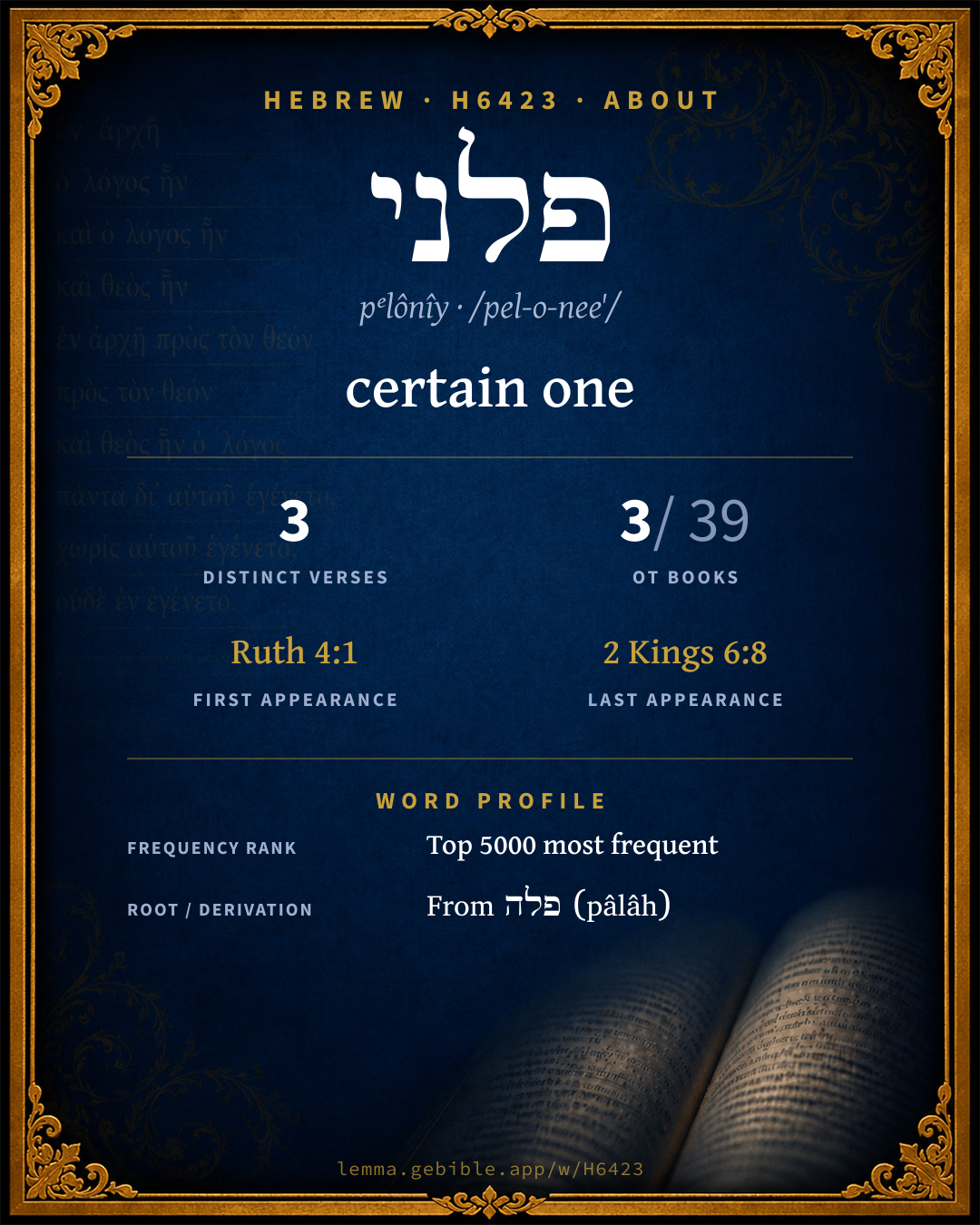
פְּלֹנִי
certain one
Full lexicon entry — Brown-Driver-Briggs (BDB)
From Brown-Driver-Briggs (BDB)
Where this word appears
Grammar key — what these labels mean
Part of speech
- Pronoun
- A word standing in for a noun (“he,” “this,” “who”).
Every verse where H6423 appears in the Book of Ruth — 1 distinct verse. Click any verse to open its interlinear word-by-word view. Verse text shown in the World English Bible for context — . Each verse’s Hebrew form is shown with its reference; the English is not keyword-highlighted, since the data carries no word-level English alignment. Use “Compare translations” on any verse to read it across multiple English versions. This concordance covers the Hebrew Bible; Septuagint (Greek Old Testament) occurrences are not indexed here.
Ruth
About this entry
At a glance — auto-summarized from this page’s data, not written by a person. Every figure links to its source below. This summary describes the numbers; it doesn’t interpret them.
The Hebrew word פלני centers on the idea of “certain one.” A scarce word — 3 verses in all of the Hebrew Bible. The word gravitates to Ruth (33%), then 1 Samuel and 2 Kings. Debuting at Ruth 4:1, it then recurs through the corpus. It shares a root with פלה, פלמוני and פלוא. Dig into 3-verse concordance and the renderings breakdown below.
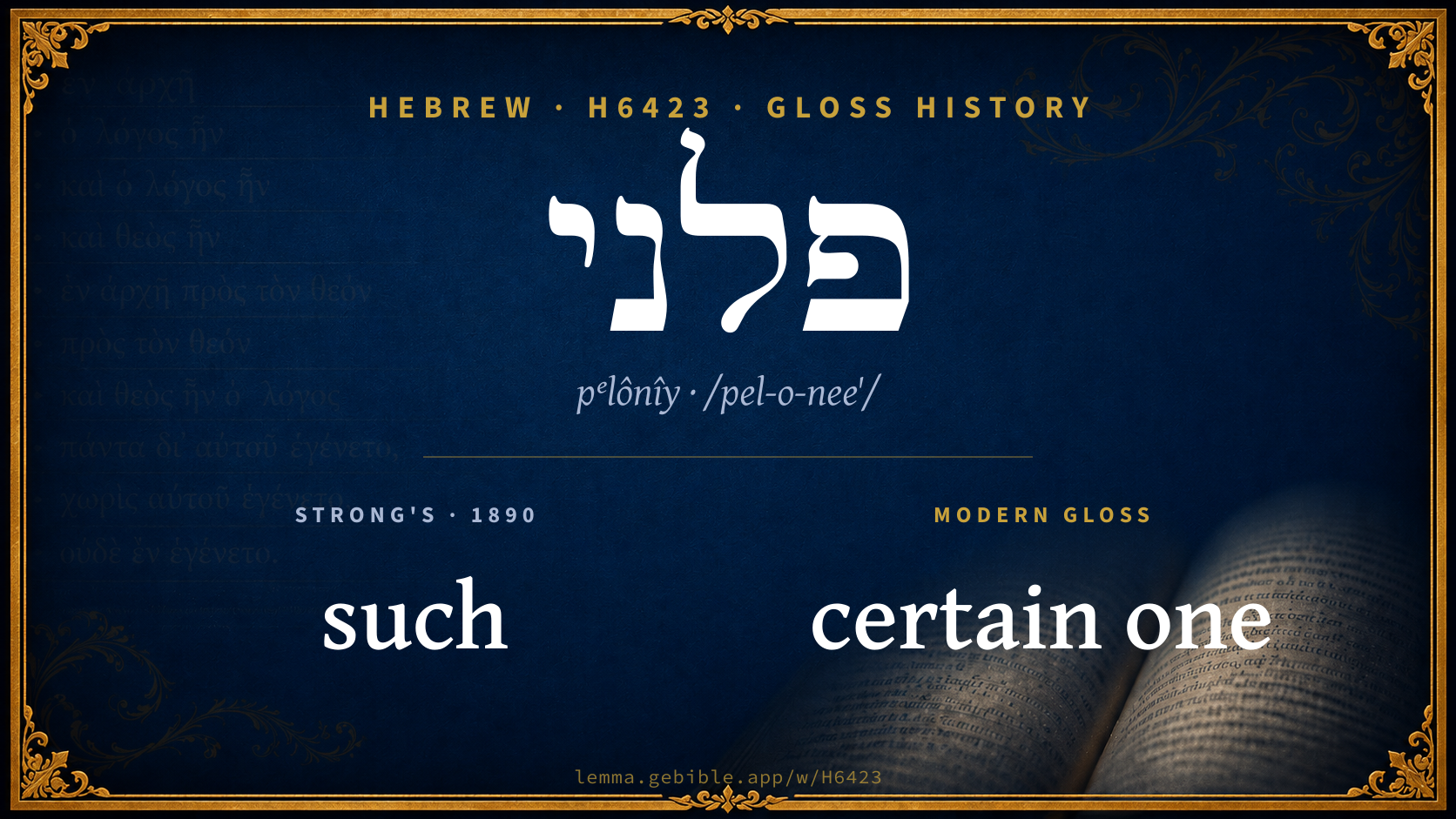
Gloss history
Strong's 1890 vs modern scholarship
About this word
Strong's H6423 catalogs a Hebrew word from the Hebrew Old Testament.
These counts are not copied from any lexicon or concordance. They are computed here, from the morphology-tagged Hebrew Old Testament. What Lemma adds →
- 3
- distinct verses
- The word appears in 3 distinct verses.
- 3 / 39
- OT books
- The word appears in 3 of 39 Old Testament books.
- #4,179
- by frequency
- Top 5000 most frequent Hebrew words (rank 4,179 of 8,640 Hebrew words by occurrence).
View all 3 occurrences in the concordance →
By section of the Old Testament
By traditional corpus
Conventional, traditional groupings — biblical authorship is debated, so this is a traditional corpus grouping, not an authorship claim. Each share is this word’s portion of its verses in that division of the Hebrew canon. Each figure is a share of the word’s 3 distinct verses.
- Prophets (Nevi'im) 2 verses · 67%
- Writings (Ketuvim) 1 verse · 33%
How translations render this word
Counts come from each version’s own published word-to-Strong’s tagging or interlinear alignment — an approximate guide to how each version renders this word, not a word-level alignment the data otherwise carries. Because each total is that version’s own tagged count, the per-version totals vary from one another and need not match the appearance or distinct-verse counts above. These counts may also differ from a printed concordance because Lemma counts each distinctly tagged rendering and does not collapse phrase taggings into a single head-word total. This is a fixed set of word-tagged versions (KJV, ASV, BSB, ULT) and does not change with the reading translation you choose elsewhere. Each version’s license is shown beside its name below (and on Sources).
BDB lists this Strong’s number as 2 distinct words (homographs). Each count above pools all of them and is not split by sense — see the Senses section below. A low-frequency rendering may belong to a different one of those words, not the primary meaning.
- King James Version†: Such 3×
- American Standard Version†: Such 3×
- Berean Standard Bible†: Friend 1×, Such 1×
- unfoldingWord Literal Text†: Certain 1×, Certain person 1×, Such 1×
King James Version Public Domain
Renders H6423 across 3† tagged occurrences — most commonly:
American Standard Version Public Domain
Renders H6423 across 3† tagged occurrences — most commonly:
Berean Standard Bible Public Domain
Renders H6423 across 2† tagged occurrences — most commonly:
Not rendered by a distinct English word in 1 further occurrence.
unfoldingWord Literal Text CC BY-SA 4.0
Renders H6423 across 3† tagged occurrences — most commonly:
Senses in the full BDB
What do BDB’s symbols mean?
BDB uses these scholarly abbreviations:
| Symbol | Meaning |
|---|---|
| 𝔊 | the Septuagint (the ancient Greek translation, LXX) |
| 𝔙 | the Vulgate (the Latin translation) |
| 𝔖 | the Syriac version (the Peshitta) |
| 𝔗 | the Targum (the Aramaic translation) |
| ψ | the Psalms |
| √ | root (the underlying root or stem) |
| ‖ | parallel passage (a synonymous or contrasted parallel) |
| † | the dagger: every passage where the word occurs is cited |
The 0 senses and sub-senses the full Brown-Driver-Briggs lexicon distinguishes for this word, in lexicon order (not ranked by frequency), with BDB’s own verbatim wording and sub-sense lettering. Shown in Hebrew script with BDB’s own scholarly abbreviations. The condensed entry is in the Lexicon Entry tab. See also the Forms in the corpus table below.
פלני I on. a certain one
פלני II erron.
Senses from the full Brown-Driver-Briggs lexicon (Brown, Driver, Briggs; Oxford 1906 — public domain), digitized via Sefaria, supplemented by the OpenScriptures HebrewLexicon (CC BY 4.0). Full attribution on Sources.
Word origin
I. pron. a certain one; Gk. ὁ, ἡ δεῖνα (according to Thes from above √, through an unused noun פָּלֹן, proposes one defined, a particular one: NH id.; Aramaic ܦܠܳܢ, f. ܦܠܳܢܻܝܬܳܐ; Arabic فُلَانُ WAG i. § 353 R. c, voc. فُلُ SiegfZWTh xxvii. 355; Assyrian pulpul HptBAS i. 114), always joined with אַלְמֹנִי (proposes one not mentioned) in the sense of ‘ein gewisser verschwiegener’ (Ew§ 106 c, 2 Sta§ 150 b), ‘a certain unnamed one,’ i.e. such a one; Ru 4:1 שְׁבָה־פֹּה פְּלֹנִי אַלְמֹנִי sit down here, such a one (Gk. ὦ οὗτος; Arabic يَا فُلُ); in the phr. מְקוֹם פ׳ א׳ the place of such a one = such and such a place, 1 S 21:3 2 K 6:8. From פ׳ א׳ arose by contraction (or conflation, PerlesAnal. 82) פַּלְמֹנִי †Dn 8:13 ויאמר … לַפּ׳ הַמְדַבֵּר to that certain one who spake.—ii. פְּלֹנִי v. p. 813.
II. adj.gent. erron.: c. art. הַפְּלוֹנִי 1 Ch 11:27; 27:10 read הַפַּלְטִי as 2 S 23:26 (v. בֵּית פָּ֑לֶט); הַפְּלֹנִי 1 Ch 11:36 read הַגִּלֹנִי, as 2 S 23:34.—i. פְּלֹנִי v. פלה.
— Brown-Driver-Briggs (Oxford 1906, public domain), digitized via Sefaria, supplemented by the OpenScriptures HebrewLexicon (CC BY 4.0). See Sources.
Derived from פלה (pâlâh) (H6395) — to distinguish.
Jastrow Dictionary
A second Hebrew/Aramaic lexicon for comparison, covering Aramaic and post-biblical (Talmudic, Targumic, Midrashic) usage that the biblical-Hebrew BDB does not. Matched by lemma rather than by Strong’s number, so a lemma may carry more than one Jastrow headword (shown separately below), and the entries cover usage well beyond the Bible.
פְּלוֹנִי
- a specified person or thing, such and such, name ‘blank’ (abbrev. פלו׳). Gitt. VI, 3 במקים פ׳ in such and such a place. Y. ib. VIII, end, 49ᵈ (in a document) אני פ׳ בן פ׳ I—, son of—. Kidd. 65ᵃ קידשתיך בפני פ׳ ופ׳ והלכו וכ׳ I betrothed thee unto me in the presence of—and—, and they have left &c. Tosef. Yeb. III, 4 ופ׳ מהו לעה"ב and will such and such a man have a share in the hereafter?; דומה שלא שאלתם אלא על פ׳ it seems to me that you inquired about such and such (naming some one else); Yoma 66ᵇ; a. fr.—Koh. R. to I, 8, v. יֵשׁוּ.—Fem. פְּלוֹנִית, פְּלֹנִית. Kidd. III, 1 צא וקדש לי אשה פ׳ go and betroth for me that certain woman. Y. Sot. VI, 21ᵃ top פ׳ כהנת וכ׳ such and such is a priest’s daughter, and she has prostituted herself &c.; a. fr.—Ch. פְּלַן.
פְּלֹנִי
- , v. פְּלוֹנִי, a. פְּלן.
A Dictionary of the Targumim, the Talmud Babli and Yerushalmi, and the Midrashic Literature (Marcus Jastrow; London, Luzac, 1903) — Public Domain. Digitized via Sefaria. Digitized via Sefaria. Full attribution on Sources.
Forms in the corpus
The 3 distinct written forms H6423 takes in the Hebrew Bible, most frequent first — each parse links to that state’s occurrences in the concordance. Hebrew forms include their vowel points and cantillation, so a single lemma takes many written forms.
| Form | Parsing | Example | Uses |
|---|---|---|---|
| פְּלֹנִ֖י | Pronoun, Indefinite | 1 Samuel 21:2 | 1 |
| פְּלֹנִ֣י | Pronoun, Indefinite | Ruth 4:1 | 1 |
| פְּלֹנִ֥י | Pronoun, Indefinite | 2 Kings 6:8 | 1 |
Same root — word family
Other BDB entries built from the same root as H6423, grouped by Strong’s listed origin. These share a root / origin per the lexicon — not necessarily a shared meaning. Each links to that word’s own entry.
Derives from
Derived from this word
Proper names from this root
People and places named from this root — a name, not an additional meaning of the word.
Compare all same-root words → Showing 4 of 5 — not the complete family. 2 of the same-root words are proper names (people or places). They share a root, not necessarily a meaning.
Septuagint verse parallels
This word appears in 3 verses that also exist in the Greek Old Testament (Septuagint), out of the 3 Hebrew verses it occurs in. You can read those verses in Greek by switching the Old Testament edition to the Septuagint.
Read these verses in the Septuagint
This is a verse-level parallel only — the same verses exist in both the Hebrew and Greek Old Testaments. No word-level Hebrew↔Greek correspondence is claimed: the data carries no such alignment, so no Greek word is shown as this Hebrew word’s translation. Coverage is not total — the Septuagint omits the deuterocanon and renumbers the Psalms, so some Hebrew verses have no direct Greek parallel.