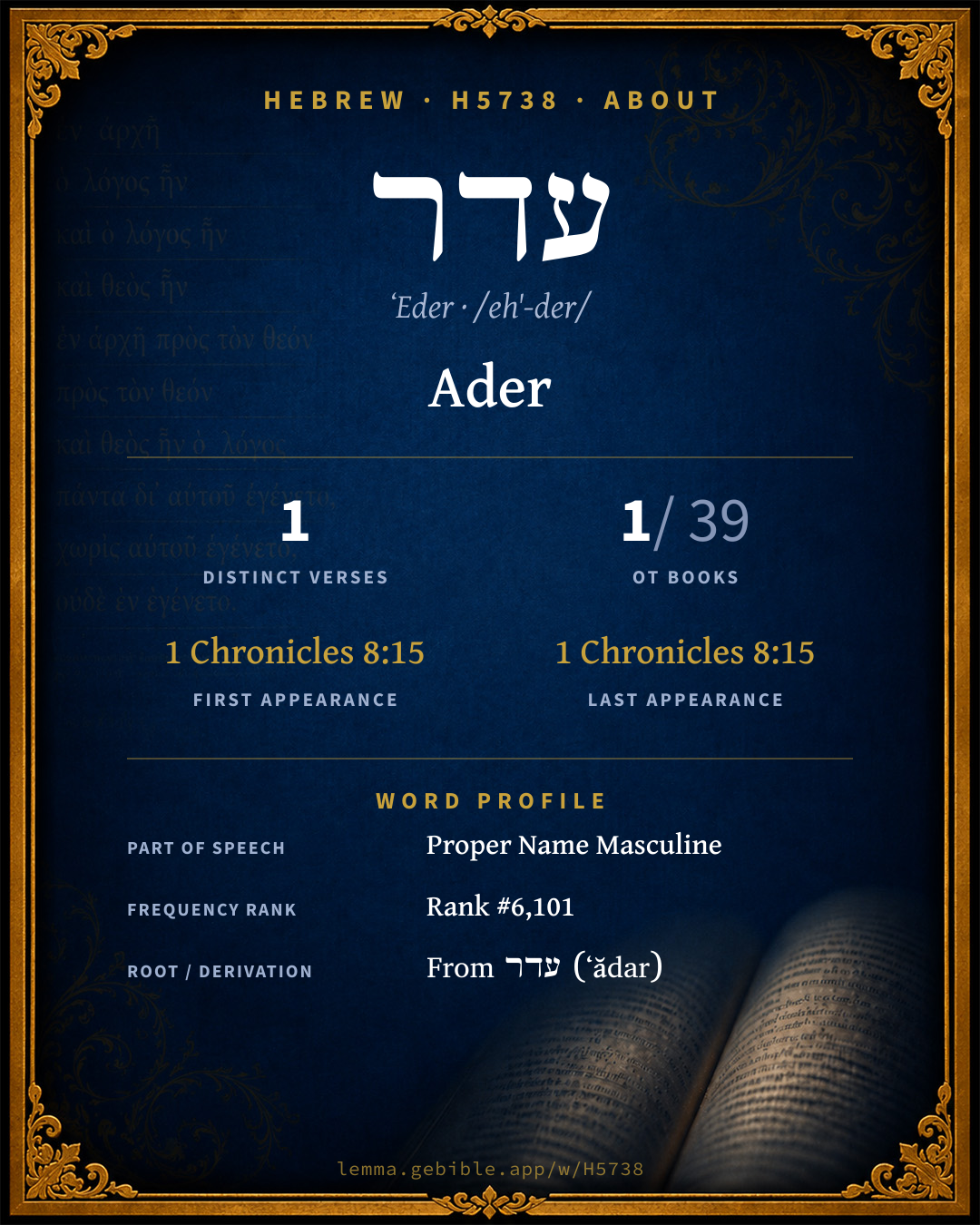
עֶ֫דֶר
Ader
BDB lists 2 entries for ‘Ader’ fuller range ↓
Full lexicon entry — Brown-Driver-Briggs (BDB)
From Brown-Driver-Briggs (BDB)
Where this word appears
Grammar key — what these labels mean
Noun type
- Proper
- A name of a specific person, place, or people (e.g. Abraham, Zion, Israel).
Every verse where H5738 appears — 1 distinct verse across 1 book. Click any verse to open its interlinear word-by-word view. Verse text shown in the World English Bible for context — . Each verse’s Hebrew form is shown with its reference; the English is not keyword-highlighted, since the data carries no word-level English alignment. Use “Compare translations” on any verse to read it across multiple English versions. This concordance covers the Hebrew Bible; Septuagint (Greek Old Testament) occurrences are not indexed here.
1 Chronicles 1 verse
About this entry
At a glance — auto-summarized from this page’s data, not written by a person. Every figure links to its source below. This summary describes the numbers; it doesn’t interpret them.
עדר (ʻEder) is a Hebrew name most often rendered “Ader.” With only 1 verse it sits in the long tail of Hebrew Bible vocabulary. It clusters heavily in 1 Chronicles, which alone accounts for 100% of its uses. Its lone occurrence is 1 Chronicles 8:15. The sections below give every occurrence and version rendering.
Gloss history
Strong's 1890 vs modern scholarship
About this word
Strong's H5738 catalogs a Hebrew word from the Hebrew Old Testament.
These counts are not copied from any lexicon or concordance. They are computed here, from the morphology-tagged Hebrew Old Testament. What Lemma adds →
- 1
- distinct verses
- The word appears in 1 distinct verse.
- 1 / 39
- OT books
- The word appears in 1 of 39 Old Testament books.
- #6,101
- by frequency
- Rank #6,101 (rank 6,101 of 8,640 Hebrew words by occurrence).
View all 1 occurrence in the concordance →
Most concentrated in
- 1 Chronicles 1 verse 100%
By section of the Old Testament
By traditional corpus
Conventional, traditional groupings — biblical authorship is debated, so this is a traditional corpus grouping, not an authorship claim. Each share is this word’s portion of its verses in that division of the Hebrew canon. Each figure is a share of the word’s 1 distinct verse.
- Writings (Ketuvim) 1 verse · 100%
How translations render this word
Counts come from each version’s own published word-to-Strong’s tagging or interlinear alignment — an approximate guide to how each version renders this word, not a word-level alignment the data otherwise carries. Because each total is that version’s own tagged count, the per-version totals vary from one another and need not match the appearance or distinct-verse counts above. These counts may also differ from a printed concordance because Lemma counts each distinctly tagged rendering and does not collapse phrase taggings into a single head-word total. This is a fixed set of word-tagged versions (KJV, ASV, BSB, ULT) and does not change with the reading translation you choose elsewhere. Each version’s license is shown beside its name below (and on Sources).
- King James Version: Ader 1×
- American Standard Version: Eder 1×
- Berean Standard Bible: Eder 1×
- unfoldingWord Literal Text: Eder 1×
King James Version Public Domain
Renders H5738 across 1 tagged occurrence — most commonly:
American Standard Version Public Domain
Renders H5738 across 1 tagged occurrence — most commonly:
Berean Standard Bible Public Domain
Renders H5738 across 1 tagged occurrence — most commonly:
unfoldingWord Literal Text CC BY-SA 4.0
Renders H5738 across 1 tagged occurrence — most commonly:
Senses in BDB
The 2 senses BDB distinguishes for this word, in lexicon order (not ranked by frequency or importance). The full entry — with sub-senses — is in the Lexicon Entry tab.
- Ader = "flock"
- a Benjamite, son of Beriah, chief of the inhabitants of Aijalon
Word origin
[ עֶ֫דֶר ] n.pr.m. a Benjamite, 1 Ch 8:15
— Brown-Driver-Briggs (Oxford 1906, public domain), digitized via Sefaria, supplemented by the OpenScriptures HebrewLexicon (CC BY 4.0). See Sources.
Derived from עדר (ʻădar) (H5737) — to help.
Jastrow Dictionary
A second Hebrew/Aramaic lexicon for comparison, covering Aramaic and post-biblical (Talmudic, Targumic, Midrashic) usage that the biblical-Hebrew BDB does not. Matched by lemma rather than by Strong’s number, so a lemma may carry more than one Jastrow headword (shown separately below), and the entries cover usage well beyond the Bible.
עָדַר
- 1. to strip.—Part. pass. עָדוּר; f. עֲדוּרָה, v. אָדַר.
- 2. to pluck, clear (of weeds); to hoe; to pick (figs, cmp. אָרָה); [b. h. also: to sift an army, to discharge the unfit &c., to muster out, v. I Chr. XII, 34; 39]. Neg. II, 4; Sifra Thazr., Neg., Par. 3, ch. IV כעוֹדֵר in the position of one hoeing; כעודר בבית הסתרים the position of one hoeing is required for the examination of the posteriors. Tosef. Maasr. II, 14 פועלים שהיו עוֹדְרִין בתאנים laborers engaged in picking figs; B. Mets. 89ᵇ (Ar. אורין, v. אָרָה). Ib. לַעֲדוֹר ולקשקש וכ׳ Rashi (ed. לעַדֵּר, Pi.) to hoe and to cover up the roots of olive trees. B. Kam. 119ᵇ עוֹדְרֵי ירקות engaged in thinning vegetables (cmp. דָּלַל); a. fr. e.g. 1 Chronicles 12:34
- same. Tosef. Maasr. II, 13 מְעַדְּרִין בשדה engaged in hoeing a field. Gen. R. s. 82 better is he who rents one field ומזבלה ומְעַדְּרָהּ וכ׳ and manures and hoes it &c. Y. Maasr. III, end, 51ᵃ והוא שעי׳ רובה provided he broke the ground of the larger portion of the court; a. fr.—[Tosef. Makhsh. I, 3 מעודר, ed. Zuck. מעודרון, v. עוּד.]
- 1. to be hoed, to be prepared for tillage. Y. l. c. והיא שתהא נעדרת provided the ground of the court has been broken (before sowing). Ib. 50ᵈ bot. חצר שהיא נעדרת ונזרעת R. S. to Maasr. III, 9 (ed. only נעדרת) a court which has been hoed up and planted with seeds; a. e.
- 2. to be cast out, rejected, banished. Sot. IX, 15 (49ᵇ) והאמת תהא נעדרת and Truth shall be banished (fr. Is. LIX, 15); Snh. 97ᵃ; Cant. R. to II, 13; v. עֵדֶר. e.g. Isaiah 59:15
- 3. to withdraw one’s self, fail. Lev. R. s. 31; Midr. Till. to Ps. XIX; Yalk. ib. 673 (expl. Zeph. III, 5), v. פְּסַק. e.g. Zephaniah 3:5
עֲדַר I
- , to hoe; (of chickens) to pick. Lev. R. s. 25 זיל עֲדוֹר וכ׳ go and pick in thy own dunghill; Yalk. Job 925.
- same. Lev. R. l. c. ומְעַדְּרָה קדמיהון (not ומעדרנה) and she (the mother) picks for them; Yalk. l. c. (not ומעררה).
עֲדַר II
- = h. עָזַר, to help. Targ. Prov. XIII, 12 דמשרי למְעַדְרֵיה (ed. Lag. a. oth. דמשדי) who begins to help himself (v. Pesh. a. LXX).
- to be helped. Ib. XVIII, 19 דמִתְעֲדַר (oth. ed. דמתעוי; v. Pesh. a. LXX).
עֵדֶר
- enclosure, pen, fold; herd, flock. Ohol. VIII, 1 ע׳ בהמה וכ׳ clean or unclean beasts closely penned; Tosef. ib. IX, 1; [Ar. s. v. אדר, ed. Koh. s. v. אדורה, I, p. 39ᵃ, explains our w.: hide, v. עָדַר 1, a. עָדַד]. Yoma 34ᵇ; 70ᵇ; Meg. 28ᵃ אחד מיוחד שבעֶדְרוֹ ‘one’ (Num. XXVIII, 4) means one singled out (the best) of its fold. Bekh. 24ᵃ הנכנס לתוך עדרו וכ׳ if one enters his pen at night. Naz. V, 3 תצא ותרעה בע׳ let it go and be fed in the fold (as a profane animal). Yoma 61ᵇ, sq. וכי עדרו משלח … וכי עדרו שורף shall one send off his whole flock (of goats)?… shall one burn &c.?; a. fr.—Pl. עֲדָרִים, עֲדָרִין. Ex. R. s. 1 באין ע׳ ע׳ וכ׳ they came to their homes in flocks; א"ת עדי עדיים אלא עֶדְרֵי ע׳ read not (Ez. XVI, 7) ʿădi ʿădayim (choice attractions) but ‘edré ʿădarim (flocks after flocks). Cant. R. to II, 13 (ref. to Is. LIX, 5) להיכן הולכת … ויושבת ע׳ ע׳ במדבר whither does banished Truth go (v. עָדַר)? She goes and sits down in groups (of eremites) in the desert; Snh. 97ᵃ; Yalk. Is. 357; a. fr.—Tosef. Eduy. III, 2 נוחרין היו עֲדָרוֹת וכ׳ they stabbed entire herds in the camp. (v., however, עָרוֹד).—מִגְדַּל עֵדֶר (b. h.) pr. n. pl. Migdal Eder (Fold Tower), between Bethlehem and Jerusalem. Shek. VII, 4; Kidd. 55ᵃ e.g. Numbers 28:4
A Dictionary of the Targumim, the Talmud Babli and Yerushalmi, and the Midrashic Literature (Marcus Jastrow; London, Luzac, 1903) — Public Domain. Digitized via Sefaria. Digitized via Sefaria. Full attribution on Sources.
Same root — word family
Other BDB entries built from the same root as H5738, grouped by Strong’s listed origin. These share a root / origin per the lexicon — not necessarily a shared meaning. Each links to that word’s own entry.
Derives from
Shares the same root
Compare all same-root words → They share a root, not necessarily a meaning.
Bible dictionary
Public-domain dictionary articles matched to this entry by name (Ader). A biblical name can be shared by more than one person or place, so an article may treat several.
Smith's Bible Dictionary · William Smith, 1863
(flock), a Benjamites, son of Beriah, chief of the inhabitants of Aijalon. (1 Chronicles 8:15) The name is more correctly Eder.
Classic public-domain reference works; full attribution on Sources.
Septuagint verse parallels
This word appears in 1 verse that also exists in the Greek Old Testament (Septuagint), out of the 1 Hebrew verse it occurs in. You can read those verses in Greek by switching the Old Testament edition to the Septuagint.
Read these verses in the Septuagint
This is a verse-level parallel only — the same verses exist in both the Hebrew and Greek Old Testaments. No word-level Hebrew↔Greek correspondence is claimed: the data carries no such alignment, so no Greek word is shown as this Hebrew word’s translation. Coverage is not total — the Septuagint omits the deuterocanon and renumbers the Psalms, so some Hebrew verses have no direct Greek parallel.