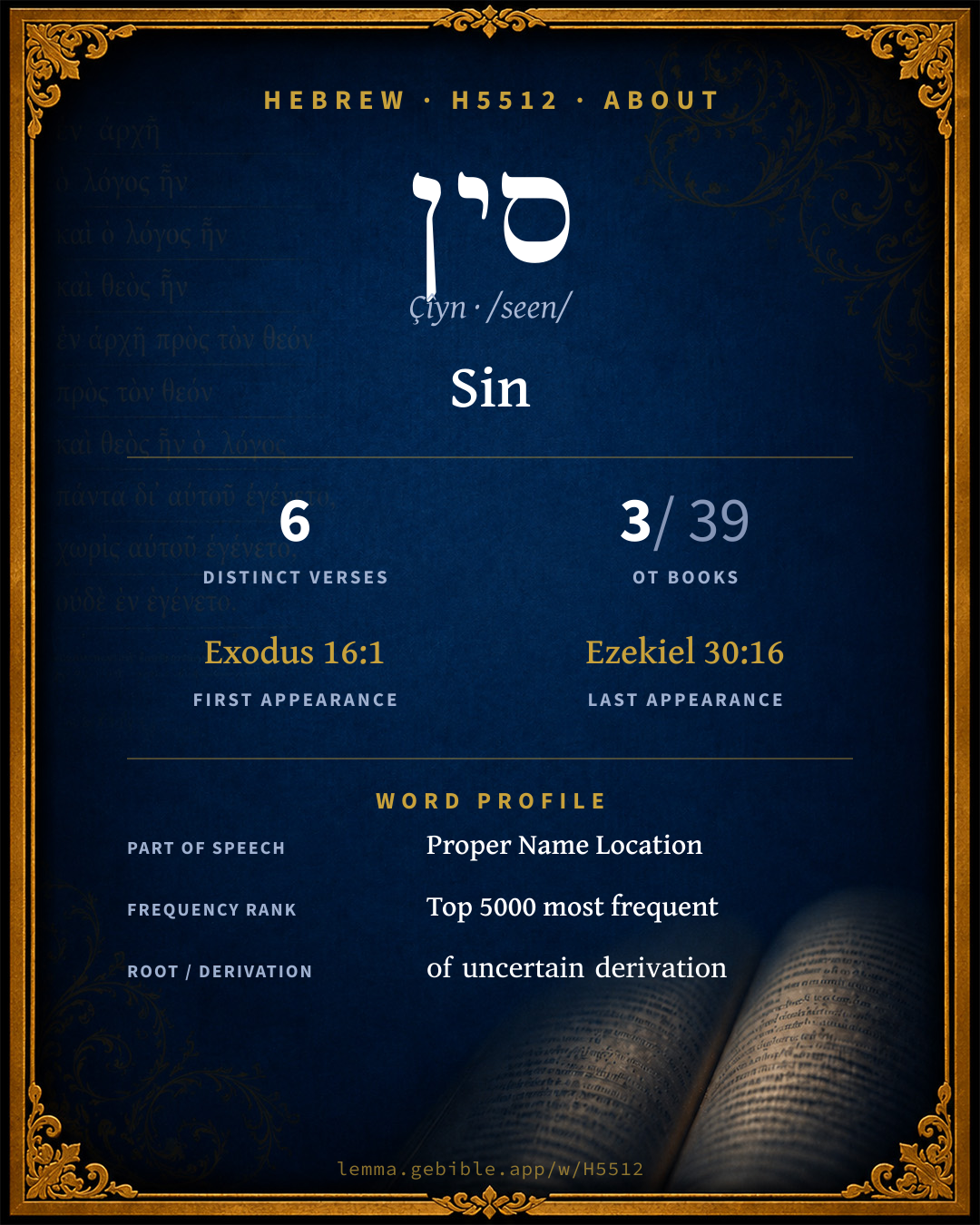
סִין
Sin
BDB lists 3 entries for ‘Sin’ fuller range ↓
Full lexicon entry — Brown-Driver-Briggs (BDB)
From Brown-Driver-Briggs (BDB)
Where this word appears
Grammar key — what these labels mean
Part of speech
- Noun
- A naming word — a person, place, thing, or idea.
Noun type
- Proper
- A name of a specific person, place, or people (e.g. Abraham, Zion, Israel).
Every verse where H5512 appears in the Book of Ezekiel — 2 distinct verses. Click any verse to open its interlinear word-by-word view. Verse text shown in the World English Bible for context — . Each verse’s Hebrew form is shown with its reference; the English is not keyword-highlighted, since the data carries no word-level English alignment. Use “Compare translations” on any verse to read it across multiple English versions. This concordance covers the Hebrew Bible; Septuagint (Greek Old Testament) occurrences are not indexed here.
Ezekiel
About this entry
At a glance — auto-summarized from this page’s data, not written by a person. Every figure links to its source below. This summary describes the numbers; it doesn’t interpret them.
At its core, סין (Çîyn) means “Sin.” Scripture first uses it in Exodus 16:1. With 6 verses in 3 books, it is an uncommon word in the Hebrew Bible. Its uses concentrate in Exodus (33% of all occurrences). Each statement above links to its evidence; the full detail follows below.
Gloss history
Strong's 1890 vs modern scholarship
About this word
Strong's H5512 catalogs a Hebrew word from the Hebrew Old Testament.
These counts are not copied from any lexicon or concordance. They are computed here, from the morphology-tagged Hebrew Old Testament. What Lemma adds →
- 6
- distinct verses
- The word appears in 6 distinct verses.
- 3 / 39
- OT books
- The word appears in 3 of 39 Old Testament books.
- #3,040
- by frequency
- Top 5000 most frequent Hebrew words (rank 3,040 of 8,640 Hebrew words by occurrence).
View all 6 occurrences in the concordance →
By section of the Old Testament
By traditional corpus
Conventional, traditional groupings — biblical authorship is debated, so this is a traditional corpus grouping, not an authorship claim. Each share is this word’s portion of its verses in that division of the Hebrew canon. Each figure is a share of the word’s 6 distinct verses.
- Torah (Pentateuch) 4 verses · 67%
- Prophets (Nevi'im) 2 verses · 33%
How translations render this word
Counts come from each version’s own published word-to-Strong’s tagging or interlinear alignment — an approximate guide to how each version renders this word, not a word-level alignment the data otherwise carries. Because each total is that version’s own tagged count, the per-version totals vary from one another and need not match the appearance or distinct-verse counts above. These counts may also differ from a printed concordance because Lemma counts each distinctly tagged rendering and does not collapse phrase taggings into a single head-word total. This is a fixed set of word-tagged versions (KJV, ASV, BSB, ULT) and does not change with the reading translation you choose elsewhere. Each version’s license is shown beside its name below (and on Sources).
BDB lists this Strong’s number as 2 distinct words (homographs). Each count above pools all of them and is not split by sense — see the Senses section below. A low-frequency rendering may belong to a different one of those words, not the primary meaning.
- King James Version†: Sin 6×
- American Standard Version†: Sin 6×
- Berean Standard Bible†: Sin 4×, Pelusium 2×
- unfoldingWord Literal Text†: Sin 4×, Pelusium 2×
King James Version Public Domain
Renders H5512 across 6† tagged occurrences — most commonly:
American Standard Version Public Domain
Renders H5512 across 6† tagged occurrences — most commonly:
Berean Standard Bible Public Domain
Renders H5512 across 6† tagged occurrences — most commonly:
unfoldingWord Literal Text CC BY-SA 4.0
Renders H5512 across 6† tagged occurrences — most commonly:
Senses in BDB
The 3 senses BDB distinguishes for this word, in lexicon order (not ranked by frequency or importance). The full entry — with sub-senses — is in the Lexicon Entry tab.
- Sin = "thorn" or " clay"
- a town in eastern Egypt
- the tract of wilderness between Elim and Sinai
Word origin
I. n.pr.loc. Sin, i.e. Pelusium, E. frontier city of Egypt (Egyptian ʾImt = clay, of which סין is transl. (cf. Aramaic סְיָן clay), according to SteindorffBAS i. 599, who cp. Πηλούσιον (πηλός = dirt, mud), cf. BrugschDict. Géogr. 1081 ff.);—Ez 30:15 (𝔊 Σαιν acc.), + v 16, but here Co Toy read plausibly סון, i.e. סְוָן = Syene (v. [סְוָן], סְוֵנֵה), 𝔊 Συηνη.—On Pelusium v. Bd.Egyptian 4 (1898), 169.
II. n.pr.loc. wilderness between Elim and Sinai, מִדְבַּר־סִין, according to P, Ex 16:1; 17:1 Nu 33:11, 12; 𝔊 Σειν, A 𝔊L Σιν; cf. EbGS 2. 155 ff. and especially Di Ex 16:1.
— Brown-Driver-Briggs (Oxford 1906, public domain), digitized via Sefaria, supplemented by the OpenScriptures HebrewLexicon (CC BY 4.0). See Sources.
Origin: of uncertain derivation
Jastrow Dictionary
A second Hebrew/Aramaic lexicon for comparison, covering Aramaic and post-biblical (Talmudic, Targumic, Midrashic) usage that the biblical-Hebrew BDB does not. Matched by lemma rather than by Strong’s number, so a lemma may carry more than one Jastrow headword (shown separately below), and the entries cover usage well beyond the Bible.
חִסְחוּס
- (חסחס, Pilp. of חסם, v. חוּס a. preced. art.) [projection, protection,] the cartilages forming the ear, helix &c. Bekh. VI, 1 (37ᵃ) נפגמה אזני מן הח׳ (ed. חסחום; Mish. ed. a. Ar. הסּחוֹס) if its ear it split (defective) from the cartilages (inward).—Pl. חִסְחוּסִים, סִין … gristles. Pes. VII, 11 (84ᵃ) Y. ed. (Mish. a. Bab. ed. הַסְּחוּסִין; Ms. M. 2 also הסחיסין, v. Rabb. D. S. a. l. note 30).—Y. Snh. VIII, beg. 26ᵃ אכלו הסוקים, read: אכל ח׳.—V. חַסְחָסִית.
סְיָן
- (סאן to tread) clay, dirt. Targ. Ps. XVIII, 43; Targ. II Sam. XXII, 43. Targ. Is. X, 6. Ib. LVII, 20. Targ. Mic. VII, 10; Targ. Zech. X, 5 סין ed. Lag. (ed. טִין; Ar. סְוָון). Targ. Job XLI, 22; Targ. Ps. XL, 3, v. כְּסָן.
A Dictionary of the Targumim, the Talmud Babli and Yerushalmi, and the Midrashic Literature (Marcus Jastrow; London, Luzac, 1903) — Public Domain. Digitized via Sefaria. Digitized via Sefaria. Full attribution on Sources.
Forms in the corpus
The 5 distinct written forms H5512 takes in the Hebrew Bible, most frequent first — each parse links to that state’s occurrences in the concordance. Hebrew forms include their vowel points and cantillation, so a single lemma takes many written forms.
| Form | Parsing | Example | Uses |
|---|---|---|---|
| סִ֔ין | Noun, Proper | Exodus 16:1 | 2 |
| סִ֑ין | Noun, Proper | Numbers 33:12 | 1 |
| סִ֖ין | Noun, Proper | Ezekiel 30:15 | 1 |
| סִ֛ין | Noun, Proper | Exodus 17:1 | 1 |
| סִֽין | Noun, Proper | Numbers 33:11 | 1 |
Bible dictionary
Public-domain dictionary articles matched to this entry by name (Sin). A biblical name can be shared by more than one person or place, so an article may treat several.
Easton's Bible Dictionary · M. G. Easton, 1897
Is "any want of conformity unto or transgression of the law of God" (1 John 3:4; Rom. 4:15), in the inward state and habit of the soul, as well as in the outward conduct of the life, whether by omission or commission (Rom. 6:12-17; 7:5-24). It is "not a mere violation of the law of our constitution, nor of the system of things, but an offence against a personal lawgiver and moral governor who vindicates his law with penalties. The soul that sins is always conscious that his sin is (1) intrinsically vile and polluting, and (2) that it justly deserves punishment, and calls down the righteous wrath of God. Hence sin carries with it two inalienable characters, (1) ill-desert, guilt (reatus); and
(2) pollution (macula).", Hodge's Outlines.
The moral character of a man's actions is determined by the moral state of his heart. The disposition to sin, or the habit of the soul that leads to the sinful act, is itself also sin (Rom. 6:12-17; Gal. 5:17; James 1:14, 15).
The origin of sin is a mystery, and must for ever remain such to us. It is plain that for some reason God has permitted sin to enter this world, and that is all we know. His permitting it, however, in no way makes God the author of sin.
Adam's sin (Gen. 3:1-6) consisted in his yielding to the assaults of temptation and eating the forbidden fruit. It involved in it, (1) the sin of unbelief, virtually making God a liar; and (2) the guilt of disobedience to a positive command. By this sin he became an apostate from God, a rebel in arms against his Creator. He lost the favour of God and communion with him; his whole nature became depraved, and he incurred the penalty involved in the covenant of works.
Original sin. "Our first parents being the root of all mankind, the guilt of their sin was imputed, and the same death in sin and corrupted nature were conveyed to all their posterity, descending from them by ordinary generation." Adam was constituted by God the federal head and representative of all his posterity, as he was also their natural head, and therefore when he fell they fell with him (Rom. 5:12-21; 1 Cor. 15:22-45). His probation was their probation, and his fall their fall. Because of Adam's first sin all his posterity came into the world in a state of sin and condemnation, i.e., (1) a state of moral corruption, and (2) of guilt, as having judicially imputed to them the guilt of Adam's first sin.
"Original sin" is frequently and properly used to denote only the moral corruption of their whole nature inherited by all men from Adam. This inherited moral corruption consists in, (1) the loss of original righteousness; and (2) the presence of a constant proneness to evil, which is the root and origin of all actual sin. It is called "sin" (Rom. 6:12, 14, 17; 7:5-17), the "flesh" (Gal. 5:17, 24), "lust" (James 1:14, 15), the "body of sin" (Rom. 6:6), "ignorance," "blindness of heart," "alienation from the life of God" (Eph. 4:18, 19). It influences and depraves the whole man, and its tendency is still downward to deeper and deeper corruption, there remaining no recuperative element in the soul. It is a total depravity, and it is also universally inherited by all the natural descendants of Adam (Rom. 3:10-23; 5:12-21; 8:7). Pelagians deny original sin, and regard man as by nature morally and spiritually well; semi-Pelagians regard him as morally sick; Augustinians, or, as they are also called, Calvinists, regard man as described above, spiritually dead (Eph. 2:1; 1 John 3:14).
The doctrine of original sin is proved, (1.) From the fact of the universal sinfulness of men. "There is no man that sinneth not" (1 Kings 8:46; Isa. 53:6; Ps. 130:3; Rom. 3:19, 22, 23; Gal. 3:22). (2.) From the total depravity of man. All men are declared to be destitute of any principle of spiritual life; man's apostasy from God is total and complete (Job 15:14-16; Gen. 6:5, 6). (3.) From its early manifestation (Ps. 58:3; Prov. 22:15). (4.) It is proved also from the necessity, absolutely and universally, of regeneration (John 3:3; 2 Cor. 5:17). (5.) From the universality of death (Rom. 5:12-20).
Various kinds of sin are mentioned, (1.) "Presumptuous sins," or as literally rendered, "sins with an uplifted hand", i.e., defiant acts of sin, in contrast with "errors" or "inadvertencies" (Ps. 19:13). (2.) "Secret", i.e., hidden sins (19:12); sins which escape the notice of the soul. (3.) "Sin against the Holy Ghost" (q.v.), or a "sin unto death" (Matt. 12:31, 32; 1 John 5:16), which amounts to a wilful rejection of grace.
Sin, a city in Egypt, called by the Greeks Pelusium, which means, as does also the Hebrew name, "clayey" or "muddy," so called from the abundance of clay found there. It is called by Ezekel (Ezek. 30:15) "the strength of Egypt, "thus denoting its importance as a fortified city. It has been identified with the modern Tineh, "a miry place," where its ruins are to be found. Of its boasted magnificence only four red granite columns remain, and some few fragments of others.
Smith's Bible Dictionary · William Smith, 1863
a city of Egypt, mentioned only by Ezekiel. (Ezekiel 30:15,16) The name is Hebrew, or at least Semitic, perhaps signifying clay . It is identified in the Vulgate with Pelusium, "the clayey or muddy" town. Its antiquity may perhaps be inferred from the mention of "the wilderness of Sin" in the journeys of the Israelites. (Exodus 16:1; Numbers 33:11) Ezekiel speaks of Sin as "Sin the strongholds of Egypt." (Ezekiel 30:15) This place was held by Egypt from that time until the period of the Romans. Herodotus relates that Sennacherib advanced against Pelusium, and that near Pelusium Cambyses defeated Psammenitus. In like manner the decisive battle in which Ochus defeated the last native king, Nectanebes, was fought near this city.
Hitchcock's Bible Names Dictionary · Roswell D. Hitchcock, 1869
bush
Classic public-domain reference works; full attribution on Sources.
Septuagint verse parallels
This word appears in 6 verses that also exist in the Greek Old Testament (Septuagint), out of the 6 Hebrew verses it occurs in. You can read those verses in Greek by switching the Old Testament edition to the Septuagint.
Read these verses in the Septuagint
This is a verse-level parallel only — the same verses exist in both the Hebrew and Greek Old Testaments. No word-level Hebrew↔Greek correspondence is claimed: the data carries no such alignment, so no Greek word is shown as this Hebrew word’s translation. Coverage is not total — the Septuagint omits the deuterocanon and renumbers the Psalms, so some Hebrew verses have no direct Greek parallel.