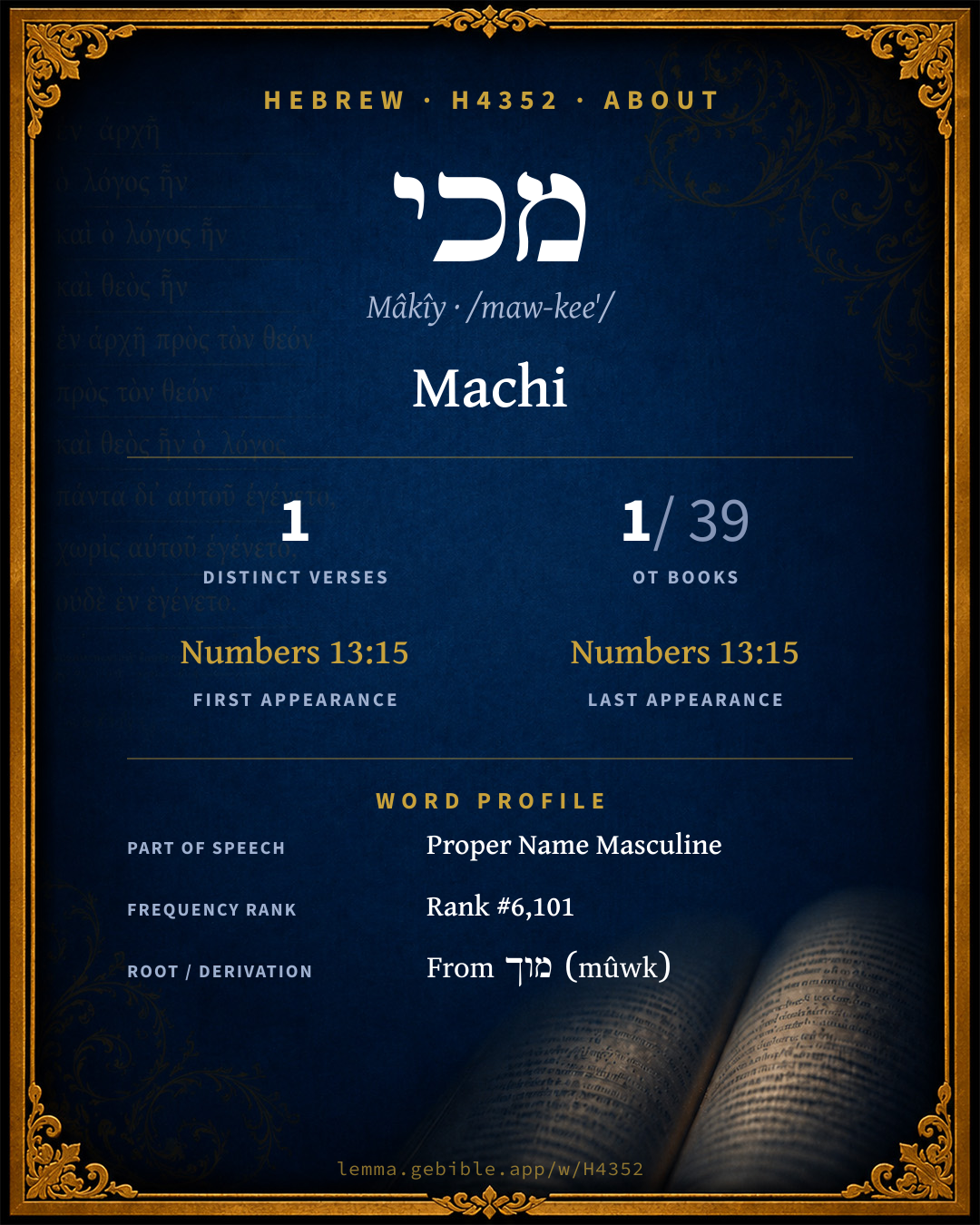
מָכִי
Machi
BDB lists 2 entries for ‘Machi’ fuller range ↓
Full lexicon entry — Brown-Driver-Briggs (BDB)
From Brown-Driver-Briggs (BDB)
Where this word appears
Grammar key — what these labels mean
Part of speech
- Noun
- A naming word — a person, place, thing, or idea.
Noun type
- Proper
- A name of a specific person, place, or people (e.g. Abraham, Zion, Israel).
Every verse where H4352 appears — 1 distinct verse across 1 book. Click any verse to open its interlinear word-by-word view. Verse text shown in the World English Bible for context — . Each verse’s Hebrew form is shown with its reference; the English is not keyword-highlighted, since the data carries no word-level English alignment. Use “Compare translations” on any verse to read it across multiple English versions. This concordance covers the Hebrew Bible; Septuagint (Greek Old Testament) occurrences are not indexed here.
Numbers 1 verse
About this entry
At a glance — auto-summarized from this page’s data, not written by a person. Every figure links to its source below. This summary describes the numbers; it doesn’t interpret them.
מכי (Mâkîy) is a Hebrew name most often rendered “Machi.” A scarce word — 1 verse in all of the Hebrew Bible. Numbers dominates its distribution — 1 of 1 verses. A true hapax — its single appearance is Numbers 13:15. For the data behind this summary, explore 1-verse concordance and the renderings breakdown below.
Gloss history
Strong's 1890 vs modern scholarship
About this word
Strong's H4352 catalogs a Hebrew word from the Hebrew Old Testament.
These counts are not copied from any lexicon or concordance. They are computed here, from the morphology-tagged Hebrew Old Testament. What Lemma adds →
- 1
- distinct verses
- The word appears in 1 distinct verse.
- 1 / 39
- OT books
- The word appears in 1 of 39 Old Testament books.
- #6,101
- by frequency
- Rank #6,101 (rank 6,101 of 8,640 Hebrew words by occurrence).
View all 1 occurrence in the concordance →
Most concentrated in
- Numbers 1 verse 100%
By section of the Old Testament
By traditional corpus
Conventional, traditional groupings — biblical authorship is debated, so this is a traditional corpus grouping, not an authorship claim. Each share is this word’s portion of its verses in that division of the Hebrew canon. Each figure is a share of the word’s 1 distinct verse.
- Torah (Pentateuch) 1 verse · 100%
How translations render this word
Counts come from each version’s own published word-to-Strong’s tagging or interlinear alignment — an approximate guide to how each version renders this word, not a word-level alignment the data otherwise carries. Because each total is that version’s own tagged count, the per-version totals vary from one another and need not match the appearance or distinct-verse counts above. These counts may also differ from a printed concordance because Lemma counts each distinctly tagged rendering and does not collapse phrase taggings into a single head-word total. This is a fixed set of word-tagged versions (KJV, ASV, BSB, ULT) and does not change with the reading translation you choose elsewhere. Each version’s license is shown beside its name below (and on Sources).
- King James Version: Machi 1×
- American Standard Version: Machi 1×
- Berean Standard Bible: Machi 1×
- unfoldingWord Literal Text: Maki 1×
King James Version Public Domain
Renders H4352 across 1 tagged occurrence — most commonly:
American Standard Version Public Domain
Renders H4352 across 1 tagged occurrence — most commonly:
Berean Standard Bible Public Domain
Renders H4352 across 1 tagged occurrence — most commonly:
unfoldingWord Literal Text CC BY-SA 4.0
Renders H4352 across 1 tagged occurrence — most commonly:
Senses in BDB
The 2 senses BDB distinguishes for this word, in lexicon order (not ranked by frequency or importance). The full entry — with sub-senses — is in the Lexicon Entry tab.
- Machi = "decrease"
- father of Geuel the Gadite who was one of the 12 spies of Israel
Word origin
n.pr.m. a Gadite Nu 13:15. 𝔊 Μα(κ)χι.
— Brown-Driver-Briggs (Oxford 1906, public domain), digitized via Sefaria, supplemented by the OpenScriptures HebrewLexicon (CC BY 4.0). See Sources.
Derived from מוך (mûwk) (H4134) — to be poor.
Jastrow Dictionary
A second Hebrew/Aramaic lexicon for comparison, covering Aramaic and post-biblical (Talmudic, Targumic, Midrashic) usage that the biblical-Hebrew BDB does not. Matched by lemma rather than by Strong’s number, so a lemma may carry more than one Jastrow headword (shown separately below), and the entries cover usage well beyond the Bible.
כְּ־
- prefix, h. (v. כֵּן)
- 1. as, like. Targ. Gen. IX, 3. Targ. Hos. IV, 9; a. v. fr.—Ber. I, 2 כאדם וכ׳ like one reading in the Torah. Ib. 3 כדרכו as usual; a. v. fr.—
- *2. whereas. Tosef. Snh. II, 6 כגוזלייא … וכאימרייא וכ׳ ed. Zuck. (Var. דגוזלייא … ואמרייא, as Snh. 11ᵃ, Y. ib. I, 18ᵈ top) whereas the spring pigeons are yet tender &c.—[Ib. 5 בגוזלייא וכ׳.]—[Compound particles כְּדֵי, כְּוָת &c., v. s. vv. or second component.—ך as affix, frequ. indicating place (כ locale) or instrument, as בָּזָךְ, דוּךְ, אוּשְׁפְּזִיכָא &c.]
כי
- the Greek letter Chi (χ). Men. VI, 3 כמין כי, expl. ib. 75ᵃ כמין כי יוני (Ar. יונית) drawing the figure of a Greek Chi; Tosef. ib. VIII, 8; 10; Ker. 5ᵇ; Hor. 12ᵃ, expl. כמין כף יוני ed. (Ms. M. כי). Kel. XX, 7.
כֵּי
- (= כְּאֵי, v. אֵי III) like which?; כֵּי זֶה צַד, כֵּיזֶה צד how?, in what manner? Tosef. B. Kam. III, 4. Tosef. Ter. I, 5; a. fr. ed. Zuck. (ed. usu. כֵּיצַד).
כִּי
- v. כּ־)
- 1. like. Sot. 35ᵇ כי סיד like lime. Y. Yeb. XVI, end, 16ᵃ כי חיה like a lying-in woman; a. fr.
- 2. when. Ex. R. s. 9, beg. (ref. to Ex. VII, 9) … אם ידבר אלא כי וכ׳ it does not read, ‘if Pharaoh …, but when …; he will say so. R. Hash. 3ᵃ, v. אִי II. e.g. Exodus 7:9
- 3. so, thus. Y. Ḥag. III, 77ᵇ וכי היה המעשה and thus it came to pass. Yeb. VIII, 3 לא כי הלכה וכ׳ (some ed. לא כי אלא וכ׳) it is not so; I am reciting a Halakhah. Shek. I, 4 לא כי אלא וכ׳ it is not so, but &c. B. Kam. 25ᵇ; a. fr.
- 4. for. Yoma 87ᵇ (quoting from a prayer) כי עונותינו וכ׳ for our iniquities are &c.
- 5. וְכִי (introducing a question to which a negative answer is expected) is it really so that? R. Hash. 9ᵃ וכי בתשעה … והלא וכ׳ do we fast on the ninth? Is it not the tenth &c.? Sabb. 4ᵃ וכי אומרים וכ׳ dare we say to a man &c.?; Men. 48ᵃ. Yoma 7ᵃ; a. v. fr.
כִּי ²
- 1. as, like. Targ. Is. XIV, 19, v. יְחַט; a. fr., v. כְּ־.—M. Kat. 28ᵇ מותא כי מותא וכ׳ death like death, i.e. death must naturally ensue, v. חֲבוּלְיָא. Sabb. 140ᵇ. v. אוּרְכָּא.—Kidd. 81ᵃ יומא כי האידנא on a day like this.—כי הא ד־ as that which is told of &c. Pes. 117ᵃ; a. fr.—Ḥag. 2ᵃ, a. fr. דלא כי האי תנא which is not in agreement with the opinion of &c.—B. Kam. 46ᵃ לְכִי הא דאיתמר for a case like the one that is told.—Ned. 49ᵃ, a. fr. כי אתריה, v. אֲתַר.—Hor. 13ᵇ נתקין … כי לדידן let us institute something like that which has been done concerning ourselves; a. fr.
- 2. when. Targ. Y. II, Lev. XXVI, 44; a. fr.—Ḥull. 110ᵃ; B. Bath. 87ᵃ כי סליק וכ׳ when R. El. went to Palestine. Snh. 74ᵃ, a. fr. כי אתא וכ׳ when R. … came (from Palestine).—וכי תימא (abbr. וכ"ת), v. אֲמָא II.—Y. Snh. VII, end, 25ᵈ כי יתבון וכ׳ (not כיי) when they sat down to eat; a. v. fr.—כי היכי a) in order that, v. הֵיכִי.—b) as well as, in the same way as. Taan. 9ᵇ כי ה׳ … הכי וכ׳ as the Babylonians are deceitful, so are their rains; a. fr.—[כַּי, v. כַּיי.]
מְכִי
- (v. מוּךְ) to decline, bend. Targ. Jud. V, 4; a. e. (v. מוּךְ).
- to lower. Gen. R. s. 17, beg. אַמְכַת לאפה she lowered her face (looked down sulkily); Lev. R. s. 34 אמכת על אפא (corr. acc.).
- to be bent down, depressed. Targ. Ps. XXXVIII, 9 אִתְמְכָיִית (ed. Wil. אִתְמַכִית; h. text נדכיתי). Ib. CVI, 43. Targ. Job XXIV, 24 (Ms. אִתְמַכִּיכוּ).
מְכֵי
- (preced.)
- 1. bent, cowed, timid. Lev. R. s. 13 [read:] הדא חיותא כי סלקא מן ימא היא מ׳ וכ׳ Ar. (ed. ממכיא) an animal coming on land from the water is timid, coming out of the forest, it is not; Cant. R. to III, 4 (corr. acc.).
- 2. low.—Pl. מָכַיָּיא. Gen. R. s. 32 אי מן מ׳ הוא if it is one of the low mounts; (Cant. R. to IV, 4 מַכִּיכַיָּא, v. next w.).
A Dictionary of the Targumim, the Talmud Babli and Yerushalmi, and the Midrashic Literature (Marcus Jastrow; London, Luzac, 1903) — Public Domain. Digitized via Sefaria. Digitized via Sefaria. Full attribution on Sources.
Bible dictionary
Public-domain dictionary articles matched to this entry by name (Machi). A biblical name can be shared by more than one person or place, so an article may treat several.
Smith's Bible Dictionary · William Smith, 1863
(decrease), the father of Geuel the Gadite, who went with Caleb and Joshua to spy out the land of Canaan. (Numbers 13:15)
Hitchcock's Bible Names Dictionary · Roswell D. Hitchcock, 1869
poor; a smiter
Classic public-domain reference works; full attribution on Sources.
Septuagint verse parallels
This word appears in 1 verse that also exists in the Greek Old Testament (Septuagint), out of the 1 Hebrew verse it occurs in. You can read those verses in Greek by switching the Old Testament edition to the Septuagint.
Read these verses in the Septuagint
This is a verse-level parallel only — the same verses exist in both the Hebrew and Greek Old Testaments. No word-level Hebrew↔Greek correspondence is claimed: the data carries no such alignment, so no Greek word is shown as this Hebrew word’s translation. Coverage is not total — the Septuagint omits the deuterocanon and renumbers the Psalms, so some Hebrew verses have no direct Greek parallel.