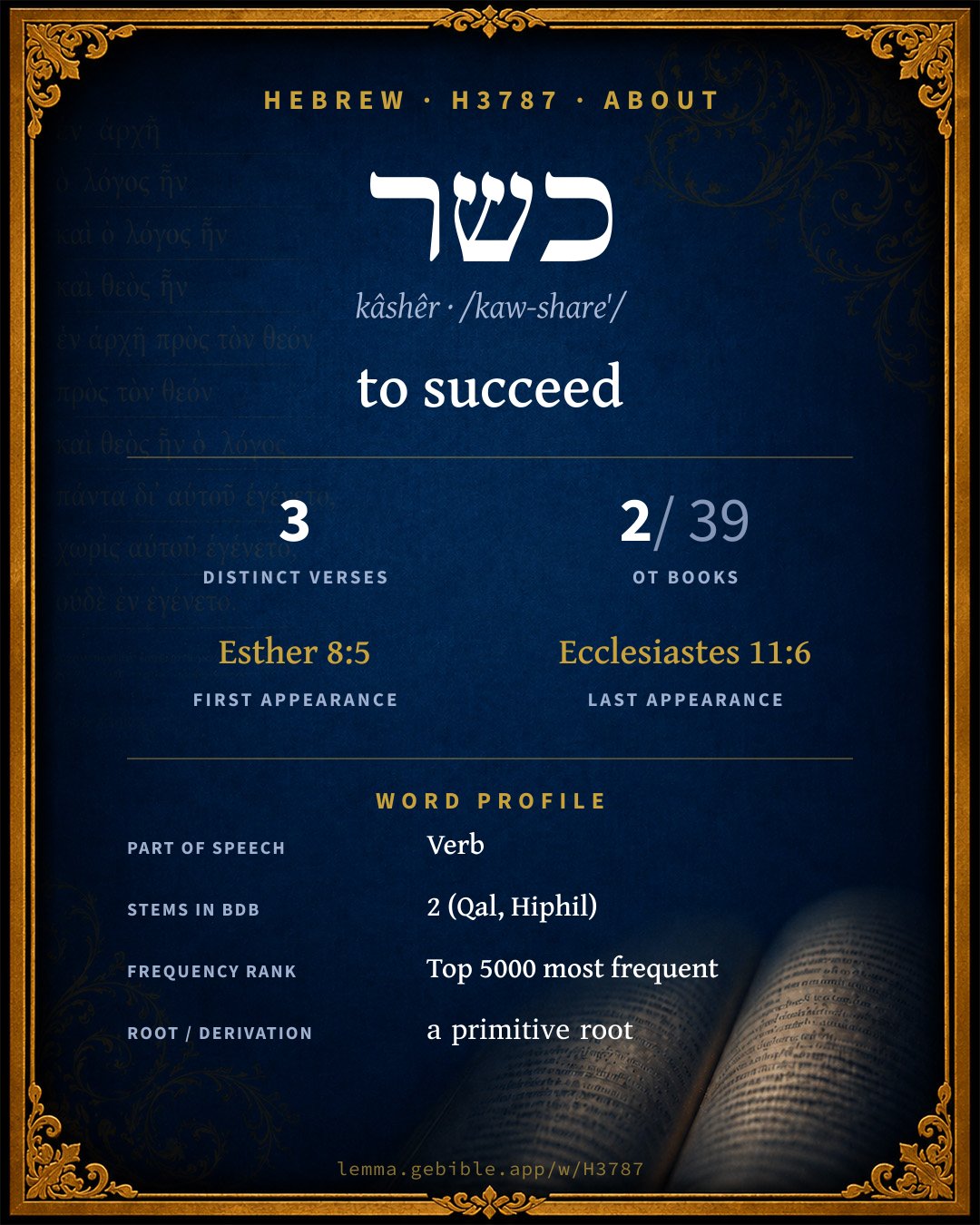
כָּשֵׁר
to succeed
also: please, be suitable, be proper, be advantageous fuller range ↓
Full lexicon entry — Brown-Driver-Briggs (BDB)
From Brown-Driver-Briggs (BDB)
Where this word appears
See every Hiphil verb in the Hebrew Bible →
Grammar key — what these labels mean
Part of speech
- Verb
- An action or state-of-being word.
Stem
- Hiphil
- The causative active stem (“he caused / brought about”).
- Qal
- The basic, simple active stem — the plain form of the verb (“he wrote”). Here: ‘and the thing be proper in the view of the king’
Form
- Infinitive Construct
- A bound verbal noun, frequently with prepositions (“to write / in writing”).
- Perfect
- A completed action or state — Hebrew marks aspect (completeness) more than strict tense (“he wrote”).
- Imperfect
- An incomplete, ongoing, or future action (“he will / would write”).
Person
- 3rd Person
- The one spoken about (“he / she / it / they”).
Gender
- Masculine
- Grammatically masculine.
Number
- Singular
- One.
1 verse where H3787 appears in the Hiphil stem in the Book of Ecclesiastes. Filtered view — show all forms. Click any verse to open its interlinear word-by-word view. Verse text shown in the World English Bible for context — . Each verse’s Hebrew form is shown with its reference; the English is not keyword-highlighted, since the data carries no word-level English alignment. Use “Compare translations” on any verse to read it across multiple English versions. This concordance covers the Hebrew Bible; Septuagint (Greek Old Testament) occurrences are not indexed here.
Ecclesiastes
About this entry
At a glance — auto-summarized from this page’s data, not written by a person. Every figure links to its source below. This summary describes the numbers; it doesn’t interpret them.
The Hebrew verb כשר centers on the idea of “to succeed.” A scarce word — 3 verses in all of the Hebrew Bible. Ecclesiastes dominates its distribution — 2 of 3 verses. Debuting at Esther 8:5, it then recurs through the corpus. The verb spans 2 stems, from Qal to Hiphil. Dig into 3-verse concordance and the renderings breakdown below.
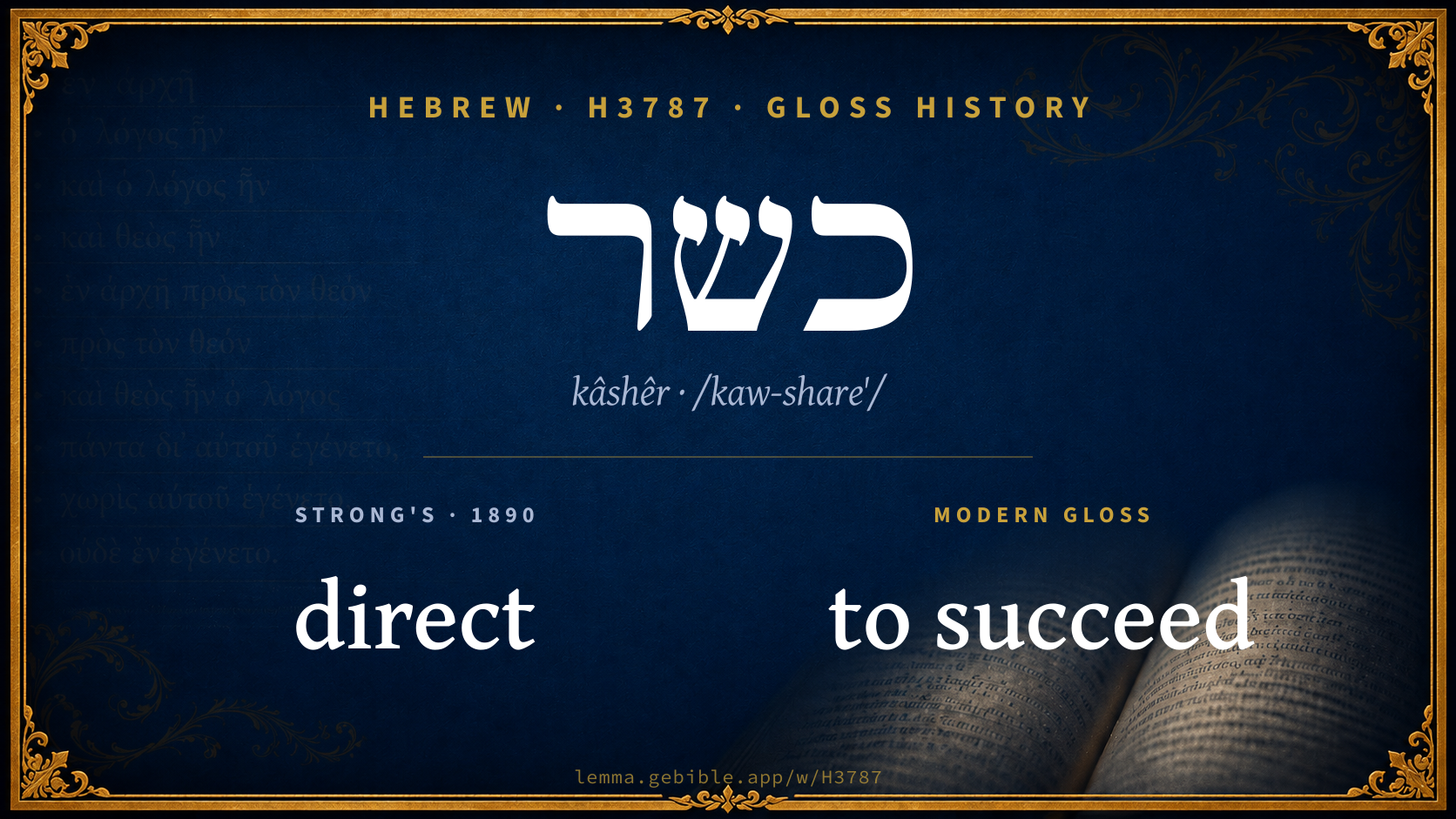
Gloss history
Strong's 1890 vs modern scholarship
About this word
Strong's H3787 catalogs a Hebrew word from the Hebrew Old Testament.
These counts are not copied from any lexicon or concordance. They are computed here, from the morphology-tagged Hebrew Old Testament. What Lemma adds →
- 3
- distinct verses
- The word appears in 3 distinct verses.
- 2 / 39
- OT books
- The word appears in 2 of 39 Old Testament books.
- #3,696
- by frequency
- Top 5000 most frequent Hebrew words (rank 3,696 of 8,640 Hebrew words by occurrence).
View all 3 occurrences in the concordance →
Most concentrated in
- Ecclesiastes 2 verses 67%
- Esther 1 verse 33%
By section of the Old Testament
By traditional corpus
Conventional, traditional groupings — biblical authorship is debated, so this is a traditional corpus grouping, not an authorship claim. Each share is this word’s portion of its verses in that division of the Hebrew canon. Each figure is a share of the word’s 3 distinct verses.
- Writings (Ketuvim) 3 verses · 100%
How translations render this word
Counts come from each version’s own published word-to-Strong’s tagging or interlinear alignment — an approximate guide to how each version renders this word, not a word-level alignment the data otherwise carries. Because each total is that version’s own tagged count, the per-version totals vary from one another and need not match the appearance or distinct-verse counts above. These counts may also differ from a printed concordance because Lemma counts each distinctly tagged rendering and does not collapse phrase taggings into a single head-word total. This is a fixed set of word-tagged versions (KJV, ASV, BSB, ULT) and does not change with the reading translation you choose elsewhere. Each version’s license is shown beside its name below (and on Sources).
- King James Version: Direct 1×, Seem right 1×, Shall prosper 1×
- American Standard Version: Direct 1×, Seem right 1×, Shall prosper 1×
- Berean Standard Bible: Proper 1×, Success 1×, Will succeed 1×
- unfoldingWord Literal Text: And 1×, Is proper 1×, Succeeding 1×
King James Version Public Domain
Renders H3787 across 3 tagged occurrences — most commonly:
American Standard Version Public Domain
Renders H3787 across 3 tagged occurrences — most commonly:
Berean Standard Bible Public Domain
Renders H3787 across 3 tagged occurrences — most commonly:
unfoldingWord Literal Text CC BY-SA 4.0
Renders H3787 across 4 tagged occurrences — most commonly:
Senses in the full BDB
Hebrew verbs can shift meaning by stem (binyan): Qal is the basic action, Niphal is often passive or reflexive, Piel often intensifies or makes it factitive, and Hiphil is typically causative. The senses below are grouped under the stem BDB assigns to each.
What do BDB’s symbols mean?
BDB uses these scholarly abbreviations:
| Symbol | Meaning |
|---|---|
| 𝔊 | the Septuagint (the ancient Greek translation, LXX) |
| 𝔙 | the Vulgate (the Latin translation) |
| 𝔖 | the Syriac version (the Peshitta) |
| 𝔗 | the Targum (the Aramaic translation) |
| ψ | the Psalms |
| √ | root (the underlying root or stem) |
| ‖ | parallel passage (a synonymous or contrasted parallel) |
| † | the dagger: every passage where the word occurs is cited |
The 2 senses and sub-senses the full Brown-Driver-Briggs lexicon distinguishes for this word, in lexicon order (not ranked by frequency), with BDB’s own verbatim wording and sub-sense lettering. Shown in Hebrew script with BDB’s own scholarly abbreviations. The condensed entry is in the Lexicon Entry tab. See also the Forms in the corpus table below.
Qal
- and the thing be proper in the view of the king
Hiphil
- . an advantage for giving success in wisdom.
Senses from the full Brown-Driver-Briggs lexicon (Brown, Driver, Briggs; Oxford 1906 — public domain), digitized via Sefaria, supplemented by the OpenScriptures HebrewLexicon (CC BY 4.0). Full attribution on Sources.
Word origin
כָּשֵׁר vb. be advantageous, proper, suitable, succeed
— Brown-Driver-Briggs (Oxford 1906, public domain), digitized via Sefaria, supplemented by the OpenScriptures HebrewLexicon (CC BY 4.0). See Sources.
Origin: a primitive root
Jastrow Dictionary
A second Hebrew/Aramaic lexicon for comparison, covering Aramaic and post-biblical (Talmudic, Targumic, Midrashic) usage that the biblical-Hebrew BDB does not. Matched by lemma rather than by Strong’s number, so a lemma may carry more than one Jastrow headword (shown separately below), and the entries cover usage well beyond the Bible.
כָּשֵׁר I
- [to be well-joined, (cmp. יָפֶה, אֲרִיךְ II),] to be proper, fit, right; to turn out well, to succeed. Y. Ḥall. I, 57ᵇ top החטים שׁכָּשְׁרוּ לשאר וכ׳ wheats which are fit for all other meat offerings; ib. 57ᶜ; Sifra Vayikra, N’dabah, ch. XIV, Par. 13; a. fr.—V. כָּשֵׁר II.
- 1. (ritual, v. (ritual, v. כָּשֵׁר II) to pronounce kasher, to permit. Ḥull. III, 2 ר׳ … מַכְשִׁיר R. pronounces it fit to be eaten, opp. פוסל; a. v. fr.
- 2. to make fit, to prepare. Ab. VI, 1 מַכְשַׁרְתּוֹ להיות וכ׳ enables him to be righteous &c. Ḥull. 140ᵃ מַכְשִׁיר an offering which makes fit for admission to the Temple or eating sacred food, contrad. to מכפר an offering which procures atonement; Kidd. 57ᵃ, a. e.—Snh. 42ᵇ הוצא … מכשיר ומכפר ‘the carrying outside of the camp’ (Lev. IV, 12; 21) makes the act legal and procures atonement; ib. מכשיר ממכשיר עדיף ליה the analogy between one fitting act and another is preferred.—B. Kam. I, 2 הִכְשַׁרְתִּי את נזקו I have prepared (am responsible for) the damage, v. חוּב. Ib. הכשרתי (ב)מקצת נזקו וכ׳ wherever I am the partial cause of a damage (e.g. by completing a pit to its legally indictable depth), I am as responsible as if I had been the entire author. Gen. R. s. 56 the slaughtering knife is called מַאֲכֶלֶת (causing the eating) לפי שׁמַכְשֶׁרֶת את האוכלים (not שמכשר) because it makes the food fit for eating.—Esp. (with or without לקבל טומאה) to make an object fit for levitical uncleanness (v. Lev. XI, 34; 38). Ḥull. 35ᵇ וכי הדם מַכְשִׁיר … מַכְשֶׁרֶת is it the blood (as a liquid) which fits the meat for uncleanness?; is it not rather the slaughtering (because it makes it ‘an eatable’)?—Ib. 33ᵃ חיבת הקדש מַכְשַׁרְתָּן, v. חִבָּה; ib. 36ᵇ מַכְשַׁרְתָּהּ. Makhsh. VI, 6. Y. Gitt. I, 43ᶜ על מי בצים שאינן מַכְשִׁירִין that the liquid of eggs does not fit for uncleanness; Y. Shebi. VI, 36ᶜ top שאין כשירין (corr. acc.); a. v. fr.—V. הֶכְשֵׁר, מַכְשִׁירִין. e.g. Leviticus 4:12
- to be made fit; to be pronounced fit; to be prepared; to be fitted for levitical uncleanness. Yoma 50ᵃ במה ה׳ אהרן וכ׳ through what act is Aaron (a high priest) made fit to enter &c.?—Sabb. 76ᵃ כל שאינו כשר … וה׳ לזה וכ׳ that which is not fit for preservation but appeared fit to this man, and he did preserve it. Ḥull. 22ᵇ הוּכְשְׁרוּ are pronounced fit for sacrifices. Ib. II, 5 הוכשרו בדם they became fit for uncleanness through the blood (flowing out at killing); ה׳ בשחיטה they became fit through the act of slaughtering (v. supra); a. v. fr.—[Y. Keth. XII, 35ᵃ מכושר, read: מב׳, v. בָּשַׂר.]
- to adapt one’s self, to work with zeal and conscientiousness. Koh. R. to V, 11 מִתְכַּשֵּׁר במלאכתו וכ׳ more skilled and zealous in his work than &c. (cmp. זָרִיז). Gen. R. s. 9; a. e.
כְּשַׁר
- , to be right, pleasing, fit. Targ. I Sam. XVIII, 20. Targ. Jud. XIV, 3. Targ. Ez. XV, 4; a. fr.
- to be (made) fit &c. (v. preced.Hof.). Targ. Y. Deut. XXIX, 22. Targ. Y. Lev. XI, 2; a. fr.—Gitt. 87ᵃ לִיתְכַּשַּׁר האי וכ׳ let the one deed be declared valid through the signature ‘Reuben ben’ &c.—Ḥull. 36ᵇ איתכ׳ במשקי וכ׳ it was made fit for uncleanness through the fluids &c.; ib. אתכ׳ בחבת הקדש, v. חִבָּה; a. e.
- 1. as preced. Hif. Targ. I Sam. XVII, 8. Targ. Ruth II, 13.—B. Mets. 89ᵇ top לאַכְשׁוּרֵי גברא וכ׳ as to making the man fitter, i.e. as to the laborer in fruits being permitted to use means for increasing his appetite, there is no question, opp. to לאכשורי פירא using means for making the fruits more appetizing.—Zeb. 25ᵃ בשמאל אכשורי מַכְשַׁר he (R. S.) declares it permissible to use the left hand (for קְמִיצָה). Sabb. 154ᵃ; Yeb. 45ᵇ אַכְשְׁרֵיה וכ׳ pronounced R. Mari … to be legally a Jew. Ḥull. 58ᵇ סבר … לאַכְשׁוּרָהּ R. … wanted to pronounce it kasher; a. fr.
- 2. to grow better, improve. Ib. 39ᵇ; Yeb. 39ᵇ, v. דָּרָא I.
כָּשֵׁר II
- preced.)
- 1. fit, esp. kasher, ritually permitted, legal, opp. פסול, טרפה. Fem. כְּשֵׁרָה, כְּשֵׁירָה. Ḥull. I, 4 כ׳ בשחיטה פסול במליקה what is legal in slaughtering (cutting the throat) is illegal in pinching (the neck). Ib. שְׁחִיטָתוֹ כ׳ his act of slaughtering has been properly executed. Kidd. IV, 6 בתו כ׳ לכהונה his daughter is fit to marry a priest. Gitt. IX, 4 הולד כ׳ the issue is legitimate, is under no religious or civil disabilities; a. v. fr.—Pl. כְּשֵׁרִים, כְּשֵׁרִין, כְּשֵׁי׳; f. כְּשֵׁרוֹת, כְּשֵׁי׳. Ḥull. III, 2 אלו כ׳ בבהמה the following defects in a domestic animal are kasher, i.e. do not make the animals unfit for eating. Ib. 3 אם אדומים כ׳ if they (the entrails) are red (have their natural color) they are (the animal is) kasher; a. v. fr.
- 2. worthy, honest, of noble conduct. Ber. II, 7 כ׳ היה he was a worthy man. Kidd. IV, 14 הכ׳ שבטבחים the best of butchers; a. fr.—Pl. as ab. Ib. רובן כ׳ are mostly honest men, opp. רשעים. Y. Yoma III, end, 41ᵇ כְּשַׁירֵי כל דור ודור the worthiest of every generation; Y. Shek. V, beg. 48ᶜ. Y. Dem. VI, 25ᵈ top (ref. to Mish. Dem. VI, 6 צנועי בית הלל) מהו צנועי כְּשֵׁירֵי in what sense is צנועי here used? In the sense of K’sheré (the worthies of the house of Hillel). Yoma 19ᵇ, v. חָשַׁד; a. fr.—[Y. Shebi. VI, 36ᶜ top שאין כשירין, read: מַכְשִׁירִין, v. כָּשֵׁר I.]
- 3. apt, convenient. Mekh. Bo, s. 16; Tanḥ. Bo 11 חדש שהוא כ׳ וכ׳ a month convenient to you, when it is not too warm &c.
כָּשַׁר
- same,
- 1. fit, adapted, proper. Targ. Num. XX, 5 ed. Berl. כָּ׳ (oth. ed. כְּ׳; Y. כְּשָׁר). Targ. Jud. XVII, 6. Targ. Zech. III, 5; a. fr.
- 2. (cmp. זָרִיז, חָרוּץ) well-equipped; quick, zealous, industrious, worthy. Targ. Prov. VI, 11 (h. text איש מגן).—Koh. R. to III, 9 וכ׳ בכשרותיה and what has the industrious profited by his industry? (v. אוּמָנוּתָא); a. fr. [Y. Taan. II, 65ᵇ, v. חָצִיף.]—Pl. כַּשְׁרִין, כְּשֵׁירִין; f. כָּשְׁרָן. Targ. Lev. IV, 2. Targ. Zech. III, 3, sq.; a. fr.
A Dictionary of the Targumim, the Talmud Babli and Yerushalmi, and the Midrashic Literature (Marcus Jastrow; London, Luzac, 1903) — Public Domain. Digitized via Sefaria. Digitized via Sefaria. Full attribution on Sources.
Forms in the corpus
The 4 distinct written forms H3787 takes in the Hebrew Bible, most frequent first — each parse links to that stem’s occurrences in the concordance. Hebrew forms include their vowel points and cantillation, so a single lemma takes many written forms.
| Form | Parsing | Example | Uses |
|---|---|---|---|
| הַכְשֵׁ֖ר | Verb, Hiphil, Infinitive Construct | Ecclesiastes 10:10 | 1 |
| הכשיר | Verb, Hiphil, Infinitive Construct | Ecclesiastes 10:10 | 1 |
| וְ/כָשֵׁ֤ר | Verb, Qal, Perfect, 3rd Person, Masculine, Singular | Esther 8:5 | 1 |
| יִכְשָׁר֙ | Verb, Qal, Imperfect, 3rd Person, Masculine, Singular | Ecclesiastes 11:6 | 1 |
Same root — word family
Other BDB entries built from the same root as H3787, grouped by Strong’s listed origin. These share a root / origin per the lexicon — not necessarily a shared meaning. Each links to that word’s own entry.
Derived from this word
Compare all same-root words → They share a root, not necessarily a meaning.
Septuagint verse parallels
This word appears in 3 verses that also exist in the Greek Old Testament (Septuagint), out of the 3 Hebrew verses it occurs in. You can read those verses in Greek by switching the Old Testament edition to the Septuagint.
Read these verses in the Septuagint
This is a verse-level parallel only — the same verses exist in both the Hebrew and Greek Old Testaments. No word-level Hebrew↔Greek correspondence is claimed: the data carries no such alignment, so no Greek word is shown as this Hebrew word’s translation. Coverage is not total — the Septuagint omits the deuterocanon and renumbers the Psalms, so some Hebrew verses have no direct Greek parallel.