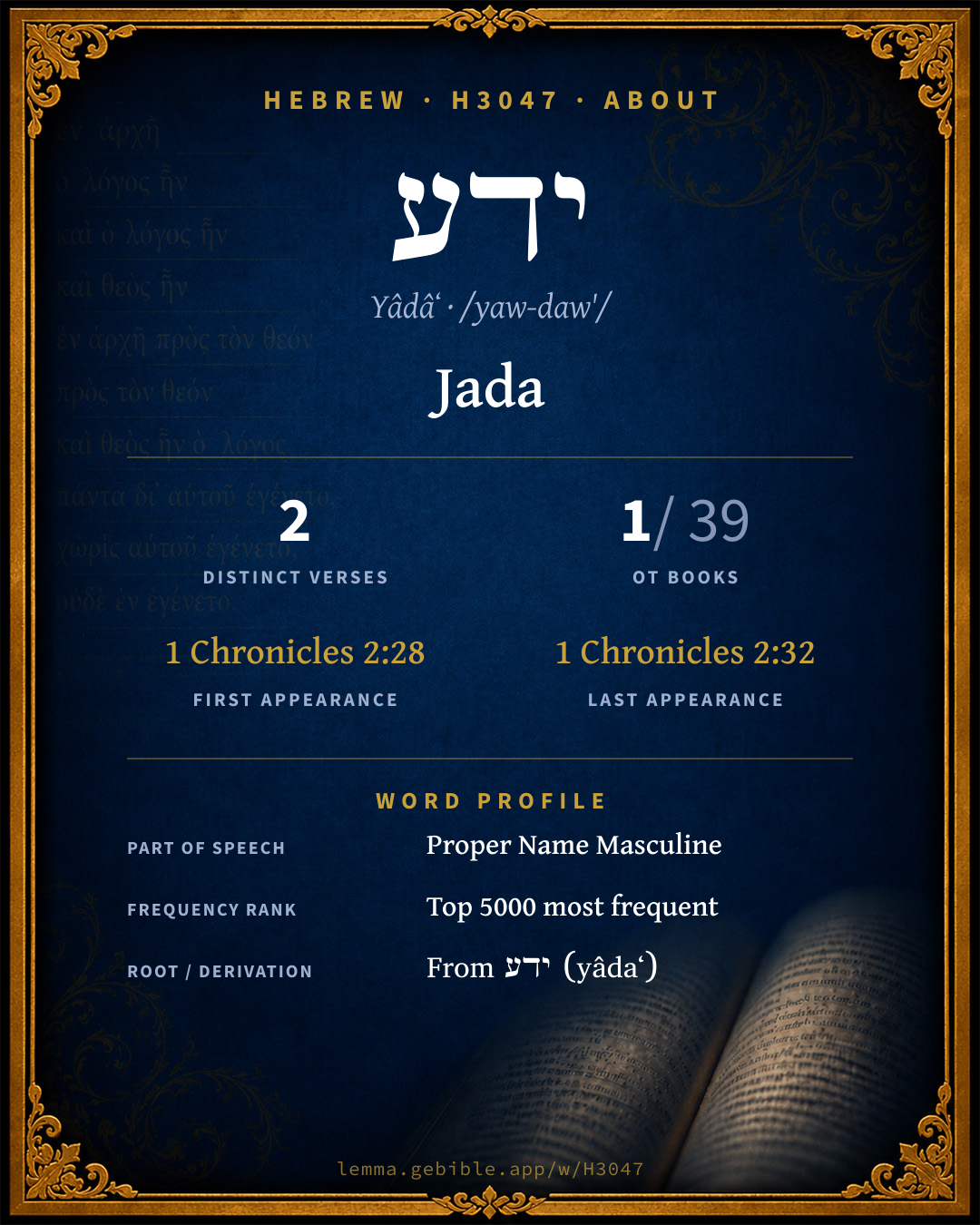
יָדָע
Jada
BDB lists 2 entries for ‘Jada’ fuller range ↓
Full lexicon entry — Brown-Driver-Briggs (BDB)
From Brown-Driver-Briggs (BDB)
Where this word appears
Grammar key — what these labels mean
Part of speech
- Noun
- A naming word — a person, place, thing, or idea.
Noun type
- Proper
- A name of a specific person, place, or people (e.g. Abraham, Zion, Israel).
Every verse where H3047 appears — 2 distinct verses across 1 book. Click any verse to open its interlinear word-by-word view. Verse text shown in the World English Bible for context — . Each verse’s Hebrew form is shown with its reference; the English is not keyword-highlighted, since the data carries no word-level English alignment. Use “Compare translations” on any verse to read it across multiple English versions. This concordance covers the Hebrew Bible; Septuagint (Greek Old Testament) occurrences are not indexed here.
1 Chronicles 2 verses
About this entry
At a glance — auto-summarized from this page’s data, not written by a person. Every figure links to its source below. This summary describes the numbers; it doesn’t interpret them.
“Jada” is the headline sense of the Hebrew name ידע (Yâdâʻ). A scarce word — 2 verses in all of the Hebrew Bible. It clusters heavily in 1 Chronicles, which alone accounts for 100% of its uses. Scripture first uses it in 1 Chronicles 2:28. The sections below give every occurrence and version rendering.
Gloss history
Strong's 1890 vs modern scholarship
About this word
Strong's H3047 catalogs a Hebrew word from the Hebrew Old Testament.
These counts are not copied from any lexicon or concordance. They are computed here, from the morphology-tagged Hebrew Old Testament. What Lemma adds →
- 2
- distinct verses
- The word appears in 2 distinct verses.
- 1 / 39
- OT books
- The word appears in 1 of 39 Old Testament books.
- #4,807
- by frequency
- Top 5000 most frequent Hebrew words (rank 4,807 of 8,640 Hebrew words by occurrence).
View all 2 occurrences in the concordance →
Most concentrated in
- 1 Chronicles 2 verses 100%
By section of the Old Testament
By traditional corpus
Conventional, traditional groupings — biblical authorship is debated, so this is a traditional corpus grouping, not an authorship claim. Each share is this word’s portion of its verses in that division of the Hebrew canon. Each figure is a share of the word’s 2 distinct verses.
- Writings (Ketuvim) 2 verses · 100%
How translations render this word
Counts come from each version’s own published word-to-Strong’s tagging or interlinear alignment — an approximate guide to how each version renders this word, not a word-level alignment the data otherwise carries. Because each total is that version’s own tagged count, the per-version totals vary from one another and need not match the appearance or distinct-verse counts above. These counts may also differ from a printed concordance because Lemma counts each distinctly tagged rendering and does not collapse phrase taggings into a single head-word total. This is a fixed set of word-tagged versions (KJV, ASV, BSB, ULT) and does not change with the reading translation you choose elsewhere. Each version’s license is shown beside its name below (and on Sources).
- King James Version: Jada 2×
- American Standard Version: Jada 2×
- Berean Standard Bible: Jada 2×
- unfoldingWord Literal Text: Jada 2×
King James Version Public Domain
Renders H3047 across 2 tagged occurrences — most commonly:
American Standard Version Public Domain
Renders H3047 across 2 tagged occurrences — most commonly:
Berean Standard Bible Public Domain
Renders H3047 across 2 tagged occurrences — most commonly:
unfoldingWord Literal Text CC BY-SA 4.0
Renders H3047 across 2 tagged occurrences — most commonly:
Senses in BDB
The 2 senses BDB distinguishes for this word, in lexicon order (not ranked by frequency or importance). The full entry — with sub-senses — is in the Lexicon Entry tab.
- Jada = "He knows"
- a Judahite, son of Onam and brother of Shammai, in the genealogy of the sons of Jerahmeel by his wife Atarah
Word origin
n.pr.m. (Sab. ידע, epith. of king, the knowing, shrewd one MordtZMG 1876, 37)—a man of Judah 1 Ch 2:28 (יָדָ֑ע), v 32.
— Brown-Driver-Briggs (Oxford 1906, public domain), digitized via Sefaria, supplemented by the OpenScriptures HebrewLexicon (CC BY 4.0). See Sources.
Derived from ידע (yâdaʻ) (H3045) — to know.
Jastrow Dictionary
A second Hebrew/Aramaic lexicon for comparison, covering Aramaic and post-biblical (Talmudic, Targumic, Midrashic) usage that the biblical-Hebrew BDB does not. Matched by lemma rather than by Strong’s number, so a lemma may carry more than one Jastrow headword (shown separately below), and the entries cover usage well beyond the Bible.
יָדַע
- [to point out, select, love,]
- 1. to recognize, know; to find out. Pes. 87ᵇ כיון שי׳ שחטא when he was convinced that he had done wrong. Ib. ואין אתה יוֹדֵעַ אם וכ׳ and thou knowest not whether &c. Ib. יודע הקב"ה את ישראל וכ׳ the Lord knows that Israel cannot endure the cruel persecutions of Rome (v. Rabb. D. S. a. l. note); Yalk. Hos. 529. Shebu. 4ᵇ; ib. 5ᵃ ונעלם מבלל שי׳ it says, ‘and it escaped his memory’ (Lev. V, 3)—this proves that there was a time when he knew (the nature of his act, v. יְדִיעָה). Zeb. 115ᵇ דבר זה … ולא יְדָעוֹ וכ׳ this word (Ex. XXIX, 43) the Lord had said to Moses, but he did not understand it, until the sons of Aaron died. Ib. כיון שי׳ … יְדוּעֵי מקום הן when Aaron learned that his sons were the chosen of the Lord (Lev. X, 3); a. v. fr.—Part. pass. יָדוּעַ a) chosen. Pl. יְדוּעִים, constr. יְדוּעֵי, v. supra.—b) known, special, certain. Sifra Vayikra, Ḥobah, Par. 6, ch. VIII חטא י׳ a known (discovered) sin, v. יְדִיעָה. Y. Sot. I, 16ᶜ טומאה יְדוּעָה (not ידוע) an ascertained levitical uncleanness, opp. ספק; a. fr.—בְּיָדוּעַ it is sure. R. Hash. 20ᵇ בי׳ שנראה וכ׳ the moon must have been visible &c. Succ. 49ᵇ כל אדם … בי׳ שהוא וכ׳ a popular man (v. חֵן) is, you may be sure, a God-fearing man; a. fr. e.g. Leviticus 5:3
- 2. (euphem.) to have sexual intercourse with. Yeb. 57ᵃ בלא יְדָעָהּ when he never had connection with her. Esth. R. to III, 7 שלא יְדָעָהּ איש וכ׳ whom no man except her husband touched; a. e.
- to make known, inform. Gen. R. s. 22, beg. (ref. to Gen. IV, 1, reading יִדַּע for homiletical purposes) ה׳ דרך ארץ לכל he showed to all the way of the land (propagation, v. דֶּרֶךְ). Ḥull. V, 3 צריך להוֹדִיעַ must inform (the purchaser). Ab. IV, 22 לֵידַע להודיע ולהִוָּורַע to learn, to proclaim and to be made to feel (be thoroughly convinced). Sabb. 10ᵇ צריך להוֹדִיעוֹ must inform him. Ib. לך והוֹדִיעֵם go and tell them. Ib. הנותן … צריך לה׳ לאמו he who gives bread to a child must inform his mother; a. fr. e.g. Genesis 4:1
- to be informed, become conscious; to be made known. Shebu. I, 6 ה׳ ולא ה׳ whether he became conscious (of his transgression) or not. Sifra Vayikra, Ḥobah, ch. XX, Par. 12 (ref. to Lev. IV, 23; 28) את ה׳ שלהם when they become known; a. fr.—B. Bath. 113ᵇ הוֹדְעָה Ms. M. (v. אָרַע II). e.g. Leviticus 4:23
- same. Hor. III, 3. Ab. IV, 22, v. supra. Shebu. 9ᵇ שסופו לִיוָּדַע of which he is likely to be informed. Ḥull. 9ᵃ עד שיִוָּדַע לך, v. חֲזָקָה. Nidd. IX, 5, v. infra; a. fr.
- , Nithpa. נִתְוַודַּע
- 1. same. Bekh. 25ᵇ עד שיִתְוַורַּע הטומאה (Nidd. l. c. עד שיודע לך וכ׳) until he ascertains the exact place of uncleanness; Pes. 10ᵃ עד שתִּיוָּדַע לך Ms. M. (v. Rabb. D. S. a. l.). Y. Sabb. III, 6ᵇ נתודע לו וכ׳ he found it out after sunset; a. fr.
- 2. (v. מוֹדַע) to force one’s self upon the notice of, to pretend friendship for. Ab. I, 10 אל תִּתְוַדַּע לרשות do not make thyself a partisan of the (foreign) government.
יְדַע
- Targ. Gen. IV, 1; a. fr.—Ib. XXX, 26; a. fr:—Fut. יִדַּע, יִנְדַּע (fr. נדע). Targ. Ps. XXXIX, 5 אִידַּע Ms. (ed. אֵידַע). Targ. Ex. VIII, 6; a. fr.—Ber. 33ᵇ אנא לא האי יְדַעְנָע I learned nothing either about this &c. Snh. 103ᵃ (prov.—of one who derives no lesson from adversity or success) בכיי ליה למר ולא י׳ וכ׳ Ms. M. (ed. דלא, v. Rabb. D. S. a. l.) they lament to you and you understand it not, they laugh to you and you understand it not; וי ליה למאן דלא י׳ וכ׳ (not למר) woe to him who knows not the difference between good and evil; a. fr.
- as preced. Hif. Targ. Ex. XXXIII, 13. Targ. Ps. CVI, 8 לאוֹדָעָה (Ms. לאַנְדָּ׳, v. supra); a. fr.—Snh. 11ᵇ מְהוֹדְעִין אנחנא וכ׳ we (the Sanhedrin) notify you &c.; Y. ib. I, 18ᵈ top מוֹדַעְנָא; Tosef. ib. II, 6 מְהוֹדַעְנָא (Var. מְהוֹדְעֵי אנחנא). Sabb. 33ᵇ מאן לוֹדְעֵיה לבר וכ׳ (Ms. M. מוֹדְעֵיה) Oh, that some one would inform the son of Yoḥai &c. Ned. 62ᵃ לאוֹדוּעֵי נפשיה to make one’s self known (as a scholar). Gen. R. s. 11 מנאן את מוֹדַע לי (some ed. מְיַדַּע) how will you prove it to me?; a. fr.
- same. Cant. R. to III, 6 לינא מְיַדַּע לדין וכ׳ shall I not let him know with whom he is dealing?. Gen. R. s. 11, v. supra.—Part. pass. מְיַדַּע friend. Targ. Ps. LXXXVIII, 9 מְיַדְּעַי Ms. (ed. מיודעי, hebraism).
- to be made known, to make one’s self known. Targ. O. Gen. XLV, 1. Ib. XLI, 21; a. fr.—[Targ. Y. Deut. XXI, 11 תתידעון, read: תיתרעון, as in v. 14.]—Hor. 2ᵃ כי מִתְיַדַּע להו לבי דינא if the court were made aware of it. Sabb. 71ᵇ א׳ ליה קודם וכ׳ he became aware of it before setting the sacrifice aside; a. e.
A Dictionary of the Targumim, the Talmud Babli and Yerushalmi, and the Midrashic Literature (Marcus Jastrow; London, Luzac, 1903) — Public Domain. Digitized via Sefaria. Digitized via Sefaria. Full attribution on Sources.
Forms in the corpus
The 2 distinct written forms H3047 takes in the Hebrew Bible, most frequent first — each parse links to that state’s occurrences in the concordance. Hebrew forms include their vowel points and cantillation, so a single lemma takes many written forms.
| Form | Parsing | Example | Uses |
|---|---|---|---|
| וְ/יָדָ֑ע | Noun, Proper | 1 Chronicles 2:28 | 1 |
| יָדָע֙ | Noun, Proper | 1 Chronicles 2:32 | 1 |
Same root — word family
Other BDB entries built from the same root as H3047, grouped by Strong’s listed origin. These share a root / origin per the lexicon — not necessarily a shared meaning. Each links to that word’s own entry.
Derives from
Shares the same root
- דע dêaʻ H1843 knowledge
- דעת daʻath H1847 knowledge
- ידע yᵉdaʻ H3046 to know
- ידעני yiddᵉʻônîy H3049 soothsayer
- מדע maddâʻ H4093 knowledge
- מודע môwdaʻ H4129 kinsman
- מודעת môwdaʻath H4130 kindred
Proper names from this root
People and places named from this root — a name, not an additional meaning of the word.
- דעואל Dᵉʻûwʼêl H1845 Deuel
- ידוע Yaddûwaʻ H3037 Jaddua
- ידיעאל Yᵉdîyʻăʼêl H3043 Jediael
- ידעיה Yᵉdaʻyâh H3048 Jedaiah
Compare all same-root words → Showing 4 of 13 — not the complete family. 4 of the same-root words are proper names (people or places). They share a root, not necessarily a meaning.
Bible dictionary
Public-domain dictionary articles matched to this entry by name (Jada). A biblical name can be shared by more than one person or place, so an article may treat several.
Smith's Bible Dictionary · William Smith, 1863
(wise), son of Onam and brother of Shammai, in the genealogy of the sons of Jerahmeel by his wife Atarah. (1 Chronicles 2:28,32) (B.C. after 1445.)
Hitchcock's Bible Names Dictionary · Roswell D. Hitchcock, 1869
knowing
Classic public-domain reference works; full attribution on Sources.
Septuagint verse parallels
This word appears in 2 verses that also exist in the Greek Old Testament (Septuagint), out of the 2 Hebrew verses it occurs in. You can read those verses in Greek by switching the Old Testament edition to the Septuagint.
Read these verses in the Septuagint
This is a verse-level parallel only — the same verses exist in both the Hebrew and Greek Old Testaments. No word-level Hebrew↔Greek correspondence is claimed: the data carries no such alignment, so no Greek word is shown as this Hebrew word’s translation. Coverage is not total — the Septuagint omits the deuterocanon and renumbers the Psalms, so some Hebrew verses have no direct Greek parallel.