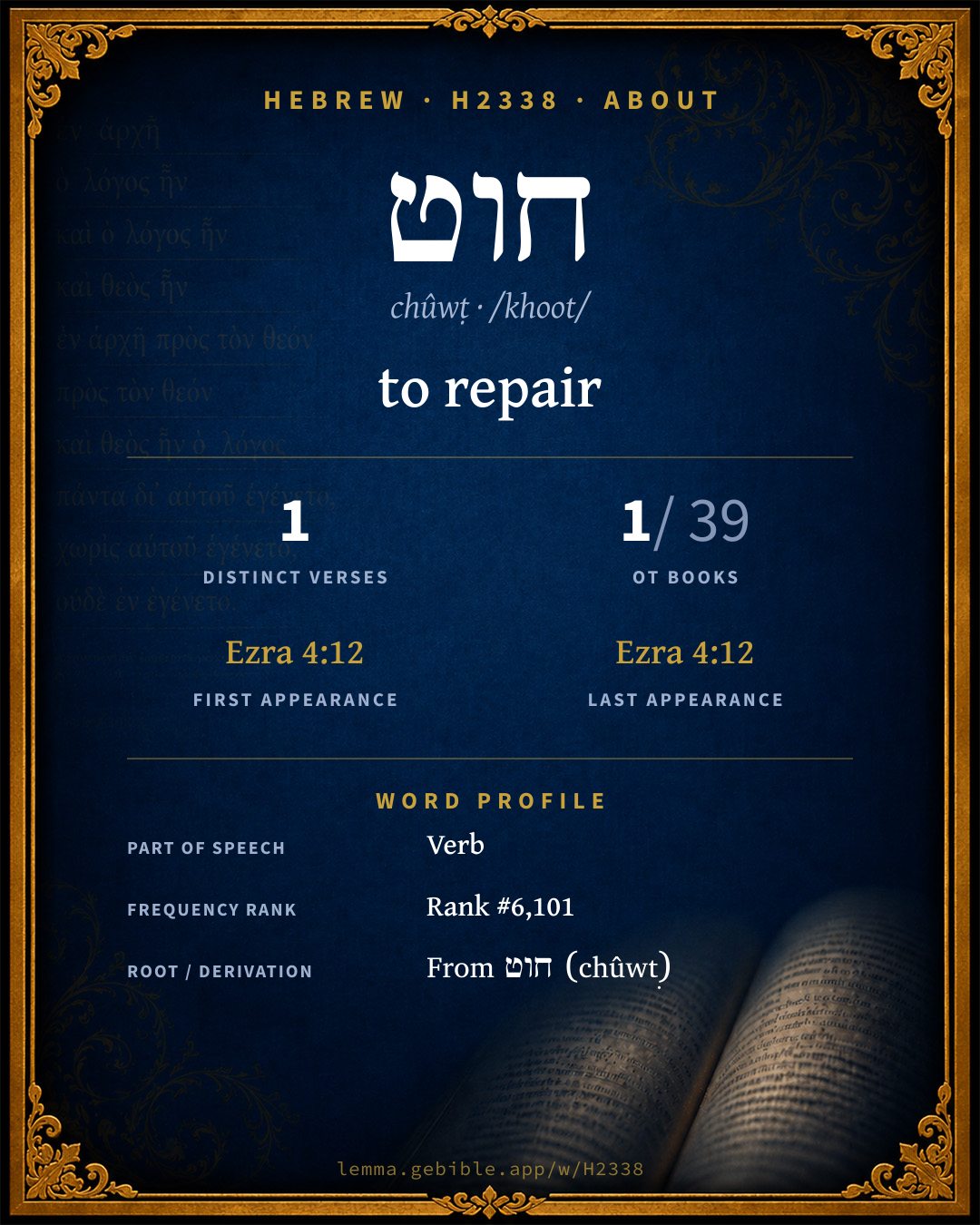
חוּט
to repair
Full lexicon entry — Brown-Driver-Briggs (BDB)
From Brown-Driver-Briggs (BDB)
Where this word appears
Grammar key — what these labels mean
Part of speech
- Verb
- An action or state-of-being word.
Form
- Imperfect
- An incomplete, ongoing, or future action (“he will / would write”).
Person
- 3rd Person
- The one spoken about (“he / she / it / they”).
Gender
- Masculine
- Grammatically masculine.
Number
- Plural
- More than one (in Hebrew, generally three or more).
Every verse where H2338 appears — 1 distinct verse across 1 book. Click any verse to open its interlinear word-by-word view. Verse text shown in the World English Bible for context — . Each verse’s Hebrew form is shown with its reference; the English is not keyword-highlighted, since the data carries no word-level English alignment. Use “Compare translations” on any verse to read it across multiple English versions. This concordance covers the Hebrew Bible; Septuagint (Greek Old Testament) occurrences are not indexed here.
Ezra 1 verse
About this entry
At a glance — auto-summarized from this page’s data, not written by a person. Every figure links to its source below. This summary describes the numbers; it doesn’t interpret them.
חוט — transliterated chûwṭ — is a Hebrew verb carrying the sense “to repair.” It is rare — just 1 verse in the entire Hebrew Bible. Its uses cluster heavily in Ezra (100% of all occurrences). Its lone occurrence is Ezra 4:12. Each statement above links to its evidence; the full detail follows below.
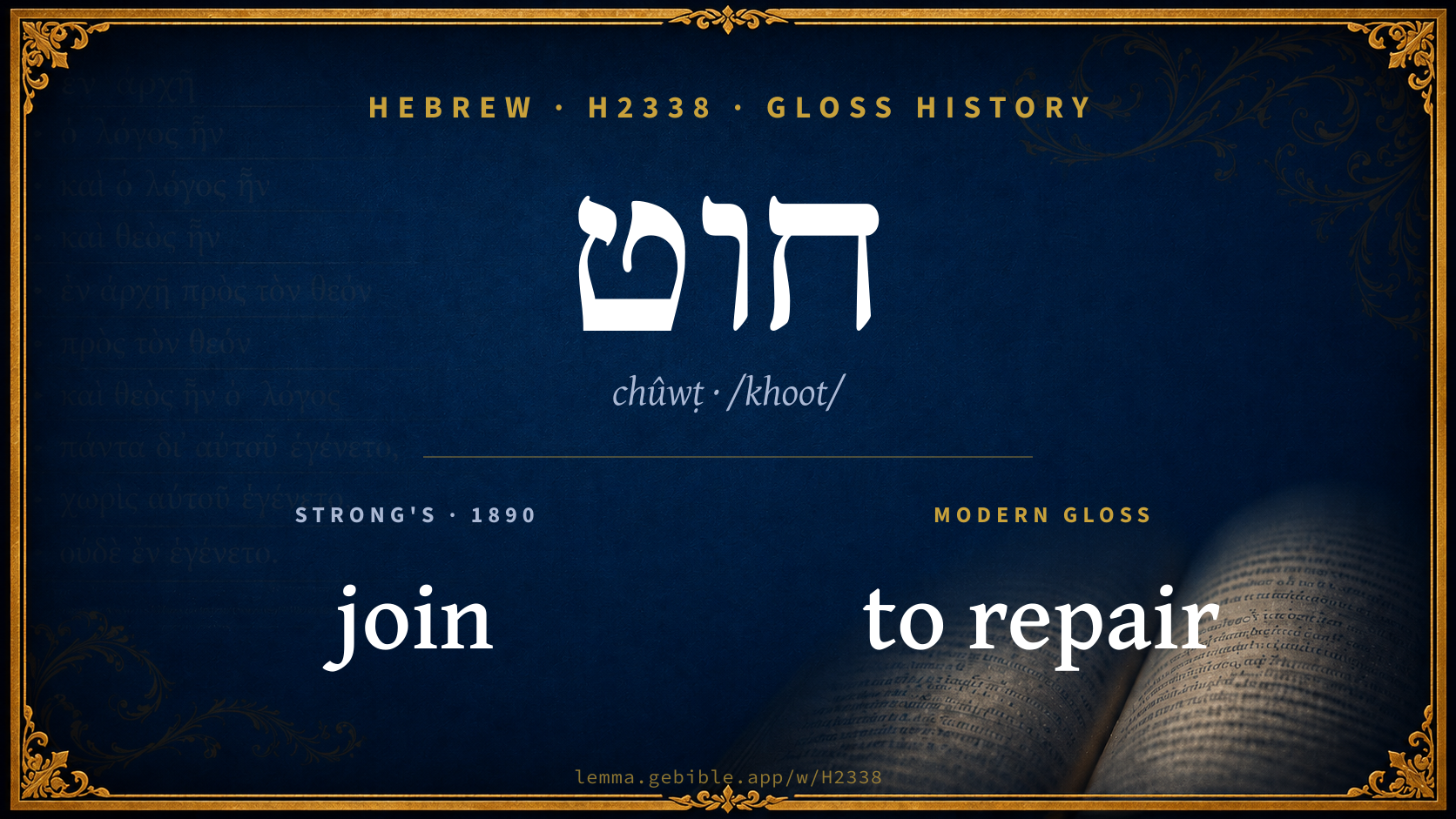
Gloss history
Strong's 1890 vs modern scholarship
About this word
Strong's H2338 catalogs a Hebrew word from the Hebrew Old Testament.
These counts are not copied from any lexicon or concordance. They are computed here, from the morphology-tagged Hebrew Old Testament. What Lemma adds →
- 1
- distinct verses
- The word appears in 1 distinct verse.
- 1 / 39
- OT books
- The word appears in 1 of 39 Old Testament books.
- #6,101
- by frequency
- Rank #6,101 (rank 6,101 of 8,640 Hebrew words by occurrence).
View all 1 occurrence in the concordance →
Most concentrated in
- Ezra 1 verse 100%
By section of the Old Testament
By traditional corpus
Conventional, traditional groupings — biblical authorship is debated, so this is a traditional corpus grouping, not an authorship claim. Each share is this word’s portion of its verses in that division of the Hebrew canon. Each figure is a share of the word’s 1 distinct verse.
- Writings (Ketuvim) 1 verse · 100%
How translations render this word
Counts come from each version’s own published word-to-Strong’s tagging or interlinear alignment — an approximate guide to how each version renders this word, not a word-level alignment the data otherwise carries. Because each total is that version’s own tagged count, the per-version totals vary from one another and need not match the appearance or distinct-verse counts above. These counts may also differ from a printed concordance because Lemma counts each distinctly tagged rendering and does not collapse phrase taggings into a single head-word total. This is a fixed set of word-tagged versions (KJV, ASV, BSB, ULT) and does not change with the reading translation you choose elsewhere. Each version’s license is shown beside its name below (and on Sources).
- King James Version: Thereof and joined 1×
- American Standard Version: Repaired 1×
- Berean Standard Bible: Repairing 1×
- unfoldingWord Literal Text: Repairing 1×
King James Version Public Domain
Renders H2338 across 1 tagged occurrence — most commonly:
American Standard Version Public Domain
Renders H2338 across 1 tagged occurrence — most commonly:
Berean Standard Bible Public Domain
Renders H2338 across 1 tagged occurrence — most commonly:
unfoldingWord Literal Text CC BY-SA 4.0
Renders H2338 across 1 tagged occurrence — most commonly:
Senses in the full BDB
What do BDB’s symbols mean?
BDB uses these scholarly abbreviations:
| Symbol | Meaning |
|---|---|
| 𝔊 | the Septuagint (the ancient Greek translation, LXX) |
| 𝔙 | the Vulgate (the Latin translation) |
| 𝔖 | the Syriac version (the Peshitta) |
| 𝔗 | the Targum (the Aramaic translation) |
| ψ | the Psalms |
| √ | root (the underlying root or stem) |
| ‖ | parallel passage (a synonymous or contrasted parallel) |
| † | the dagger: every passage where the word occurs is cited |
The 3 senses and sub-senses the full Brown-Driver-Briggs lexicon distinguishes for this word, in lexicon order (not ranked by frequency), with BDB’s own verbatim wording and sub-sense lettering. Shown in Hebrew script with BDB’s own scholarly abbreviations. The condensed entry is in the Lexicon Entry tab.
- 1. thread, as easily broken Ju 16:12 (sim.); as composing a rope or cord; תִּקְוַת ח׳ הַשָּׁנִי הַזֶּה Jos 2:18 (JE) this cord of scarlet thread (lit. the cord of this thread of scarlet); prob. also מִחוּט וְעַד שְׂרוֹךְ נַעַל Gn 14:23 from a thread to a sandal-thong; in sim. כְּח׳ הַשָּׁנִי Ct 4:3 like a thread of scarlet are thy lips. e.g. Judges 16:12
- 2. cord, הַח׳ הַמְּשֻׁלָּשׁ Ec 4:12 a three-fold cord. e.g. Ecclesiastes 4:12
- 3. line, as measure of length 1 K 7:15 and a line of twelve cubits surrounded (i.e. would surround) it (cf. קָו v 23), so Je 52:21. e.g. 1 Kings 7:15
Senses from the full Brown-Driver-Briggs lexicon (Brown, Driver, Briggs; Oxford 1906 — public domain), digitized via Sefaria, supplemented by the OpenScriptures HebrewLexicon (CC BY 4.0). Full attribution on Sources.
Word origin
n.m. Jos 2:18 thread, cord, line (NH id.; Arabic خَيْطٌ, Aramaic ܚܽܘܛܳܐ, חוּטָא)—ח׳ abs. Gn 14:23 + 2 times; cstr. Jos 2:18 + 3 times;—
— Brown-Driver-Briggs (Oxford 1906, public domain), digitized via Sefaria, supplemented by the OpenScriptures HebrewLexicon (CC BY 4.0). See Sources.
Derived from חוט (chûwṭ) (H2339) — thread.
Jastrow Dictionary
A second Hebrew/Aramaic lexicon for comparison, covering Aramaic and post-biblical (Talmudic, Targumic, Midrashic) usage that the biblical-Hebrew BDB does not. Matched by lemma rather than by Strong’s number, so a lemma may carry more than one Jastrow headword (shown separately below), and the entries cover usage well beyond the Bible.
חוֹט
- (חטט) incisors. Bekh. VI, 4 (39ᵃ) ח׳ החיצונות (Mish. ed. חִיטָּיו, read חוּ׳) the central two incisors, הפנימיות (Bab. ed. הפנימים) the one each to the right and left of the central incisors. Ib. 35ᵃ; 37ᵃ
חוּט I
- (v. חָטַט) to dig, perforate.—Pol. חוֹטֵט, Hithpol. הִתְחוֹטֵט, v. חָטַט.
חוּט
- Pa. חַיֵּיט same. Targ. Y. Ex. XXI, 6.—B. Bath. 58ᵃ, v. חַטִּיטָא.
חוּט II
- to fasten, esp. (denom. of חֲוַט) to provide a shoe with straps. Y. Kil. IX, 32ᵈ top לא יֵחוֹט ליה מסאניה that he should not make for his (woolen) shoes straps of flax but leather thongs. Ib. מהו מֵיחוֹט מסאניה בכיתן (not דכ׳) is it permitted to put flax straps on &c.?
- 1. same, same, to fasten, strap. Targ. Y. Deut. XXV, 9.
- 2. to sew. Targ. Job XVI, 15; a. e.—Men. 37ᵇ האי מאן דחַיְּיטֵיה לגלימיה he who sewed the trail of his cloak up. Y. Shebi. IV, 35ᵃ bot. הוה מְחַיֵּיט וכ׳ was doing tailor’s work at &c.; a. fr.
- 3. to mend, patch. Lam. R. to I, 1 רבתי (חד כות׳ 1) ח׳ ליה מן וכ׳ he patched it in one place &c.; a. e.
- 4. to form a net of straps, plait. Ab. Zar. 75ᵃ דחַיְּיטֵי בחבלי וכ׳ Ms. M. (ed. דחַיְּטֵי) which they plait with chords &c.
חֲוַט
- , shoe-thong. Y. Kil. IX, 32ᵈ top, v. חוּט II.
חוּט III
- preced. wds.)
- 1. thread, chord, strap; sinew. Kel. XXIX, 3 ח׳ משקולת chord of the plumb-line; ib. 4 ח׳ מאזנים of the balances.—Yeb. 121ᵇ, a. fr. ח׳ השערה a single hair, v. דִּקְדֵּק.—Ḥull. III, 1, a fr. ח׳ השדרה the spinal chord.—Ḥag. 12ᵇ הקב"ה … ח׳ של חסד the Lord strings around him a chord of grace (protection). Meg. 13ᵃ ח׳ של חסד וכ׳ a chord of (divine) grace was strung &c. Men. 39ᵃ נפסק הח׳ מעיקרו the twining thread of the show-fringes is broken at the top. Ib. ח׳ של כרך the thread used for twining; a. fr.—Y. Sabb. VI, 8ᵇ bot. חוטמה וכ׳, read: חוט דומה לשערה a band (of hair) resembling her own hair.—Pl. חוּטִים, חוּטִין. Snh. 52ᵃ, a. e. שני ח׳ של אש two threads (lines) of fire. Lev. R. s. 14, v. זְהוֹרִית.—Men. 39ᵇ חוּטֵי צמר woolen threads (as show-fringes). Sabb. VI, 5 חוטי שיער bands made of hair. Ib. 6 בח׳ וכ׳ with threads … in their ears (in place of earrings). Ḥull. 93ᵃ ח׳ שביד the veins of the fore-foot; a. fr.
- 2. (Geogr.) air-line. Tosef. Ter. II, 12. Ib. 13 מן הח׳ ולפנים וכ׳ what is inside (East) of the line is considered as belonging to the land of Israel.—[Tosef. Kel. B. Bath. V, 14 יוצאת החוט, v. חוּץ II.]
חָטַט
- 1. to dig, cut out (of the sucket), hollow out. Mikv. IV, 3 החוֹטֵט בצינור וכ׳ if one makes a cavity in a water pipe for the deposit of pebbles. Gen. R. s. 34 היה חוטט את וכ׳ the embryo would cut its way through &c. Kidd. 24ᵇ וחֲטָטָהּ and he (the master) cut it (the eye) out.
- 2. to rake, clean a well. M. Kat. I, 2 וחוֹטְטִין אותן and you may clean the wells. Ib. 5ᵃ ח׳ … ואין חופרין וכ׳ you may clean …, but not dig (deepen) &c. [Ib. ולא חוטטין לתוכן you must not rake pebbles into them; v., however vers. Ms. M., Rabb. D. S. a. l.]—Y. ib. 80ᵇ bot. חוטטין אותן גרפין לון וכ׳ (not חוטטן) ḥot’tin means ‘they rake them’, as we read (Mikv. l. c.).
- 3. to take sheaves out with a rake. Succ. I, 8 החוטט בגדיש וכ׳ if one takes sheaves out of a stack, so as to form a shed (Succah). Ib. 15ᵃ
- 1. to rake. Y. Sabb. III, beg. 5ᶜ צריך לחַטֵּט ביד וכ׳ he must rake (coals and ashes out of the oven) with a handle, which proves that he must clean thoroughly.
- 2. to make holes, to pick. Tosef. Mikv. VII (VIII), 2 אוצין צריך לחטט Var. (ed. Zuck. לחַטְחֵט) if the holes in the baskets are filled up with grapes &c., one must clean them by picking. B. Kam. 18ᵃ תרנגולין שהיו מְחַטְּטִין וכ׳ chickens that picked on the rope of a bucket. Tosef. B. Mets. VIII, 30 שמְחַטְּטִין את וכ׳ (Var. שמְחַטְחֲטִין) for they pick holes in the walls.
- 3. (with אחר) to dig after, to trace with the knife. Ḥull. 74ᵇ; Tosef. Ib. VII, 4.
- 4. to trim. Sabb. 90ᵃ; Men. 107ᵃ, v. מָחַט.
- same. Y. Orl. III, 63ᵃ מצוי לחַטְחֵט אחריו it is likely that they dig after it (to take it out of the ground); a. e. (v. supra).
- to be dug out, picked out. Kidd. 24ᵇ נֶחְטְטָה עינה if the bird’s eye was picked out; Zeb. VII, 5 (68ᵇ) Ar. (ed. נסמית).
- to be exhumed. Yeb. 63ᵇ מתים מִתְחַטְּטִין the dead are exhumed (by the Guebres).
- ), part. מְחוֹטֵט (v. מַחַט) stinging (the eye), dazzling, v. infra.
- to be cut (of jewels), to be polished, glisten. Meg. 12ᵃ (play on בה̇ט̇, Esth. I, 6) אב̇נים שמִתְח̇וֹטְֹטוֹת על בעליהן וי"א אב̇נים המְח̇וֹטְֹטוֹת לעינים במקומן Ms. F. (v. Rabb. D. S. a. l. note 5) stones which glisten on those who wear them, and some say, Stones which dazzle the eyes in the place where they are found. e.g. Esther 1:6
A Dictionary of the Targumim, the Talmud Babli and Yerushalmi, and the Midrashic Literature (Marcus Jastrow; London, Luzac, 1903) — Public Domain. Digitized via Sefaria. Digitized via Sefaria. Full attribution on Sources.
Septuagint verse parallels
This word appears in 1 verse that also exists in the Greek Old Testament (Septuagint), out of the 1 Hebrew verse it occurs in. You can read those verses in Greek by switching the Old Testament edition to the Septuagint.
Read these verses in the Septuagint
This is a verse-level parallel only — the same verses exist in both the Hebrew and Greek Old Testaments. No word-level Hebrew↔Greek correspondence is claimed: the data carries no such alignment, so no Greek word is shown as this Hebrew word’s translation. Coverage is not total — the Septuagint omits the deuterocanon and renumbers the Psalms, so some Hebrew verses have no direct Greek parallel.