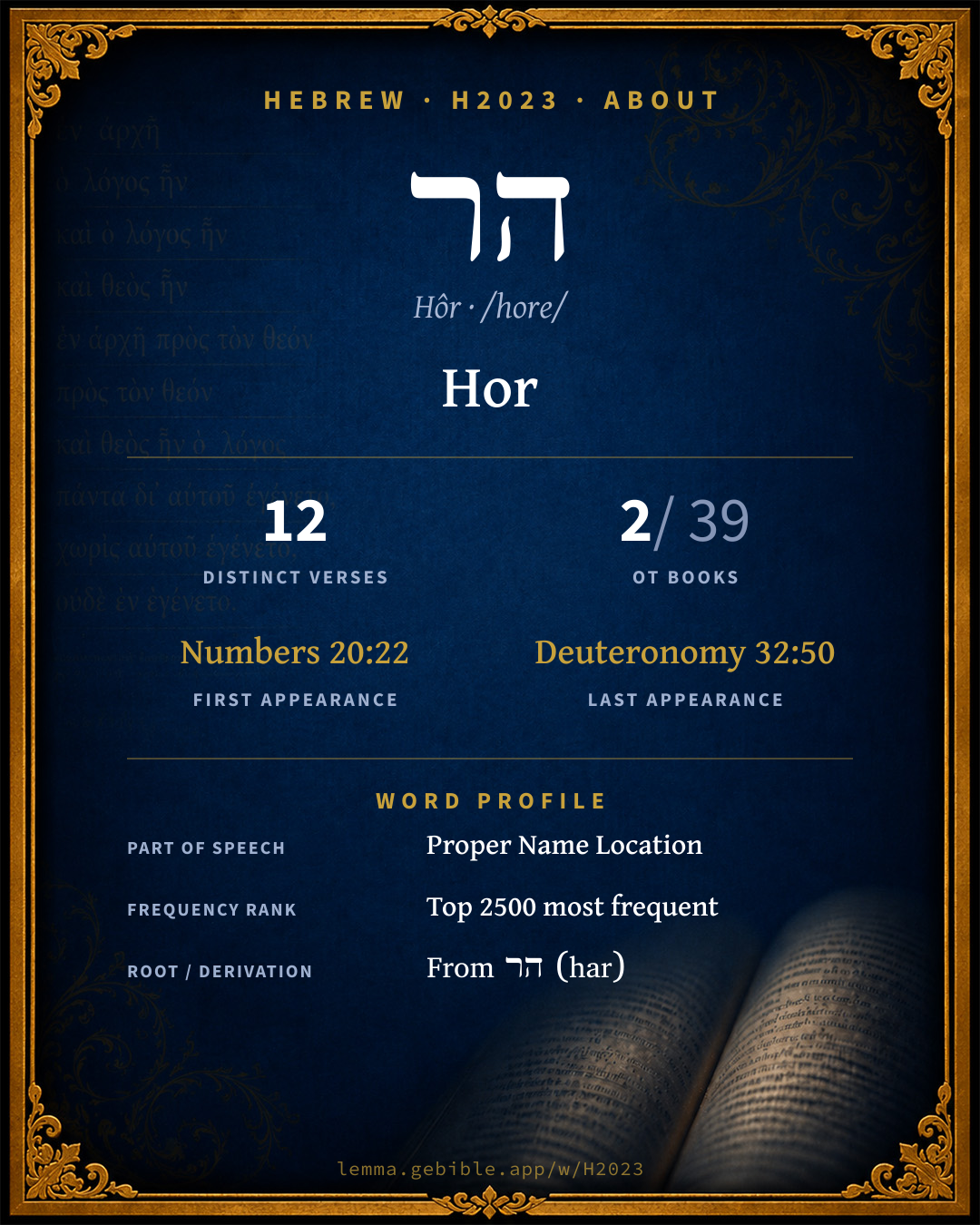
הֹר
Hor
BDB lists 3 entries for ‘Hor’ fuller range ↓
Full lexicon entry — Brown-Driver-Briggs (BDB)
From Brown-Driver-Briggs (BDB)
Where this word appears
Grammar key — what these labels mean
Part of speech
- Noun
- A naming word — a person, place, thing, or idea.
Noun type
- Proper
- A name of a specific person, place, or people (e.g. Abraham, Zion, Israel).
Every verse where H2023 appears in the Book of Deuteronomy — 1 distinct verse. Click any verse to open its interlinear word-by-word view. Verse text shown in the World English Bible for context — . Each verse’s Hebrew form is shown with its reference; the English is not keyword-highlighted, since the data carries no word-level English alignment. Use “Compare translations” on any verse to read it across multiple English versions. This concordance covers the Hebrew Bible; Septuagint (Greek Old Testament) occurrences are not indexed here.
Deuteronomy
About this entry
At a glance — auto-summarized from this page’s data, not written by a person. Every figure links to its source below. This summary describes the numbers; it doesn’t interpret them.
“Hor” is the headline sense of the Hebrew name הר (Hôr). It clusters heavily in Numbers, which alone accounts for 92% of its uses. It turns up in 12 verses across 2 books, an uncommon footprint. Its earliest occurrence is Numbers 20:22. See 12-verse concordance and the renderings breakdown below.
Gloss history
Strong's 1890 vs modern scholarship
About this word
Strong's H2023 catalogs a Hebrew word from the Hebrew Old Testament.
These counts are not copied from any lexicon or concordance. They are computed here, from the morphology-tagged Hebrew Old Testament. What Lemma adds →
- 12
- distinct verses
- The word appears in 12 distinct verses.
- 2 / 39
- OT books
- The word appears in 2 of 39 Old Testament books.
- #2,101
- by frequency
- Top 2500 most frequent Hebrew words (rank 2,101 of 8,640 Hebrew words by occurrence).
View all 12 occurrences in the concordance →
Most concentrated in
- Numbers 11 verses 92%
- Deuteronomy 1 verse 8%
By section of the Old Testament
By traditional corpus
Conventional, traditional groupings — biblical authorship is debated, so this is a traditional corpus grouping, not an authorship claim. Each share is this word’s portion of its verses in that division of the Hebrew canon. Each figure is a share of the word’s 12 distinct verses.
- Torah (Pentateuch) 12 verses · 100%
How translations render this word
Counts come from each version’s own published word-to-Strong’s tagging or interlinear alignment — an approximate guide to how each version renders this word, not a word-level alignment the data otherwise carries. Because each total is that version’s own tagged count, the per-version totals vary from one another and need not match the appearance or distinct-verse counts above. These counts may also differ from a printed concordance because Lemma counts each distinctly tagged rendering and does not collapse phrase taggings into a single head-word total. This is a fixed set of word-tagged versions (KJV, ASV, BSB, ULT) and does not change with the reading translation you choose elsewhere. Each version’s license is shown beside its name below (and on Sources).
- King James Version: Hor 12×
- American Standard Version: Hor 12×
- Berean Standard Bible: Hor 12×
- unfoldingWord Literal Text: Hor 12×, At 3×, From 3×
King James Version Public Domain
Renders H2023 across 12 tagged occurrences — most commonly:
American Standard Version Public Domain
Renders H2023 across 12 tagged occurrences — most commonly:
Berean Standard Bible Public Domain
Renders H2023 across 12 tagged occurrences — most commonly:
unfoldingWord Literal Text CC BY-SA 4.0
Renders H2023 across 20 tagged occurrences — most commonly:
Plus 2 renderings that appear only once — usually multi-word phrases or single function words the recovered tagging swept in, not distinct renderings.
Senses in the full BDB
What do BDB’s symbols mean?
BDB uses these scholarly abbreviations:
| Symbol | Meaning |
|---|---|
| 𝔊 | the Septuagint (the ancient Greek translation, LXX) |
| 𝔙 | the Vulgate (the Latin translation) |
| 𝔖 | the Syriac version (the Peshitta) |
| 𝔗 | the Targum (the Aramaic translation) |
| ψ | the Psalms |
| √ | root (the underlying root or stem) |
| ‖ | parallel passage (a synonymous or contrasted parallel) |
| † | the dagger: every passage where the word occurs is cited |
The 2 senses and sub-senses the full Brown-Driver-Briggs lexicon distinguishes for this word, in lexicon order (not ranked by frequency), with BDB’s own verbatim wording and sub-sense lettering. Shown in Hebrew script with BDB’s own scholarly abbreviations. The condensed entry is in the Lexicon Entry tab. See also the Forms in the corpus table below.
- 1. mt. on border of Edom, always הֹר הָהָר, named as stage in Isr.’s journey to Canaan Nu 20:22; 21:4; 33:37 Dt 32:50; as place of Aaron’s death Nu 20:23, 25, 27; 33:38, 39, 41 Dt 32:50 (all P); = mod. Jebel Nebi Hârûn c. 50 miles S. of Dead Sea, just S. (SW.) of Petra, according to RobBR ii, 125, 152, cf. 519 ff. BdPal. 153; disputed by Ew Kn Di, & especially TrumbullKadesh Barnea 128 ff., who thinks of J. Madurah, NW. of Edom. e.g. Numbers 20:22
- 2. a NE. spur of Lebanon Nu 34:7, 8 (P); mod. Jebel ʿAkkar cf. PorterDamascus, ed. 2, p. 333 NbrGéogr. du Talm. p. 9 FurrerZPV viii. 27; yet v. Di. e.g. Numbers 34:7
Senses from the full Brown-Driver-Briggs lexicon (Brown, Driver, Briggs; Oxford 1906 — public domain), digitized via Sefaria, supplemented by the OpenScriptures HebrewLexicon (CC BY 4.0). Full attribution on Sources.
Word origin
Derived from הר (har) (H2022) — mountain.
Jastrow Dictionary
A second Hebrew/Aramaic lexicon for comparison, covering Aramaic and post-biblical (Talmudic, Targumic, Midrashic) usage that the biblical-Hebrew BDB does not. Matched by lemma rather than by Strong’s number, so a lemma may carry more than one Jastrow headword (shown separately below), and the entries cover usage well beyond the Bible.
הַר
- mound, mountain; trnsf. eminent person. Midd. II, 1, a. fr. הַר הבית the Temple mount. Yeb. 17ᵃ (play on ה̇ר̇פ̇נ̇יא) ה̇ר̇ שהכל פ̇ונ̇ין בו a hill to which all turn (whose spurious descent prevents them from getting wives elsewhere); a. v. fr.—Ḥull. 39ᵇ (in Chald. diction) רישיך והר here is thy head and here the mountain (a colloquial phrase for compelling one to give up a bargain).—Ex. R. s. 28 (ref. to Ex. XIX, 3) בזכות הה׳ for the merit of the distinguished one (Abraham), ואין הה׳ אלא אבות har means the patriarchs (ref. to Mic. VI, 2). Snh. 107ᵃ ה׳ שבכם the most prominent of you; a. fr.—[For proper nouns composed with הר, v. respective determinants.]—Pl. הָרִים, הֲרָרִים. Tam. 32ᵃ, a. e. הָרֵי חושך, v. חו̇שֶׁךְ.—Snh. 24ᵃ עוקר הרי הרים uprooting the highest mountains (a figure for dialectical ingenuity). Y. Yeb. I, 3ᵃ bot. בין שני הֶהָ׳ וכ׳ between the two high mountains (great scholars). Ex. R. s. 15 ואין ה׳ אלא אבות, v. supra.—Ḥag. I, 8 כה׳ תלויין בשערה like mountains suspended on a hair (a slender Bible text for numerous Talmudic laws); a. v. fr. e.g. Exodus 19:3
A Dictionary of the Targumim, the Talmud Babli and Yerushalmi, and the Midrashic Literature (Marcus Jastrow; London, Luzac, 1903) — Public Domain. Digitized via Sefaria. Digitized via Sefaria. Full attribution on Sources.
Forms in the corpus
The 6 distinct written forms H2023 takes in the Hebrew Bible, most frequent first — each parse links to that state’s occurrences in the concordance. Hebrew forms include their vowel points and cantillation, so a single lemma takes many written forms.
| Form | Parsing | Example | Uses |
|---|---|---|---|
| הֹ֥ר | Noun, Proper | Numbers 20:22 | 4 |
| בְּ/הֹ֣ר | Noun, Proper | Deuteronomy 32:50 | 3 |
| מֵ/הֹ֣ר | Noun, Proper | Numbers 33:41 | 2 |
| בְּ/הֹ֥ר | Noun, Proper | Numbers 33:39 | 1 |
| הֹ֣ר | Noun, Proper | Numbers 20:27 | 1 |
| מֵ/הֹ֤ר | Noun, Proper | Numbers 21:4 | 1 |
Same root — word family
Other BDB entries built from the same root as H2023, grouped by Strong’s listed origin. These share a root / origin per the lexicon — not necessarily a shared meaning. Each links to that word’s own entry.
Derives from
Shares the same root
Proper names from this root
People and places named from this root — a name, not an additional meaning of the word.
Compare all same-root words → Showing 4 of 7 — not the complete family. 3 of the same-root words are proper names (people or places). They share a root, not necessarily a meaning.
Bible dictionary
Public-domain dictionary articles matched to this entry by name (Hor). A biblical name can be shared by more than one person or place, so an article may treat several.
Easton's Bible Dictionary · M. G. Easton, 1897
Mountain. (1.) One of the mountains of the chain of Seir or Edom, on the confines of Idumea (Num. 20:22-29; 33:37). It was one of the stations of the Israelites in the wilderness (33:37), which they reached in the circuitous route they were obliged to take because the Edomites refused them a passage through their territory. It was during the encampment here that Aaron died (Num. 33:37-41). (See AARON.) The Israelites passed this mountain several times in their wanderings. It bears the modern name of Jebel Harun, and is the highest and most conspicious of the whole range. It stands about midway between the Dead Sea and the Elanitic gulf. It has two summits, in the hallow between which it is supposed that Aaron died. Others, however, suppose that this mountain is the modern Jebel Madurah, on the opposite, i.e., the western, side of the Arabah.
(2.) One of the marks of the northern boundary of Palestine (Num. 34:7, 8). Nowhere else mentioned. Perhaps it is one of the peaks of Lebanon.
Smith's Bible Dictionary · William Smith, 1863
(mountain), Mount.
+ The mountain on which Aaron died. (Numbers 20:25,27) It was "on the boundary line," (Numbers 20:23) or "at the edge," ch. (Numbers 33:37) of the land of Edom. It was the halting-place of the people next after Kadesh, ch. (Numbers 20:22; 33:37) and they quitted it for Zalmonah, ch. (Numbers 33:41) in the road to the Red Sea. ch. (Numbers 21:4) It was during the encampment at Kadesh that Aaron was gathered to his fathers. Mount Hor is situated on the eastern side of the great valley of the Arabah, the highest and most conspicuous of the whole range of the sandstone mountains of Edom, having close beneath it on its: eastern side the mysterious; city of Petra. It is now the Jebel Nebi-Harim "the mountain of the prophet Aaron." Its height is 4800 feet above the Mediterranean; that is to say, about 1700 feet above the town of Petra, 4800 above the level of the Arabah, and more than 6000 above the Dead Sea. The mountain is marked far and near by its double top, which rises like a huge castellated building from a lower base, and is surmounted by a circular dome of the tomb of Aaron, a distinct white spot on the dark red surface of the mountain. The chief interest of Mount Hor consists in the prospect from its summit, the last view of Aaron--that view which was to him what Pisgah was to his brother. + A mountain, entirely distinct from the preceding, named in (Numbers 34:7,8) only, as one of the marks of the northern boundary of the land which the children of Israel were about to conquer. This Mount Hor is the great chain of Lebanon itself.
Hitchcock's Bible Names Dictionary · Roswell D. Hitchcock, 1869
who conceives, or shows; a hill
Classic public-domain reference works; full attribution on Sources.
Septuagint verse parallels
This word appears in 12 verses that also exist in the Greek Old Testament (Septuagint), out of the 12 Hebrew verses it occurs in. You can read those verses in Greek by switching the Old Testament edition to the Septuagint.
Read these verses in the Septuagint
This is a verse-level parallel only — the same verses exist in both the Hebrew and Greek Old Testaments. No word-level Hebrew↔Greek correspondence is claimed: the data carries no such alignment, so no Greek word is shown as this Hebrew word’s translation. Coverage is not total — the Septuagint omits the deuterocanon and renumbers the Psalms, so some Hebrew verses have no direct Greek parallel.