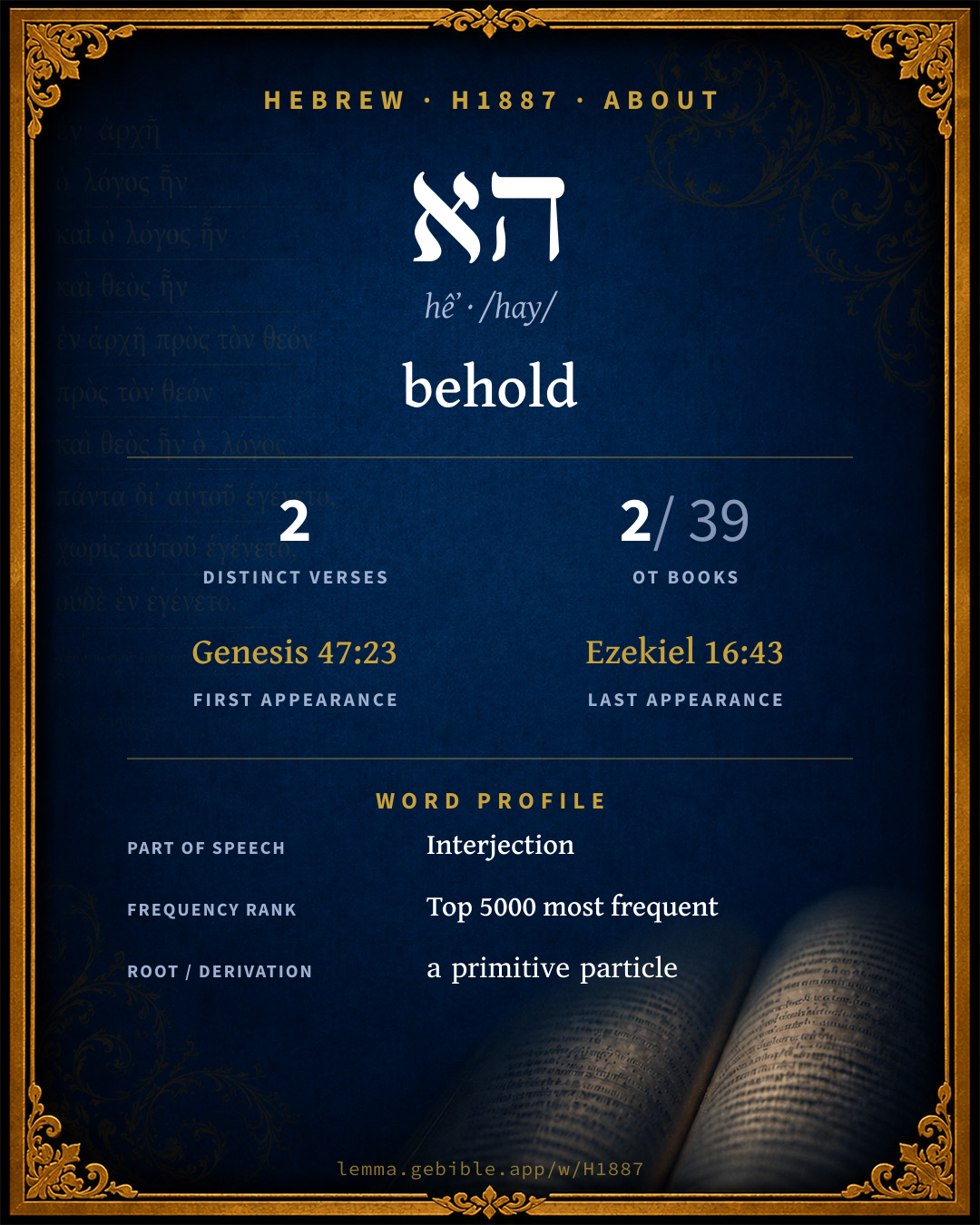
הֵא
behold
Full lexicon entry — Brown-Driver-Briggs (BDB)
From Brown-Driver-Briggs (BDB)
Where this word appears
Grammar key — what these labels mean
Part of speech
- Particle
- A short function word — article, negation, interrogative, the sign of the direct object, and the like.
Every verse where H1887 appears in the Book of Ezekiel — 1 distinct verse. Click any verse to open its interlinear word-by-word view. Verse text shown in the World English Bible for context — . Each verse’s Hebrew form is shown with its reference; the English is not keyword-highlighted, since the data carries no word-level English alignment. Use “Compare translations” on any verse to read it across multiple English versions. This concordance covers the Hebrew Bible; Septuagint (Greek Old Testament) occurrences are not indexed here.
Ezekiel
About this entry
At a glance — auto-summarized from this page’s data, not written by a person. Every figure links to its source below. This summary describes the numbers; it doesn’t interpret them.
The Hebrew word הא centers on the idea of “behold.” A scarce word — 2 verses in all of the Hebrew Bible. Genesis dominates its distribution — 1 of 2 verses. First canonically at Genesis 47:23, it enters the text early. Related forms include הא and האח. Each statement above links to its evidence; the full detail follows below.
Gloss history
Strong's 1890 vs modern scholarship
About this word
Strong's H1887 catalogs a Hebrew word from the Hebrew Old Testament.
These counts are not copied from any lexicon or concordance. They are computed here, from the morphology-tagged Hebrew Old Testament. What Lemma adds →
- 2
- distinct verses
- The word appears in 2 distinct verses.
- 2 / 39
- OT books
- The word appears in 2 of 39 Old Testament books.
- #4,807
- by frequency
- Top 5000 most frequent Hebrew words (rank 4,807 of 8,640 Hebrew words by occurrence).
View all 2 occurrences in the concordance →
By traditional corpus
Conventional, traditional groupings — biblical authorship is debated, so this is a traditional corpus grouping, not an authorship claim. Each share is this word’s portion of its verses in that division of the Hebrew canon. Each figure is a share of the word’s 2 distinct verses.
- Torah (Pentateuch) 1 verse · 50%
- Prophets (Nevi'im) 1 verse · 50%
How translations render this word
Counts come from each version’s own published word-to-Strong’s tagging or interlinear alignment — an approximate guide to how each version renders this word, not a word-level alignment the data otherwise carries. Because each total is that version’s own tagged count, the per-version totals vary from one another and need not match the appearance or distinct-verse counts above. These counts may also differ from a printed concordance because Lemma counts each distinctly tagged rendering and does not collapse phrase taggings into a single head-word total. This is a fixed set of word-tagged versions (KJV, ASV, BSB, ULT) and does not change with the reading translation you choose elsewhere. Each version’s license is shown beside its name below (and on Sources).
- King James Version: All these things behold 1×, Lo 1×
- American Standard Version: Against me in all these things 1×, Lo 1×
- Berean Standard Bible: Here 1×
- unfoldingWord Literal Text: Here 1×, Is 1×, Will 1×
King James Version Public Domain
Renders H1887 across 2 tagged occurrences — most commonly:
American Standard Version Public Domain
Renders H1887 across 2 tagged occurrences — most commonly:
Berean Standard Bible Public Domain
Renders H1887 across 1 tagged occurrence — most commonly:
Not rendered by a distinct English word in 1 further occurrence.
unfoldingWord Literal Text CC BY-SA 4.0
Renders H1887 across 3 tagged occurrences — most commonly:
Senses in BDB
The 1 sense BDB distinguishes for this word, in lexicon order (not ranked by frequency or importance). The full entry — with sub-senses — is in the Lexicon Entry tab.
- behold!, lo!
Word origin
interj. (Aramaic הָא, Dn 2:43 הֵא (q.v.), ܗܳܐ; Arabic هَا ) lo, behold! Gn 47:23 Ez 16:43.
— Brown-Driver-Briggs (Oxford 1906, public domain), digitized via Sefaria, supplemented by the OpenScriptures HebrewLexicon (CC BY 4.0). See Sources.
Origin: a primitive particle
Jastrow Dictionary
A second Hebrew/Aramaic lexicon for comparison, covering Aramaic and post-biblical (Talmudic, Targumic, Midrashic) usage that the biblical-Hebrew BDB does not. Matched by lemma rather than by Strong’s number, so a lemma may carry more than one Jastrow headword (shown separately below), and the entries cover usage well beyond the Bible.
הָא I
- (demonstr. pronoun) this. Yoma 26ᵃ הא שכיחא והא וכ׳ the one is a frequent (daily) performance, but the other is rare. Ber. 2ᵃ והא קמ"ל and this he intimates. Ib. 4ᵇ והא דקאמרי וכ׳ and as to this (the fact) that they say, ‘Until midnight’, it is said in order to prevent &c. Ib. 9ᵃ הא דר׳ אחא as to this (opinion) of R. Aḥa. Ib. 15ᵇ הא דידיה והא דרביה the one represents his own opinion, the other that of his teacher; a. v. fr.—הא והא both. Taan. 25ᵃ bot.; a. fr.—Contractions: הָנַיְחָא = הא ניחא this would be right. Yoma 3ᵃ; a. fr.—וְהָדְתַנְיָא = והא דת׳ and as to it being taught in the Boraitha. B. Kam. 12ᵃ; a. fr.—With prefixes: דְּהָא of this. Yoma 13ᵇ דגיטא דהא וכ׳ that the letter of divorce for this wife is invalid; a. fr.—אַהָא = על הא referring to this. Keth. 40ᵇ אַתּוּן אהא וכ׳ ye cited it (Resh Lakish’s opinion) with reference to that, we used to cite it with reference to this; a. fr.—2) here, here is. Targ. Gen. XXII, 7; a. fr.—B. Kam. 12ᵃ הא עולא וכ׳ here is (the opinion of) Ulla, here &c.; a. fr.—3) (as conjunction) [there is this,] a) introducing a self-evident consequent, then of course. Yoma 13ᵃ מיתה הך הא קיימא הא if that one dies, there is the other one living; a. fr.—דְּהָא for, of course. Ber. 3ᵇ דהא אשה וכ׳ for, of course, a woman is not liable to be found in the open field; a. fr.—b) introducing a counter-argument, [here is a case speaking against you,] but, is’nt it? &c. Ib. 4ᵇ ואי אמרת … הא לא קא סמך … דהא וכ׳ and if you be right in saying that one must &c.; then he failed to do so, since he had to say hashkibenu between. Ib. 9ᵇ הא בליליא נמי וכ׳ are they not by night, too, distinguishable?—Ib. 13ᵃ לקרות והא קא קרי you say, ‘if he directed his heart’ (Mish. ib. II, 1) means the intention to read in the Law? well, was he not reading?—Ib. ולרבי נמי הא כתיב שמע but according to Rabbi’s opinion, too, does not the text say sh’ma (you must understand)?—Contractions: הָכְתִיב = הא כתיב, הָאֲמַר = הא אמר, הָתַנְיָא = הא תניא do we not read?, did he not say?, has it not been taught? &c. Yoma 26ᵃ. R. Hash. 34ᵇ. Ber. 14ᵇ; a. fr.—c) introducing an inference of limitation, this means to say but.—Ib. 13ᵇ מקרא … הא מיגנא ש"ד read he dare not (while lying on his back), but sleeping in that position is permitted?, והא ר׳ וכ׳ but did’nt R. … say &c.?—Y. Succ. V, beg. 55ᵃ (ref. to Mishnah: ‘playing the flute &c.) הא של קרבן דוחה this allows the inference that at offerings the playing does supersede the Sabbath.—[Targ. Y. Ex. VII, 23 הא some ed., read דָּא.]
הָא II
- (v. preced.) an interjection,
- 1. (cmp. הָ־) Oh! Targ. Jer. IV, 30 (not והא). —Ned. II, 2 (15ᵇ) הא קרבן שאוכל לך (Mish. a. Y. ed. קרבן) Oh, the sacrifice, that I will (not) eat this which belongs to thee!. Ib. 16ᵃ לא שני ליה קרבן … הקרבן draws no distinction between korban and ha-korban (v. marginal note to Rashi a. l.). Ib. II, 2 הא שבועה שאוכל לך (Mish. a. Y. ed. שבועה) Oh, an oath that &c. Ib. 16ᵃ מכלל דהא שבועה שאוכל וכ׳ we infer from this that ‘Oh, an oath that I will eat’ means that I will not eat.
- 2. behold(h.. Dan. III, 25.—Targ. Gen. III, 22. Ib. XX, 15; a. fr.—Dan. II, 43 הֵא־כְדִי as if.—Targ. Ps. CXXIII, 2 הָא כמא as, … הא כדין Ms. (ed. הֵכְדֵין) so e.g. Daniel 3:25
- 3. introducing a question, is it that? Targ. Job XV, 7; a. e.—Ib. XXXVIII, 19 הא דין Ms. (ed. אֵידֵין) where?
הֵא II
- He-He. Ab. V, 23 בן הא הא. Ḥag. 9ᵇ בר הֵי הֵי (Ms. M. 2 הֵיהֵי); Yalk. Is. 328; Yalk. Mal. 591 בר הא הא (v. Rabb. D. S. to Ḥag. l. c. note 19).
הִא III
- name of a worm, v. הֵה.
A Dictionary of the Targumim, the Talmud Babli and Yerushalmi, and the Midrashic Literature (Marcus Jastrow; London, Luzac, 1903) — Public Domain. Digitized via Sefaria. Digitized via Sefaria. Full attribution on Sources.
Forms in the corpus
The 2 distinct written forms H1887 takes in the Hebrew Bible, most frequent first — each parse links to that state’s occurrences in the concordance. Hebrew forms include their vowel points and cantillation, so a single lemma takes many written forms.
| Form | Parsing | Example | Uses |
|---|---|---|---|
| הֵ֜א | Particle, Interjection | Ezekiel 16:43 | 1 |
| הֵֽא | Particle, Interjection | Genesis 47:23 | 1 |
Same root — word family
Other BDB entries built from the same root as H1887, grouped by Strong’s listed origin. These share a root / origin per the lexicon — not necessarily a shared meaning. Each links to that word’s own entry.
Derived from this word
Compare all same-root words → They share a root, not necessarily a meaning.
Septuagint verse parallels
This word appears in 2 verses that also exist in the Greek Old Testament (Septuagint), out of the 2 Hebrew verses it occurs in. You can read those verses in Greek by switching the Old Testament edition to the Septuagint.
Read these verses in the Septuagint
This is a verse-level parallel only — the same verses exist in both the Hebrew and Greek Old Testaments. No word-level Hebrew↔Greek correspondence is claimed: the data carries no such alignment, so no Greek word is shown as this Hebrew word’s translation. Coverage is not total — the Septuagint omits the deuterocanon and renumbers the Psalms, so some Hebrew verses have no direct Greek parallel.