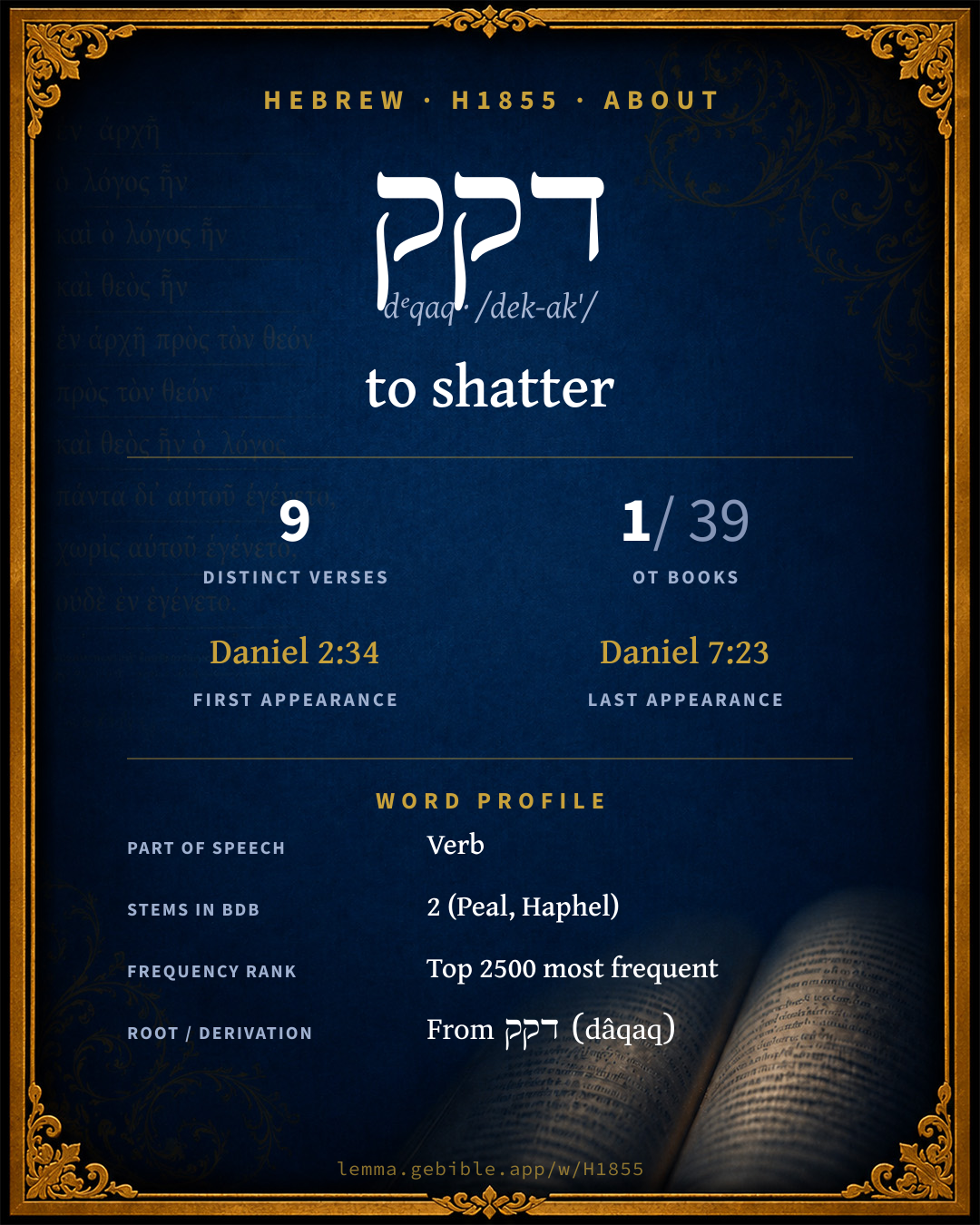
דְּקַק
to shatter
‘to shatter’ is one of 3 main senses fuller range ↓
Full lexicon entry — Brown-Driver-Briggs (BDB)
From Brown-Driver-Briggs (BDB)
Where this word appears
See every Hiphil verb in the Hebrew Bible →
Grammar key — what these labels mean
Part of speech
- Verb
- An action or state-of-being word.
Stem
- Hiphil
- The causative active stem (“he caused / brought about”).
- Qal
- The basic, simple active stem — the plain form of the verb (“he wrote”).
Form
- Perfect
- A completed action or state — Hebrew marks aspect (completeness) more than strict tense (“he wrote”).
- Imperfect
- An incomplete, ongoing, or future action (“he will / would write”).
- Participle Active
- A verbal adjective expressing ongoing or characteristic action (“writing / one who writes”).
State
- Absolute
- The independent form of a noun, not bound to a following word.
Person
- 3rd Person
- The one spoken about (“he / she / it / they”).
Gender
- Feminine
- Grammatically feminine.
- Masculine
- Grammatically masculine.
Number
- Singular
- One.
- Plural
- More than one (in Hebrew, generally three or more).
Grammatical forms
- Verb, Hiphil, Perfect, 3rd Person, Feminine, Singular 2 times (20%)
- Verb, Hiphil, Imperfect, 3rd Person, Feminine, Singular 2 times (20%)
- Verb, a, Participle Active, Feminine, Singular, Absolute 2 times (20%)
- Verb, a, Imperfect, 3rd Person, Feminine, Singular 1 time (10%)
- Verb, Hiphil, Perfect, 3rd Person, Masculine, Plural 1 time (10%)
- Verb, Hiphil, Participle Active, Masculine, Singular, Absolute 1 time (10%)
- Verb, Qal, Perfect, 3rd Person, Masculine, Plural 1 time (10%)
Parsed forms decoded from the imported morphology (morphhb / Westminster Leningrad Codex — WLC text public domain, morphhb tagging CC BY 4.0), counted across 10 parsed occurrences — not distinct verses.
Every verse where H1855 appears — 9 distinct verses across 1 book. Click any verse to open its interlinear word-by-word view. Verse text shown in the World English Bible for context — . Each verse’s Hebrew form is shown with its reference; the English is not keyword-highlighted, since the data carries no word-level English alignment. Use “Compare translations” on any verse to read it across multiple English versions. This concordance covers the Hebrew Bible; Septuagint (Greek Old Testament) occurrences are not indexed here.
Daniel 9 verses
- Daniel 2:34 וְ/הַדֵּ֖קֶת conj + Hiphil pf 3fs You saw until a stone was cut out without hands, which struck the image on its feet that were of iron and clay, and broke them in pieces.
- Daniel 2:35 דָּ֣קוּ Qal pf 3mp Then was the iron, the clay, the brass, the silver, and the gold, broken in pieces together, and became like the chaff of the summer threshing floors; and the wind carried them away, so that no place was found for them: and the stone that struck the image became a great mountain, and filled the whole earth.
- Daniel 2:40 מְהַדֵּ֤ק תַּדִּ֥ק Hiphil ptcp.act ms Hiphil impf 3fs The fourth kingdom shall be strong as iron, because iron breaks in pieces and subdues all things; and as iron that crushes all these, shall it break in pieces and crush.
- Daniel 2:44 תַּדִּ֤ק Hiphil impf 3fs In the days of those kings shall the God of heaven set up a kingdom which shall never be destroyed, nor shall the sovereignty of it be left to another people; but it shall break in pieces and consume all these kingdoms, and it shall stand forever.
- Daniel 2:45 וְ֠/הַדֶּקֶת conj + Hiphil pf 3fs Because you saw that a stone was cut out of the mountain without hands, and that it broke in pieces the iron, the brass, the clay, the silver, and the gold; the great God has made known to the king what shall happen hereafter: and the dream is certain, and the interpretation of it sure.
- Daniel 6:24 הַדִּֽקוּ Hiphil pf 3mp The king commanded, and they brought those men who had accused Daniel, and they cast them into the den of lions, them, their children, and their wives; and the lions had the mastery of them, and broke all their bones in pieces, before they came to the bottom of the den.
- Daniel 7:7 וּ/מַדֱּקָ֔ה conj + a ptcp.act fs After this I saw in the night-visions, and, behold, a fourth animal, awesome and powerful, and strong exceedingly; and it had great iron teeth; it devoured and broke in pieces, and stamped the residue with its feet: and it was diverse from all the animals that were before it; and it had ten horns.
- Daniel 7:19 מַדֲּקָ֔ה a ptcp.act fs Then I desired to know the truth concerning the fourth animal, which was diverse from all of them, exceedingly terrible, whose teeth were of iron, and its nails of brass; which devoured, broke in pieces, and stamped the residue with its feet;
- Daniel 7:23 וְ/תַדְּקִנַּֽ/הּ conj + a impf 3fs + sfx pers 3fs Thus he said, The fourth animal shall be a fourth kingdom on earth, which shall be diverse from all the kingdoms, and shall devour the whole earth, and shall tread it down, and break it in pieces.
About this entry
At a glance — auto-summarized from this page’s data, not written by a person. Every figure links to its source below. This summary describes the numbers; it doesn’t interpret them.
דקק — transliterated dᵉqaq — is a Hebrew verb carrying the sense “to shatter.” Its uses cluster heavily in Daniel (100% of all occurrences). With 9 verses in 1 book, it is an uncommon word in the Hebrew Bible. It first appears in Daniel 2:34. Across 2 stems, its meaning turns on the binyan (Peal, Haphel). Each statement above links to its evidence; the full detail follows below.
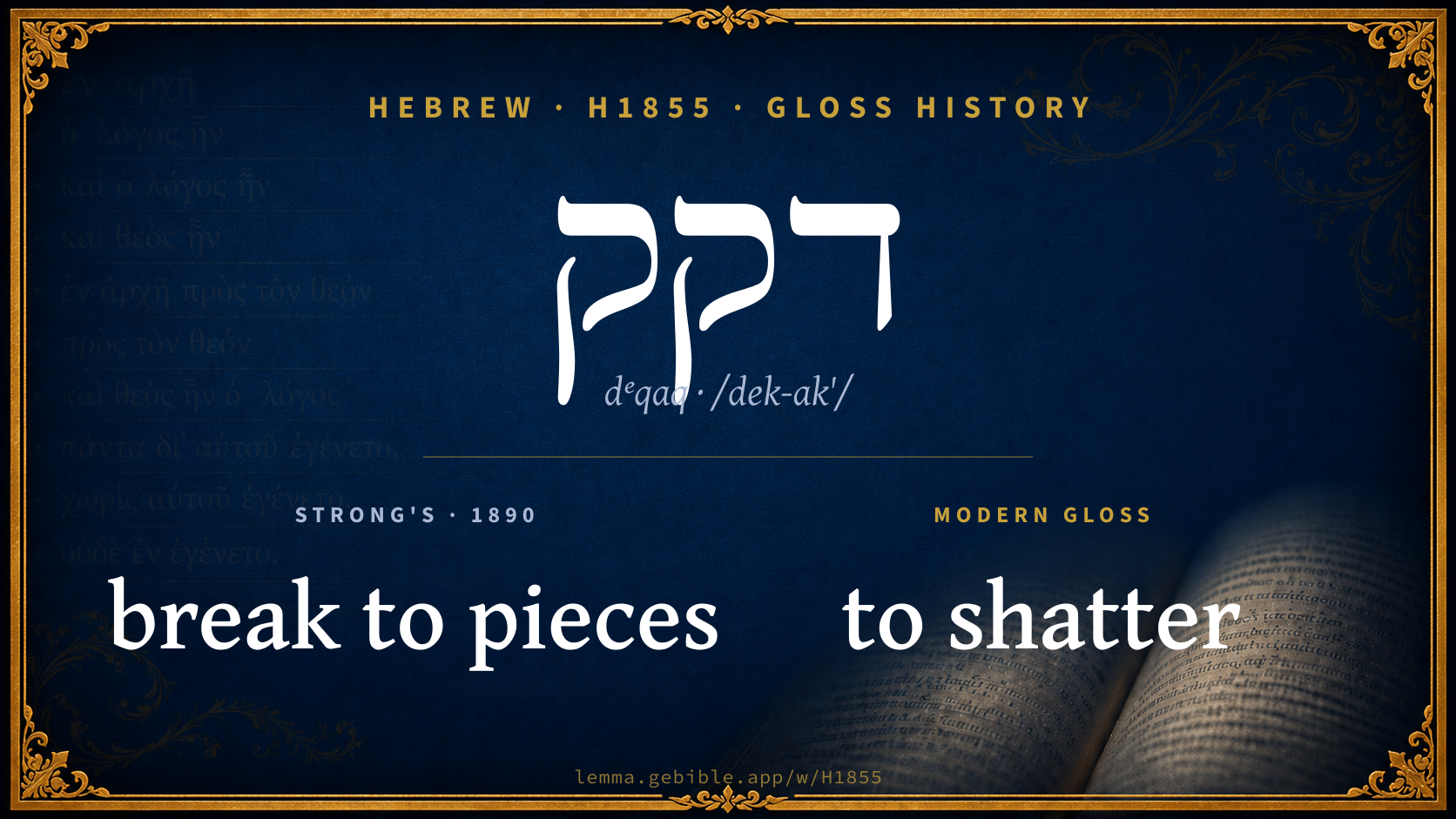
Gloss history
Strong's 1890 vs modern scholarship
About this word
Strong's H1855 catalogs a Hebrew word from the Hebrew Old Testament.
These counts are not copied from any lexicon or concordance. They are computed here, from the morphology-tagged Hebrew Old Testament. What Lemma adds →
- 9
- distinct verses
- The word appears in 9 distinct verses.
- 1 / 39
- OT books
- The word appears in 1 of 39 Old Testament books.
- #2,342
- by frequency
- Top 2500 most frequent Hebrew words (rank 2,342 of 8,640 Hebrew words by occurrence).
View all 9 occurrences in the concordance →
Most concentrated in
- Daniel 9 verses 100%
By section of the Old Testament
By traditional corpus
Conventional, traditional groupings — biblical authorship is debated, so this is a traditional corpus grouping, not an authorship claim. Each share is this word’s portion of its verses in that division of the Hebrew canon. Each figure is a share of the word’s 9 distinct verses.
- Writings (Ketuvim) 9 verses · 100%
How translations render this word
Counts come from each version’s own published word-to-Strong’s tagging or interlinear alignment — an approximate guide to how each version renders this word, not a word-level alignment the data otherwise carries. Because each total is that version’s own tagged count, the per-version totals vary from one another and need not match the appearance or distinct-verse counts above. These counts may also differ from a printed concordance because Lemma counts each distinctly tagged rendering and does not collapse phrase taggings into a single head-word total. This is a fixed set of word-tagged versions (KJV, ASV, BSB, ULT) and does not change with the reading translation you choose elsewhere. Each version’s license is shown beside its name below (and on Sources).
- King James Version: Brake in pieces 3×, Brake 2×, Pieces 2×
- American Standard Version: Brake in pieces 3×, Pieces 2×
- Berean Standard Bible: Crushed 3×, Will shatter 2×
- unfoldingWord Literal Text: Crushed 5×, Will crush 2×
King James Version Public Domain
Renders H1855 across 12 tagged occurrences — most commonly:
Plus 5 renderings that appear only once — usually multi-word phrases or single function words the recovered tagging swept in, not distinct renderings.
American Standard Version Public Domain
Renders H1855 across 12 tagged occurrences — most commonly:
Plus 7 renderings that appear only once — usually multi-word phrases or single function words the recovered tagging swept in, not distinct renderings.
Berean Standard Bible Public Domain
Renders H1855 across 10 tagged occurrences — most commonly:
Plus 5 renderings that appear only once — usually multi-word phrases or single function words the recovered tagging swept in, not distinct renderings.
unfoldingWord Literal Text CC BY-SA 4.0
Renders H1855 across 10 tagged occurrences — most commonly:
Plus 3 renderings that appear only once — usually multi-word phrases or single function words the recovered tagging swept in, not distinct renderings.
Senses in the full BDB
Hebrew verbs can shift meaning by stem (binyan): Qal is the basic action, Niphal is often passive or reflexive, Piel often intensifies or makes it factitive, and Hiphil is typically causative. The senses below are grouped under the stem BDB assigns to each. This entry also uses Peal (the basic Aramaic stem, parallel to Qal) and Haphel (the causative Aramaic stem, parallel to Hiphil).
What do BDB’s symbols mean?
BDB uses these scholarly abbreviations:
| Symbol | Meaning |
|---|---|
| 𝔊 | the Septuagint (the ancient Greek translation, LXX) |
| 𝔙 | the Vulgate (the Latin translation) |
| 𝔖 | the Syriac version (the Peshitta) |
| 𝔗 | the Targum (the Aramaic translation) |
| ψ | the Psalms |
| √ | root (the underlying root or stem) |
| ‖ | parallel passage (a synonymous or contrasted parallel) |
| † | the dagger: every passage where the word occurs is cited |
The 2 senses and sub-senses the full Brown-Driver-Briggs lexicon distinguishes for this word, in lexicon order (not ranked by frequency), with BDB’s own verbatim wording and sub-sense lettering. Shown in Hebrew script with BDB’s own scholarly abbreviations. The condensed entry is in the Lexicon Entry tab. See also the Forms in the corpus table below.
Senses from the full Brown-Driver-Briggs lexicon (Brown, Driver, Briggs; Oxford 1906 — public domain), digitized via Sefaria, supplemented by the OpenScriptures HebrewLexicon (CC BY 4.0). Full attribution on Sources.
Word origin
[ דְּקַק ] vb. be shattered, fall to pieces (BH)
— Brown-Driver-Briggs (Oxford 1906, public domain), digitized via Sefaria, supplemented by the OpenScriptures HebrewLexicon (CC BY 4.0). See Sources.
Derived from דקק (dâqaq) (H1854) — to crush.
Jastrow Dictionary
A second Hebrew/Aramaic lexicon for comparison, covering Aramaic and post-biblical (Talmudic, Targumic, Midrashic) usage that the biblical-Hebrew BDB does not. Matched by lemma rather than by Strong’s number, so a lemma may carry more than one Jastrow headword (shown separately below), and the entries cover usage well beyond the Bible.
דָּקַק
- to crush, pound, powder.—Denom. דַּק.—Pilp. דִּקְדֵּק q. v.
- 1. same. Kerith. 6ᵇ היטב הֵידֵק הֵידֵק היטב pounding well &c.; Y. Yoma IV, 41ᵈ bot. כשהיה מֵידַק היה אומר הָדֵק וכ׳ when the attendant pounded, the superintendent called, Pound well &c. [Sifré Deut. 207 להדוק פשתן, read להָדֵיק or לִסְרוֹק.]
- 2. to be fine, small. Part. מֵידַק, מֵדַק. Succ. IV, 9 (48ᵇ) one was wide (מעובה), ואחד מדק Ms. M. (ed. דק; Y. ed., Ms. M. 2, a. Mish. ed. Pes. מי׳; Mish. Nap. מוּדָק Hof.) and the other tube was narrow; Y. ib. 54ᵈ top (they thought) המ׳ של יין the narrow was for wine. Y. Yoma III, 41ᵃ; Y. Sot. II, 18ᵃ top מידק small and thin type of letters. Arakh. 25ᵃ מי׳ a sparsely sown field.
- to be crushed. Mekh. Bo. s. 13 נִידָּקוֹת; Pesik. R. s. 17 נִידֶּקֶת; Pesik. Vayhi, p. 64ᵇ נָדֶקֶת. [Zeb. 22ᵃ טיט הנדוק, read הנרוק, v. רָקַק.]
דְּקַק
- , v. דקיק.—Imperat. דּוֹק (v. דּוּק). Sabb. 152ᵃ ד׳ בככי וכ׳ grind with thy jaws (eat well), and thou wilt find (its effect) in marching.
- same. B. Kam. 101ᵃ ודַקִּינְהוּ and pounded them.—Part. pass. (מִדְקַק) מְדַקַּק. Targ. Is. XXX, 14 (h. text כָּתוּת).—Palp. דַּקְדֵּק q. v.
- same. Targ. II Kings XXIII, 15; Targ. II Chr. XXXIV, 4 אודיק.—Gen. R. s. 70 מְהַדֵּק, v. גַּרְמָא. Lam. R. introd. (R. Ḥǎnina 2) אכלה ומַדְּקָה (fr. Dan. VII, 7). [Targ. Y. II, Num. V, 19 הִדַּקִּי = הִזְדַּקִּי, v. זְקַק.] e.g. Daniel 7:7
A Dictionary of the Targumim, the Talmud Babli and Yerushalmi, and the Midrashic Literature (Marcus Jastrow; London, Luzac, 1903) — Public Domain. Digitized via Sefaria. Digitized via Sefaria. Full attribution on Sources.
Forms in the corpus
The 10 distinct written forms H1855 takes in the Hebrew Bible, most frequent first — each parse links to that stem’s occurrences in the concordance. Hebrew forms include their vowel points and cantillation, so a single lemma takes many written forms.
| Form | Parsing | Example | Uses |
|---|---|---|---|
| דָּ֣קוּ | Verb, Qal, Perfect, 3rd Person, Masculine, Plural | Daniel 2:35 | 1 |
| הַדִּֽקוּ | Verb, Hiphil, Perfect, 3rd Person, Masculine, Plural | Daniel 6:24 | 1 |
| וְ/הַדֵּ֖קֶת | Verb, Hiphil, Perfect, 3rd Person, Feminine, Singular | Daniel 2:34 | 1 |
| וְ/תַדְּקִנַּֽ/הּ | Verb, a, Imperfect, 3rd Person, Feminine, Singular | Daniel 7:23 | 1 |
| וְ֠/הַדֶּקֶת | Verb, Hiphil, Perfect, 3rd Person, Feminine, Singular | Daniel 2:45 | 1 |
| וּ/מַדֱּקָ֔ה | Verb, a, Participle Active, Feminine, Singular, Absolute | Daniel 7:7 | 1 |
| מְהַדֵּ֤ק | Verb, Hiphil, Participle Active, Masculine, Singular, Absolute | Daniel 2:40 | 1 |
| מַדֲּקָ֔ה | Verb, a, Participle Active, Feminine, Singular, Absolute | Daniel 7:19 | 1 |
| תַּדִּ֤ק | Verb, Hiphil, Imperfect, 3rd Person, Feminine, Singular | Daniel 2:44 | 1 |
| תַּדִּ֥ק | Verb, Hiphil, Imperfect, 3rd Person, Feminine, Singular | Daniel 2:40 | 1 |
Same root — word family
Other BDB entries built from the same root as H1855, grouped by Strong’s listed origin. These share a root / origin per the lexicon — not necessarily a shared meaning. Each links to that word’s own entry.
Derives from
Shares the same root
- דוק dûwq H1751 to be shattered, fall to pieces
- דק daq H1851 thin
- דק dôq H1852 veil
- הדך hâdak H1915 to tread down
Compare all same-root words → Showing 4 of 6 — not the complete family. They share a root, not necessarily a meaning.
Septuagint verse parallels
This word appears in 9 verses that also exist in the Greek Old Testament (Septuagint), out of the 9 Hebrew verses it occurs in. You can read those verses in Greek by switching the Old Testament edition to the Septuagint.
Read these verses in the Septuagint
This is a verse-level parallel only — the same verses exist in both the Hebrew and Greek Old Testaments. No word-level Hebrew↔Greek correspondence is claimed: the data carries no such alignment, so no Greek word is shown as this Hebrew word’s translation. Coverage is not total — the Septuagint omits the deuterocanon and renumbers the Psalms, so some Hebrew verses have no direct Greek parallel.