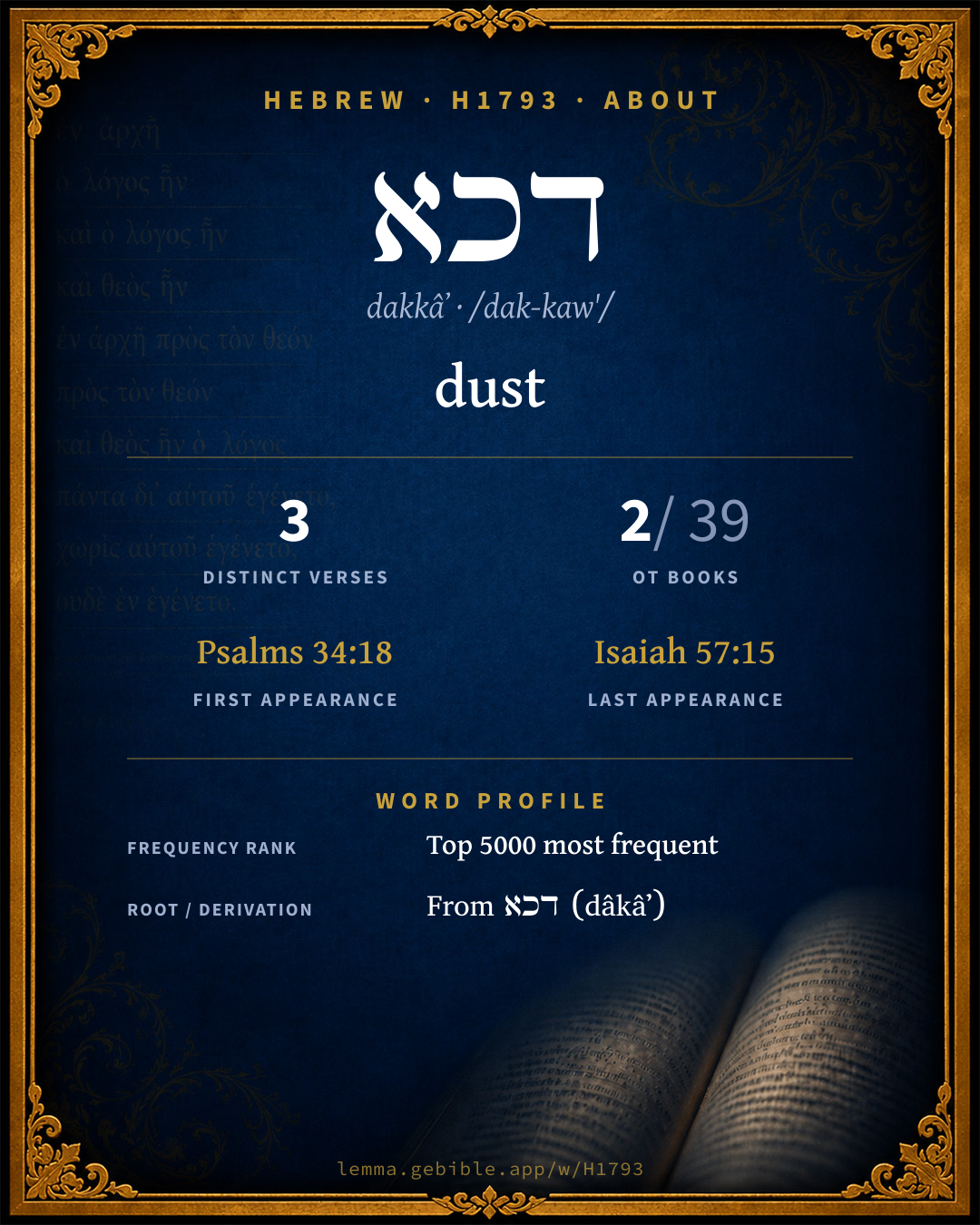
דַּכָּא
dust
‘dust’ is one of 2 main senses fuller range ↓
Full lexicon entry — Brown-Driver-Briggs (BDB)
From Brown-Driver-Briggs (BDB)
Where this word appears
See every Absolute-state word in the Hebrew Bible →
Grammar key — what these labels mean
Part of speech
- Adjective
- A word that describes or qualifies a noun.
- Noun
- A naming word — a person, place, thing, or idea.
Noun type
- Common
- A common noun — a general class of person, place, or thing (“king,” “city,” “water”), not a specific name.
State
- Construct
- A noun bound to a following noun in a possessive / “of” relationship (the construct chain).
- Absolute
- The independent form of a noun, not bound to a following word.
Gender
- Masculine
- Grammatically masculine.
Number
- Plural
- More than one (in Hebrew, generally three or more).
- Singular
- One.
1 verse where H1793 appears in the Absolute state in the Book of Psalms. Filtered view — show all forms. Click any verse to open its interlinear word-by-word view. Verse text shown in the World English Bible for context — . Each verse’s Hebrew form is shown with its reference; the English is not keyword-highlighted, since the data carries no word-level English alignment. Use “Compare translations” on any verse to read it across multiple English versions. This concordance covers the Hebrew Bible; Septuagint (Greek Old Testament) occurrences are not indexed here.
Psalms
About this entry
At a glance — auto-summarized from this page’s data, not written by a person. Every figure links to its source below. This summary describes the numbers; it doesn’t interpret them.
דכא (dakkâʼ) is a Hebrew word most often rendered “dust.” The Hebrew Bible uses it only 3 verses. It clusters heavily in Psalms, which alone accounts for 67% of its uses. It first appears in Psalms 34:18. Ranging over 2 senses, it is not a single-sense word. For the data behind this summary, explore the sense tree and the renderings breakdown below.
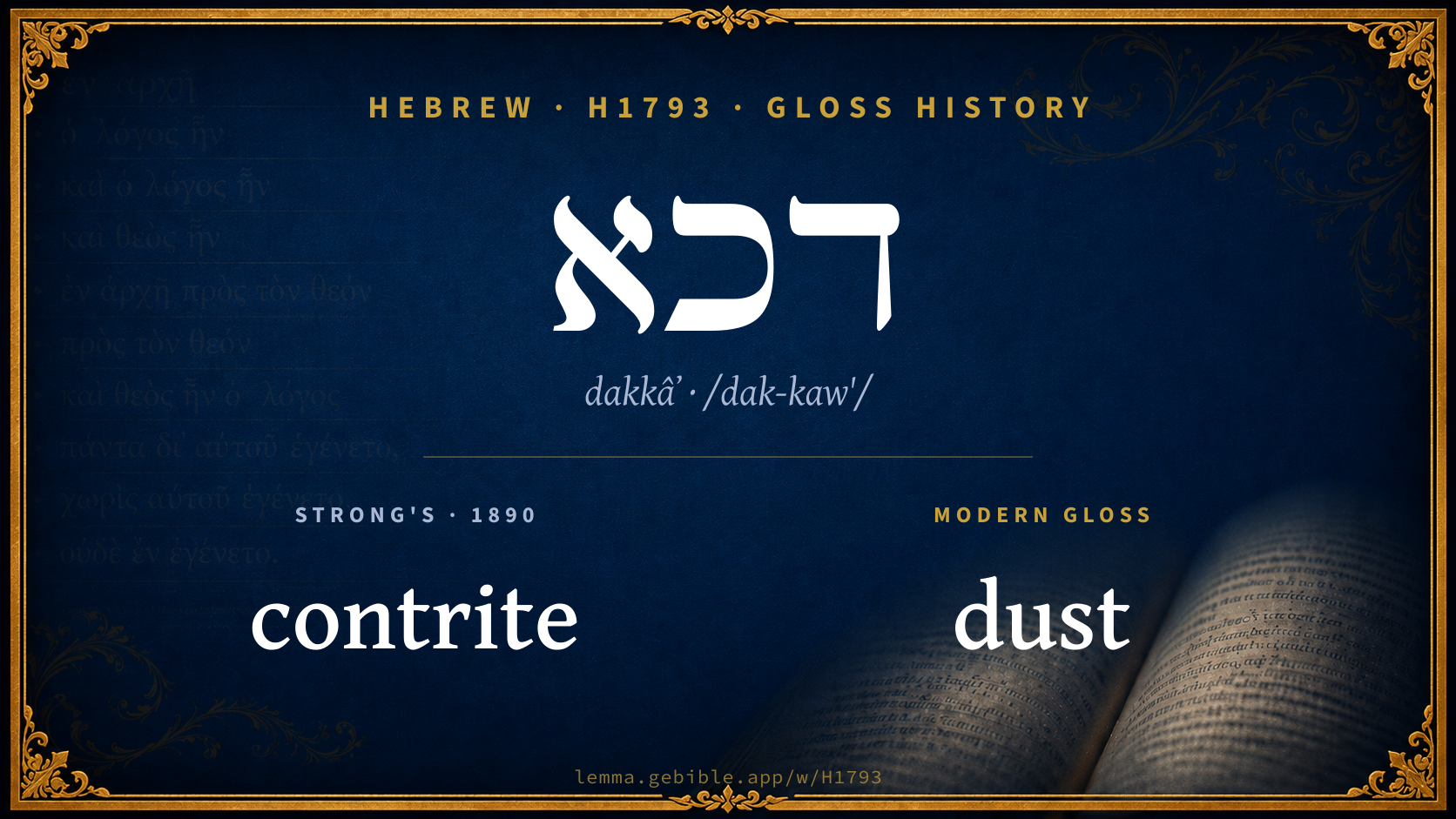
Gloss history
Strong's 1890 vs modern scholarship
About this word
Strong's H1793 catalogs a Hebrew word from the Hebrew Old Testament.
These counts are not copied from any lexicon or concordance. They are computed here, from the morphology-tagged Hebrew Old Testament. What Lemma adds →
- 3
- distinct verses
- The word appears in 3 distinct verses.
- 2 / 39
- OT books
- The word appears in 2 of 39 Old Testament books.
- #4,179
- by frequency
- Top 5000 most frequent Hebrew words (rank 4,179 of 8,640 Hebrew words by occurrence).
View all 3 occurrences in the concordance →
By traditional corpus
Conventional, traditional groupings — biblical authorship is debated, so this is a traditional corpus grouping, not an authorship claim. Each share is this word’s portion of its verses in that division of the Hebrew canon. Each figure is a share of the word’s 3 distinct verses.
- Writings (Ketuvim) 2 verses · 67%
- Prophets (Nevi'im) 1 verse · 33%
How translations render this word
Counts come from each version’s own published word-to-Strong’s tagging or interlinear alignment — an approximate guide to how each version renders this word, not a word-level alignment the data otherwise carries. Because each total is that version’s own tagged count, the per-version totals vary from one another and need not match the appearance or distinct-verse counts above. These counts may also differ from a printed concordance because Lemma counts each distinctly tagged rendering and does not collapse phrase taggings into a single head-word total. This is a fixed set of word-tagged versions (KJV, ASV, BSB, ULT) and does not change with the reading translation you choose elsewhere. Each version’s license is shown beside its name below (and on Sources).
BDB lists this Strong’s number as 2 distinct words (homographs). Each count above pools all of them and is not split by sense — see the Senses section below. A low-frequency rendering may belong to a different one of those words, not the primary meaning.
- King James Version†: Be of a contrite 1×, Destruction 1×, Place with him also that is of a contrite 1×
- American Standard Version†: Are of a contrite 1×, Destruction 1×, Place 1×
- Berean Standard Bible†: Contrite 1×, Dust 1×, Oppressed 1×
- unfoldingWord Literal Text†: Crushed 1×, Crushed of 1×, Dust 1×
King James Version Public Domain
Renders H1793 across 3† tagged occurrences — most commonly:
American Standard Version Public Domain
Renders H1793 across 3† tagged occurrences — most commonly:
Berean Standard Bible Public Domain
Renders H1793 across 3† tagged occurrences — most commonly:
unfoldingWord Literal Text CC BY-SA 4.0
Renders H1793 across 3† tagged occurrences — most commonly:
Senses in the full BDB
What do BDB’s symbols mean?
BDB uses these scholarly abbreviations:
| Symbol | Meaning |
|---|---|
| 𝔊 | the Septuagint (the ancient Greek translation, LXX) |
| 𝔙 | the Vulgate (the Latin translation) |
| 𝔖 | the Syriac version (the Peshitta) |
| 𝔗 | the Targum (the Aramaic translation) |
| ψ | the Psalms |
| √ | root (the underlying root or stem) |
| ‖ | parallel passage (a synonymous or contrasted parallel) |
| † | the dagger: every passage where the word occurs is cited |
The 0 senses and sub-senses the full Brown-Driver-Briggs lexicon distinguishes for this word, in lexicon order (not ranked by frequency), with BDB’s own verbatim wording and sub-sense lettering. Shown in Hebrew script with BDB’s own scholarly abbreviations. The condensed entry is in the Lexicon Entry tab. See also the Forms in the corpus table below.
דכא I contrite (crushed)
דכא II [m.] dust (as pulverized), תָּשֵׁב אֱנוֹשׁ עַד־דַּכָּא ψ 90
Senses from the full Brown-Driver-Briggs lexicon (Brown, Driver, Briggs; Oxford 1906 — public domain), digitized via Sefaria, supplemented by the OpenScriptures HebrewLexicon (CC BY 4.0). Full attribution on Sources.
Word origin
I. adj. contrite (crushed)—דַּכָּא Is 57:15; דַּכְּאֵי ψ 34:19—contrite Is 57:15 (‖ שְׁפַל־רוּהַ); ד׳ רוּחַ ψ 34:19 (‖ נִשְׁבְּרֵי־לֵב).
II. n.[m.] dust (as pulverized), תָּשֵׁב אֱנוֹשׁ עַד־דַּכָּא ψ 90:3 (on form cf. BaNB 143).
— Brown-Driver-Briggs (Oxford 1906, public domain), digitized via Sefaria, supplemented by the OpenScriptures HebrewLexicon (CC BY 4.0). See Sources.
Derived from דכא (dâkâʼ) (H1792) — to crush.
Jastrow Dictionary
A second Hebrew/Aramaic lexicon for comparison, covering Aramaic and post-biblical (Talmudic, Targumic, Midrashic) usage that the biblical-Hebrew BDB does not. Matched by lemma rather than by Strong’s number, so a lemma may carry more than one Jastrow headword (shown separately below), and the entries cover usage well beyond the Bible.
דָּכָא
- , Pi. דִּכֵּא (b. h.; v. preced.) to crush, humble. Midr. Till. to Ps. XCIII, 3 (play on דכים ib.) אני מְדַכְּאָן וכ׳ I will crush them (the Philistines) by means of severe afflictions. Ib. וִידַּכְּאוּ ישראל וכ׳ and crush Israel by means of persecutions; a. e.—Part. pass. מְדוּכָּא, pl. מְדוּכָּאִין. Keth. 8ᵇ
דְּכָא
- , v. דְּכִי
דְּכִי
- (= h. זָכָה) [to be clear (cmp. דְּכַךְ),]
- 1. to be clean, pure; to be cleared, acquitted, cleansed from sin. Targ. Lev. XII, 7 ותִדְכֵּי O. ed. Berl. (ed. ותַ׳ incorr., Y. ותִדְכֵי). Ib. XVI, 30 תִּדְכּוֹן O. (Y. תֵּידְכוּן). Targ. Ezek. XXIV, 13 תִדְכִּין (Nun emphat.; ed. Lag. תדכן); a. fr.
- 2. to be deserving, privileged, admitted (cmp. זכי). Targ. O. Deut. XXIII, 2 sq.—Targ. Ruth II, 10. Ib. 13 מִדְכֵי (sub. למיעל).—Lev. R. s. 34 [read:] זכי בי או דכי בי, v. זְכֵי.—Part. דָּכֵי, f. דַּכְיָא. Targ. Is. LXV, 5 דְּכֵינָא וכ׳ I am purer than &c., v. דְּכֵי. [Targ. Prov. VI, 11, v. דְּרַךְ.]
- to clear, purify; to restore to levitical cleanness, to cleanse. Targ. Ezek. XXIV, 13. Targ. Lev. XVI, 30; a. fr.—Gen. R. s. 79 לית אנן מְדַכָּן יתה וכ׳ should we not restore it (Tiberias) to levitical cleanness from the slain (buried there)?; Yalk. ib. 133 מְדַכְּיָין. Gen. R. l. c. [read:] צרוכין אנו מְדַכְּיָהּ לטבריא we must cleanse Tiberias (Pesik. B’shall. p. 89ᵇ למזכייה); Koh. R. to X, 8.—Ib. דדַכְּיֵיה which he had declared clean. Y. Shebi. IX, 38ᵈ מְדַכֵּי טיבריא.—Nidd. 6ᵇ מְדַכָּן וכ׳ observe the same levitical cleanness as required for Temple offerings, v. חַבְרָא.
- 1. to became clean, be cleansed (from sin), be purified. Targ. II Sam. XI, 4. Targ. Lev. XIV, 4 לִדְמִדַּכֵּי ed. Berl. (Var. לַמִּידַּכֵּי; Y. לִדְמִדְכֵּי); ib. 7; a. fr.
- 2. to be cleared away, be removed, be gone. Ber. 2ᵇ אִדַּכֵּי יומא the day is past; v. טְהֵר.
- to polish; trnsf. to train. Targ. Prov. XXII, 6 אדכא ed. Lag. (Ms. אדכיח, read אַדְכֵיה; some ed. אַדְרְכָא; h. text חנך).
כָּא
- (b. h. כֹּה, v. preced.) adverb of place: here, v. הָכָא; of time: now. Targ. Gen. XXII, 5. Targ. Job XXXVIII, 11; a. fr.—Y. Ber. IV, 7ᶜ top וכא אמר הכין and here he says so? Ib. וכה; a. v. fr.—לְכָא hither; מִיכָּא from here. Targ. Josh. VIII, 20. Targ. Ex. XVII, 12; a. fr.—Y. Bets. V, 63ᵃ פצל … לכא ולכא skimmed the water in both directions. Y. B. Mets. VI, 11ᵃ top מיכא ללוד from here to Lydda; a. fr.—v. אִיכָּא, לִיכָּא &c.; כַּאַן, כַּן &c.
A Dictionary of the Targumim, the Talmud Babli and Yerushalmi, and the Midrashic Literature (Marcus Jastrow; London, Luzac, 1903) — Public Domain. Digitized via Sefaria. Digitized via Sefaria. Full attribution on Sources.
Forms in the corpus
The 3 distinct written forms H1793 takes in the Hebrew Bible, most frequent first — each parse links to that state’s occurrences in the concordance. Hebrew forms include their vowel points and cantillation, so a single lemma takes many written forms.
| Form | Parsing | Example | Uses |
|---|---|---|---|
| דַּכְּאֵי | Adjective, Adjective, Masculine, Plural, Construct | Psalms 34:18 | 1 |
| דַּכָּ֑א | Noun, Common, Masculine, Singular, Absolute | Psalms 90:3 | 1 |
| דַּכָּא֙ | Adjective, Adjective, Masculine, Singular, Absolute | Isaiah 57:15 | 1 |
Septuagint verse parallels
This word appears in 3 verses that also exist in the Greek Old Testament (Septuagint), out of the 3 Hebrew verses it occurs in. You can read those verses in Greek by switching the Old Testament edition to the Septuagint.
Read these verses in the Septuagint
This is a verse-level parallel only — the same verses exist in both the Hebrew and Greek Old Testaments. No word-level Hebrew↔Greek correspondence is claimed: the data carries no such alignment, so no Greek word is shown as this Hebrew word’s translation. Coverage is not total — the Septuagint omits the deuterocanon and renumbers the Psalms, so some Hebrew verses have no direct Greek parallel.