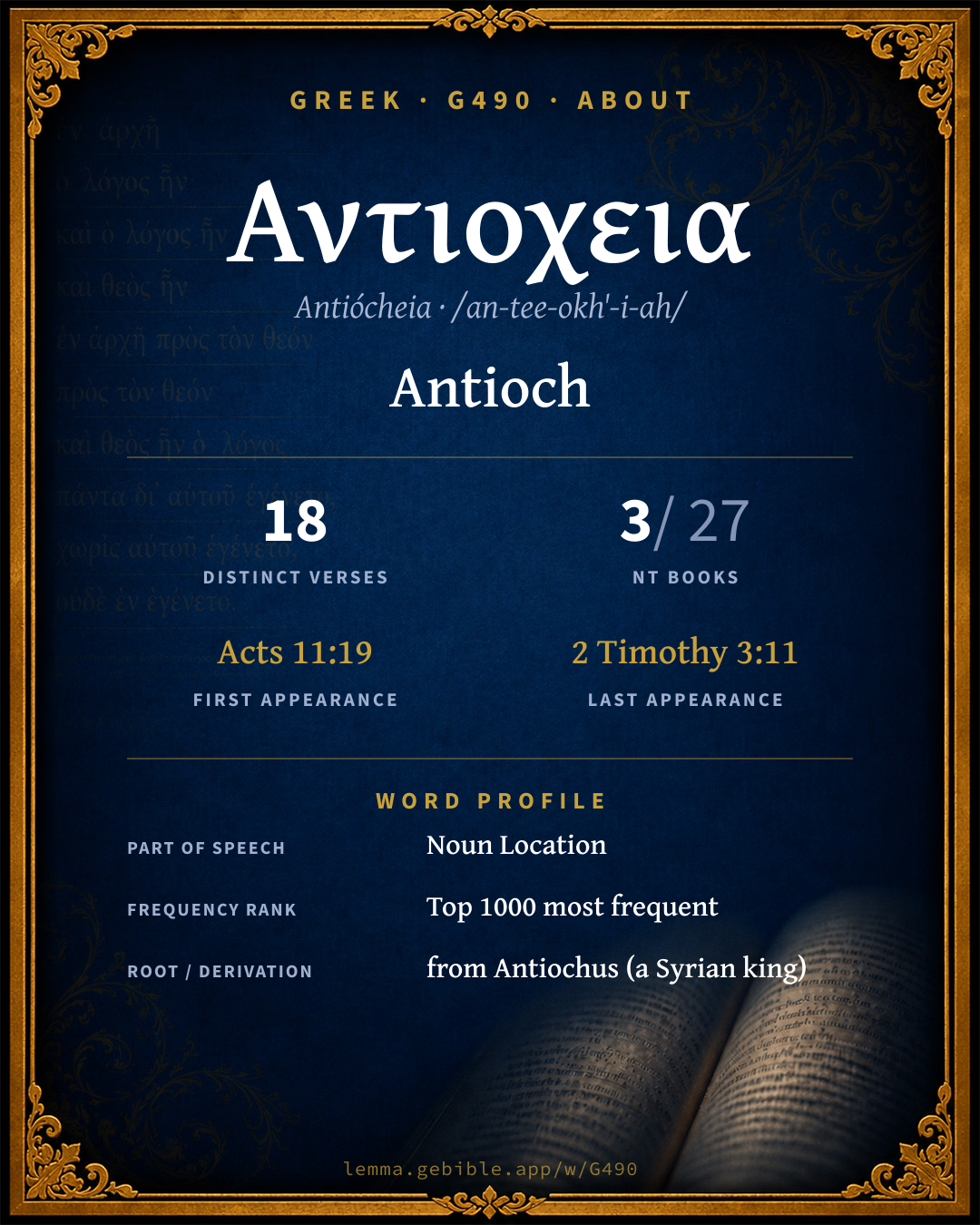
Ἀντιόχεια
Antioch
Thayer's lists 3 entries for ‘Antioch’ fuller range ↓
Full lexicon entry — Thayer's Greek Lexicon
From Thayer's Greek Lexicon
Where this word appears
See every Accusative-case word in the Greek New Testament →
Grammar key — what these labels mean
Part of speech
- Noun
- A naming word — a person, place, thing, or idea.
Case
- Accusative
- The case of the direct object and of extent.
- Dative
- The case of the indirect object, means, or location — “to / for / with / in.”
- Genitive
- The case of source, possession, or “of” — answers “whose / from what.”
Gender
- Feminine
- Grammatically feminine.
Number
- Singular
- One.
3 verses where G490 appears in the Dative case in the Book of Acts. Filtered view — show all forms. Click any verse to open its interlinear word-by-word view. Verse text shown in the World English Bible for context — . Each verse’s Greek form is shown with its reference; the English is not keyword-highlighted, since the data carries no word-level English alignment. Use “Compare translations” on any verse to read it across multiple English versions. This concordance covers the Greek New Testament; Septuagint (Greek Old Testament) occurrences of this word are not indexed here.
Acts
- Acts 11:26 Ἀντιοχείᾳ n dat sg fem When he had found him, he brought him to Antioch. It happened, that for a whole year they were gathered together with the assembly, and taught many people. The disciples were first called Christians in Antioch.
- Acts 13:1 Ἀντιοχείᾳ n dat sg fem Now in the assembly that was at Antioch there were some prophets and teachers: Barnabas, Simeon who was called Niger, Lucius of Cyrene, Manaen the foster-brother of Herod the tetrarch, and Saul.
- Acts 15:35 Ἀντιοχείᾳ n dat sg fem But Paul and Barnabas stayed in Antioch, teaching and preaching the word of the Lord, with many others also.
About this entry
At a glance — auto-summarized from this page’s data, not written by a person. Every figure links to its source below. This summary describes the numbers; it doesn’t interpret them.
“Antioch” is the headline sense of the Greek name Αντιοχεια (Antiócheia). More than three-quarters of its appearances fall in Acts. It appears 18 verses across 3 books of the Greek New Testament, among its uncommon vocabulary. Scripture first uses it in Acts 11:19. Each statement above links to its evidence; the full detail follows below.
Gloss history
Strong's 1890 vs modern scholarship
About this word
Strong's G490 catalogs a Greek word from the Greek New Testament.
These counts are not copied from any lexicon or concordance. They are computed here, from the morphology-tagged Greek New Testament. What Lemma adds →
- 18
- distinct verses
- The word appears in 18 distinct verses.
- 3 / 27
- NT books
- The word appears in 3 of 27 New Testament books.
- #664
- by frequency
- Top 1000 most frequent Greek words (rank 664 of 5,347 Greek words by occurrence).
View all 18 occurrences in the concordance →
By section of the New Testament
By traditional corpus
Conventional, traditional groupings — biblical authorship is debated, so this is a traditional corpus grouping, not an authorship claim. Some books belong to more than one corpus (Luke is in both the Gospels and the Lukan corpus, and so on), so these shares overlap and need not total 100%. Each figure is a share of the word’s 18 distinct verses.
- Lukan (Luke–Acts) 16 verses · 89%
- Pauline corpus 2 verses · 11%
How translations render this word
Counts come from each version’s own published word-to-Strong’s tagging or interlinear alignment — an approximate guide to how each version renders this word, not a word-level alignment the data otherwise carries. Because each total is that version’s own tagged count, the per-version totals vary from one another and need not match the appearance or distinct-verse counts above. These counts may also differ from a printed concordance because Lemma counts each distinctly tagged rendering and does not collapse phrase taggings into a single head-word total. This is a fixed set of word-tagged versions (KJV, ASV, BSB, ULT) and does not change with the reading translation you choose elsewhere. Each version’s license is shown beside its name below (and on Sources).
- King James Version: Antioch 18×
- American Standard Version: Antioch 18×
- Berean Standard Bible: Antioch 18×
- unfoldingWord Literal Text: Antioch 18×
King James Version Public Domain
Renders G490 across 18 tagged occurrences — most commonly:
American Standard Version Public Domain
Renders G490 across 18 tagged occurrences — most commonly:
Berean Standard Bible Public Domain
Renders G490 across 18 tagged occurrences — most commonly:
unfoldingWord Literal Text CC BY-SA 4.0
Renders G490 across 18 tagged occurrences — most commonly:
Senses in Thayer's
The 3 senses Thayer's distinguishes for this word, in lexicon order (not ranked by frequency or importance). The full entry — with sub-senses — is in the Lexicon Entry tab.
- Antioch = 'driven against"
- Capital of Syria…
- A city in Pisidia on the borders Phrygia…
Word origin
Origin: from Antiochus (a Syrian king)
From Ἀντίοχος Antiochos (a Syrian king); Antiochia a place in Syria : - Antioch.
— Strong’s Exhaustive Concordance (1890), public domain.
Forms in the corpus
The 3 distinct written forms G490 takes in the Greek New Testament, most frequent first — each parse links to that case’s occurrences in the concordance.
| Form | Parsing | Example | Uses |
|---|---|---|---|
| Ἀντιόχειαν Antiócheian | Noun, Accusative, Singular, Feminine | Acts 11:20 | 11 |
| Ἀντιοχείᾳ Antiocheía | Noun, Dative, Singular, Feminine | Acts 11:26 | 4 |
| Ἀντιοχείας Antiocheías | Noun, Genitive, Singular, Feminine | Acts 11:19 | 3 |
Same root — word family
Other Thayer's entries built from the same root as G490, grouped by Strong’s listed origin. These share a root / origin per the lexicon — not necessarily a shared meaning. Each links to that word’s own entry.
Proper names from this root
People and places named from this root — a name, not an additional meaning of the word.
Compare all same-root words → 1 of the same-root words is a proper name (a person or place). They share a root, not necessarily a meaning.
Bible dictionary
Public-domain dictionary articles matched to this entry by name (Antioch). A biblical name can be shared by more than one person or place, so an article may treat several.
Easton's Bible Dictionary · M. G. Easton, 1897
(1.) In Syria, on the river Orontes, about 16 miles from the Mediterranean, and some 300 miles north of Jerusalem. It was the metropolis of Syria, and afterwards became the capital of the Roman province in Asia. It ranked third, after Rome and Alexandria, in point of importance, of the cities of the Roman empire. It was called the "first city of the East." Christianity was early introduced into it (Acts 11:19, 21, 24), and the name "Christian" was first applied here to its professors (Acts 11:26). It is intimately connected with the early history of the gospel (Acts 6:5; 11:19, 27, 28, 30; 12:25; 15:22-35; Gal. 2:11, 12). It was the great central point whence missionaries to the Gentiles were sent forth. It was the birth-place of the famous Christian father Chrysostom, who died A.D. 407. It bears the modern name of Antakia, and is now a miserable, decaying Turkish town. Like Philippi, it was raised to the rank of a Roman colony. Such colonies were ruled by "praetors" (R.V. marg., Acts 16:20, 21).
(2.) In the extreme north of Pisidia; was visited by Paul and Barnabas on the first missionary journey (Acts 13:14). Here they found a synagogue and many proselytes. They met with great success in preaching the gospel, but the Jews stirred up a violent opposition against them, and they were obliged to leave the place. On his return, Paul again visited Antioch for the purpose of confirming the disciples (Acts 14:21). It has been identified with the modern Yalobatch, lying to the east of Ephesus.
Smith's Bible Dictionary · William Smith, 1863
(from Antiochus)-
+ IN Syria. The capital of the Greek kings of Syria, and afterwards the residence of the Roman governors of the province which bore the same name. Situation .--This metropolis was situated where the chain of Lebanon, running northward, and the chain of Taurus, running eastward. are brought to an abrupt meeting. Here the Orontes breaks through the mountains; and Antioch was placed at a bend of the river, 16 1/2 miles from the Mediterranean, partly on an island, partly on the levee which forms the left bank, and partly on the steep and craggy ascent of Mount Silpius, which, rose abruptly on the south. It is about 300 miles north of Jerusalem. In the immediate neighborhood was Daphne the celebrated sanctuary of Apollo 2 Macc. 4:33; whence the city was sometimes called Antioch by Daphne, to distinguish it from other cities of the same name. Destruction .--The city was founded in the year 300 B.C., by Seleucus Nicator. It grew under the successive Seleucid kings till it became a city of great extent and of remarkable beauty. One feature, which seems to have been characteristic of the great Syrian cities,--a vast street with colonnades, intersecting the whole from end to end,--was added by Antiochus Epiphanes. By Pompey it was made a free city, and such it continued till the time of Antoninus Pius. The early emperors raised there some large and important structures, such as aqueducts, amphitheatres and baths. (Antioch, in Paul's time, was the third city of the Roman empire, and contained over 200,000 inhabitants. Now it is a small, mean place of about 6000.--ED.) Bible History .--No city, after Jerusalem, is so intimately connected with the history of the apostolic church. Jews were settled there from the first in large numbers, were governed by their own ethnarch, and allowed to have the same political privileges with the Greeks. The chief interest of Antioch, however, is connected with the progress of Christianity among the heathen, Here the first Gentile church was founded, (Acts 11:20,21) here the disciples of Jesus Christ were first called Christians (Acts 11:26) It was from Antioch that St. Paul started on his three missionary journeys. + IN Pisidia, (Acts 13:14; 14:19,21; 2 Timothy 3:11) on the borders of Phrygia, corresponds to Yalobatch, which is distant from Aksher six hours over the mountains. This city, like the Syrian Antioch, was founded by Seleucus Nicator. Under the Romans it became a colonia, and was also called Caesarea.
Hitchcock's Bible Names Dictionary · Roswell D. Hitchcock, 1869
speedy as a chariot
Classic public-domain reference works; full attribution on Sources.