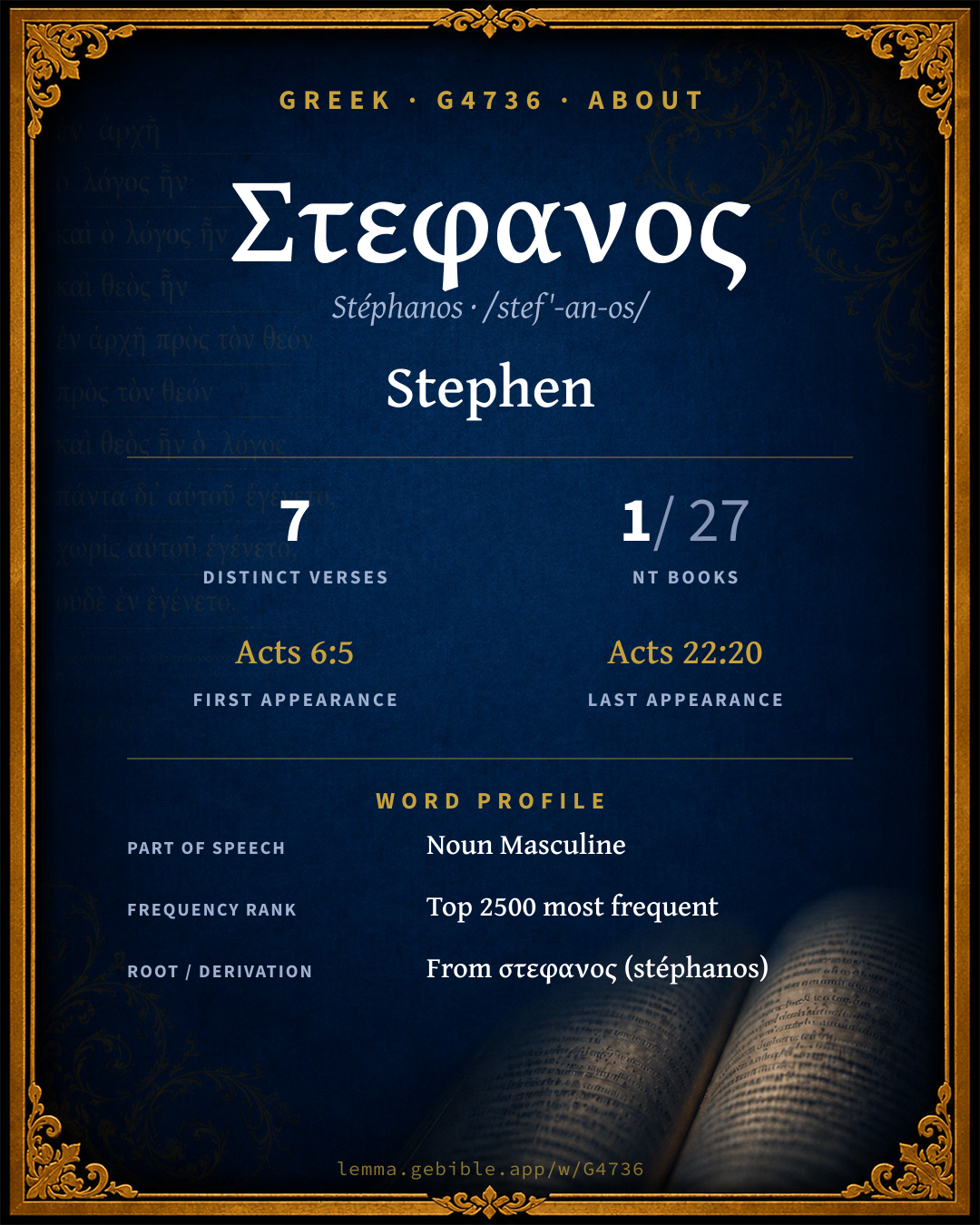
Στέφανος
Stephen
Thayer's lists 2 entries for ‘Stephen’ fuller range ↓
Full lexicon entry — Thayer's Greek Lexicon
From Thayer's Greek Lexicon
Where this word appears
See every Accusative-case word in the Greek New Testament →
Grammar key — what these labels mean
Part of speech
- Noun
- A naming word — a person, place, thing, or idea.
Case
- Accusative
- The case of the direct object and of extent.
- Dative
- The case of the indirect object, means, or location — “to / for / with / in.”
- Genitive
- The case of source, possession, or “of” — answers “whose / from what.”
- Nominative
- The case of the subject (and the predicate nominative).
Gender
- Masculine
- Grammatically masculine.
Number
- Singular
- One.
Grammatical forms
- Noun, Accusative, Singular, Masculine 3 times (43%)
- Noun, Dative, Singular, Masculine 2 times (29%)
- Noun, Genitive, Singular, Masculine 1 time (14%)
- Noun, Nominative, Singular, Masculine 1 time (14%)
Parsed forms decoded from the imported morphology (Robinson–Tischendorf, public domain), counted across 7 parsed occurrences — not distinct verses.
Every verse where G4736 appears — 7 distinct verses across 1 book. Click any verse to open its interlinear word-by-word view. Verse text shown in the World English Bible for context — . Each verse’s Greek form is shown with its reference; the English is not keyword-highlighted, since the data carries no word-level English alignment. Use “Compare translations” on any verse to read it across multiple English versions. This concordance covers the Greek New Testament; Septuagint (Greek Old Testament) occurrences of this word are not indexed here.
Acts 7 verses
- Acts 6:5 Στέφανον n acc sg masc These words pleased the whole multitude. They chose Stephen, a man full of faith and of the Holy Spirit, Philip, Prochorus, Nicanor, Timon, Parmenas, and Nicolaus, a proselyte of Antioch;
- Acts 6:8 Στέφανος n nom sg masc Stephen, full of faith and power, performed great wonders and signs among the people.
- Acts 6:9 Στεφάνῳ n dat sg masc But some of those who were of the synagogue called "The Libertines," and of the Cyrenians, of the Alexandrians, and of those of Cilicia and Asia arose, disputing with Stephen.
- Acts 7:59 Στέφανον n acc sg masc They stoned Stephen as he called out, saying, "Lord Jesus, receive my Spirit!"
- Acts 8:2 Στέφανον n acc sg masc Devout men buried Stephen, and lamented greatly over him.
- Acts 11:19 Στεφάνῳ n dat sg masc They therefore who were scattered abroad by the oppression that arose about Stephen traveled as far as Phoenicia, Cyprus, and Antioch, speaking the word to no one except to Jews only.
- Acts 22:20 Στεφάνου n gen sg masc When the blood of Stephen, your witness, was shed, I also was standing by, and consenting to his death, and guarding the cloaks of those who killed him.'
About this entry
At a glance — auto-summarized from this page’s data, not written by a person. Every figure links to its source below. This summary describes the numbers; it doesn’t interpret them.
The Greek name Στεφανος centers on the idea of “Stephen.” The word gravitates to Acts (100%). It appears 7 verses across 1 book of the Greek New Testament, among its uncommon vocabulary. Debuting at Acts 6:5, it then recurs through the corpus. Dig into 7-verse concordance and the renderings breakdown below.
Gloss history
Strong's 1890 vs modern scholarship
About this word
Strong's G4736 catalogs a Greek word from the Greek New Testament.
These counts are not copied from any lexicon or concordance. They are computed here, from the morphology-tagged Greek New Testament. What Lemma adds →
- 7
- distinct verses
- The word appears in 7 distinct verses.
- 1 / 27
- NT books
- The word appears in 1 of 27 New Testament books.
- #1,358
- by frequency
- Top 2500 most frequent Greek words (rank 1,358 of 5,347 Greek words by occurrence).
View all 7 occurrences in the concordance →
Most concentrated in
- Acts 7 verses 100%
By section of the New Testament
By traditional corpus
Conventional, traditional groupings — biblical authorship is debated, so this is a traditional corpus grouping, not an authorship claim. Some books belong to more than one corpus (Luke is in both the Gospels and the Lukan corpus, and so on), so these shares overlap and need not total 100%. Each figure is a share of the word’s 7 distinct verses.
- Lukan (Luke–Acts) 7 verses · 100%
How translations render this word
Counts come from each version’s own published word-to-Strong’s tagging or interlinear alignment — an approximate guide to how each version renders this word, not a word-level alignment the data otherwise carries. Because each total is that version’s own tagged count, the per-version totals vary from one another and need not match the appearance or distinct-verse counts above. These counts may also differ from a printed concordance because Lemma counts each distinctly tagged rendering and does not collapse phrase taggings into a single head-word total. This is a fixed set of word-tagged versions (KJV, ASV, BSB, ULT) and does not change with the reading translation you choose elsewhere. Each version’s license is shown beside its name below (and on Sources).
- King James Version: Stephen 7×
- American Standard Version: Stephen 7×
- Berean Standard Bible: Stephen 7×
- unfoldingWord Literal Text: Stephen 7×
King James Version Public Domain
Renders G4736 across 7 tagged occurrences — most commonly:
American Standard Version Public Domain
Renders G4736 across 7 tagged occurrences — most commonly:
Berean Standard Bible Public Domain
Renders G4736 across 7 tagged occurrences — most commonly:
unfoldingWord Literal Text CC BY-SA 4.0
Renders G4736 across 7 tagged occurrences — most commonly:
Senses in Thayer's
The 2 senses Thayer's distinguishes for this word, in lexicon order (not ranked by frequency or importance). The full entry — with sub-senses — is in the Lexicon Entry tab.
- Stephen = "crowned"
- one of the seven deacons in Jerusalem and the first Christian martyr
Word origin
Derived from στεφανος (stéphanos) (G4735) — crown.
the same as G4735 ; Stephanus a Christian : - Stephen.
— Strong’s Exhaustive Concordance (1890), public domain.
Forms in the corpus
The 4 distinct written forms G4736 takes in the Greek New Testament, most frequent first — each parse links to that case’s occurrences in the concordance.
| Form | Parsing | Example | Uses |
|---|---|---|---|
| Στέφανον Stéphanon | Noun, Accusative, Singular, Masculine | Acts 6:5 | 3 |
| Στεφάνῳ Stephánō | Noun, Dative, Singular, Masculine | Acts 6:9 | 2 |
| Στέφανος Stéphanos | Noun, Nominative, Singular, Masculine | Acts 6:8 | 1 |
| Στεφάνου Stephánou | Noun, Genitive, Singular, Masculine | Acts 22:20 | 1 |
Same root — word family
Other Thayer's entries built from the same root as G4736, grouped by Strong’s listed origin. These share a root / origin per the lexicon — not necessarily a shared meaning. Each links to that word’s own entry.
Derives from
Shares the same root
Compare all same-root words → Showing 4 of 5 — not the complete family. They share a root, not necessarily a meaning.
Bible dictionary
Public-domain dictionary articles matched to this entry by name (Stephen). A biblical name can be shared by more than one person or place, so an article may treat several.
Easton's Bible Dictionary · M. G. Easton, 1897
One of the seven deacons, who became a preacher of the gospel. He was the first Christian martyr. His personal character and history are recorded in Acts 6. "He fell asleep" with a prayer for his persecutors on his lips (7:60). Devout men carried him to his grave (8:2).
It was at the feet of the young Pharisee, Saul of Tarsus, that those who stoned him laid their clothes (comp. Deut. 17:5-7) before they began their cruel work. The scene which Saul then witnessed and the words he heard appear to have made a deep and lasting impression on his mind (Acts 22:19, 20).
The speech of Stephen before the Jewish ruler is the first apology for the universalism of the gospel as a message to the Gentiles as well as the Jews. It is the longest speech contained in the Acts, a place of prominence being given to it as a defence.
Smith's Bible Dictionary · William Smith, 1863
the first Christian martyr, was the chief of the seven (commonly called Deacons) appointed to rectify the complaints in the early Church of Jerusalem, made by the Hellenistic against the hebrew Christians. His Greek name indicates his own Hellenistic origin. His importance is stamped on the narrative by a reiteration of emphatic, almost superlative, phrases: "full of faith and of the Holy Ghost," (Acts 6:5) "full of grace and power," ibid. (Acts 6:8) irresistible "spirit and wisdom," ibid (Acts 6:10) "full of the Holy Ghost." (Acts 7:55) He shot far ahead of his six companions, and far above his particular office. First, he arrests attention by the "great wonders and miracles that he did." Then begins a series of disputations with the Hellenistic Jews of north Africa, Alexandria and Asia Minor, his companions in race and birthplace. The subject of these disputations is not expressly mentioned; but from what follows it is obvious that he struck into a new vein of teaching, which evidently caused his martyrdom. Down to this time the apostles and the early Christian community had clung in their worship, not merely to the holy land and the holy city but to the holy place of the temple. This local worship, with the Jewish customs belonging to it, Stephen denounced. So we must infer from the accusations brought against him confirmed as they are by the tenor of his defence. He was arrested at the instigation of the Hellenistic Jews, and brought before the Sanhedrin. His speech in his defence, and his execution by stoning outside the gates of Jerusalem, are related at length in Acts 7. The frame work in which his defence is cast is a summary of the history of the Jewish Church. In the facts which he selects from his history he is guided by two principles. The first is the endeavor to prove that, even in the previous Jewish history, the presence and favor of God had not been confined to the holy land or the temple of Jerusalem. The second principle of selection is based on the at tempt to show that there was a tendency from the earliest times toward the same ungrateful and narrow spirit that had appeared in this last stage of their political existence. It would seem that, just at the close of his argument, Stephen saw a change in the aspect of his judges, as if for the first time they had caught the drift of his meaning. He broke off from his calm address, and tumult suddenly upon them in an impassioned attack, which shows that he saw what was in store for him. As he spoke they showed by their faces that their hearts "were being sawn asunder," and they kept gnashing their set teeth against him; but still, though with difficultly, restraining themselves. He, in this last crisis of his fate, turned his face upward to the; open sky, and as he gazed the vault of heaven seemed to him to part asunder; and the divine Glory appeared through the rending of the earthly veil--the divine Presence, seated on a throne, and on the right hand the human form of Jesus. Stephen spoke as if to himself, describing the glorious vision; and in so doing, alone of all the speakers and writers in the New Testament except, only Christ himself, uses the expressive phrase "the Son of man." As his judges heard the words, they would listen no longer. They broke into, a loud yell; they clapped their hands to their ears; they flew as with one impulse upon him, and dragged him out of the city to the place of execution. Those who took the lead in the execution were the persons wile had taken upon themselves the responsibility of denouncing him. (17:7) comp. John 8:7 In this instance they were the witnesses who had reported or misreported the words of Stephen. They, according to the custom, stripped themselves; and one, of the prominent leaders in the transaction was deputed by custom to signify his assent to the act by taking the clothes into his custody and standing over them while the bloody work went on. The person was officiated on this occasion was a young man from Tarsus, the future apostle of the Gentiles. [Paul] As the first volley of stones burst upon him, Stephen called upon the Master whose human form he had just seen in the heavens, and repeated almost the words with which he himself had given up his life on the cross, "O Lord Jesus receive my spirit." Another crash of stones brought him on his knees. One loud, piercing cry, answering to the shriek or yell with which his enemies had flown upon him, escaped his dying lips. Again clinging to the spirit of his Master's words, he cried "Lord, lay not this sin to their charge" and instantly sank upon the ground, and, in the touching language of the narrator who then uses for the first time the words afterward applied to the departure of all Christians, but here the more remarkable from the bloody scenes in the midst of which death took place, fell asleep . His mangled body was buried by the class of Hellenists and proselytes to which he belonged. The importance of Stephen's career may be briefly summed up under three heads:
+ He was the first great Christian ecclesiastic, "the Archdeacon," as he is called in the eastern Church. + He is the first martyr--the protomartyr. To him the name "martyr" is first applied. (Acts 23:20) + He is the forerunner of St. Paul. He was the anticipator, as, had he lived, he would have been the propagator, of the new phase of Christianity of which St. Paul became the main support.
Hitchcock's Bible Names Dictionary · Roswell D. Hitchcock, 1869
same as Stephanas
Classic public-domain reference works; full attribution on Sources.