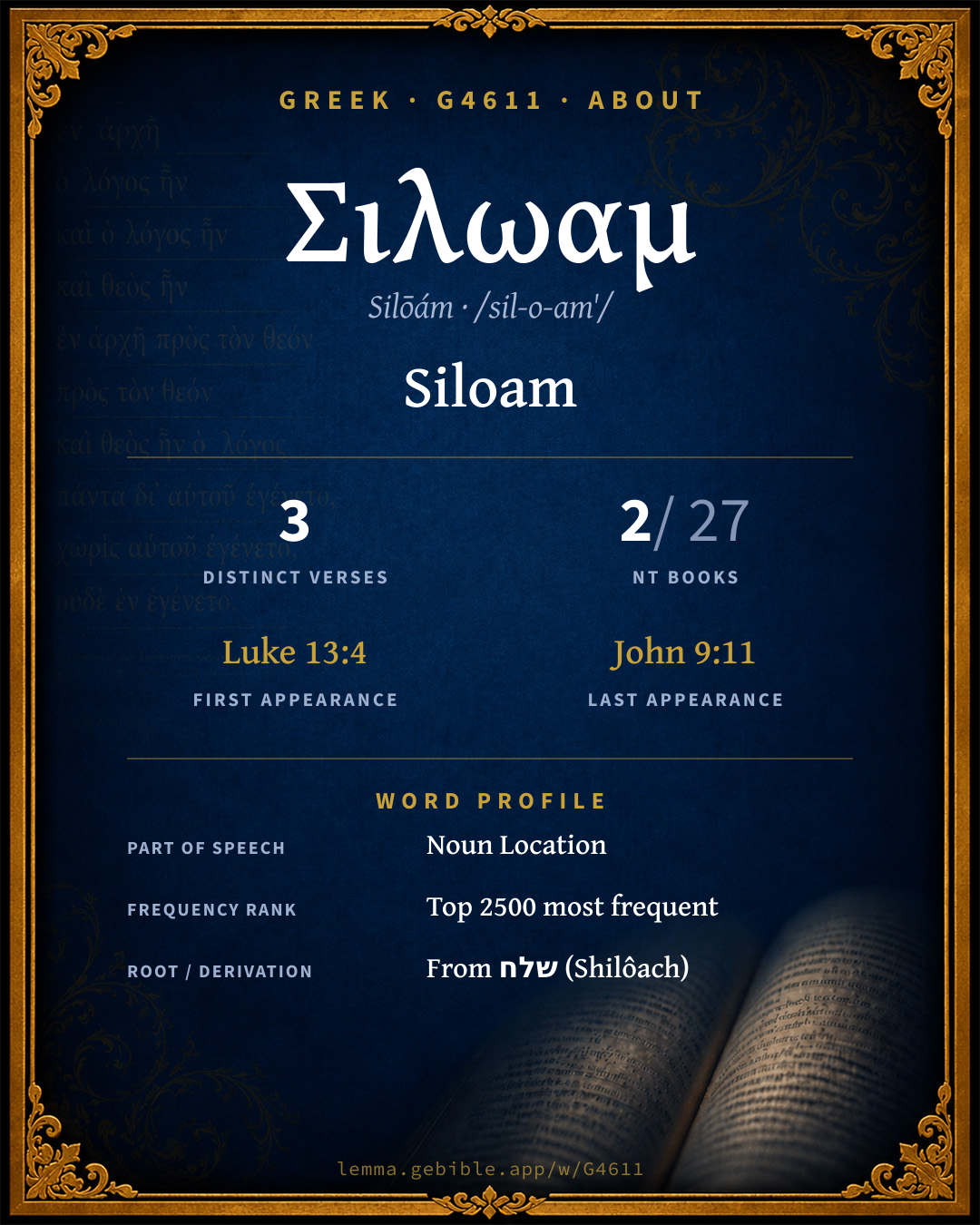
Σιλωάμ
Siloam
Thayer's lists 3 entries for ‘Siloam’ fuller range ↓
Full lexicon entry — Thayer's Greek Lexicon
From Thayer's Greek Lexicon
Where this word appears
Every verse where G4611 appears — 3 distinct verses across 2 books. Click any verse to open its interlinear word-by-word view. Verse text shown in the World English Bible for context — . Each verse’s Greek form is shown with its reference; the English is not keyword-highlighted, since the data carries no word-level English alignment. Use “Compare translations” on any verse to read it across multiple English versions. This concordance covers the Greek New Testament; Septuagint (Greek Old Testament) occurrences of this word are not indexed here.
Luke 1 verse
John 2 verses
- John 9:7 Σιλωάμ n proper indecl and said to him, "Go, wash in the pool of Siloam" (which means "Sent"). So he went away, washed, and came back seeing.
- John 9:11 Σιλωὰμ n proper indecl He answered, "A man called Jesus made mud, anointed my eyes, and said to me, 'Go to the pool of Siloam, and wash.' So I went away and washed, and I received sight."
About this entry
At a glance — auto-summarized from this page’s data, not written by a person. Every figure links to its source below. This summary describes the numbers; it doesn’t interpret them.
Σιλωαμ — transliterated Silōám — is a Greek name carrying the sense “Siloam.” With only 3 verses it sits in the long tail of Greek New Testament vocabulary. More than two-thirds of its appearances fall in John. Debuting at Luke 13:4, it then recurs through the corpus. Each statement above links to its evidence; the full detail follows below.
Gloss history
Strong's 1890 vs modern scholarship
About this word
Strong's G4611 catalogs a Greek word from the Greek New Testament.
These counts are not copied from any lexicon or concordance. They are computed here, from the morphology-tagged Greek New Testament. What Lemma adds →
- 3
- distinct verses
- The word appears in 3 distinct verses.
- 2 / 27
- NT books
- The word appears in 2 of 27 New Testament books.
- #2,203
- by frequency
- Top 2500 most frequent Greek words (rank 2,203 of 5,347 Greek words by occurrence).
View all 3 occurrences in the concordance →
By traditional corpus
Conventional, traditional groupings — biblical authorship is debated, so this is a traditional corpus grouping, not an authorship claim. Some books belong to more than one corpus (Luke is in both the Gospels and the Lukan corpus, and so on), so these shares overlap and need not total 100%. Each figure is a share of the word’s 3 distinct verses.
- Gospels 3 verses · 100%
- Johannine 2 verses · 67%
- Lukan (Luke–Acts) 1 verse · 33%
How translations render this word
Counts come from each version’s own published word-to-Strong’s tagging or interlinear alignment — an approximate guide to how each version renders this word, not a word-level alignment the data otherwise carries. Because each total is that version’s own tagged count, the per-version totals vary from one another and need not match the appearance or distinct-verse counts above. These counts may also differ from a printed concordance because Lemma counts each distinctly tagged rendering and does not collapse phrase taggings into a single head-word total. This is a fixed set of word-tagged versions (KJV, ASV, BSB, ULT) and does not change with the reading translation you choose elsewhere. Each version’s license is shown beside its name below (and on Sources).
- King James Version: Siloam 3×
- American Standard Version: Siloam 3×
- Berean Standard Bible: Siloam 3×
- unfoldingWord Literal Text: Siloam 3×
King James Version Public Domain
Renders G4611 across 3 tagged occurrences — most commonly:
American Standard Version Public Domain
Renders G4611 across 3 tagged occurrences — most commonly:
Berean Standard Bible Public Domain
Renders G4611 across 3 tagged occurrences — most commonly:
unfoldingWord Literal Text CC BY-SA 4.0
Renders G4611 across 3 tagged occurrences — most commonly:
Senses in Thayer's
The 3 senses Thayer's distinguishes for this word, in lexicon order (not ranked by frequency or importance). The full entry — with sub-senses — is in the Lexicon Entry tab.
- Siloam = "sent"
- the Pool of Siloam, a fountain of water in Jerusalem, also called Shiloah in Isa. 8:6
- the Tower of Siloam…
Word origin
Derived from שלח (Shilôach) (H7975) — Shiloah.
Of hebrew origin [ H7975 ]; Siloam (that is Shiloach ) a pool of Jerusalem : - Siloam.
— Strong’s Exhaustive Concordance (1890), public domain.
Forms in the corpus
Bible dictionary
Public-domain dictionary articles matched to this entry by name (Siloam). A biblical name can be shared by more than one person or place, so an article may treat several.
Smith's Bible Dictionary · William Smith, 1863
(sent). Shiloach, (Isaiah 8:6) Siloah, (Nehemiah 3:15) Siloam, (John 9:11) Siloam is one of the few undisputed localities in the topography of Jerusalem; still retaining its old name (with Arabic modification, Silwan), while every other pool has lost its Bible designation. This is the more remarkable as it is a mere suburban tank of no great size, and for many an age not particularly good or plentiful in its waters, though Josephus tells us that in his day they were both "sweet and abundant." A little way below the Jewish burying-ground, but on the opposite side of the valley, where the Kedron turns slightly westward and widens itself considerable, is the fountain of the Virgin, or Um'ed'Deraj, near the beginning of that saddle-shaped projection of the temple hill supposed to be the Ophel of The Bible and the Ophlas of Josephus. At the back part of this fountain a subterraneous passage begins, through which the water flows, and through which a man may make his way, sometimes walking erect, sometimes stooping, sometimes kneeling, and sometime crawling, to Siloam. This conduit is 1708 feet long, 16 feet high at the entrance, but only 16 inches at its narrowest tributaries which sent their waters down from the city pools or temple wells to swell Siloam. It enters Siloam at the northwest angle; or rather enters a small rock-cut chamber which forms the vestibule of Siloam, about five or six feet broad. To this you descend by a few rude steps, under which the water pours itself into the main pool. This pool is oblong, about 52 feet long, 18 feet broad and 19 feet deep; but it is never filled, the water either passing directly through or being maintained at a depth of three or four feet. The present pool is a ruin, with no moss or ivy to make it romantic; its sides fallen in; its pillars broken; its stair a fragment; its walls giving way; the edge of every stone was round or sharp by time; in some parts mere debris, though around its edges wild flowers, and among other plants the caper trees, grow luxuriantly. The present pool is not the original building; it may be the work of crusaders, perhaps even improved by Saladin, whose affection for wells and pools led him to care for all these things. Yet the spot is the same. This pool, which we may call the second, seems anciently to have poured its waters into a third before it proceeded to water the royal gardens. This third is perhaps that which Josephus calls "Solomon's pool," and which nehemiah calls the "king's pool." (Nehemiah 2:14) The expression in (Isaiah 8:6) "waters of Shiloah that go softly," seems to point to the slender rivulet, flowing gently though once very profusely out of Siloam into the lower breadth of level where the king's gardens, or royal paradise, stood, and which is still the greenest spot about the holy city. Siloam is a mere spot even to the Moslem; much more to the Jew. It was to Siloam that the Levite was sent with the golden pitcher on the "last and great day of the feast" of Tabernacles; it was from Siloam that he brought the water which was then poured over the sacrifice, in memory of the water from the rock of Rephidim; and it was to this Siloam water that the Lord pointed when he stood in the temple on that day and cried, "If any man thirst let him come unto me and drink." The Lord sent the blind man to wash, not in, as our version has it, but at (eis), the pool of siloam; for it was the clay from his eyes that was to be washed off.
Classic public-domain reference works; full attribution on Sources.
Septuagint usage
The same Greek word Σιλωαμ appears 1 time in the Greek Old Testament (Septuagint), across 1 verse in 1 book.
- 1
- LXX occurrences
- Tagged occurrences of this Greek word in the Septuagint.
- 1
- verse
- Distinct Septuagint verses containing this word.
- 1 / 39
- OT books
- The word appears in 1 of the 39 Old Testament books.
Sample Septuagint occurrences
- Isaiah 8:6 σιλωαμ
Septuagint occurrences (same lexeme)
Every verse where the same Strong’s number (G4611) appears in the Greek Septuagint. Verse text shown in the World English Bible for context; the Greek form is the matched word — the English is not keyword-highlighted.
These are occurrences of the same Greek lexeme (G4611) in the Septuagint — not a translation of any one Hebrew word. The store carries no word-level Hebrew↔Greek alignment, so no Hebrew original is asserted here. Counts come from the recovered LXX Strong's tagging — high-frequency vocabulary is well covered, while rare or late forms may be untagged — so they reflect tagged occurrences and may slightly undercount.