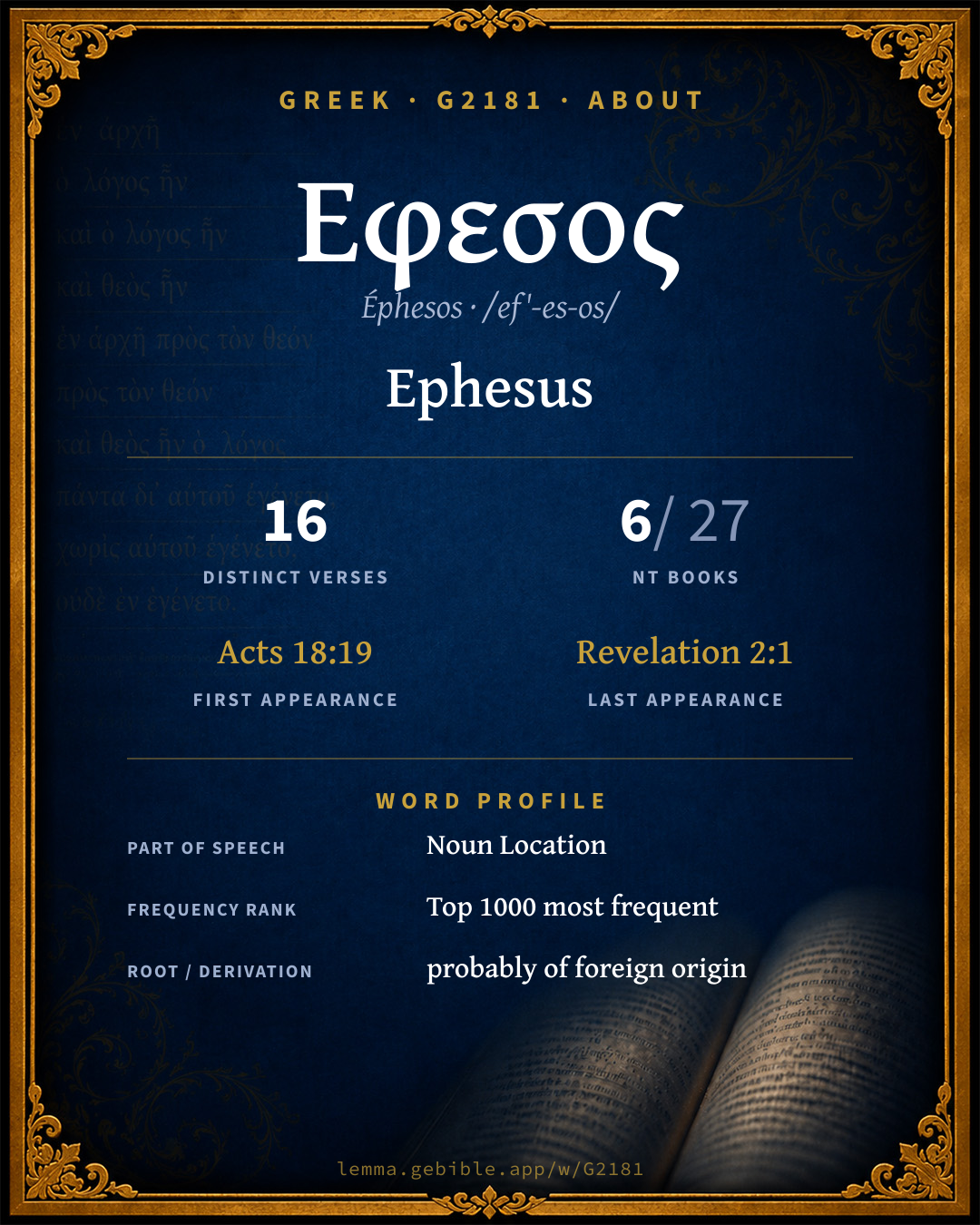
Ἔφεσος
Ephesus
Thayer's lists 2 entries for ‘Ephesus’ fuller range ↓
Full lexicon entry — Thayer's Greek Lexicon
From Thayer's Greek Lexicon
Where this word appears
Grammar key — what these labels mean
Part of speech
- Noun
- A naming word — a person, place, thing, or idea.
Case
- Accusative
- The case of the direct object and of extent.
- Dative
- The case of the indirect object, means, or location — “to / for / with / in.”
- Genitive
- The case of source, possession, or “of” — answers “whose / from what.”
Gender
- Feminine
- Grammatically feminine.
Number
- Singular
- One.
Every verse where G2181 appears in the Book of Ephesians — 1 distinct verse. Click any verse to open its interlinear word-by-word view. Verse text shown in the World English Bible for context — . Each verse’s Greek form is shown with its reference; the English is not keyword-highlighted, since the data carries no word-level English alignment. Use “Compare translations” on any verse to read it across multiple English versions. This concordance covers the Greek New Testament; Septuagint (Greek Old Testament) occurrences of this word are not indexed here.
Ephesians
About this entry
At a glance — auto-summarized from this page’s data, not written by a person. Every figure links to its source below. This summary describes the numbers; it doesn’t interpret them.
“Ephesus” is the headline sense of the Greek name Εφεσος (Éphesos). More than half of its appearances fall in Acts. The Greek New Testament uses it across 16 verses — uncommon. Its earliest occurrence is Acts 18:19. The sections below give every occurrence and version rendering.
Gloss history
Strong's 1890 vs modern scholarship
About this word
Strong's G2181 catalogs a Greek word from the Greek New Testament.
These counts are not copied from any lexicon or concordance. They are computed here, from the morphology-tagged Greek New Testament. What Lemma adds →
- 16
- distinct verses
- The word appears in 16 distinct verses.
- 6 / 27
- NT books
- The word appears in 6 of 27 New Testament books.
- #726
- by frequency
- Top 1000 most frequent Greek words (rank 726 of 5,347 Greek words by occurrence).
View all 16 occurrences in the concordance →
Most concentrated in
- Acts 8 verses 50%
- 1 Corinthians 2 verses 13%
- 2 Timothy 2 verses 13%
By section of the New Testament
By traditional corpus
Conventional, traditional groupings — biblical authorship is debated, so this is a traditional corpus grouping, not an authorship claim. Some books belong to more than one corpus (Luke is in both the Gospels and the Lukan corpus, and so on), so these shares overlap and need not total 100%. Each figure is a share of the word’s 16 distinct verses.
- Lukan (Luke–Acts) 8 verses · 50%
- Pauline corpus 6 verses · 38%
- Johannine 2 verses · 13%
- Revelation 2 verses · 13%
How translations render this word
Counts come from each version’s own published word-to-Strong’s tagging or interlinear alignment — an approximate guide to how each version renders this word, not a word-level alignment the data otherwise carries. Because each total is that version’s own tagged count, the per-version totals vary from one another and need not match the appearance or distinct-verse counts above. These counts may also differ from a printed concordance because Lemma counts each distinctly tagged rendering and does not collapse phrase taggings into a single head-word total. This is a fixed set of word-tagged versions (KJV, ASV, BSB, ULT) and does not change with the reading translation you choose elsewhere. Each version’s license is shown beside its name below (and on Sources).
- King James Version: Ephesus 15×
- American Standard Version: Ephesus 15×
- Berean Standard Bible: Ephesus 16×
- unfoldingWord Literal Text: Ephesus 16×
King James Version Public Domain
Renders G2181 across 15 tagged occurrences — most commonly:
American Standard Version Public Domain
Renders G2181 across 15 tagged occurrences — most commonly:
Berean Standard Bible Public Domain
Renders G2181 across 16 tagged occurrences — most commonly:
unfoldingWord Literal Text CC BY-SA 4.0
Renders G2181 across 16 tagged occurrences — most commonly:
Senses in Thayer's
The 2 senses Thayer's distinguishes for this word, in lexicon order (not ranked by frequency or importance). The full entry — with sub-senses — is in the Lexicon Entry tab.
- Ephesus = "permitted"
- a maritime city of Asia Minor…
Word origin
Origin: probably of foreign origin
Probably of foreign origin; Ephesus a city of Asia Minor : - Ephesus.
— Strong’s Exhaustive Concordance (1890), public domain.
Forms in the corpus
The 4 distinct written forms G2181 takes in the Greek New Testament, most frequent first — each parse links to that case’s occurrences in the concordance.
| Form | Parsing | Example | Uses |
|---|---|---|---|
| Ἔφεσον Épheson | Noun, Accusative, Singular, Feminine | Acts 18:19 | 8 |
| Ἐφέσῳ Ephésō | Noun, Dative, Singular, Feminine | 1 Corinthians 15:32 | 5 |
| Ἐφέσου Ephésou | Noun, Genitive, Singular, Feminine | Acts 18:21 | 2 |
| Ἐφέσῳ] Ephésō | Noun, Dative, Singular, Feminine | Ephesians 1:1 | 1 |
Same root — word family
Other Thayer's entries built from the same root as G2181, grouped by Strong’s listed origin. These share a root / origin per the lexicon — not necessarily a shared meaning. Each links to that word’s own entry.
Proper names from this root
People and places named from this root — a name, not an additional meaning of the word.
Compare all same-root words → 2 of the same-root words are proper names (people or places). They share a root, not necessarily a meaning.
Bible dictionary
Public-domain dictionary articles matched to this entry by name (Ephesus). A biblical name can be shared by more than one person or place, so an article may treat several.
Easton's Bible Dictionary · M. G. Easton, 1897
The capital of proconsular Asia, which was the western part of Asia Minor. It was colonized principally from Athens. In the time of the Romans it bore the title of "the first and greatest metropolis of Asia." It was distinguished for the Temple of Diana (q.v.), who there had her chief shrine; and for its theatre, which was the largest in the world, capable of containing 50,000 spectators. It was, like all ancient theatres, open to the sky. Here were exhibited the fights of wild beasts and of men with beasts. (Comp. 1 Cor. 4:9; 9:24, 25; 15:32.)
Many Jews took up their residence in this city, and here the seeds of the gospel were sown immediately after Pentecost (Acts 2:9; 6:9). At the close of his second missionary journey (about A.D. 51), when Paul was returning from Greece to Syria (18:18-21), he first visited this city. He remained, however, for only a short time, as he was hastening to keep the feast, probably of Pentecost, at Jerusalem; but he left Aquila and Priscilla behind him to carry on the work of spreading the gospel.
During his third missionary journey Paul reached Ephesus from the "upper coasts" (Acts 19:1), i.e., from the inland parts of Asia Minor, and tarried here for about three years; and so successful and abundant were his labours that "all they which dwelt in Asia heard the word of the Lord Jesus, both Jews and Greeks" (19:10). Probably during this period the seven churches of the Apocalypse were founded, not by Paul's personal labours, but by missionaries whom he may have sent out from Ephesus, and by the influence of converts returning to their homes.
On his return from his journey, Paul touched at Miletus, some 30 miles south of Ephesus (Acts 20:15), and sending for the presbyters of Ephesus to meet him there, he delivered to them that touching farewell charge which is recorded in Acts 20:18-35. Ephesus is not again mentioned till near the close of Paul's life, when he writes to Timothy exhorting him to "abide still at Ephesus" (1 Tim. 1:3).
Two of Paul's companions, Trophimus and Tychicus, were probably natives of Ephesus (Acts 20:4; 21:29; 2 Tim. 4:12). In his second epistle to Timothy, Paul speaks of Onesiphorus as having served him in many things at Ephesus (2 Tim. 1:18). He also "sent Tychicus to Ephesus" (4:12), probably to attend to the interests of the church there. Ephesus is twice mentioned in the Apocalypse (1:11; 2:1).
The apostle John, according to tradition, spent many years in Ephesus, where he died and was buried.
A part of the site of this once famous city is now occupied by a small Turkish village, Ayasaluk, which is regarded as a corruption of the two Greek words, hagios theologos; i.e., "the holy divine."
Smith's Bible Dictionary · William Smith, 1863
(permitted), the capital of the Roman province of Asia, and an illustrious city in the district of Ionia, nearly opposite the island of Samos. Buildings.--Conspicuous at the head of the harbor of Ephesus was the great temple of Diana or Artemis, the tutelary divinity of the city. This building was raised on immense substructions, in consequence of the swampy nature of the ground. The earlier temple, which had been begun before the Persian war, was burnt down in the night when Alexander the Great was born; and another structure, raise by the enthusiastic co-operation of all the inhabitants of "Asia," had taken its place. The magnificence of this sanctuary was a proverb throughout the civilized world. In consequence of this devotion the city of Ephesus was called neo'koros, (Acts 19:35) or "warden" of Diana. Another consequence of the celebrity of Diana's worship at Ephesus was that a large manufactory grew up there of portable shrines, which strangers purchased, and devotees carried with them on journeys or set up in the houses. The theatre, into which the mob who had seized on Paul, (Acts 19:29) rushed, was capable of holding 25,000 or 30,000 persons, and was the largest ever built by the Greeks. The stadium or circus, 685 feet long by 200 wide, where the Ephesians held their shows, is probably referred to by Paul as the place where he "fought with beasts at Ephesus." (1 Corinthians 15:32) Connection with Christianity--The Jews were established at Ephesus in considerable numbers. (Acts 2:9; 6:9) It is here and here only that we find disciples of John the Baptist explicitly mentioned after the ascension of Christ. (Acts 18:25; 19:3) The first seeds of Christian truth were possibly sown here immediately after the great Pentecost. (Acts 2:1) ... St. Paul remained in the place more than two years, (Acts 19:8,10; 20:31) during which he wrote the First Epistle to the Corinthians. At a later period Timothy was set over the disciples, as we learn from the two epistles addressed to him. Among St. Paul's other companions, two, Trophimus and Tychicus, were natives of Asia, (Acts 20:4) and the latter was probably, (2 Timothy 4:12) the former certainly, (Acts 21:29) a native of Ephesus. Present condition--The whole place is now utterly desolate, with the exception of the small Turkish village at Ayasaluk . The ruins are of vast extent.
Hitchcock's Bible Names Dictionary · Roswell D. Hitchcock, 1869
desirable
Classic public-domain reference works; full attribution on Sources.