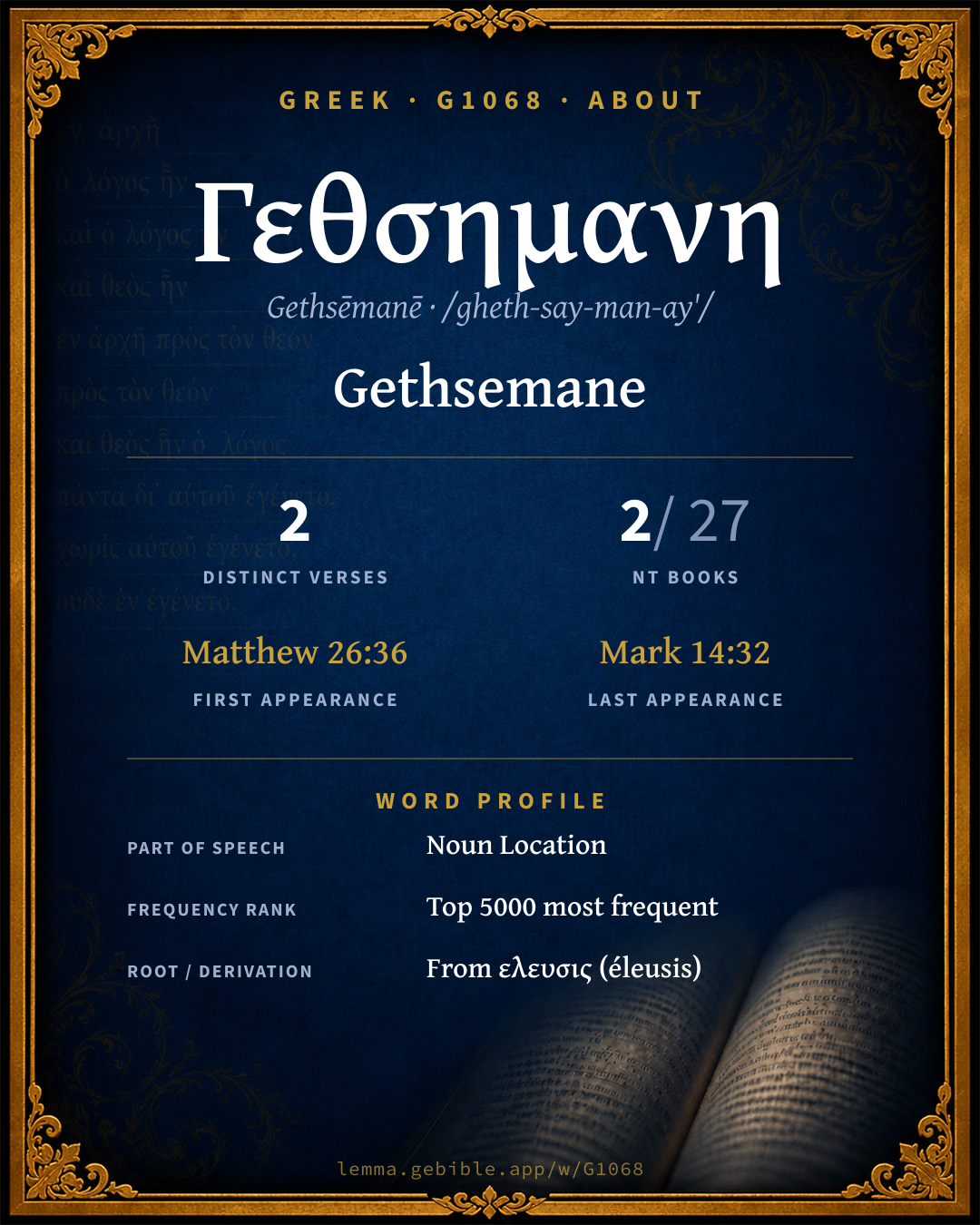
Γεθσημανῆ
Gethsemane
Full lexicon entry — Thayer's Greek Lexicon
From Thayer's Greek Lexicon
Where this word appears
Every verse where G1068 appears — 2 distinct verses across 2 books. Click any verse to open its interlinear word-by-word view. Verse text shown in the World English Bible for context — . Each verse’s Greek form is shown with its reference; the English is not keyword-highlighted, since the data carries no word-level English alignment. Use “Compare translations” on any verse to read it across multiple English versions. This concordance covers the Greek New Testament; Septuagint (Greek Old Testament) occurrences of this word are not indexed here.
Matthew 1 verse
Mark 1 verse
About this entry
At a glance — auto-summarized from this page’s data, not written by a person. Every figure links to its source below. This summary describes the numbers; it doesn’t interpret them.
Γεθσημανη — transliterated Gethsēmanē — is a Greek name carrying the sense “Gethsemane.” The Greek New Testament uses it only 2 verses. More than half of its appearances fall in Matthew. Debuting at Matthew 26:36, it then recurs through the corpus. See 2-verse concordance and the renderings breakdown below.
Gloss history
Strong's 1890 vs modern scholarship
About this word
Strong's G1068 catalogs a Greek word from the Greek New Testament.
These counts are not copied from any lexicon or concordance. They are computed here, from the morphology-tagged Greek New Testament. What Lemma adds →
- 2
- distinct verses
- The word appears in 2 distinct verses.
- 2 / 27
- NT books
- The word appears in 2 of 27 New Testament books.
- #2,678
- by frequency
- Top 5000 most frequent Greek words (rank 2,678 of 5,347 Greek words by occurrence).
View all 2 occurrences in the concordance →
By traditional corpus
Conventional, traditional groupings — biblical authorship is debated, so this is a traditional corpus grouping, not an authorship claim. Some books belong to more than one corpus (Luke is in both the Gospels and the Lukan corpus, and so on), so these shares overlap and need not total 100%. Each figure is a share of the word’s 2 distinct verses.
- Gospels 2 verses · 100%
How translations render this word
Counts come from each version’s own published word-to-Strong’s tagging or interlinear alignment — an approximate guide to how each version renders this word, not a word-level alignment the data otherwise carries. Because each total is that version’s own tagged count, the per-version totals vary from one another and need not match the appearance or distinct-verse counts above. These counts may also differ from a printed concordance because Lemma counts each distinctly tagged rendering and does not collapse phrase taggings into a single head-word total. This is a fixed set of word-tagged versions (KJV, ASV, BSB, ULT) and does not change with the reading translation you choose elsewhere. Each version’s license is shown beside its name below (and on Sources).
- King James Version: Gethsemane 2×
- American Standard Version: Gethsemane 2×
- Berean Standard Bible: Gethsemane 2×
- unfoldingWord Literal Text: Gethsemane 1×, Is gethsemane 1×
King James Version Public Domain
Renders G1068 across 2 tagged occurrences — most commonly:
American Standard Version Public Domain
Renders G1068 across 2 tagged occurrences — most commonly:
Berean Standard Bible Public Domain
Renders G1068 across 2 tagged occurrences — most commonly:
unfoldingWord Literal Text CC BY-SA 4.0
Renders G1068 across 2 tagged occurrences — most commonly:
Senses in Thayer's
The 1 sense Thayer's distinguishes for this word, in lexicon order (not ranked by frequency or importance). The full entry — with sub-senses — is in the Lexicon Entry tab.
- Gethsemane = "an oil press"
Word origin
Derived from ελευσις (éleusis) (G1660) — coming.
Bible dictionary
Public-domain dictionary articles matched to this entry by name (Gethsemane). A biblical name can be shared by more than one person or place, so an article may treat several.
Easton's Bible Dictionary · M. G. Easton, 1897
Oil-press, the name of an olive-yard at the foot of the Mount of Olives, to which Jesus was wont to retire (Luke 22:39) with his disciples, and which is specially memorable as being the scene of his agony (Mark 14:32; John 18:1; Luke 22:44). The plot of ground pointed out as Gethsemane is now surrounded by a wall, and is laid out as a modern European flower-garden. It contains eight venerable olive-trees, the age of which cannot, however, be determined. The exact site of Gethsemane is still in question. Dr. Thomson (The Land and the Book) says: "When I first came to Jerusalem, and for many years afterward, this plot of ground was open to all whenever they chose to come and meditate beneath its very old olivetrees. The Latins, however, have within the last few years succeeded in gaining sole possession, and have built a high wall around it...The Greeks have invented another site a little to the north of it...My own impression is that both are wrong. The position is too near the city, and so close to what must have always been the great thoroughfare eastward, that our Lord would scarcely have selected it for retirement on that dangerous and dismal night...I am inclined to place the garden in the secluded vale several hundred yards to the north-east of the present Gethsemane."
Smith's Bible Dictionary · William Smith, 1863
(an oil-press), a small "farm," (Matthew 26:36; Mark 14:32) situated across the brook Kedron (John 18:1) probably at the foot of Mount Olivet, (Luke 22:39) to the northwest and about one-half or three quarters of a mile English from the walls of Jerusalem, and 100 yards east of the bridge over the Kedron. There was a "garden," or rather orchard, attached to it, to which the olive, fig and pomegranate doubtless invited resort by their hospitable shade. And we know from the evangelists (Luke 22:39) And (John 18:2) that our Lord ofttimes resorted thither with his disciples. But Gethsemane has not come down to us as a scene of mirth; its inexhaustible associations are the offspring of a single event--the agony of the Son of God on the evening preceding his passion. A garden, with eight venerable olive trees, and a grotto to the north detached from it, and in closer connection with the church of the sepulchre of the Virgin, are pointed out as the Gethsemane. Against the contemporary antiquity of the olive trees it has been urged that Titus cut down all the trees about Jerusalem. The probability would seem to be that they were planted by Christian hands to mark the spot unless, like the sacred olive of the Acropolis, they may have reproduced themselves.
Hitchcock's Bible Names Dictionary · Roswell D. Hitchcock, 1869
a very fat or plentiful vale
Classic public-domain reference works; full attribution on Sources.