
Numbers 26:44

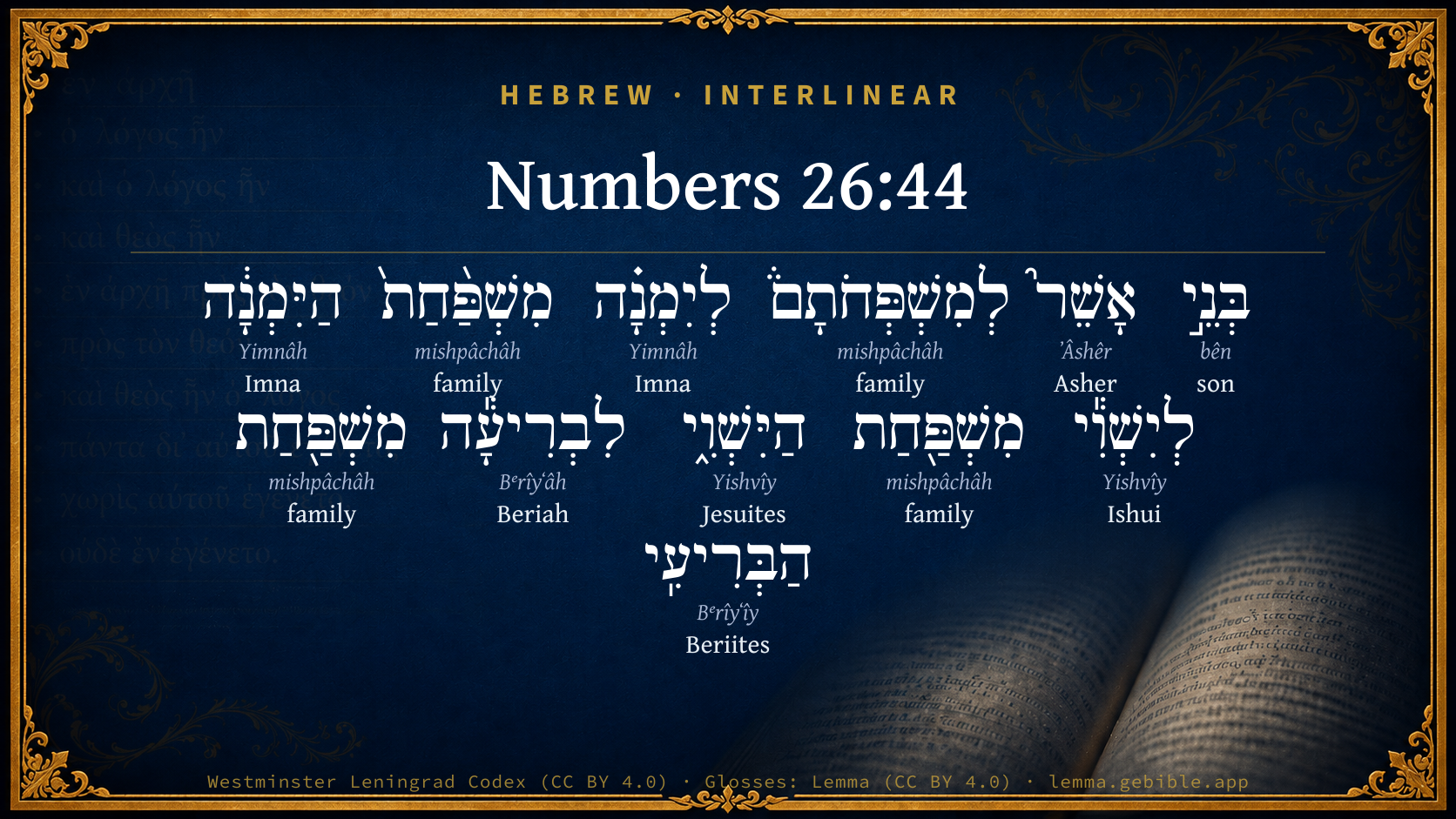
Hebrew (Westminster Leningrad Codex) Numbers 26:44 appears in the Hebrew Old Testament. The text above is from the Westminster Leningrad Codex. Each word links to its Strong’s number, a concise gloss, and parsing drawn from the Open Scriptures Hebrew Bible morphology. Click any word for its full Brown-Driver-Briggs (BDB) entry.
Download image
Cite this verse

Numbers 26:44 (World English Bible). Public Domain. Lemma interlinear Bible study tool, https://lemma.gebible.app/v/numbers/26/44.

Show BibTeX & RIS
BibTeX
RIS
English Translation
The sons of Asher after their families: of Imnah, the family of the Imnites; of Ishvi, the family of the Ishvites; of Beriah, the family of the Berites.
World English Bible · Public Domain
Highlights
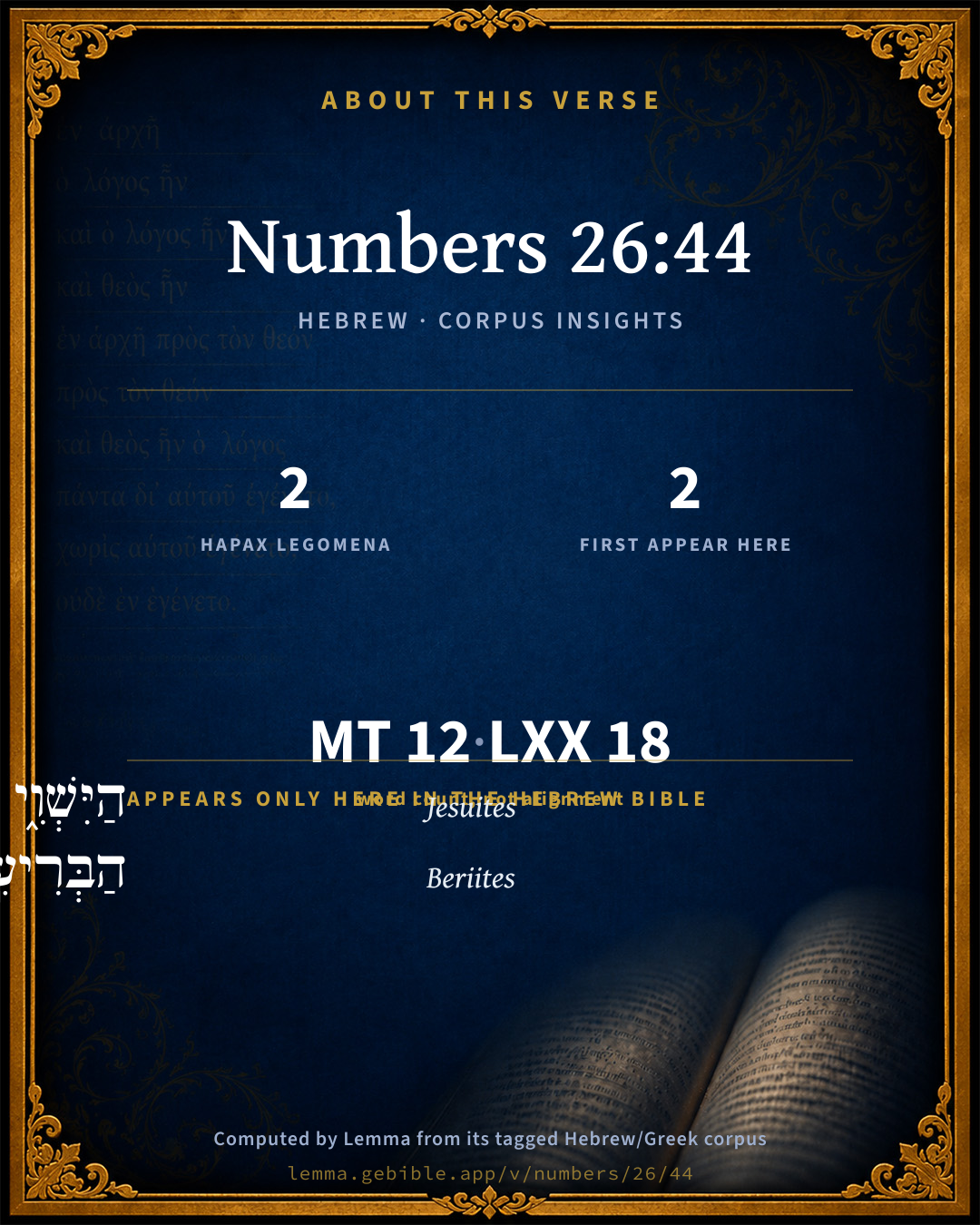
  • 2 hapax legomena — only here in the Hebrew Bible
  • 2 first appearances in the Hebrew Bible
Full analysis ↓
Download a study sheet

One document with this verse’s original text, its word-by-word gloss line, the meaning frame, cross-references with their text, attributed commentary, and full source and license credits — printable, and it pastes into notes with its structure intact.

This verse Autodidact and up

Study sheet (.html) Plain text (.txt)

A passage Seminary Student

Up to 50 verses in one chapter. A passage sheet keeps up to 6 commentary sources and 12 cross-references per verse, in the order this page ranks them, and says so on the sheet whenever that leaves anything out. Ask for a single verse and you get the Autodidact verse sheet above.

Everything on this page stays free to read, with no account — the sheet is a download of what is already on screen, not access to it.

Want to remove ads? Support Godless Engineer
Compare translations 3

The same verse in 3 English versions, stacked beneath the original-language interlinear above. Click any original word for its lexicon entry.

Each is an independent rendering of the whole verse — the interlinear is not word-aligned to these translations.

Highlighted words mark where these versions differ — a whole-verse word diff, not a word-by-word alignment.

  • World English Bible Public Domain
    The sons of Asher after their families: of Imnah, the family of the Imnites; of Ishvi, the family of the Ishvites; of Beriah, the family of the Berites.
  • King James Version Public Domain
    Of the children of Asher after their families: of Jimna, the family of the Jimnites: of Jesui, the family of the Jesuites: of Beriah, the family of the Beriites.
  • unfoldingWord Literal Text CC BY-SA 4.0
    The sons of Asher according to their clans: of Imnah, the clan of the Imnite; of Ishvi, the clan of the Ishvite; of Beriah, the clan of the Beriite.

unfoldingWord Literal Text — © unfoldingWord, licensed CC BY-SA 4.0. Word-aligned USFM3 via Door43 (git.door43.org/unfoldingWord/en_ult).

Versions to compare (up to 4)

3 of 4 selected

Show all 18 translations

Every available English version of this verse, each an independent rendering of the whole verse.

  • World English Bible Public Domain
    The sons of Asher after their families: of Imnah, the family of the Imnites; of Ishvi, the family of the Ishvites; of Beriah, the family of the Berites.
  • Berean Standard Bible Public Domain
    These were the descendants of Asher by their clans: The Imnite clan from Imnah, the Ishvite clan from Ishvi, and the Beriite clan from Beriah.
  • Majority Standard Bible Public Domain
    These were the descendants of Asher by their clans: The Imnite clan from Imnah, the Ishvite clan from Ishvi, and the Beriite clan from Beriah.
  • King James Version Public Domain
    Of the children of Asher after their families: of Jimna, the family of the Jimnites: of Jesui, the family of the Jesuites: of Beriah, the family of the Beriites.
  • American Standard Version (1901) Public Domain
    The sons of Asher after their families: of Imnah, the family of the Imnites; of Ishvi, the family of the Ishvites; of Beriah, the family of the Berites.
  • Revised Version (1885) Public Domain
    The sons of Asher after their families: of Imnah, the family of the Imnites: of Ishvi, the family of the Ishvites: of Beriah, the family of the Beriites.
  • Geneva Bible (1599) Public Domain
    The sonnes of Asher after their families were: of Iimnah, the familie of the Iimnites: of Isui, the familie of the Isuites: of Beriah, the familie of the Berijtes.
  • Douay-Rheims (1899) Public Domain
    The sons of Aser by their kindreds: Jemna, of whom is the family of the Jemnaites: Jessui, of whom is the family of the Jessuites: Brie, of whom is the family of the Brieites.
  • Young's Literal Translation Public Domain
    Sons of Asher by their families: of Jimna `is' the family of the Jimnite; of Jesui the family of the Jesuite; of Beriah the family of the Beriite.
  • Literal Standard Version CC BY-SA 4.0
    Sons of Asher by their families: of Jimna [is] the family of the Jimnite; of Jesui the family of the Jesuite; of Beriah the family of the Beriite.
  • Unlocked Literal Bible CC BY-SA 4.0
    The clans of Asher's descendants were these: Through Imnah, the clan of the Imnites, through Ishvi, the clan of the Ishvites, through Beriah, the clan of the Beriites.
  • unfoldingWord Literal Text CC BY-SA 4.0
    The sons of Asher according to their clans: of Imnah, the clan of the Imnite; of Ishvi, the clan of the Ishvite; of Beriah, the clan of the Beriite.
  • Darby Bible Public Domain
    The sons of Asher, after their families: of Jimnah, the family of the Jimnites; of Jishvi, the family of the Jishvites; of Beriah, the family of the Beriites.
  • World Messianic Bible Public Domain
    The sons of Asher after their families: of Imnah, the family of the Imnites; of Ishvi, the family of the Ishvites; of Beriah, the family of the Berites.
  • Webster's Bible Public Domain
    Of the children of Asher after their families: of Jimna, the family of the Jimnites: of Jesui, the family of the Jesuites: of Beriah, the family of the Beriites.
  • Free Bible Version CC BY-SA 4.0
    These were the descendants of Asher by family: Imnah, ancestor of the Imnite family; Ishvi, ancestor of the Ishvite family; and Beriah, ancestor of the Beriite family.
  • Bible in Basic English Public Domain
    The sons of Asher by their families: of Imnah, the family of the Imnites: of Ishvi, the family of the Ishvites: of Beriah, the family of the Beriites.
  • JPS Tanakh (1917) Public Domain
    The sons of Asher after their families: of Imnah, the family of the Imnites; of Ishvi, the family of the Ishvites; of Beriah, the family of the Beriites.

Literal Standard Version (2020), Covenant Press — licensed CC BY-SA 4.0. Text via the HelloAO Bible API (eBible.org). Unlocked Literal Bible (unfoldingWord) — licensed CC BY-SA 4.0. Text via the HelloAO Bible API (eBible.org). unfoldingWord Literal Text — © unfoldingWord, licensed CC BY-SA 4.0. Word-aligned USFM3 via Door43 (git.door43.org/unfoldingWord/en_ult). Free Bible Version, Dr. Jonathan Gallagher — licensed CC BY-SA 4.0. Text via the HelloAO Bible API (eBible.org).

Word by word

More ways to search: Search by grammar → Find every occurrence → Compare this word →

Practice this passage: Drill this verse → Learn its vocabulary →

הַיִּשְׁוִ֑י
Yishvîy
H3441
“the · Jesuites”
Particle, Definite Article + Noun, Gentilic, Masculine, Singular, Absolute
Part of Speech
Particle + Noun
Type
Gentilic
Gender
Masculine
Number
Singular
State
Absolute
Full BDB Definition

Origin: patronymically from H3440

TWOT: None

Jesuites = see Jesui " he will justify me"
  1. בְּנֵ֣י bên H1121 “sons of” Noun, Common, Masculine, Plural, Construct
  2. אָשֵׁר֮ ʼÂshêr H836 “Asher” Noun, Proper
  3. לְמִשְׁפְּחֹתָם֒ mishpâchâh H4940 “to/for · families · their” Preposition + Noun, Common, Feminine, Plural, Construct + Suffix, Personal, 3rd Person, Masculine, Plural
  4. לְיִמְנָ֗ה Yimnâh H3232 “to/for · Imna” Preposition + Noun, Proper
  5. מִשְׁפַּ֨חַת֙ mishpâchâh H4940 “family of” Noun, Common, Feminine, Singular, Construct
  6. הַיִּמְנָ֔ה Yimnâh H3232 “the · Imna” Particle, Definite Article + Noun, Proper
  7. לְיִשְׁוִ֕י Yishvîy H3440 “to/for · Ishui” Preposition + Noun, Proper
  8. מִשְׁפַּ֖חַת mishpâchâh H4940 “family of” Noun, Common, Feminine, Singular, Construct
  9. לִבְרִיעָ֕ה Bᵉrîyʻâh H1283 “to/for · Beriah” Preposition + Noun, Proper
  10. מִשְׁפַּ֖חַת mishpâchâh H4940 “family of” Noun, Common, Feminine, Singular, Construct
  11. הַבְּרִיעִֽי Bᵉrîyʻîy H1284 “the · Beriites” Particle, Definite Article + Noun, Gentilic, Masculine, Singular, Absolute

About this verse

These counts appear in no published source. They are computed here, from the morphology-tagged text and Lemma’s own curated glosses. What Lemma adds →

12
words
8
distinct lemmas
Pentateuch
section

Notable vocabulary

2 hapax legomena — words that appear only here in the entire Hebrew Bible:

  • הַיִּשְׁוִ֑י Jesuites H3441
  • הַבְּרִיעִֽי Beriites H1284

First appearance in Scripture

These words make their first canonical appearance in the Hebrew Bible here:

  • הַיִּשְׁוִ֑י Jesuites H3441
  • הַבְּרִיעִֽי Beriites H1284

Shared distinctive vocabulary

לְיִשְׁוִ֕י Ishui H3440 occurs in 4 verses of the Hebrew Bible. Also found in:

Grammatical profile

  • 12 nouns

Repetition

Words recur within this verse — often emphatic in Hebrew:

  • לְמִשְׁפְּחֹתָם֒ family H4940 ×4
  • לְיִמְנָ֗ה Imna H3232 ×2

Hebrew & Septuagint length

In English translation the verse runs 28 words from the Hebrew and 24 from the Septuagint (LXX English) — closely comparable.

A rough comparison of the two English renderings, which tokenize alike — not a word-level alignment.

Word counts can differ between the Hebrew and the Greek without any difference in meaning — e.g. the Hebrew direct-object marker אֵת has no separate Greek word, and Greek often adds the article ὁ.

In the original languages it is 12 Hebrew tokens and 18 Greek tokens — but the two are counted differently (Hebrew bundles its prefixes and suffixes into one token; the Greek is in lemma form), so that isn’t a like-for-like length.

Cross-references

2

Topical passages linked to Numbers 26:44 in the Treasury of Scripture Knowledge — connected by theme and wording, ordered by reader-vote popularity; previews shown in the World English Bible.

  • Genesis 46:17 The sons of Asher: Imnah, Ishvah, Ishvi, Beriah, and Serah their sister. The sons of Beriah: Heber and Malchiel.
  • 1 Chronicles 7:30 The sons of Asher: Imnah, and Ishvah, and Ishvi, and Beriah, and Serah their sister.

Cross-references courtesy of OpenBible.info (CC BY 4.0).

Hebrew and Greek witnesses Masoretic Hebrew ↔ Greek Septuagint

The same verse in the two great witnesses to the Old Testament, shown verse-for-verse.

These are two independent witnesses, not word-aligned to each other, and the Septuagint is shown in lemma (dictionary) form.

Hebrew Numbers 26:44 Masoretic · Westminster Leningrad Codex

בְּנֵ֣י אָשֵׁר֮ לְמִשְׁפְּחֹתָם֒ לְיִמְנָ֗ה מִשְׁפַּ֨חַת֙ הַיִּמְנָ֔ה לְיִשְׁוִ֕י מִשְׁפַּ֖חַת הַיִּשְׁוִ֑י לִבְרִיעָ֕ה מִשְׁפַּ֖חַת הַבְּרִיעִֽי

The sons of Asher after their families: of Imnah, the family of the Imnites; of Ishvi, the family of the Ishvites; of Beriah, the family of the Berites.

World English Bible · Public Domain

Greek LXX Numbers 26:44 Septuagint · lemma form

καί γίγνομαι ὁ υἱός βαλε αδαρ καί νοεμαν ὁ αδαρ δῆμος ὁ αδαρι ὁ νοεμαν δῆμος ὁ νοεμανι

And the sons of Bale were Adar and Noeman; to Adar, the family of the Adarites; and to Noeman, the family of the Noemanites.

LXX2012 (modern English Septuagint) · Public Domain

Hebrew: Westminster Leningrad Codex (CC BY 4.0). Greek: Septuagint (public domain); English from LXX2012 (modern English Septuagint) (Public Domain). How the Septuagint differs from the Hebrew →

Targum (Aramaic paraphrase)

2

The Targum is the ancient Jewish Aramaic paraphrase of the Hebrew Scriptures — an interpretive translation, not the Hebrew text itself. Onkelos (literal) and Pseudo-Jonathan (expansive) render the Torah, and Jonathan the Prophets. Coverage is partial: where no permissively-licensed English translation exists for a verse, only the Aramaic is shown. This is verse-level text, not a word-by-word alignment to the Hebrew.

  1. Targum Onkelos Torah (Genesis–Deuteronomy)
    בְּנֵי אָשֵׁר לְזַרְעֲיַתְהוֹן לְיִמְנָה זַרְעִית יִמְנָה לְיִשְׁוִי זַרְעִית יִשְׁוִי לִבְרִיעָה זַרְעִית בְּרִיעָה

    (no public-domain English translation for this verse)

    Targum Onkelos — Aramaic: “Onkelos Genesis” (public domain); “Onkelos Exodus” (public domain); “Onkelos Leviticus” (public domain); “Onkelos Numbers” (public domain); “Onkelos Deuteronomy” (public domain). English: “Sefaria Community Translation” (CC0 1.0 (public-domain dedication)); “J.W. Etheridge. The Targums of Onkelos and Jonathan Ben Uzziel on the Pentateuch. London: Longmans, Green, 1862” (public domain). Text via Sefaria.

  2. Targum Pseudo-Jonathan Torah (Genesis–Deuteronomy)
    בְּנוֹי דְאָשֵׁר לִגְנִיסַתְהוֹן לְיִמְנָה גְנִיסַת יִמְנָה לְיִשְׁוָה גְנִיסַת יִשְׁוָה לִבְרִיעָה גְנִיסַת בְּרִיעָא

    Those of Asher with their families, of Jimnah, the family of Jimnah; of Jishvah, the family of Jishvah; of Beriah, the family of Beriah.

    Targum Pseudo-Jonathan — Aramaic: “Targum Jonathan on Genesis” (public domain); “Targum Jonathan on Exodus” (public domain); “Targum Jonathan on Leviticus” (public domain); “Targum Jonathan on Numbers” (public domain); “Targum Jonathan on Deuteronomy” (public domain). English: “The Targum of Jonathan ben Uzziel, trans. J. W. Etheridge, London, 1862” (public domain). Text via Sefaria.

Commentary

Notes on Numbers 26:44 from classic Christian and Jewish commentators (each source and its license shown beneath its notes). The classic Christian expositions comment on the surrounding passage and are grouped to its opening verse, so a note may address several verses; the Jewish commentaries on the Tanakh (Rashi and others) are per-verse, so they appear only where the commentator wrote on this verse.

Lemma curates 59 commentaries, every one of them public domain or Creative Commons licensed, each selected and text-cleaned for this edition rather than reprinted as found. About our sources →

Trapp's Complete Commentary

John Trapp

Num 26:44 [Of] the children of Asher after their families: of Jimna, the family of the Jimnites: of Jesui, the family of the Jesuites: of Beriah, the family of the Beriites.

Ver. 44. The family of the Jesuites.] Serrarius will needs derive the name Jesuites from Num 26:24; it is wonder how he missed of this plainer text. Jesuites quasi Jashubites: like as Erasmus found friars in St Paul’s time, inter falsos fratres, amongst the false brethren. In Salamanca a friar would prove that the name of the Virgin Mary was spoken of in Gen 1:1-31. God called the gathering together of the waters Maria {a} Dr Poynes {b} writes, that it was foretold in the Old Testament that the Protestants were a malignant Church, alleging, {2Ch 24:19} Mittebatque prophetas ut reverterentur ad Dominum, quos protestantes illi audire nolebant. We may, with far more show of reason, fetch the name of Protestants (retained also in their Douay translation) from that text than they can from this, the name of Jesuites alias Jebusites.

{a} Stella, De Modo Concionandi, cap. 6.

{b} Preface to his book Of the Sacrament.

John Trapp, A Commentary or Exposition upon All the Books of the Old and New Testament (1647–1656) — public domain. Text from a community e-Sword module.

John Gill's Exposition

According to the lot shall the possession thereof be divided,.... It was by the determination of the lot that the land was divided by inheritance, and that was by the Lord, according to Pro 16:33.

between many and few; it was so ordered of the Lord by the lot, that the many should have a larger share, and the few a lesser.

John Gill's Exposition of the Whole Bible (1746–1763) — public domain (CC PDM 1.0). Text via the HelloAO Bible API.

Matthew Poole's English Annotations

Of Jesui, called Isui, Gen 46:17, where also there is another son of Asher named, to wit, Ishuah, whose family seems now to be lost.

Matthew Poole's English Annotations on the Holy Bible (1683–1685) — public domain. Text from a community e-Sword/MySword module.

Whedon's Commentary on the Bible

Daniel D. Whedon

44-47. The children of Asher — This passage agrees with Gen_46:17 and 1Ch_7:30, except that Ishua, not being a founder, is dropped.

Daniel D. Whedon (gen. ed.), Commentary on the Old and New Testaments (1874–1909) — public domain. Text from a community e-Sword module.

The Pulpit Commentary

The children of Asher. Of these three families were named after sons, two after grandsons. In Gen_46:17 1Ch_7:30, 31 a sixth name occurs, Ishuah, or Isuah. It is possible that its similarity to the following name of Isui or Ishui led to its accidental omission; but if the family continued to exist in Israel, such an omission could scarcely be overlooked.

The Pulpit Commentary (1880–1919), ed. H.D.M. Spence-Jones & Joseph S. Exell — public domain. Text from a community e-Sword module.

unfoldingWord translationNotes

Door43 World Missions Community

General Information:

The leaders of Israel are counting the men, 20 years old and older, according to their tribes and families. (See: How to Translate Names and Numbers)

53,400 men

"fifty-three thousand four hundred men" (See: Numbers)

translationWords

clan

Asher

descend

unfoldingWord translationNotes — © Distant Shores Media and the Door43 World Missions Community, licensed CC BY-SA 4.0. Source: git.door43.org/Door43/en_tn.

Lesson kit

Teaching starters — assembled from the data on this page, not authored interpretation. Every prompt links to the verse data it draws on. Edit before teaching.

Numbers, in the Pentateuch, opens this verse with 12 words (8 distinct Hebrew lemmas). Its most distinctive word is Yishvîy (“Jesuites”). A historical commentator’s framing appears above. Read the whole chapter for the surrounding context.

Discussion questions

  1. How does “Jesuites” (Yishvîy) shape what this verse is saying?
  2. This verse holds 2 words here found nowhere else in the Hebrew Bible. What might the rare words draw attention to?
  3. 2 words here appear for the first time in Scripture. What is being introduced at this debut?
  4. Genesis 46:17 shares the word «Ishui» with this verse. How do the two illuminate each other?
  5. “family” occurs 4× in this one verse. What is the effect of the repetition?
  6. These translations render this verse differently. What is at stake in choosing one wording over another?
  7. Reading how Trapp's Complete Commentary and John Gill's Exposition read this verse, where do the two commentators agree and where do they part?

Things to notice

  • 2 words in this verse appear nowhere else in the Hebrew Bible.
  • 2 words make their first canonical appearance in Scripture here.
  • This verse counts 12 Hebrew ↔ 18 Greek words.
  • These translations choose different wording for 21 words in this verse.
  • “family” occurs 4× in this single verse.

Reading settings

Reading text

Shown beneath each verse's original-language words.

Old Testament
Old Testament edition

Read the OT as the Masoretic Hebrew (MT) or the Greek Septuagint (LXX).

English shown for the Greek Septuagint (in the Hebrew ↔ Greek comparison).

Comparing translations? Open the Compare panel on any verse page to stack up to four side by side.